
Qingdao Gaoce(688556)

Search documents
光伏早盘收跌近5%,多家公司公告澄清与马斯克合作!协会:太空光伏仍处验证初期
Di Yi Cai Jing· 2026-02-05 03:59
Core Viewpoint - Multiple companies have denied the existence of executable projects in collaboration with Elon Musk's team, indicating significant uncertainty in the industrialization process of "space photovoltaics" [1][2][3][4][5][6] Company Responses - JinkoSolar (688223.SH) announced that it has not engaged in any cooperation with Musk's team and has no existing orders related to "space photovoltaics," emphasizing that the technology is still in the preliminary exploration stage [2] - Shuangliang Energy (600481.SH) stated that it has not confirmed any revenue related to commercial space projects in the past two years and that the development of related business faces uncertainty [2] - Guosheng Technology (603778.SH) clarified that it does not provide "space photovoltaic" systems and that its products are primarily used in terrestrial power plants [2] - High Measurement Technology (688556.SH) confirmed it has not engaged in any "space photovoltaic" business or collaborations [3] - Jingcheng Machinery (300316.SZ) reiterated that the application scenarios for "space photovoltaics" are still in the exploratory phase, with significant uncertainty in the industrialization process [4] Industry Insights - The "space photovoltaic" technology is still in the early stages of exploration and verification, according to industry experts [5][6] - The mainstream material for space photovoltaics remains gallium arsenide (GaAs), which, despite its high cost, has undergone long-term in-orbit verification [5][6] - Current cost estimates for space photovoltaics are significantly higher than terrestrial photovoltaics, with estimates of $2-3 per kilowatt-hour compared to $0.03-0.05 for ground-based systems [6]





2月5日重要公告一览
Xi Niu Cai Jing· 2026-02-05 02:46
Group 1 - Fujian State-owned Assets Management Company plans to reduce its stake in Fuguang Co., Ltd. by up to 3%, amounting to a maximum of 481.68 million shares [1] - Ice Wheel Environment Technology Co., Ltd. intends to reduce its stake in Qingda Environmental Protection by up to 3%, totaling a maximum of 372.68 million shares [2] - Wang Zhong, a shareholder of Jiangshan Oupai, plans to reduce his stake by up to 3%, which equates to a maximum of 531.51 million shares [6] Group 2 - Huadong Medicine's subsidiary, Zhejiang Daer Biotechnology Co., Ltd., received approval for a clinical trial of DR10624 injection for hypertriglyceridemia [3] - Guangdong Construction won a bid for a lithium battery intelligent manufacturing project worth 1.524 billion yuan [4] - Qilu Bank reported a net profit of 5.713 billion yuan for 2025, a year-on-year increase of 14.58% [5] Group 3 - Chang'an Automobile plans to repurchase shares worth between 1 billion and 2 billion yuan [8] - The company reported a January sales figure of 134,700 vehicles, a year-on-year decrease of 51.14% [31] - Foton Motor's January sales reached 55,553 vehicles, reflecting a year-on-year growth of 10.99% [35] Group 4 - Hongchang Technology plans to acquire a 21% stake in Liangzhi Joint Technology for 54.6 million yuan, aiming for control [11] - Suwen Electric Power's subsidiary is participating in an investment fund focused on high-tech industries [19] - Tangyuan Electric's application for a stock issuance to specific investors has been approved by the CSRC [20] Group 5 - JinkoSolar announced it has no orders related to "space photovoltaics" and remains focused on ground photovoltaic products [39] - High Measurement Co. clarified that it has not engaged in any space photovoltaic business or collaborations with relevant teams [40] - Jin Jing Technology noted that the TCO glass market is still small and has minimal impact on its revenue [13]


“马斯克团队调研”消息引爆太空光伏概念!多家公司回应
Sou Hu Cai Jing· 2026-02-05 02:17
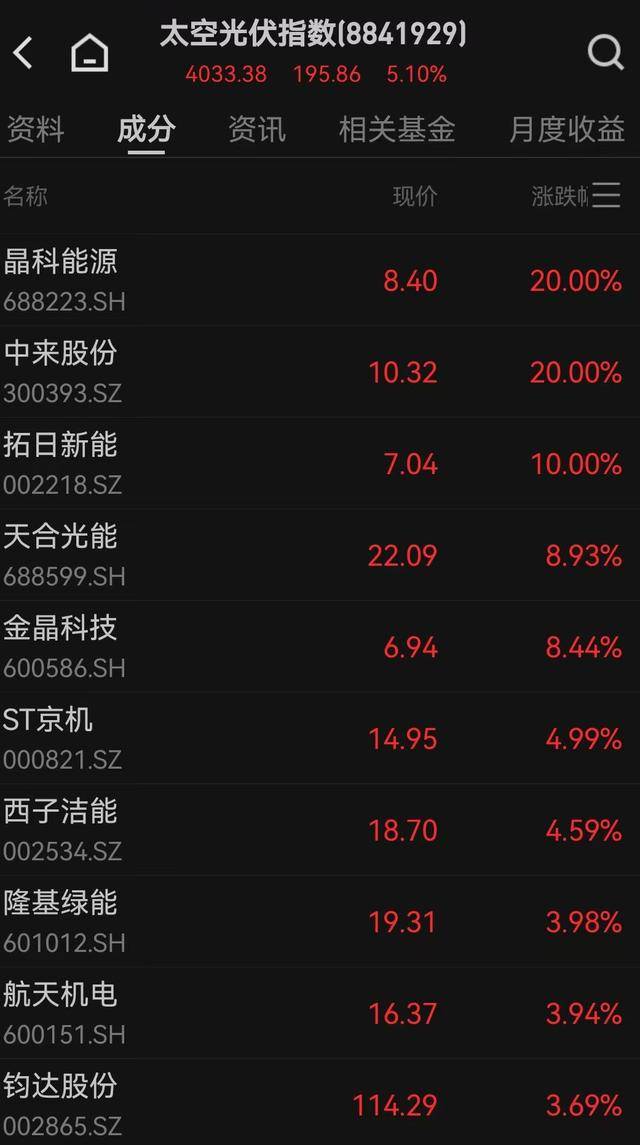
Core Viewpoint - The news highlights the recent interest in space photovoltaic technology sparked by Elon Musk's teams from SpaceX and Tesla conducting research on Chinese photovoltaic companies, leading to significant stock price movements in related A-share companies. Group 1: Market Reactions - The space photovoltaic index saw increases of 7.48% and 5.10% on February 3 and 4, respectively, with companies like JinkoSolar and Zhonglai Co. hitting the 20% daily limit up [4]. - Several companies, including JinkoSolar and Trina Solar, experienced significant stock price increases, with JinkoSolar's stock reaching a closing price of 22.09, up 8.93% [2][4]. Group 2: Company Responses - JinkoSolar issued a statement clarifying that while there were rumors of contact with Musk's team, no formal agreements or orders have been established, and the technology is still in the exploratory phase [4][5]. - High Measurement Co. confirmed it has not engaged in any space photovoltaic business or collaborations with Musk's teams, emphasizing the uncertainty surrounding the commercialization of space photovoltaic technology [5][6]. - Other companies like Guosheng Technology and Shuangliang Energy also stated they have not been approached by Musk's team and are not involved in space photovoltaic projects, reiterating the exploratory nature of the technology [8][9]. Group 3: Industry Insights - Space photovoltaic energy refers to harnessing solar energy in outer space and transmitting it wirelessly to Earth or powering satellites and space stations, positioning it as a strategic solution for commercial space and high-end applications [9]. - According to research from China International Capital Corporation, the demand for space photovoltaic technology is expected to grow significantly, potentially reaching a market size of hundreds of billions by 2030, particularly as low Earth orbit satellites become more prevalent [10].




高测股份回应:未与马斯克团队合作
Shen Zhen Shang Bao· 2026-02-05 00:23
公司与光伏行业相关的产品及服务为光伏切割设备、光伏切割耗材、硅片及切割加工服务,上述产品及 服务聚焦于地面光伏领域,主营产品及服务应用场景未发生重大变化。公司目前未与相关团队开展合 作,尚未开展太空光伏相关业务,未产生相关订单和形成相关收入,对公司当前业绩无实质影响。 公司已于2026年1月30日披露了《2025年年度业绩预告》。光伏行业正处于阶段性供需失衡的深度调整 期,2025年,光伏产业链产品价格持续处于低位,同时,公司根据《企业会计准则》及公司会计政策等 相关规定,基于谨慎性原则计提相应减值准备,公司预计2025年度归属于母公司所有者的净利润 为-4800万元到-3500万元,预计归属于母公司所有者的扣除非经常性损益后的净利润为-14000万元 到-12000万元,具体财务数据以公司正式披露的2025年年度报告为准。公司本报告期业绩依然出现亏 损,敬请广大投资者注意业绩风险。 2月4日晚间,青岛高测科技股份有限公司(以下简称"高测股份"或"公司")发布澄清公告。 公告就近期市场流传的"公司与马斯克团队有接触"相关传闻予以明确否认,避免误导投资者。 公告显示,公司目前尚未开展任何太空光伏相关业务,未与马 ...
8点1氪丨微信公关总监回应屏蔽元宝链接;vivo确认立项Vlog相机,对标大疆;贾国龙微博解禁,首发内容是速冻西兰花科普视频
3 6 Ke· 2026-02-05 00:04
Group 1 - Novo Nordisk's semaglutide sales reached 250.84 billion yuan in 2025, with a year-on-year growth of over 10% [5] - The sales breakdown includes 127.09 billion Danish kroner for Ozempic, 79.11 billion for Wegovy, and 22.09 billion for oral semaglutide [5] - In China, the total sales for all three semaglutide products amounted to 6.81 billion Danish kroner (approximately 7.49 billion yuan) [5] Group 2 - The Hong Kong High Court rejected Xu Jiayin's appeal regarding the appointment of a receiver and ordered him to pay 1.2 million HKD in legal fees by February 20 [6] - The National Healthcare Security Administration is conducting collective interviews with mental health insurance institutions to strengthen management and combat misuse of insurance funds [6][7] Group 3 - Panasonic's CFO announced potential layoffs could expand to 12,000 employees, following a previous plan to cut 10,000 jobs globally [8] - Multiple small and medium-sized banks have announced increases in deposit rates ahead of the Spring Festival, while some banks have opted to lower rates [8] Group 4 - Walmart's market capitalization surpassed 1 trillion USD, with a stock price increase of over 24% in the past year [10] - PayPal announced that Enrique Lores will take over as CEO on March 1, aiming to enhance execution efficiency and advance strategic initiatives [11] Group 5 - AMD reported a fourth-quarter net profit of 2.52 billion USD, with a year-on-year growth of 42% and revenue of 10.27 billion USD, exceeding market expectations [23] - Alphabet's fourth-quarter net profit was 34.455 billion USD, a 29.8% increase year-on-year, with total revenue of 113.83 billion USD [21]




高测股份:公司未与马斯克团队开展合作,未签署任何框架性协议或正式协议
3 6 Ke· 2026-02-04 23:19
36氪获悉,高测股份公告,公司关注到有媒体报道称,公司与马斯克团队有过接触,引起市场关注与讨 论。经公司核查,公司目前尚未开展太空光伏相关业务,未与相关团队开展合作,未签署任何框架性协 议或正式协议,未产生相关订单和形成相关收入,未对公司经营业绩造成影响。 ...
高测股份:公司未与马斯克团队开展合作 未签署任何框架性协议或正式协议
Di Yi Cai Jing· 2026-02-04 15:03
(本文来自第一财经) 高测股份公告,公司关注到有媒体报道称,公司与马斯克团队有过接触,引起市场关注与讨论。经公司 核查,公司目前尚未开展太空光伏相关业务,未与相关团队开展合作,未签署任何框架性协议或正式协 议,未产生相关订单和形成相关收入,未对公司经营业绩造成影响。 ...
高测股份(688556) - 澄清公告
2026-02-04 15:02
青岛高测科技股份有限公司 澄清公告 本公司董事会及全体董事保证本公告内容不存在任何虚假记载、误导性陈述 或者重大遗漏,并对其内容的真实性、准确性和完整性依法承担法律责任。 重要内容提示: 市场传闻的内容 公司关注到有媒体报道称,公司与马斯克团队有过接触,引起市场关注与讨 论。 关于相关传闻的声明 证券代码:688556 证券简称:高测股份 公告编号:2026-002 青岛高测科技股份有限公司(以下简称"公司")关注到有媒体报道称,公司 与马斯克团队有过接触,引起市场关注与讨论。 经公司核查,公司目前尚未开展太空光伏相关业务,未与相关团队开展合作, 未签署任何框架性协议或正式协议,未产生相关订单和形成相关收入,未对公司 经营业绩造成影响。 为避免相关市场传闻对社会各界和投资者造成误导,现予以澄清说明。 二、 澄清声明 公司与光伏行业相关的产品及服务为光伏切割设备、光伏切割耗材、硅片及 切割加工服务,上述产品及服务聚焦于地面光伏领域,主营产品及服务应用场景 未发生重大变化。公司目前未与相关团队开展合作,尚未开展太空光伏相关业务, 未产生相关订单和形成相关收入,对公司当前业绩无实质影响。 公司已于 2026 年 1 ...
太空光伏概念爆发!多家上市公司,集体公告
Mei Ri Jing Ji Xin Wen· 2026-02-04 15:00
图片来源:每经媒资库 每经编辑|黄胜 2月4日,A股太空光伏概念爆发,中来股份20cm涨停,国晟科技2连板。盘后,多家上市公司集体发布公告回应。 高测股份(688556.SH)公告,公司关注到有媒体报道称,公司与马斯克团队有过接触,引起市场关注与讨论。经公司核查,公司目前尚未开展太空光伏相 关业务,未与相关团队开展合作,未签署任何框架性协议或正式协议,未产生相关订单和形成相关收入,未对公司经营业绩造成影响。近期资本市场对"太 空光伏"等概念板块关注度显著提升,相关个股市场表现活跃。当前"太空光伏"仍处于技术探索与地面验证阶段,其商业化路径、成本结构、在轨运维体系 等均存在重大不确定性,尚未形成可规模化落地的产业闭环,产业化进程仍面临较大不确定性。敬请广大投资者理性投资,注意投资风险。 免责声明:本文内容与数据仅供参考,不构成投资建议,使用前请核实。据此操作,风险自担。 封面图片来源:每日经济新闻 晶科能源(688223.SH)2月4日公告,公司股票于2026年2月2日、2月3日、2月4日连续三个交易日内日收盘价格涨幅偏离值累计超过30%,属于股票交易异 常波动的情形。市场传闻,马斯克团队近期秘密走访了中国多家 ...
高测股份(688556.SH):公司目前尚未开展太空光伏相关业务
智通财经网· 2026-02-04 14:59
公司与光伏行业相关的产品及服务为光伏切割设备、光伏切割耗材、硅片及切割加工服务,上述产品及 服务聚焦于地面光伏领域,主营产品及服务应用场景未发生重大变化。公司目前未与相关团队开展合 作,尚未开展太空光伏相关业务,未产生相关订单和形成相关收入,对公司当前业绩无实质影响。 智通财经APP讯,高测股份(688556.SH)公告,公司关注到有媒体报道称,公司与马斯克团队有过接 触。经公司核查,公司目前尚未开展太空光伏相关业务,未与相关团队开展合作,未签署任何框架性协 议或正式协议,未产生相关订单和形成相关收入,未对公司经营业绩造成影响。 ...