
Qingdao Gaoce(688556)

Search documents
公司问答丨高测股份:公司深耕光伏硅片切割细分领域 已推出50μm超薄硅片切割
Xin Lang Cai Jing· 2026-01-28 08:29
格隆汇1月28日|有投资者在互动平台向高测股份提问:贵公司今天下线的50μm超薄硅片供货SpaceX星 链项目? 高测股份回复称,随着太空光伏HJT超薄柔性电池的应用验证逐步推进,预计未来将会带来柔性超薄硅 片的批量需求。公司深耕光伏硅片切割细分领域,持续引领硅片薄片化进程,公司已推出50μm超薄硅 片切割,同时积极储备更薄硅片切割技术,并持续探索和提升超薄硅片切割良率,助力行业加快超薄硅 片量产节奏。 ...

高测股份:超薄硅片的需求预计将随着太空光伏超薄柔性HJT电池的应用逐步打开
Ge Long Hui· 2026-01-28 08:08
Core Viewpoint - The company is focusing on the photovoltaic silicon wafer cutting segment, leveraging its "equipment + consumables + process" technology closed-loop advantage to lead the thin wafer trend in the industry [1] Group 1: Product Development - In 2022, the company launched an 80μm ultra-thin silicon wafer, followed by a 60μm ultra-thin silicon wafer in 2023, and recently introduced a 50μm ultra-thin silicon wafer [1] - The demand for ultra-thin silicon wafers is expected to grow with the application of space photovoltaic ultra-thin flexible HJT batteries [1] Group 2: Technical Barriers and Industry Position - The cutting technology for ultra-thin silicon wafers has relatively high technical barriers, requiring advanced cutting equipment, diamond wires, and cutting processes [1] - The company has laid out and planned a path for continuous improvement in the yield of ultra-thin silicon wafers, aiding the industry in accelerating the mass production pace of ultra-thin silicon wafers [1]
高测股份(688556.SH):超薄硅片的需求预计将随着太空光伏超薄柔性HJT电池的应用逐步打开
Ge Long Hui A P P· 2026-01-28 07:52
格隆汇1月28日丨高测股份(688556.SH)在投资者互动平台表示,公司深耕光伏硅片切割细分领域,充分 发挥"设备+耗材+工艺"技术闭环优势,持续引领硅片薄片化进程。2022年公司首发80μm超薄硅片, 2023年首发60μm超薄硅片,并已在近期推出50μm超薄硅片。超薄硅片的需求预计将随着太空光伏超薄 柔性HJT电池的应用逐步打开。超薄硅片切割技术壁垒相对较高,对切割设备、金刚线及切割工艺都提 出了更高要求,公司已布局并规划超薄硅片良率持续提升路径,助力行业加快超薄硅片量产节奏。 ...
光伏设备行业深度报告:太空光伏深度报告:光伏向空,志在星海
KAIYUAN SECURITIES· 2026-01-26 05:43
Investment Rating - The investment rating for the photovoltaic equipment industry is optimistic (maintained) [1] Core Insights - The photovoltaic sector is entering a silicon era in space applications, driven by the need for cost reduction and efficiency improvement in photovoltaic technology [5][18] - Photovoltaic systems are the most reliable and sustainable power source for spacecraft, providing stable energy supply without the need for fuel resupply [18] - The transition to silicon-based photovoltaic technology in space is being accelerated by the high costs and limitations of III-V multi-junction solar cells, which are currently the most efficient but expensive [64][67] Summary by Sections 1. From Parallel to Convergence: Space Enters the Silicon Era - Photovoltaics are the most important energy supply for spacecraft, providing stable energy without atmospheric interference [18] - Cost reduction and efficiency improvement are the main drivers for the evolution of photovoltaic technology [19] - P-type HJT (Heterojunction Technology) cells show significant advantages in space applications due to their superior radiation resistance [6][69] - Silicon-perovskite tandem cells are expected to become the ultimate solution, breaking the efficiency-cost-radiation resistance triangle [6][68] 2. The Space Race Begins: Photovoltaics Open New Blue Oceans - Low Earth orbit communication satellites are driving the demand for large-scale satellite deployment [7] - The space computing market is expected to release significant potential, with a focus on reliable power supply rather than cost competition [7] 3. Pre-Volume Layout: Equipment Manufacturers Seize Opportunities - Key equipment manufacturers benefiting from the space photovoltaic technology include Maiwei, Jiejia Weichuang, Laplace, and others [8] 4. Competition Among Giants: Leading Manufacturers Tap into Blue Oceans - Major battery manufacturers deeply involved in space photovoltaic technology include Dongfang Risheng, Junda, Trina Solar, and JinkoSolar [8]






商业航天行业:太空光伏,逐日天穹,叩问千亿星辰市场
2026-01-26 02:49
Summary of the Conference Call on the Space Photovoltaics Industry Industry Overview - **Industry Focus**: Space Photovoltaics - **Key Players**: SpaceX, Amazon, Chinese satellite companies - **Market Potential**: Estimated to reach a trillion-dollar market Core Insights and Arguments 1. **Cost Reduction through Reusable Technology**: The advent of reusable rocket technology has significantly lowered launch costs, creating a golden opportunity for space photovoltaics. The successful exploration of reusable rockets by companies like SpaceX has led to a rapid decrease in launch costs, making commercial space activities more frequent [5][23][24] 2. **US-China Competition in Commercial Space**: The competition between the US and China in commercial space is accelerating, particularly in low Earth orbit (LEO) communications satellites, which is expected to drive demand for solar wings. The US currently leads in LEO satellite deployment, with China planning to submit applications for 203,000 satellites to the International Telecommunication Union (ITU) by December 2025, aiming to secure valuable orbital resources [5][44][46] 3. **AI and Space Computing**: The concept of deploying AI data centers in space is gaining traction among tech giants. Space-based computing, or "computing in space," is seen as a solution to energy and space limitations. The cost of deploying a 40MW AI data center in space is estimated at $8.2 million, significantly lower than ground deployment costs [5][52][53] 4. **Technological Developments in Photovoltaics**: - **Gallium Arsenide (GaAs)** is currently the mainstream choice for space photovoltaics due to its excellent performance, though it is costly and has material sourcing limitations. - **Heterojunction (HJT)** technology is expected to be a significant choice for large-scale industrialization due to its efficiency and simpler manufacturing process. - **Perovskite technology** shows promise but lacks sufficient empirical data for large-scale application in the short term [5][64] 5. **Investment Recommendations**: The space photovoltaics sector is entering an active exploration phase, with equipment manufacturers poised to benefit. Key companies to watch include: - **HJT/Perovskite Equipment Suppliers**: Maiwei Co., Aotwei, and Jiejia Weichuang - **Comprehensive Photovoltaic Companies**: Jing Sheng Mechanical and Gao Ce Co. [5][5] Additional Important Content 1. **Risks**: Potential risks include slower-than-expected development of the commercial space industry, uncertainties in the technological pathways for space photovoltaics, and lower-than-expected investment and application demand for space computing [5][5] 2. **Market Dynamics**: The global satellite launch frequency has increased significantly since 2020, with projections indicating around 4,000 launches annually by 2025, marking a growth rate exceeding 50% [5][38] 3. **Future Projections**: The estimated demand for space photovoltaics from existing satellite plans could reach nearly 10GW in the near term, with significant growth expected as more satellites are deployed [5][46][62] 4. **Cost Comparisons**: The Levelized Cost of Energy (LCOE) for space photovoltaics is projected to decrease significantly due to reduced launch costs and advancements in technology, potentially reaching $0.04/kWh by 2050 [5][33][34] 5. **Global Competition**: The competition for orbital resources is intensifying, with the US and China leading the charge in satellite deployments, highlighting the strategic importance of space resources [5][42][43] This summary encapsulates the key points discussed in the conference call regarding the space photovoltaics industry, emphasizing the technological advancements, market dynamics, and investment opportunities within this rapidly evolving sector.

东吴证券:马斯克规划100GW光伏产能 设备商有望充分受益于海外地面+太空光伏双重机遇
智通财经网· 2026-01-25 23:10
Group 1 - Core viewpoint: Elon Musk announced at the World Economic Forum that Tesla and SpaceX will build 100GW capacity for ground and space photovoltaics, respectively, expected to be completed by the end of 2028 [1] - The demand for space photovoltaics is expected to surge due to the exponential growth in satellite launches, with SpaceX accelerating the construction of its Starlink system [2] - Silicon-based HJT technology is identified as the optimal short-term solution for space photovoltaics due to its lightweight, cost-effectiveness, and lack of raw material constraints [2] Group 2 - The overseas ground photovoltaic market is also experiencing strong demand, with the US solar market projected to grow at a compound annual growth rate of over 20% from 2024 to 2029 [3] - China is expected to dominate the global market in 2024, with over 80% of the production capacity in silicon materials, wafers, cells, and modules [3] - Key equipment manufacturers such as Jing Sheng, Maiwei, and Aotwei are positioned to benefit from this growth, with significant market shares in their respective segments [3]

电力设备与新能源行业周观察:太空光伏开辟增量空间,看好产业链发展机遇
HUAXI Securities· 2026-01-25 12:58
Investment Rating - Industry Rating: Recommended [5] Core Insights - The humanoid robot industry is accelerating towards mass production, driven by cost reduction demands and domestic suppliers' advantages in key components like precision transmission parts and electronic skin [15][16] - The sodium battery released by CATL showcases cost and performance advantages, with significant price increases in lithium carbonate impacting lithium battery costs, while sodium batteries are expected to achieve scale applications [19][20] - Domestic energy storage installations are experiencing substantial growth, with a diverse revenue structure and economic viability, benefiting leading companies in system integration and inverters [23] - The photovoltaic industry is poised for growth due to dual applications in ground and space, with HJT technology becoming a key direction for overseas expansion, enhancing global market potential [26][31] - China's wind power equipment exports are surging, with significant opportunities for leading companies in both domestic and overseas markets, supported by technological parity and cost advantages [27][40] - The electric equipment sector is entering a super boom cycle, driven by overseas demand and advancements in AI and smart grid technologies, with companies that possess strong channel resources and technical capabilities expected to benefit [42][43] Summary by Sections Humanoid Robots - The humanoid robot industry is seeing rapid industrialization, with major tech companies entering the market and expected mass production of Tesla's Optimus robot by the end of next year [15][16] - Key components suppliers in the T-chain are likely to benefit from the anticipated production ramp-up [16][17] Electric Vehicles - CATL's sodium battery demonstrates significant advantages in cost and performance, with the price of lithium carbonate impacting battery costs, while sodium batteries are expected to see widespread adoption [19][20] Renewable Energy - Domestic energy storage installations are on a growth trajectory, with leading companies in system integration and inverters set to benefit from the expanding market [23] - The photovoltaic sector is expected to grow due to advancements in HJT technology and increased global demand for solar installations [26][31] Wind Power - China's wind power equipment exports are increasing, with leading companies poised to capitalize on both domestic and international opportunities [27][40] Electric Equipment & AIDC - The electric equipment sector is entering a favorable cycle, with companies that have strong technical capabilities and market presence expected to benefit from increased overseas demand [42][43]




光伏设备行业点评报告:马斯克规划100GW光伏产能,设备商有望充分受益于海外地面+太空光伏双重机遇
Soochow Securities· 2026-01-24 23:42
Investment Rating - The report maintains an "Overweight" rating for the photovoltaic equipment industry [1] Core Insights - Elon Musk announced plans for 100GW photovoltaic capacity for both terrestrial and space applications, expected to be completed by the end of 2028 [4] - The global satellite launch numbers are expected to grow exponentially, with silicon-based HJT being the optimal solution for space photovoltaics due to its lightweight, cost-effectiveness, and material availability [4] - The demand for terrestrial photovoltaic markets is also strong, with the U.S. market projected to have a compound annual growth rate exceeding 20% from 2024 to 2029, and an installation capacity expected to exceed 60GW in 2025 [4] - Chinese photovoltaic equipment holds a dominant position globally, with over 80% market share in silicon materials, wafers, cells, and modules by 2024 [4] - Key recommended companies include leading HJT equipment manufacturer "Maiwei," low-oxygen monocrystalline furnace leader "Jingsheng," and global market leader in string welding machines "Aotewei" [4] Summary by Sections Industry Trends - The report highlights the significant growth in satellite launches and the corresponding demand for space photovoltaics, indicating a shift towards silicon-based HJT technology as a preferred solution [4] - The U.S. photovoltaic market is experiencing robust growth, with expectations for substantial increases in installation capacity [4] Company Recommendations - The report recommends focusing on leading companies in the HJT equipment sector, including "Maiwei," "Jingsheng," "Aotewei," and suggests monitoring "Jiejia Weichuang" for integrated equipment solutions [4]
光伏的春天又来了
猛兽派选股· 2026-01-24 03:51
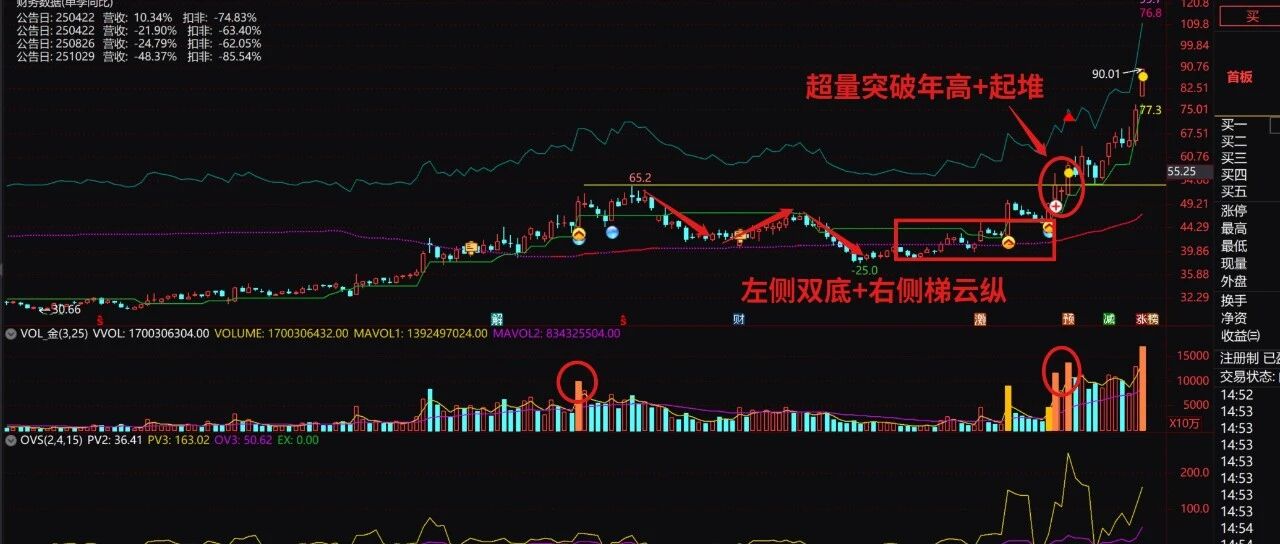
Core Viewpoint - The photovoltaic (PV) industry is experiencing significant momentum, particularly in the equipment sector, with clear RSR signals indicating strong market activity [1]. Group 1: Company Performance - Jiejia Weichuang is highlighted as a key player in the industry [3]. - Maiwei Co., Ltd. is noted for leading the market with unusual trading volumes and signals of acceleration into the second phase of growth [4]. - Aotwei and Jingcheng Machinery are also mentioned as companies that have entered the second phase of acceleration [5][7]. - High Measurement Co. and Dier Laser are part of the group showing strong performance, with most companies just entering the second phase [8][10]. - The characteristics of these stocks include significant price increases of over 50% and a strong breakout above previous highs, indicating a bullish trend [12]. Group 2: Market Dynamics - The photovoltaic industry is classified as a typical cyclical industry, with performance fluctuations similar to non-ferrous metals and chemicals, driven by expectations of industry recovery and supply-side reforms [16]. - Equipment manufacturers often outperform the core industry stocks, as seen in the non-ferrous sector where mining equipment stocks have shown greater gains [16]. - Component stocks are lagging behind equipment stocks, with JinkoSolar showing potential due to its advanced technology and market position, surpassing previous leaders [18]. Group 3: Historical Context - Historical bull stocks serve as a guide for current market behavior, with current bull stocks following similar patterns of clear upward trends and compact adjustment structures [19].


光伏行业:太空光伏创造光伏行业新需求
GF SECURITIES· 2026-01-23 15:35
Investment Rating - The industry investment rating is "Buy" [2] Core Insights - The report highlights that SpaceX and Tesla plan to build a total of 200GW of photovoltaic capacity in the U.S. over the next three years, primarily for ground data centers and space AI satellites [6] - The advantages of space computing centers are emphasized, including better convenience and real-time service compared to ground data processing, as well as significant cost reductions in communication infrastructure [6] - The report predicts that global photovoltaic demand will continue to grow, with an expected 580GW of new installations in 2026, representing a year-on-year increase of 6%. The total global photovoltaic demand is projected to reach 645GW, a year-on-year growth of 18.6% [6] Summary by Sections Industry Overview - The report discusses the emergence of new demand in the photovoltaic industry driven by space photovoltaic technology [1] Key Developments - Space photovoltaic technology is being developed in China, with three generations of solar battery technology tailored for different spacecraft, achieving international advanced performance levels [6] - Several domestic companies are accelerating their investments in space photovoltaic technology, including partnerships for the production of combined products [6] Investment Recommendations - The report suggests focusing on companies that have established early advantages in space photovoltaic layouts, such as Junda Co., Oriental Sunrise, JinkoSolar, Longi Green Energy, Foster, and others [6]

