
HIUV(688680)

Search documents
海优新材(688680) - 2025 Q4 - 年度业绩预告
2026-01-19 08:55
| 证券代码:688680 | 证券简称:海优新材 | 公告编号:2026-004 | | --- | --- | --- | | 债券代码:118008 | 债券简称:海优转债 | | 2、公司预计 2025 年度实现归属于母公司所有者的扣除非经常性损益的净利 润为-51,000 万元至-43,000 万元。 (三)本次业绩预告未经注册会计师审计。 上海海优威新材料股份有限公司 2025 年年度业绩预告 本公司董事会及全体董事保证本公告内容不存在任何虚假记载、误导性陈述 或者重大遗漏,并对其内容的真实性、准确性和完整性依法承担法律责任。 一、本期业绩预告情况 (一)业绩预告期间 2025 年 1 月 1 日至 2025 年 12 月 31 日。 (二) 业绩预告情况 1、上海海优威新材料股份有限公司(以下简称"公司")预计 2025 年度实 现归属于母公司所有者的净利润为-52,000 万元至-44,000 万元。 公司就业绩预告有关重大事项与会计师事务所进行了预沟通,公司与会计师 事务所在业绩预告方面不存在重大分歧。 二、上年同期业绩情况 (一)归属于母公司所有者的净利润:-55,843.59 万元;归属 ...

海优新材:预计2025年净亏损4.4亿元-5.2亿元
Di Yi Cai Jing· 2026-01-19 08:51
Group 1 - The company, Haiyou New Materials, expects to achieve a net profit attributable to the parent company's owners for the year 2025 in the range of -520 million to -440 million yuan [1] - The company anticipates a net profit attributable to the parent company's owners, excluding non-recurring gains and losses, for the year 2025 in the range of -510 million to -430 million yuan [1]
海优新材20260115
2026-01-16 02:53
Summary of the Conference Call for Haiyou New Materials Industry Overview - The photovoltaic (PV) industry is experiencing a recovery after reaching a bottom, with a long-term growth trend remaining intact. Although short-term shipment growth is limited, the industry's capacity reduction efforts are showing results, and long-term demand remains positive. Haiyou New Materials holds a market share of approximately 10%, with technological research and development being its core competitive advantage [2][3][8]. Key Points and Arguments Photovoltaic Business - The recent export tax rebate policy has temporarily impacted the demand for PV auxiliary materials, with an expected increase in demand around late February, lasting for about 1 to 1.5 months. Long-term, this policy will encourage the industry to focus on product competitiveness and compliance, benefiting Haiyou New Materials [2][5]. - The company has introduced leading products such as white EVA films and PPE co-extruded films, emphasizing that R&D is vital for its survival [3][8]. Automotive Business - Haiyou New Materials is adopting a dual-drive model in its automotive business, with PDLC (Polymer Dispersed Liquid Crystal) dimming films already applied in models like the Zhiji R6 and BYD Yangwang U8L. The company collaborates with leading new energy vehicle manufacturers [3][16]. - The PDLC technology offers advantages such as rapid color change and adaptability to flexible glass, positioning the company favorably in the market [4][22]. Technological Development - The company is actively exploring cutting-edge technologies such as perovskite and low-orbit satellite packaging materials, collaborating with leading downstream enterprises for R&D. However, no bulk orders are expected in the short term [2][6]. - Haiyou New Materials has shifted its focus from PV adhesive films to automotive dimming films, planning to expand production capacity in the second half of 2026 [4][17]. Regional Strategy - The company has established a subsidiary in Chengdu to take over part of its capacity from the eastern region, aiming to be closer to key customers in the western region and improve service quality while addressing cash flow risks [2][7]. Additional Important Insights - The company believes that 2026 will be a bottoming year for the PV industry, with many potential markets still to explore. It plans to focus on reducing operational risks and maintaining cash flow rather than blindly expanding production due to short-term policy changes [12]. - The cost of PDLC films is expected to decrease through optimization of raw material synthesis and structural design, with a focus on establishing a good pricing system with downstream customers [19]. - The company is also exploring the aftermarket for dimming films, which shows significant future potential despite current low volumes [18]. Conclusion Haiyou New Materials is strategically positioned in both the photovoltaic and automotive sectors, leveraging its technological advancements and regional adjustments to enhance competitiveness. The company maintains a positive outlook on future growth while navigating short-term challenges in the market.
海优新材股价涨5.19%,华夏基金旗下1只基金重仓,持有20.38万股浮盈赚取52.39万元
Xin Lang Cai Jing· 2026-01-13 04:42
Group 1 - Haiyou New Materials Co., Ltd. experienced a stock price increase of 5.19%, reaching 52.10 CNY per share, with a trading volume of 277 million CNY and a turnover rate of 6.70%, resulting in a total market capitalization of 4.378 billion CNY [1] - The company, established on September 22, 2005, and listed on January 22, 2021, specializes in the research, production, and sales of specialty polymer films, with 86.75% of its revenue coming from the photovoltaic packaging materials sector [1] Group 2 - Huaxia Fund holds a significant position in Haiyou New Materials, with its Huaxia Energy Conservation and Environmental Protection Stock A fund (004640) reducing its holdings by 116,900 shares in the third quarter, now holding 203,800 shares, which represents 4.02% of the fund's net value [2] - The fund has achieved a year-to-date return of 7.94%, ranking 1753 out of 5517 in its category, and a one-year return of 44.84%, ranking 1986 out of 4203 [2] Group 3 - The fund manager of Huaxia Energy Conservation and Environmental Protection Stock A is Lv Jiawei, who has been in the position for 8 years and 158 days, overseeing a total fund size of 1.423 billion CNY, with the best return during his tenure being 118.38% [3]
光伏锂电出口退税新政出台 一季度产能释放“淡季不淡”
2 1 Shi Ji Jing Ji Bao Dao· 2026-01-12 14:40
Core Viewpoint - The recent announcement by the Ministry of Finance and the State Taxation Administration to cancel export VAT rebates for photovoltaic and battery products is seen as a significant measure in the "anti-involution" actions within the new energy sectors, aimed at addressing the industry's profitability issues and promoting higher value-added products [5][6][8]. Industry Overview - The new energy photovoltaic and lithium battery industries have been facing challenges due to mismatched supply and demand and intense price competition, leading to weak profitability across the sector [3]. - Since 2025, there have been ongoing calls within the lithium battery sector to resist vicious competition, control capacity growth, and enhance technological innovation [3]. Policy Changes - Starting from April 1, 2026, the export VAT rebate for photovoltaic products will be canceled, and the rebate rate for battery products will be reduced from 9% to 6% until the end of 2026, after which it will be completely eliminated [1][5]. - The Ministry of Industry and Information Technology and other regulatory bodies have proposed 20 measures to regulate industry competition, including tightening approvals for low-capacity projects and establishing a cost-based price monitoring mechanism [4]. Market Reactions - Following the announcement, the stock performance of key players in the lithium battery sector showed significant volatility, with leading companies like CATL experiencing declines, while some photovoltaic companies saw substantial gains [1]. - The cancellation of export VAT rebates is expected to lead to an increase in the cost and price of Chinese photovoltaic components in overseas markets, which may help clear out low-end production capacity [8]. Price Trends - The prices of lithium carbonate futures have surged to over 160,000 yuan per ton, compared to 60,000 yuan per ton in June 2025, indicating a significant recovery in the battery materials market [6]. - The demand for upstream materials remains strong, with companies reporting full production capacity and no immediate adjustments in order volumes from downstream clients [7]. Future Outlook - The upcoming policy changes are anticipated to drive a surge in orders for photovoltaic components before the new VAT regulations take effect, although this demand may be temporary [7]. - Long-term, the cancellation of export VAT rebates is expected to facilitate industry consolidation and price normalization, benefiting the overall market structure [8].




光伏锂电出口退税将取消 ,有代理商称现货5分钟被抢光
2 1 Shi Ji Jing Ji Bao Dao· 2026-01-12 14:28
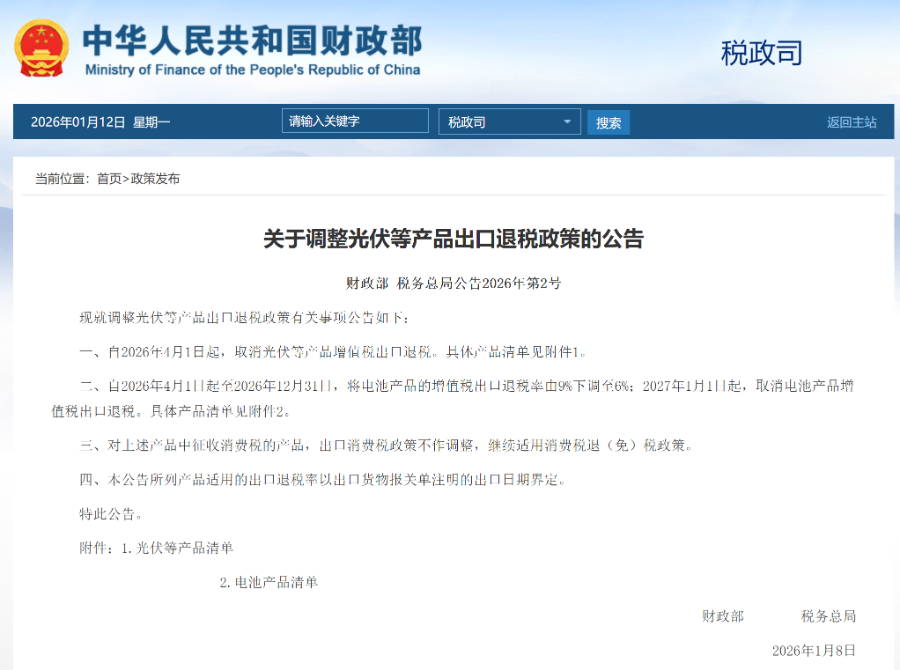
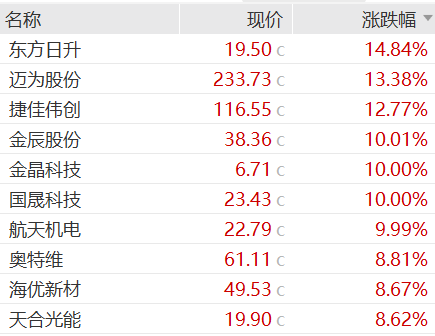
Core Viewpoint - The recent changes in export tax policies for photovoltaic and lithium battery products are seen as a significant move to combat excessive competition and improve profitability in the renewable energy sectors [4][8][9]. Group 1: Market Performance - On January 12, the opening saw fluctuations in the new energy photovoltaic and lithium battery sectors, with notable divergences in individual stock performances [1]. - Leading lithium battery company CATL (宁德时代) saw its H-shares drop by 3% and A-shares decline by over 4%, while companies like Deyang Nano (德方纳米) and Hunan Youneng (湖南裕能) experienced mixed results [1]. - In the photovoltaic sector, companies such as Maiwei (迈为股份) and Jiejia Weichuang (捷佳伟创) surged over 10%, while Trina Solar (天合光能) and Haiyou New Materials (海优新材) rose over 8% [1]. Group 2: Export Tax Policy Changes - Starting April 1, 2026, the export tax rebate for photovoltaic products will be eliminated, and the rebate rate for battery products will be reduced from 9% to 6% until the end of 2026, after which it will be completely removed [2]. - This policy change is part of a broader "anti-involution" initiative aimed at addressing the supply-demand mismatch and intense price competition that have weakened profitability in the photovoltaic and lithium battery industries [4][5][8]. Group 3: Industry Response and Measures - Since 2025, there have been ongoing calls within the lithium battery sector to resist harmful competition and control capacity growth, with various industry meetings held to discuss these issues [7]. - The Ministry of Industry and Information Technology has organized discussions with leading battery companies to establish measures for regulating competition and ensuring sustainable growth [7]. - A total of 20 measures were proposed, including monitoring production capacity and implementing penalties for non-compliant companies, which may affect financing and tax rebates [8]. Group 4: Market Dynamics and Future Outlook - Despite the seasonal downturn typically seen in the first quarter, demand for power and energy storage batteries remains strong, with companies reporting full order books and saturated production capacity [11]. - The anticipated increase in costs due to the export tax policy is prompting overseas buyers to adjust their purchasing schedules, potentially leading to a robust first quarter for lithium battery sales [11][12]. - Analysts predict that the cancellation of export tax rebates will ultimately raise the costs and prices of Chinese photovoltaic components in overseas markets, which could help clear out excess capacity and stabilize prices in the long run [13].
光伏锂电出口退税将取消 ,有代理商称现货5分钟被抢光
21世纪经济报道· 2026-01-12 14:21
Core Viewpoint - The article discusses the recent fluctuations in the new energy photovoltaic and lithium battery sectors, highlighting the impact of changes in export tax policies on these industries and the ongoing "anti-involution" actions aimed at stabilizing prices and production capacity [1][5][6]. Summary by Sections Market Performance - On January 12, the lithium battery leader CATL saw its H-shares drop by 3% and A-shares fall over 4%, while companies like Deyang Nano and Hunan Yueneng experienced mixed results with increases and decreases in their stock prices [1]. Export Tax Policy Changes - The Ministry of Finance announced that starting April 1, 2026, the export VAT refund for photovoltaic products will be canceled, and the VAT refund rate for battery products will be reduced from 9% to 6% until the end of 2026, after which it will be completely eliminated [2][3]. Industry Response and Actions - The lithium battery and photovoltaic industries have been facing challenges due to mismatched supply and demand and intense price competition, leading to a series of "anti-involution" initiatives aimed at expanding demand, adjusting prices, and controlling production capacity [3][5]. - Since 2025, there have been calls within the lithium battery sector to resist vicious competition and control the disorderly growth of production capacity, with various companies announcing price adjustments to stabilize the market [5][6]. Price Trends and Market Dynamics - Despite the seasonal downturn typically seen in the first quarter, the demand for power and energy storage batteries remains strong, with companies reporting sufficient orders and saturated production capacity [8]. - The export tax policy changes are expected to lead to an increase in battery prices, as overseas buyers adjust their purchasing strategies to avoid higher costs after the policy takes effect [8][10]. Future Outlook - Analysts predict that the cancellation of export tax refunds will increase the costs and prices of Chinese photovoltaic components in overseas markets, which may lead to industry consolidation and a return to more rational pricing in the long term [7][10].
被列入“可控核聚变”概念股后,3连板牛股公告
Shang Hai Zheng Quan Bao· 2026-01-11 15:55
Key Points - Major asset restructuring plans are underway for several companies, including JiaoYun Co. and Dongzhu Ecology, with significant risks of termination noted for Dongzhu Ecology's restructuring efforts [11][12] - ST KeliDa is set to resume trading on January 12, 2026, following a proposed change in its actual controller [5] - NineLink Technology has terminated its major asset restructuring plans due to disagreements on core transaction terms [6] - Companies like Huazhou Laojiao and others have announced substantial profit distributions and performance forecasts, indicating positive growth trends [8][9][10] Focus Area 1: Asset Restructuring - JiaoYun Co. is planning a major asset swap involving its automotive sales and service segments with assets from its controlling shareholder [11] - Dongzhu Ecology is attempting to acquire control of Kai Rui Xing Tong Information Technology but faces significant termination risks due to valuation disagreements [12] - NineLink Technology has decided to halt its plans to acquire a 51% stake in Chengdu Neng Tong Technology after failing to reach consensus on key transaction details [6] Focus Area 2: Trading Resumption and Risk Warnings - ST KeliDa will resume trading on January 12, 2026, after a proposed change in its actual controller [5] - China First Heavy Industries and Oriental Pearl have issued risk warning announcements regarding their stock trading, highlighting the volatility and lack of revenue from certain projects [3][4] Focus Area 3: Performance Forecasts - Huazhou Laojiao expects a net profit of between 235 million to 271 million yuan for 2025, a significant recovery from a loss in the previous year [8] - China Shipbuilding Defense anticipates a net profit increase of 149.61% to 196.88% for 2025, driven by improved production efficiency and revenue from joint ventures [9] - Daotong Technology projects a net profit of 900 million to 930 million yuan for 2025, reflecting a growth of 40.42% to 45.10% [10]



新华财经早报:1月10日
Xin Hua Cai Jing· 2026-01-10 01:04
Group 1 - The State Council of China is implementing a package policy to promote domestic demand through fiscal and financial collaboration, focusing on enhancing consumer capacity and supporting private investment [1] - The Ministry of Finance and the State Taxation Administration announced the cancellation of the export VAT rebate for photovoltaic products starting April 1, 2026, which is expected to help stabilize foreign market prices and reduce trade friction risks [1] - The State Administration for Market Regulation is conducting an investigation into the competitive status of the food delivery service industry, with major platforms like Meituan and JD Express expressing their willingness to cooperate [1] Group 2 - Baogang Co. announced an adjustment in the related transaction price for rare earth concentrate to 26,834 yuan per ton (excluding tax), reflecting a 2.4% increase from the previous quarter [3] - The company Tongfu Microelectronics plans to raise no more than 4.4 billion yuan through a private placement [3] - Zhongchao Technology expects a net profit increase of 149.61% to 196.88% year-on-year for 2025 [3]


上海海优威新材料股份有限公司关于收到客户项目定点通知的自愿性披露公告
Xin Lang Cai Jing· 2026-01-09 19:44
Core Viewpoint - The company has received a supplier designation notification from a well-known automotive glass manufacturer, marking a significant step in its development and supply of PDLC (Polymer Dispersed Colorant Liquid Crystal) film products for a renowned new energy vehicle model [3][4]. Group 1: Project Designation Notification Overview - The company has been selected as a designated supplier for PDLC film products by a major automotive glass manufacturer, with specific supply details to be confirmed through formal contracts or sales orders [3]. Group 2: Impact on the Company - The designation reflects the company's development capabilities and manufacturing strength, indicating progress in its "墨影瞬光" series of third-generation PDLC film products [4]. - This project is expected to positively influence the company's future operating performance, with the exact impact dependent on the execution of formal supply contracts [4]. - Successful implementation of this project will enhance collaboration with leading customers and strengthen the company's market position and brand influence in the automotive new materials sector [4].