
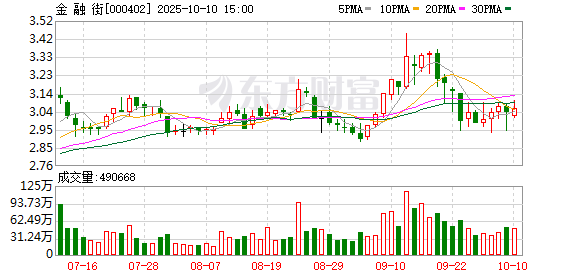
FINANCIAL STREET(000402)

Search documents
2025金融街论坛年会10月27日至30日在北京金融街举行
Bei Jing Ri Bao Ke Hu Duan· 2025-10-13 13:12
Group 1 - The 2025 Financial Street Forum Annual Meeting will be held from October 27 to 30 in Beijing's Financial Street [1] - The theme of the forum is "Global Financial Development under Innovation, Transformation, and Restructuring" [1]

2025金融街论坛年会将于10月27日至30日举行
Xin Lang Cai Jing· 2025-10-13 12:52
Group 1 - The 2025 Financial Street Forum Annual Meeting will be held from October 27 to 30 in Beijing's Financial Street, approved by the State Council [1] - The theme of the forum is "Global Financial Development under Innovation, Transformation, and Reshaping" [1]
【金融街发布】中国证监会发布《证券期货业业务域数据元规范 第4部分:证券交易所》等3项金融行业标准
Zhong Guo Jin Rong Xin Xi Wang· 2025-10-10 11:58
Group 1 - The China Securities Regulatory Commission (CSRC) has released three financial industry standards related to data management in the securities and futures sectors, effective immediately [1][2] - The standards aim to standardize data elements for securities exchanges, enterprise asset securitization, and asset management businesses, enhancing data governance and efficiency in the industry [1][2] - The implementation of these standards is expected to facilitate digital transformation in the capital market, improve information disclosure, and promote efficient data sharing among industry participants [1][2] Group 2 - The "Data Element Specification for Asset Management Business" standard is designed to improve the standardization of regulatory data collection and enhance the governance level of the industry [2] - The CSRC plans to continue developing data governance and business service standards to advance the digitalization of the capital market and strengthen the foundation for technology-driven regulation [2]
金融街:截至2025年9月底公司股东户数共计71982户
Zheng Quan Ri Bao· 2025-10-10 10:43
(文章来源:证券日报) 证券日报网讯金融街10月10日在互动平台回答投资者提问时表示,截至2025年9月底,公司股东户数共 计71,982户。 ...

【金融街发布】《吹哨人奖励规定》公开征求意见 进一步完善举报制度 较大幅度提高奖励标准
Zhong Guo Jin Rong Xin Xi Wang· 2025-09-30 12:36
Core Viewpoint - The China Securities Regulatory Commission (CSRC) has revised the whistleblower reward regulations to enhance the reporting system for securities and futures violations, aiming to promote a culture of accountability and adapt to the high-quality development of the capital market [1][2]. Summary by Sections Revision of Regulations - The name of the regulation has been changed from "Interim Provisions on Reporting Violations in Securities and Futures" to "Whistleblower Reward Regulations for Securities and Futures Violations," emphasizing the spirit of justice and accountability [2]. Improvement of Reward Conditions - Major cases that severely disrupt market order or harm financial security are now included in the reward scope, with the minimum penalty amount for rewards increased from 100,000 yuan to 1 million yuan [3]. Increase in Reward Standards - The reward percentage has been raised from 1% to 3% of the penalty amount, with the maximum reward for significant leads increased from 100,000 yuan to 500,000 yuan, and for cases with substantial impact, the cap has been raised to 1 million yuan [4]. Strict Handling Requirements - The regulations emphasize fair handling, confidentiality, and the protection of whistleblower rights, with clear channels for reporting and responsibilities for processing leads [5]. Optimization of Reward Procedures - The CSRC will batch process rewards based on the number of qualifying cases and budget considerations, with a three-month deadline for confirming whistleblower registrations [6]. Enhancement of Protection Mechanisms - Whistleblower identities will be managed anonymously, and any retaliation against whistleblowers will be strictly prohibited, with severe penalties for companies that retaliate [7]. Establishment of Supervision and Accountability Mechanisms - There will be a strengthened accountability mechanism for handling whistleblower leads, with penalties for staff who fail to perform their duties or engage in misconduct [8].
【金融街发布】国家外汇局:我国外债规模及币种结构保持基本稳定 期限结构有所优化
Xin Hua Cai Jing· 2025-09-30 09:46
Core Insights - As of June 30, 2025, China's total external debt (including both domestic and foreign currency) stands at 17.44 trillion RMB (approximately 2.44 trillion USD), showing a slight decrease of 0.6% from March 2025 [3] - The structure of external debt has shown marginal improvement, with long-term debt accounting for 42% and short-term debt for 58% [3] Debt Structure - Long-term external debt amounts to 740.09 billion RMB (approximately 103.39 billion USD), representing 42% of the total [1] - Short-term external debt totals 1,004.28 billion RMB (approximately 140.29 billion USD), with trade-related credit making up 34% of this amount [1] - Government external debt is 301.66 billion RMB (approximately 42.14 billion USD), accounting for 17% [1] - Bank external debt is 751.26 billion RMB (approximately 104.95 billion USD), making up 43% [1] - Other sectors' external debt, including inter-company loans, is 626.24 billion RMB (approximately 87.48 billion USD), which is 36% [1] Debt Instruments - Loans constitute 23.12 billion RMB (approximately 3.23 billion USD), or 13% of the total external debt [2] - Trade credit and prepayments amount to 27.35 billion RMB (approximately 3.82 billion USD), representing 16% [2] - Currency and deposits total 33.99 billion RMB (approximately 4.75 billion USD), accounting for 19% [2] - Debt securities are valued at 60.88 billion RMB (approximately 8.50 billion USD), making up 35% [2] - Special Drawing Rights (SDR) allocation is 35.61 billion RMB (approximately 4.97 billion USD), or 2% [2] Currency Structure - Domestic currency external debt is 90.80 billion RMB (approximately 12.68 billion USD), representing 52% of the total [2] - Foreign currency external debt (including SDR allocation) is 83.64 billion RMB (approximately 11.68 billion USD), accounting for 48% [2] - Among foreign currency debts, USD debt constitutes 79%, Euro debt 8%, and JPY debt 4% [2]
【金融街发布】国家外汇局:二季度我国经常账户顺差9252亿元 资本和金融账户逆差9842亿元
Xin Hua Cai Jing· 2025-09-30 09:35
Core Insights - In Q2 2025, China's current account surplus was 925.2 billion yuan, while the capital and financial account recorded a deficit of 984.2 billion yuan [1] - For the first half of 2025, the current account surplus reached 21,126 billion yuan, with a capital and financial account deficit of 19,936 billion yuan [1] Financial Data Summary - In USD terms, Q2 2025 current account surplus was 128.7 billion USD, with a goods trade surplus of 219.1 billion USD and a services trade deficit of 47.1 billion USD [1] - For the first half of 2025, the current account surplus in USD was 294.1 billion USD, driven by a goods trade surplus of 456.7 billion USD and a services trade deficit of 106.4 billion USD [1] - The capital and financial account deficit in Q2 2025 was 137 billion USD, with a capital account deficit of 1 million USD and a financial account deficit of 136.9 billion USD [1] - In the first half of 2025, the capital and financial account deficit was 277.6 billion USD, with a capital account deficit of 1 million USD and a financial account deficit of 277.5 billion USD [1] SDR Valuation Summary - In SDR terms, the current account surplus for Q2 2025 was 94.9 billion SDR, while the capital and financial account deficit was 100.8 billion SDR [1] - For the first half of 2025, the current account surplus in SDR was 220.9 billion SDR, with a capital and financial account deficit of 207.6 billion SDR [1]
【金融街发布】金融监管总局:到2030年满足全人群和全生命周期多样化需求的多层次健康保险市场格局基本形成
Xin Hua Cai Jing· 2025-09-30 09:35
Core Viewpoint - The National Financial Regulatory Administration has issued guidelines to promote the high-quality development of health insurance, aiming for a more integrated and multi-level health insurance market by 2030 [1] Group 1: Development of Health Insurance - The guidelines emphasize the active development of commercial medical insurance, creating a comprehensive and multi-tiered product system that includes new medical technologies and treatments [2] - There is a focus on the development of long-term care insurance and disability income loss insurance, aligning with home, community, and institutional care needs [2] - The guidelines advocate for the steady development of disease insurance, with regular updates to disease definitions and incidence rates [3] Group 2: Integration and Collaboration - The integration of health insurance with health management is encouraged, promoting a new service system that combines prevention, management, and protection [3] - The guidelines call for collaboration between health insurance and the broader health industry, enhancing service networks and integrating with medical and pharmaceutical sectors [4] Group 3: Regulatory Enhancements - Strengthening the regulatory framework for health insurance is a priority, including the establishment of independent financial rules and product oversight [7] - The guidelines propose measures to improve market order and address illegal activities within the health insurance sector [7] Group 4: Sustainable Development - The guidelines highlight the need for enhancing the professional capabilities of insurance companies and improving their data-driven operations [5] - There is an emphasis on increasing the core competitiveness of health insurance companies through innovative strategies and integrated health management [5] Group 5: Environment Optimization - Establishing a standardized system for health insurance is crucial, including the development of model clauses and evaluation metrics for services [8] - The guidelines promote multi-party collaboration to enhance information sharing and support the development of regional health insurance products [8]
【金融街发布】国家外汇局:6月末我国对外金融资产110645亿美元 对外负债72555亿美元
Xin Hua Cai Jing· 2025-09-30 09:34
Core Insights - As of June 30, 2025, China's international investment position shows a total foreign financial asset of 110,645 billion USD and total foreign liabilities of 72,555 billion USD, resulting in a net foreign asset of 38,090 billion USD [1] Summary by Category Foreign Financial Assets - China's foreign financial assets are composed of direct investment assets amounting to 33,491 billion USD, securities investment assets of 16,942 billion USD, financial derivatives assets of 263 billion USD, other investment assets of 23,679 billion USD, and reserve assets of 36,271 billion USD, which represent 30%, 15%, 0.2%, 21%, and 33% of total foreign financial assets respectively [1] Foreign Liabilities - The foreign liabilities consist of direct investment liabilities of 37,174 billion USD, securities investment liabilities of 21,607 billion USD, financial derivatives liabilities of 263 billion USD, and other investment liabilities of 13,511 billion USD, accounting for 51%, 30%, 0.4%, and 19% of total foreign liabilities respectively [1] SDR Valuation - In terms of Special Drawing Rights (SDR), as of June 30, 2025, China's foreign financial assets are valued at 80,528 billion SDR, foreign liabilities at 52,806 billion SDR, and net foreign assets at 27,722 billion SDR [1]
【金融街发布】国家外汇局:6月末我国银行业对外金融资产17721亿美元 对外负债15377亿美元
Zhong Guo Jin Rong Xin Xi Wang· 2025-09-29 09:34
Core Insights - As of June 2025, China's banking sector has foreign financial assets amounting to $17,721 billion and foreign liabilities of $15,377 billion, resulting in a net foreign asset position of $2,344 billion [1][2] Group 1: Foreign Financial Assets - The breakdown of foreign financial assets shows that loan and deposit assets are $10,638 billion, bond assets are $4,526 billion, and other equity assets are $2,557 billion, accounting for 60%, 26%, and 14% of total foreign financial assets respectively [1] - In terms of currency, RMB assets total $4,902 billion, USD assets are $9,008 billion, and other currency assets are $3,812 billion, representing 28%, 51%, and 22% of total foreign financial assets respectively [1] - The allocation of these assets indicates that $8,820 billion is directed towards foreign banking sectors and $8,901 billion towards foreign non-banking sectors, each making up 50% of the total [1] Group 2: Foreign Financial Liabilities - The composition of foreign financial liabilities reveals that loan and deposit liabilities are $6,761 billion, bond liabilities are $3,561 billion, and other equity liabilities are $5,056 billion, constituting 44%, 23%, and 33% of total foreign financial liabilities respectively [2] - By currency, RMB liabilities amount to $8,073 billion, USD liabilities are $3,203 billion, and other currency liabilities are $4,101 billion, making up 52%, 21%, and 27% of total foreign financial liabilities respectively [2] - The source of these liabilities shows that $6,201 billion comes from foreign banking sectors and $9,176 billion from foreign non-banking sectors, with the latter accounting for 60% of the total [2]