
Xiwang Foodstuffs(000639)

Search documents
【最全】2025年食用油行业上市公司全方位对比(附业务布局汇总、业绩对比、业务规划等)
Qian Zhan Wang· 2025-07-20 07:15
Core Insights - The edible oil industry in China is characterized by a complex supply chain that includes agricultural production, processing, packaging, and sales channels [1] - Major listed companies in the industry include Jinlongyu (300999.SZ), Shenliang Holdings (000019.SZ), and others, with Jinlongyu leading in revenue and market share [1][8] Industry Overview - The edible oil supply chain consists of upstream agricultural production, midstream processing companies, and downstream sales channels [1] - The industry has seen a decline in revenue across most listed companies in 2024, indicating increased competition and market pressure [8][15] Company Performance - Jinlongyu reported a revenue of 238.87 billion yuan in 2024, maintaining a leading position despite a decline of 10.37% in its feed raw materials and oil technology business [8][15] - Shenliang Holdings and Jinlongyu both experienced growth in net profit in Q1 2025, with increases of 42.97% and 11.24% respectively [9][10] - Other companies like Su Kuan Agricultural Development and Jingliang Holdings faced significant revenue declines in 2024 [10] Financial Metrics - As of May 27, 2025, Jinlongyu's total market capitalization reached 165.196 billion yuan, while other companies like Su Kuan Agricultural Development also exceeded 10 billion yuan [9][10] - The profit margins varied significantly among companies, with West King Food achieving a gross margin of 22.86%, while Jinlongyu and Shenliang Holdings reported margins below 3% [18] Business Strategies - Jinlongyu plans to expand into the health industry and enhance its product offerings through technological innovation [22][24] - Jingliang Holdings aims to strengthen its supply chain and marketing strategies to improve its trade business [22][24] - West King Food focuses on brand building and cost control to enhance competitiveness [22][24] Market Dynamics - The overseas revenue distribution among companies is uneven, with West King Food and others relying heavily on international markets, although some have seen declines in overseas sales [20][21] - The edible oil industry is facing challenges due to increased competition and market pressures, leading to varied performance among listed companies [15][18]




2025年中国食用油价值链分析:原材料是食用油生产成本的主要来源
Qian Zhan Wang· 2025-07-15 08:41
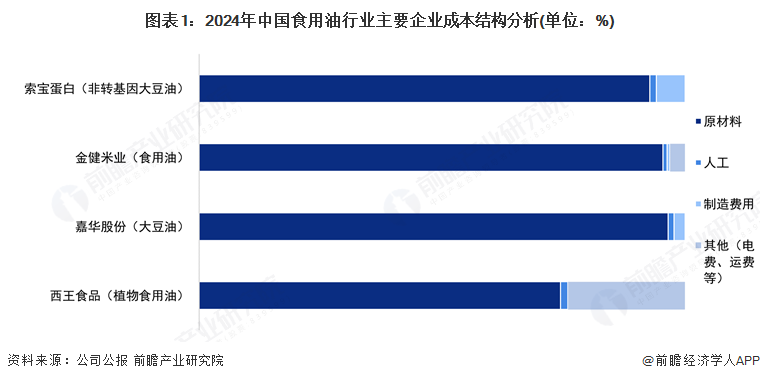
Group 1 - The core point of the article highlights that raw materials constitute the largest cost component in the edible oil production process, with companies like Xiwang Food showing a raw material cost ratio of 74.39% in 2024, while others exceed 92% [1] - Labor costs in the edible oil industry are relatively low, ranging from 0.85% to 1.51%, while manufacturing expenses fluctuate between 0.6% and 5.9% [1] - The cost structure of Jin Jian Rice Industry's edible oil products shows that direct materials account for around 95% from 2019 to 2024, indicating significant sensitivity to raw material price fluctuations [2] Group 2 - The pricing of edible oil in China is influenced by supply-side factors, manufacturing value-added premiums, and consumer demand elasticity, creating a "price-demand-price" transmission mechanism [6] - The edible oil industry value chain includes stages such as oilseed cultivation, pressing, refining, packaging, and distribution, with oilseed cultivation showing high gross profit margins [6] - The gross profit margin for oilseed crops like sunflower seeds can reach up to 72.6%, while downstream sales channels exhibit varying margins, with offline sales maintaining around 16% [8]
西王食品(000639) - 2025 Q2 - 季度业绩预告
2025-07-14 10:20
[Xiwang Food 2025 Semi-Annual Performance Forecast](index=1&type=section&id=Xiwang%20Food%20Co.%2C%20Ltd.%202025%20Semi-Annual%20Performance%20Forecast) Xiwang Food forecasts a shift from profit to loss in H1 2025, attributing it to market competition and rising costs, with strategic adjustments planned [Core Performance Forecast Data](index=1&type=section&id=I.%20Current%20Period%20Performance%20Forecast) Xiwang Food forecasts a net loss of **15 million to 25 million CNY** for H1 2025, a significant decline from the prior year's profit Performance Forecast Summary | Item | Current Reporting Period (Jan 1 - Jun 30, 2025) | Prior Period | | :--- | :--- | :--- | | **Net Profit Attributable to Shareholders** | Loss: 15 million – 25 million CNY | Profit: 40.6517 million CNY | | **Net Profit After Non-Recurring Items** | Loss: 18 million – 30 million CNY | Profit: 52.7623 million CNY | | **Basic Earnings Per Share** | Loss: 0.014 CNY/share – 0.025 CNY/share | Profit: 0.0377 CNY/share | [Analysis of Performance Changes and Future Strategies](index=1&type=section&id=III.%20Reasons%20for%20Performance%20Changes) The company attributes its H1 2025 loss to intensified market competition, online product subsidies, distributor adjustments, and high raw material costs - Key reasons for the reported period's performance loss include intense market competition, online competitor subsidies, and distributor adjustments leading to revenue decline in edible oil and sports nutrition businesses, alongside high raw material prices compressing gross margins[4](index=4&type=chunk) - Future strategy for edible oil business: Focus on deepening and integrating omnichannel e-commerce, developing differentiated operational strategies for various platforms, and strengthening channel support for key markets and distributors[5](index=5&type=chunk) - Future strategy for sports nutrition business: Gradually improve profitability by optimizing product portfolio (increasing the proportion of high-margin products), adjusting pricing, and improving formulations[5](index=5&type=chunk) [Important Statement and Risk Warning](index=1&type=section&id=II.%20Communication%20with%20Accounting%20Firm%20%26%20IV.%20Risk%20Warning) The company states the performance forecast is preliminary and unaudited, advising investors to refer to the official semi-annual report for final data - The performance forecast data represents preliminary estimates by the company's financial department and has not been audited by an accounting firm[3](index=3&type=chunk) - The company reminds investors that the final financial data will be based on the 2025 semi-annual report disclosed on China Securities Journal, Securities Times, and Juchao Information Network, urging caution regarding investment risks[6](index=6&type=chunk)

西王食品:预计2025年上半年净利润亏损1500万元–2500万元
news flash· 2025-07-14 10:17
Core Viewpoint - The company, Xiwang Food, is projecting a net profit loss for the period from January 1, 2025, to June 30, 2025, with expected losses ranging from 15 million to 25 million yuan, compared to a profit of 40.65 million yuan in the same period last year [1] Financial Performance - The net profit attributable to shareholders is expected to be a loss of 15 million to 25 million yuan, while the same period last year showed a profit of 40.65 million yuan [1] - The net profit after deducting non-recurring gains and losses is projected to be a loss of 18 million to 30 million yuan, compared to a profit of 52.76 million yuan in the previous year [1] - The basic earnings per share are expected to be a loss of 0.014 to 0.025 yuan per share, while the previous year reported earnings of 0.0377 yuan per share [1] Business Challenges - The company is facing challenges in its edible oil and sports nutrition businesses, with revenue declines attributed to intense market competition, online competitor subsidies, and adjustments by distributors [1] - High raw material prices are maintaining pressure on the company's gross margin, leading to a decrease in profitability [1]
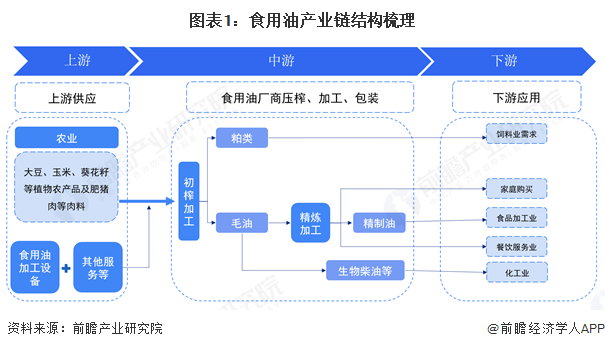
【干货】2025年食用油产业链全景梳理及区域热力地图
Qian Zhan Wang· 2025-07-09 03:12
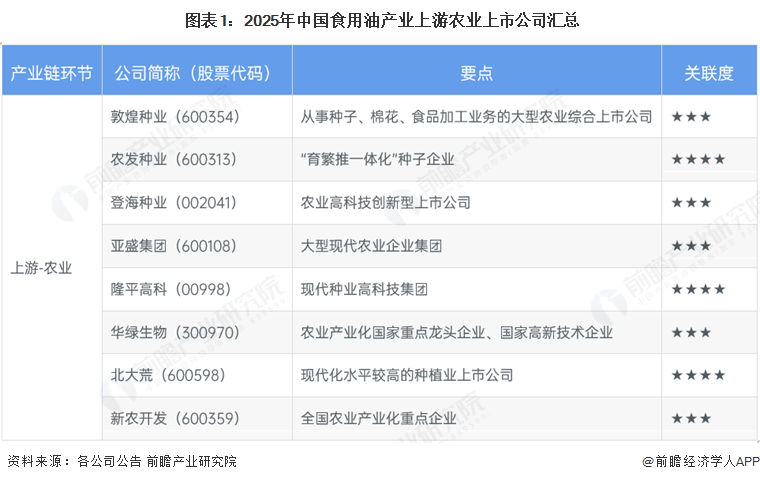
Core Insights - The article provides a comprehensive overview of the edible oil industry chain in China, detailing its various segments including oilseed cultivation, pressing, refining, packaging, and sales channels [1][5]. Industry Overview - The edible oil industry in China comprises numerous companies, with key producers including Jinlongyu, Shandong Luhua, Shanghai Liangyou, Jingliang Holdings, Jinjian Rice Industry, Xiwang Food, Daodaoquan, and COFCO Technology [2][5]. - The upstream raw materials are sourced from various agricultural enterprises, while downstream consumers include restaurants and e-commerce platforms like JD.com and Alibaba [2]. Regional Distribution - As of May 30, 2025, there are 60,329 registered companies in the edible oil industry chain in China, with Shandong province having the highest number at 5,946, followed by Hunan (5,269), Henan (4,519), and Sichuan (3,762), collectively accounting for 32.3% of the total [5][6]. - The geographical distribution of edible oil companies is closely linked to transportation convenience and agricultural production capabilities [5]. Listed Companies - Among the listed companies in the edible oil sector, 10 have disclosed revenue data related to edible oil, with a concentration in coastal regions. Notable companies include Xiwang Food and Jiahua in Shandong, Daodaoquan and Jinjian Rice Industry in Hunan, and Jinlongyu in Shanghai [6][10]. Industrial Parks - There are nearly 40 industrial parks related to edible oil production in China, primarily located in Sichuan (6 parks), followed by Henan and Zhejiang (4 parks each). Despite Shandong having the most companies, it has only 3 industrial parks, indicating a dispersed nature of edible oil enterprises in the province [10].
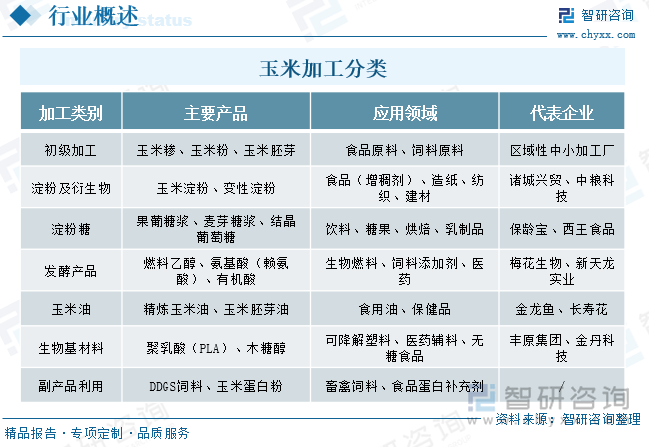
趋势研判!2025年中国玉米加工行业产业链、发展现状、细分市场产品结构及未来趋势分析:高附加值产品开发成为核心,生物制造技术引领行业转型升级[图]
Chan Ye Xin Xi Wang· 2025-07-07 01:05
Core Viewpoint - The corn industry is a strategic pillar for China's food security, with significant growth in planting area, yield, and total production expected in 2024, despite short-term market adjustments due to international price fluctuations and rising costs [1][8][14]. Group 1: Industry Overview - The corn processing industry in China has developed a complete industrial chain, from primary processing to modern biobased material research, becoming a key hub for agricultural production and industrial manufacturing [1][5][14]. - Corn processing can be categorized into primary processing and deep processing, producing various products for food, feed, and industrial applications [2][3][5]. Group 2: Current Development Status - In 2024, China's corn planting area is projected to reach 44.74 million hectares, a year-on-year increase of 1.18%, with a yield of 439.4 kg/mu, contributing to a total production of 294.92 million tons, a 2.1% increase from the previous year [1][8][10]. - The total corn consumption in 2024 is expected to reach 31.78 million tons, with industrial consumption growing by 3.07% to 7.94 million tons, driven by innovations in deep processing [12][14]. Group 3: Market Trends - The corn deep processing market size is expected to adjust to 190 billion yuan in 2024, down 6.4% from its peak in 2022, but the long-term growth trend remains solid [1][14]. - The corn processing industry is transitioning towards green and low-carbon practices, focusing on high-value product development such as polylactic acid and functional sugars [24][25][26]. Group 4: Competitive Landscape - The corn deep processing industry in China has a tiered competitive structure, with leading companies like COFCO Technology and Meihua Biological occupying the top tier, focusing on high-value products [20][22]. - The market for corn starch is highly concentrated, with top companies holding over 44% market share, and there is a trend towards differentiation and expansion into biobased materials and other emerging fields [22][24].


A股大消费板块震荡调整,美容护理、食品加工制造、饮料制造板块跌幅居前,拉芳家化跌超7%,水羊股份、南侨食品、盐津铺子、西王食品、黑芝麻、有友食品等跌幅居前。
news flash· 2025-06-05 02:37
Group 1 - The A-share consumer sector is experiencing fluctuations and adjustments, with significant declines in the beauty care, food processing, and beverage manufacturing sectors [1] - Lafang Home Products has seen a drop of over 7%, indicating a notable downturn in the beauty care segment [1] - Other companies such as Shuiyang Co., Nanjiao Food, Yanjinpuzi, Xiwang Food, Heizhima, and Youyou Food are also among those with significant declines [1]



NMN概念涨2.72%,主力资金净流入15股
Zheng Quan Shi Bao Wang· 2025-05-27 10:23
Market Performance - The NMN concept index rose by 2.72%, ranking fourth among concept sectors, with 24 stocks increasing in value [1][2] - Notable gainers included Xiwang Food, ST Hongtai, and Yabao Chemical, which saw increases of 12.41%, 5.23%, and 4.44% respectively [1][2] - Decliners included Zhongsheng Pharmaceutical and Kanghui Pharmaceutical, which fell by 2.41% and 0.36% respectively [1][2] Capital Flow - The NMN concept sector experienced a net inflow of 284 million yuan, with 15 stocks receiving net inflows [2][3] - Xiwang Food led the net inflow with 130 million yuan, followed by Zhejiang Medicine and Yabao Chemical with net inflows of 59.73 million yuan and 51.62 million yuan respectively [2][3] Stock Performance - Xiwang Food had a net inflow rate of 43.86%, while ST Hongtai and Yabao Chemical had rates of 10.26% and 7.79% respectively [3][4] - Other notable stocks included Youa Shares and Hanyu Pharmaceutical, with net inflow rates of 6.93% and 5.31% respectively [3][4] - Decliners in the sector included Zhongsheng Pharmaceutical with a net outflow of 69.36 million yuan and a decline of 2.41% [4]


西王食品: 关于控股股东股份完成过户暨权益变动的公告
Zheng Quan Zhi Xing· 2025-05-16 12:17
Core Viewpoint - The announcement details the auction and transfer of 110 million shares of Xiwang Food Co., Ltd. held by its controlling shareholder, Xiwang Group, which has been completed as of May 15, 2025 [1]. Auction Details - The auction involved 110 million shares, representing 35.25% of the company's total share capital [1]. - The shares were auctioned off in multiple batches, with each batch consisting of 5 million shares [2][3][4][5][6][7][8][9]. - The auction prices for the shares varied, with several transactions recorded at prices of 12,100,000 RMB (approximately 1.21 million USD) and 12,350,000 RMB (approximately 1.24 million USD) [2][6][9]. Shareholding Impact - As of the announcement date, Xiwang Group and its concerted parties have had a total of 346,565,763 shares auctioned, which accounts for 61.59% of their total holdings [9]. - The original shareholding structure indicates that Xiwang Group held 318,515,381 shares (29.51% of total shares) before the auction [9]. - The auction will not lead to a change in the controlling shareholder or the actual controller of the company, nor will it significantly impact the company's governance structure or ongoing operations [9].
西王食品: 简式权益变动报告书
Zheng Quan Zhi Xing· 2025-05-16 12:17
Core Viewpoint - The report outlines the equity changes of Xiwang Food Co., Ltd, indicating a reduction in shareholding by its major shareholders, Xiwang Group and Shandong Yonghua Investment, due to online auction sales of their shares [1][2]. Group 1: Equity Changes - Xiwang Group reduced its shareholding by 110,000,000 shares, representing a decrease of 10.19% [6]. - Shandong Yonghua Investment reduced its shareholding by 36,165,000 shares, representing a decrease of 3.35% [6]. - After the equity changes, Xiwang Group holds 202,075,381 shares, accounting for 18.72% of the total share capital, while Yonghua Investment holds 14,028,262 shares, accounting for 1.30% [5][7]. Group 2: Shareholding Structure - The total shares held by Xiwang Group and its concerted actions amount to 220,207,705 shares, which is 20.40% of the total share capital [5]. - The report confirms that there are no changes in the control of the company as a result of these equity changes [7]. Group 3: Future Plans - The report states that the possibility of further increases or decreases in shareholding by the information disclosure obligors within the next twelve months remains uncertain [6].