BOE(000725)

Search documents
三季度消费级AR/VR眼镜市场销量达16.9万台 ,消费电子ETF(561600)备受关注
Xin Lang Cai Jing· 2025-11-14 02:07
Group 1 - The core viewpoint of the articles highlights the growth of the consumer-grade AR/VR glasses market in China, with significant sales increases driven by new product launches and technological advancements [1][2] - CINNO Research reported that in Q3 2025, the sales volume of consumer-grade AR/VR glasses reached 169,000 units, representing a 17% quarter-over-quarter growth and a 57% year-over-year growth [1] - Consumer-grade AR devices were identified as the main growth driver, with sales reaching 130,000 units, marking a 109% year-over-year increase [1] Group 2 - The CSI Consumer Electronics Theme Index (931494) includes 50 listed companies involved in component production and consumer electronics brand design, reflecting the overall performance of the sector [2] - As of October 31, 2025, the top ten weighted stocks in the CSI Consumer Electronics Theme Index accounted for 56.3% of the index, with notable companies including Luxshare Precision, Cambricon, and Industrial Fulian [2] - The Consumer Electronics ETF (561600) closely tracks the CSI Consumer Electronics Theme Index, providing investors with exposure to the performance of the sector [2]





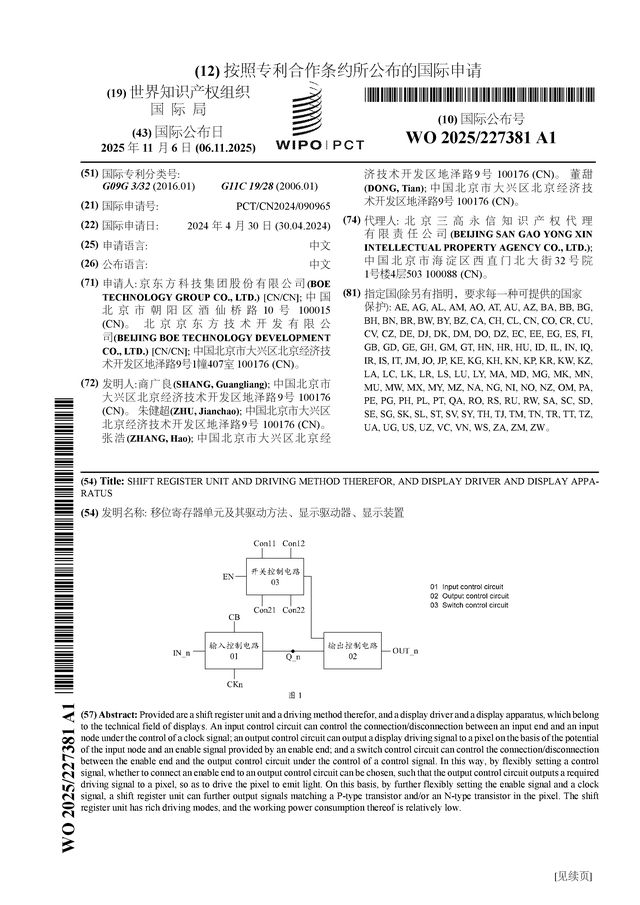
京东方A公布国际专利申请:“移位寄存器单元及其驱动方法、显示驱动器、显示装置”
Sou Hu Cai Jing· 2025-11-13 21:40
Group 1 - The core point of the article is that BOE Technology Group Co., Ltd. (京东方A) has filed an international patent application for a "shift register unit and its driving method, display driver, and display device" with the application number PCT/CN2024/090965, which is set to be published internationally on November 6, 2025 [1] Group 2 - In 2023, BOE Technology has announced a total of 904 international patent applications, representing a 5.12% increase compared to the same period last year [4] - The company invested 6.046 billion yuan in research and development in the first half of 2023, which is a year-on-year increase of 4.13% [4]


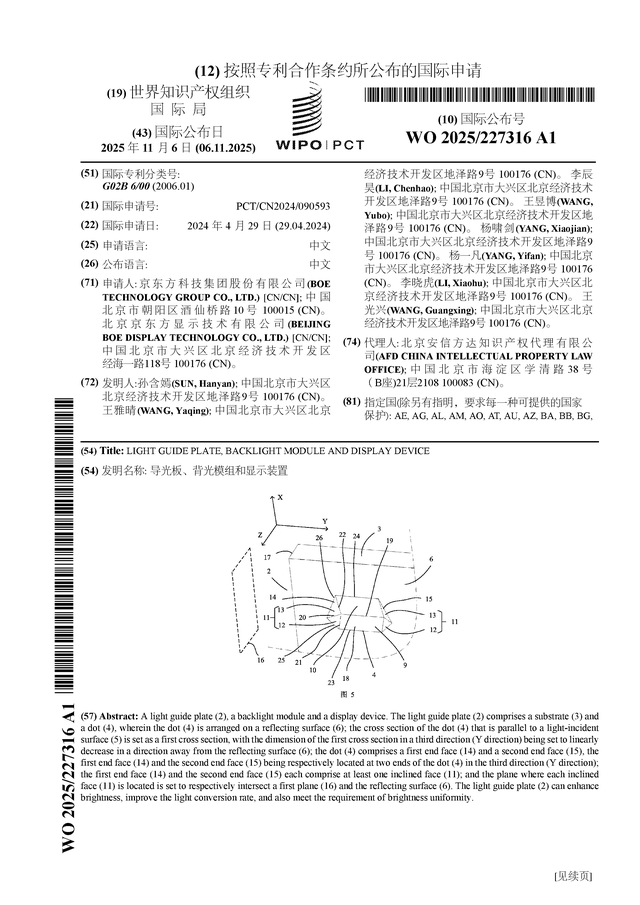
京东方A公布国际专利申请:“导光板、背光模组和显示装置”
Sou Hu Cai Jing· 2025-11-13 21:40
Core Insights - BOE Technology Group Co., Ltd. (京东方A) has filed an international patent application for a "light guide plate, backlight module, and display device" with the application number PCT/CN2024/090593, set to be published internationally on November 6, 2025 [1]. Group 1: Patent and R&D Investment - The company has announced a total of 904 international patent applications this year, representing a 5.12% increase compared to the same period last year [4]. - In the first half of 2025, the company invested 6.046 billion yuan in research and development, which is a year-on-year increase of 4.13% [4].
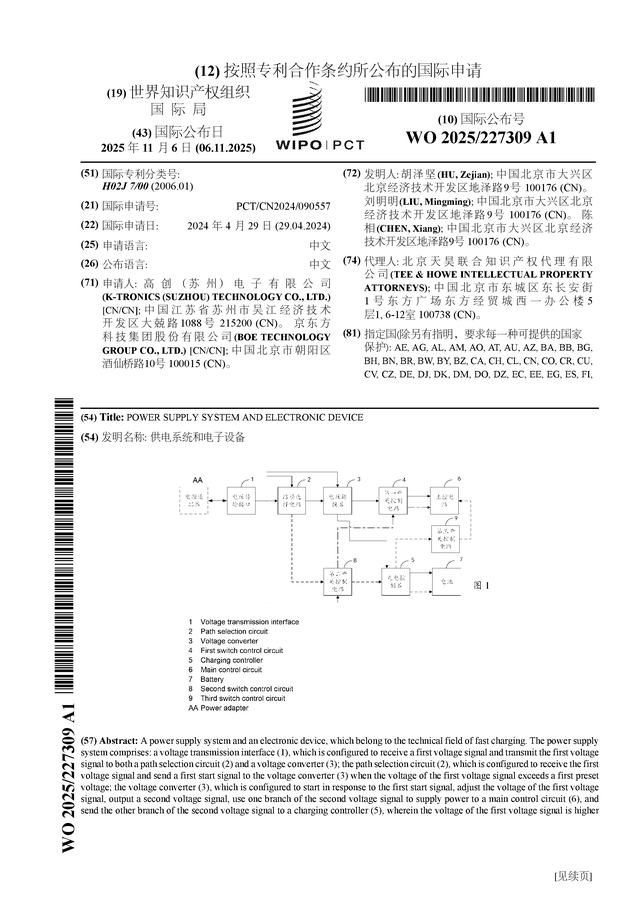
京东方A公布国际专利申请:“供电系统和电子设备”
Sou Hu Cai Jing· 2025-11-13 21:40
Group 1 - BOE Technology Group has filed 904 international patent applications this year, representing a 5.12% increase compared to the same period last year [3] - In the first half of 2023, BOE invested 6.046 billion yuan in research and development, which is a year-on-year increase of 4.13% [3] Group 2 - The A50 ETF, which tracks the MSCI China A50 Connect Index, has seen a recent 5-day change of 0.57% [6] - The latest share count for the A50 ETF is 2.28 billion, with a decrease of 7.8 million shares, while the net inflow of main funds is 8.166 million yuan [6]
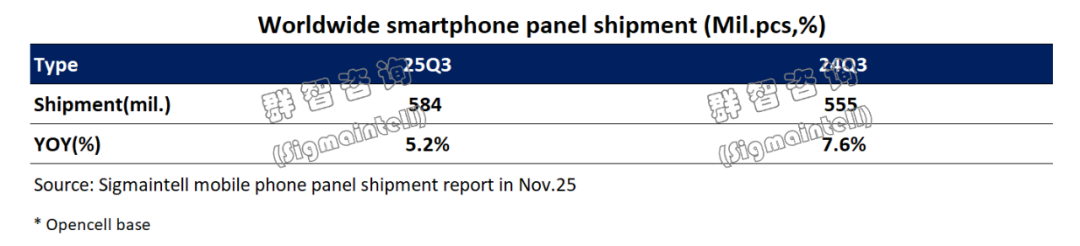
群智咨询:三季度全球智能手机面板总出货量达5.8亿片 同比增长约 5.2%
Zhi Tong Cai Jing· 2025-11-13 10:37
Core Insights - The global smartphone market is entering a high-end model release cycle in Q3 2025, leading to significant seasonal growth in the panel market, with total smartphone panel shipments reaching 580 million units, a year-on-year increase of approximately 5.2% [1][13]. Market Overview - The market is characterized by a continued differentiation, with flexible OLED leading growth while a-Si LCD remains a solid foundation. In Q3 2025, a-Si LCD smartphone panel shipments reached approximately 330 million units, a year-on-year increase of 6.9% [4]. - LTPS LCD shipments fell sharply by 40.8% year-on-year to about 20.86 million units, as brands accelerate the transition to OLED technology [4]. - Rigid OLED shipments declined by 3.0% year-on-year to approximately 49.3 million units, although some domestic brands may maintain rigid OLED product plans in the short term due to cost control measures [4]. Company Performance - BOE (京东方) maintained its position as the global leader with over 140 million units shipped, although overall shipments declined year-on-year. Flexible OLED shipments reached 38.4 million units, a year-on-year increase of 25.7% [8][9]. - Samsung Display (SDC) ranked second with over 100 million units shipped, benefiting from the release of new Apple models, with flexible OLED shipments reaching 61.4 million units [9][14]. - CSOT (华星光电) shipped approximately 70 million units, with a significant year-on-year increase of 59.2% in a-Si LCD shipments. Flexible OLED shipments were about 19.38 million units, showing fluctuations [10][11]. OLED Market Dynamics - The global OLED smartphone panel shipments reached approximately 230 million units in Q3 2025, a year-on-year increase of 10.3%, with flexible OLED shipments around 180 million units, up 14.6% [13][14]. - Korean manufacturers saw a quarterly rebound in OLED shipments, totaling about 120 million units, with a market share of 51.8%, temporarily surpassing Chinese manufacturers [14]. - Chinese manufacturers continued to grow, with total OLED shipments around 110 million units, a year-on-year increase of 14.1%, maintaining over 50% market share in flexible OLED [14][15]. Future Outlook - The smartphone panel market is expected to maintain seasonal growth in Q4 2025, driven by holiday stocking demands. The ongoing release of OLED capacity and investments in high-generation lines will intensify market competition [17]. - Rising storage chip prices may lead terminal brands to pass cost pressures upstream to panel manufacturers, potentially intensifying pricing competition and impacting profitability [18].
国产显示面板,首超50%
半导体芯闻· 2025-11-13 10:28
Core Insights - Chinese companies have surpassed 50% market share in the global display panel market for the first time, marking a significant shift from the long-standing dominance of South Korea [2] - The total sales of major panel manufacturers reached $56.2 billion in the first half of the year, with Chinese companies generating $29.3 billion, a 7% increase year-on-year, leading to a market share of 52.1% [2] - South Korean and Japanese companies have seen declines in market share, with South Korean sales down 9.5% and market share dropping to around 30%, while Japanese sales fell 16.7%, leaving a market share of only 3.5% [2] Group 1 - Taiwanese panel manufacturers experienced a 4.4% increase in sales, raising their global market share to 13.2%, an increase of 0.6 percentage points from the previous year [3] - In terms of profitability, Chinese companies are nearly on par with South Korean firms, with TCL and BOE ranking second and third in profits, achieving net profits of 4.32 billion RMB and 3.25 billion RMB (approximately 669.7 billion KRW), reflecting growth rates of 74% and 42.15% respectively [3] - Chinese companies are rapidly expanding their presence in the OLED market, with projections indicating that their share of global OLED capacity will rise from 30% this year to 42% by 2030, while South Korea's share is expected to decline from 69% to 58% [3] Group 2 - The chairman of BOE stated that global demand for OLED panels is growing rapidly, and the company plans to expand OLED applications in tablets, laptops, and wearable devices [3] - Industry experts note that the influx of technology and talent into China is accelerating the competitive pace, posing a substantial threat to South Korean manufacturers [3]

韩媒:京东方8.6代OLED产线首批面板将供货华硕
WitsView睿智显示· 2025-11-13 09:12
Core Viewpoint - BOE's 8.6-generation OLED panel production line (B16) is set to supply ASUS for 14-inch laptops and OPPO for smartphones, with an expected contract production volume of approximately 10 million panels [1][3]. Group 1: BOE's Production and Plans - The first batch of panels from BOE's B16 line will be supplied to ASUS, primarily for OLED screens in laptops [1]. - BOE plans to hold a lighting ceremony for the B16 factory in December 2023, indicating that all core processes are ready [1]. - BOE announced an investment in the 8.6-generation AMOLED production line project in November 2023, targeting high-end touch OLED displays for laptops and tablets, with mass production expected in the second half of 2026 [1]. Group 2: Competitors and Market Dynamics - Other Chinese panel manufacturers are accelerating investments in 8.6-generation OLED production lines, aiming for a broader market in laptops and mobile devices [3]. - The Hefei Guoxian 8.6-generation AMOLED production line, backed by Visionox and Hefei's investment platform, is the world's first high-generation AMOLED line using the no-FMM technology, with a total investment of 55 billion yuan and a design capacity of 32,000 glass substrates per month [3]. - TCL Huaxing's T8 project, the world's first large-scale G8.6 generation inkjet printing OLED production line, has a total investment of 29.5 billion yuan and a design capacity of approximately 22,500 glass substrates per month, covering various applications [3]. Group 3: Competitive Landscape - Industry insiders suggest that despite starting a year later than Samsung Display, BOE's B16 line may achieve mass production ahead of Samsung [4]. - Samsung Display is constructing an 8.6-generation OLED panel production line (A2) in Korea, with a monthly capacity of 16,000 panels, exclusively for Apple's next-generation MacBook series [4]. - Samsung has indicated plans to start mass production of the second A2 line in the second quarter to third quarter of 2026 [4].

同花顺果指数概念下跌0.29%,主力资金净流出14股
Zheng Quan Shi Bao Wang· 2025-11-13 08:46
Core Insights - The Tonghuashun Fruit Index concept declined by 0.29%, ranking among the top declines in the concept sector, with notable declines in stocks such as Dongshan Precision, Xunwei Communication, and Saiteng Co., Ltd. [1] - In contrast, seven stocks within the same sector experienced price increases, with Desay Battery, Zhongshi Technology, and Changdian Technology leading the gains at 5.07%, 3.68%, and 1.46% respectively [1]. Concept Sector Performance - The top-performing concept sectors included Fluorochemical (up 4.50%), Organic Silicon (up 4.47%), and Sodium-ion Battery (up 4.47%), while the Tonghuashun Fruit Index was among the laggards [2]. - The sector saw a net outflow of 999.7 million yuan, with 14 stocks experiencing net outflows, and seven stocks seeing outflows exceeding 100 million yuan [2]. Major Stock Movements - The stocks with the highest net outflows included BOE Technology Group with a net outflow of 200 million yuan, followed by Xunwei Communication, Lens Technology, and Dongshan Precision [2]. - Conversely, the stocks with the highest net inflows were Changdian Technology, Zhongshi Technology, and Zhuhai Guanyu, with net inflows of 62.58 million yuan, 47.05 million yuan, and 43.70 million yuan respectively [2][3]. Individual Stock Performance - Notable declines in individual stocks included Xunwei Communication (-3.70%), Lens Technology (-2.25%), and Dongshan Precision (-4.42%) [2][3]. - In contrast, Desay Battery saw a significant increase of 5.07%, while Zhongshi Technology and Changdian Technology also posted gains of 3.68% and 1.46% respectively [3].


京东方A(000725) - 京东方科技集团股份有限公司2025年面向专业投资者公开发行科技创新公司债券(第二期)在深圳证券交易所上市的公告
2025-11-13 07:56
发行科技创新公司债券(第二期) 在深圳证券交易所上市的公告 根据深圳证券交易所债券上市的有关规定,京东方科技集团股份有限公司 2025 年面向专业投资者公开发行科技创新公司债券(第二期)符合深圳证券交 易所债券上市条件,将于 2025 年 11 月 14 日起在深圳证券交易所上市,并面向 专业投资者中的机构投资者交易,交易方式包括匹配成交、点击成交、询价成交、 竞买成交和协商成交。债券相关要素如下: 京东方科技集团股份有限公司 2025 年面向专业投资者公开 | 债券名称 | 京东方科技集团股份有限公司 2025 | | | | | | | 年面向专业投资者公开发行科技创 | | --- | --- | --- | --- | --- | --- | --- | --- | --- | | | 新公司债券(第二期) | | | | | | | | | 债券简称 | | 25BOEK2 | | | | | | | | 债券代码 | | 524510.SZ | | | | | | | | 信用评级 | AAA,债项无 | 主体 | | | | | | | | 评级机构 | 联合资信评估股份有限公司 | | | | ...
设备先行!京东方、维信诺等4条8.6代OLED产线再次提速
WitsView睿智显示· 2025-11-13 04:04
Core Viewpoint - The investment in 8.6-generation OLED production lines is accelerating, indicating a significant development phase for OLED technology in the medium-sized application market [1][2][3]. Group 1: Industry Dynamics - The construction of 8.6-generation OLED production lines is being driven by the growing demand in the IT market, particularly for tablets, laptops, and monitors, as well as the efficiency of glass substrate cutting [3][4]. - Major panel manufacturers are actively participating in the construction of 8.6-generation OLED production lines, with a notable increase in orders for OLED equipment manufacturers [4][5]. Group 2: Equipment Procurement - Panel manufacturers are accelerating the procurement of OLED equipment, with companies like BOE and Visionox leading in the purchase of key equipment such as evaporation, exposure, and lamination machines [5][9]. - Recent contracts include BOE's procurement of automatic laminating machines and evaporation source equipment, with significant contract values indicating robust demand [9][10]. Group 3: Production Line Progress - Four major 8.6-generation OLED production lines are under construction by Samsung Display, Visionox, BOE, and TCL Huaxing, each with different investment amounts and target applications [14][15]. - Samsung Display's A6 line is expected to be the first to achieve mass production, with a projected start date in Q2 2026 [22]. - BOE's B16 line is also on track for production in early 2026, while Visionox and TCL Huaxing plan to ramp up production in 2027 [22]. Group 4: Future Outlook - The OLED display industry is transitioning towards higher generation technology, with continued investment in production equipment expected to rise as the 8.6-generation lines progress towards mass production [23].