
AHTHGC(000901)

Search documents
多家公司发布风险提示!商业航天相关概念飘绿
2 1 Shi Ji Jing Ji Bao Dao· 2026-01-13 04:28
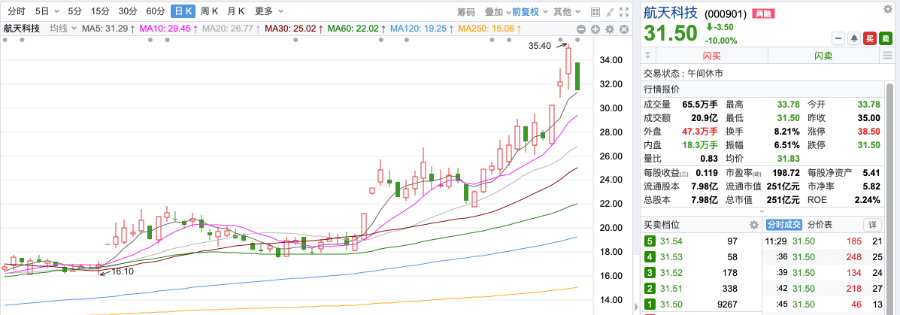
Core Viewpoint - The commercial aerospace sector has experienced significant volatility, with recent trading showing both sharp declines and substantial gains in stock prices, indicating a highly speculative environment driven by market sentiment and news events [1][3][4]. Group 1: Market Performance - The aerospace sector saw a notable decline with the aerospace index dropping by up to 9.37% and specific stocks like Aerospace Science and Technology falling by 10% [1]. - Conversely, on the previous day, the commercial aerospace index surged over 6%, with more than 90 related stocks hitting their daily price limits or increasing by over 10% [3]. - Several major commercial aerospace stocks have reported significant price increases over the past two months, with Aerospace Huan Yu and Aerospace Electronics seeing increases of 265.82% and 194.40%, respectively [4]. Group 2: Risk Warnings - Multiple commercial aerospace companies issued risk warnings due to the extreme volatility in their stock prices, with some indicating potential stock suspensions if prices continue to rise abnormally [3][4]. - The day marked the highest concentration of risk warnings since the recent surge began in late December, highlighting the speculative nature of the current market [4]. Group 3: Industry Developments - A significant driver of the recent market activity was the announcement from the International Telecommunication Union (ITU) regarding China's application for frequency and orbital resources for over 203,000 satellites, marking the largest such application to date [5]. - This application is seen as elevating satellite networking to a national strategic level, potentially leading to a surge in orders for upstream supply chains and commercial rocket companies [5]. Group 4: Industry Challenges - Industry experts caution that the commercial aerospace sector is still in a "storytelling" phase, with challenges in satellite manufacturing costs and the need for successful reusable rocket technology [6]. - The integration of satellite applications into consumer services remains incomplete, indicating that further exploration is needed to align satellite services with public demand [6]. - Experts emphasize the importance of a rational perspective on the recent developments, noting that the satellite system's implementation will take considerable time and that the current phase is still in its early stages [7].


商业航天概念,走势分化
财联社· 2026-01-13 03:52
Market Overview - The A-share ChiNext index experienced a pullback after an initial rise, with a drop exceeding 1% at one point. The total trading volume in the Shanghai and Shenzhen markets reached 2.44 trillion yuan, an increase of 128.3 billion yuan compared to the previous trading day. Over 2800 stocks in the market declined [1]. Sector Performance - The AI application sector continued to show strong performance, with over ten constituent stocks hitting the daily limit. Notable stocks include Ingrity Media, Lioo Co., and Provincial Advertising Group, all of which reached the limit. The AI medical sector was also active, with Meinian Health and Dean Diagnostics achieving three consecutive limit-ups, while Hongbo Pharmaceutical saw a 20% increase [3]. - In contrast, the commercial aerospace sector exhibited mixed performance. Stocks such as Shaoyang Hydraulic, Aerospace Changfeng, and Aerospace Technology fell over 10%, while Shaanxi Huada and Electronic Science & Technology Chip reached the limit. China Satellite and Star Map Control experienced significant fluctuations during the trading session [3]. Decline in Specific Concepts - The controlled nuclear fusion concept saw a collective decline, with stocks like Zhongzhou Special Materials and Prince New Materials experiencing significant drops. By the end of the trading session, the Shanghai Composite Index fell by 0.03%, the Shenzhen Component Index decreased by 0.31%, and the ChiNext Index dropped by 0.83% [4].



商业航天概念,集体下跌
Di Yi Cai Jing Zi Xun· 2026-01-13 02:12
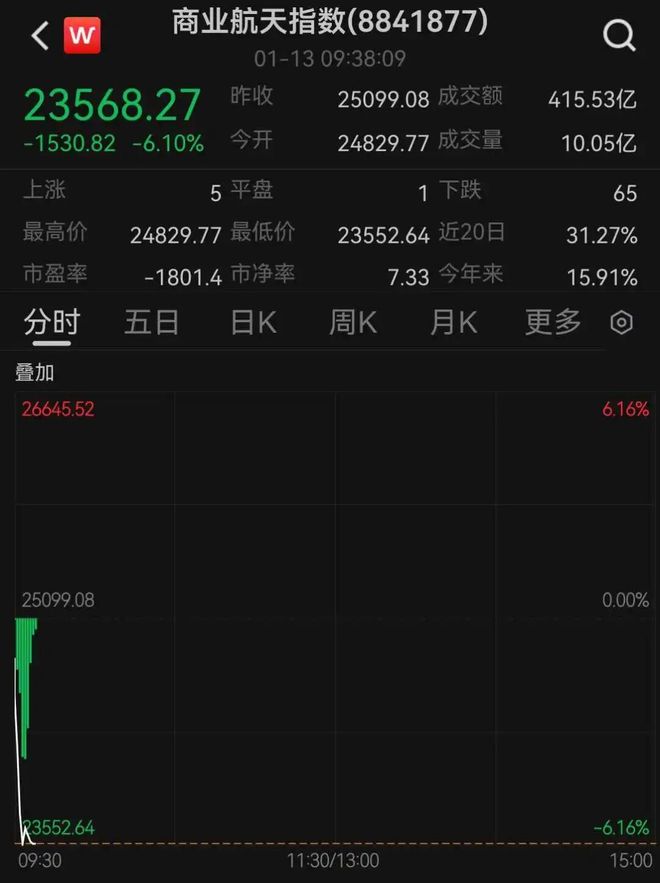
Market Overview - On January 13, the commercial aerospace concept stocks experienced a significant decline, with the sector index dropping over 6% [1] - The commercial aerospace index closed at 23,568.27, down 1,530.82 points or 6.10% from the previous close [2] Stock Performance - Several stocks within the commercial aerospace sector hit their daily limit down, including Aerospace Development, Aerospace Science and Technology, China Satellite Communications, Beidou Star, Aerospace Changfeng, and Aerospace Power [1] - Notable declines in individual stocks include: - Aerospace Universe: -16.58% [3] - Aerospace Intelligent Equipment: -13.77% [3] - Sree New Materials: -13.38% [3] - Aerospace Hongtu: -13.05% [3] - Guolian Aviation: -12.52% [3] - Other significant declines include Aerospace Electronics, China Satellite Communications, and Aerospace Longfeng, all down by 10% [4] Risk Announcements - Following the market downturn, multiple commercial aerospace companies issued risk warning announcements, clarifying that their main business does not involve commercial aerospace activities. Companies such as Aerospace Power, Aerospace Engineering, Xinghuan Technology, and Aerospace Changfeng were among those that made these disclosures [5]



双环传动:公司参股的杭州好奇号股权投资合伙企业持有江苏天兵航天科技股份有限公司0.74%股权
Mei Ri Jing Ji Xin Wen· 2026-01-13 01:01
(记者 王晓波) 每经AI快讯,有投资者在投资者互动平台提问:有资料显示公司持股天兵科技公司股权,该公司为火 箭卫星发射业务。如没有,是否持股其他航天类公司? 双环传动(002472.SZ)1月13日在投资者互动平台表示,目前公司参股的杭州好奇号股权投资合伙企业 (有限合伙)持有江苏天兵航天科技股份有限公司0.74%的股权,投资者可通过网上公开资料了解相关 信息。 ...

航天科技控股集团股份有限公司2026年第一次临时股东会决议公告
Shang Hai Zheng Quan Bao· 2026-01-12 18:07
登录新浪财经APP 搜索【信披】查看更多考评等级 2026年第一次临时股东会决议公告 本公司及董事会全体成员保证公告内容真实、准确和完整,公告不存在虚假记载、误导性陈述或者重大 遗漏。 特别提示: 本次股东会未出现否决议案的情形,亦未涉及变更以往股东会决议。 一、会议召开的基本情况 1.会议召开时间 现场会议时间:2026年1月12日14:30 网络投票时间:2026年1月12日 证券代码: 000901 证券简称:航天科技 公告编号:2026-股-001 航天科技控股集团股份有限公司 通过深圳证券交易所交易系统进行网络投票的具体时间为:2026年1月12日9:15至9:25、9:30至11:30, 13:00至15:00。 通过深圳证券交易所互联网投票的具体时间为:2026年1月12日9:15至15:00。 2.股权登记日 2026年1月7日 3.会议召开地点 北京市丰台区海鹰路6号院2号楼一层会议室 4.召开方式 现场投票及网络投票相结合的方式 5.召集人 本公司董事会 6.主持人 9.其他人员出席情况 公司董事及董事会秘书以现场结合通讯的方式出席了本次会议,部分高级管理人员以现场方式列席本次 会议,北京 ...
航天科技:公司前期披露的信息不存在需要更正、补充之处
Ge Long Hui A P P· 2026-01-12 12:31
格隆汇1月12日|航天科技发布异动公告,公司股票于2026年1月8日、2026年1月9日、2026年1月12日连 续三个交易日收盘价格涨幅偏离值累计达到20%,根据《深圳证券交易所交易规则》,属于股票异常波 动情况。本公司董事会确认,本公司目前没有任何根据深圳证券交易所《股票上市规则》等有关规定应 予以披露而未披露的事项或与该事项有关的筹划、商谈、意向、协议等;董事会也未获悉本公司有根据 深圳证券交易所《股票上市规则》等有关规定应予以披露而未披露的、对公司股票及其衍生品种交易价 格产生较大影响的信息;公司前期披露的信息不存在需要更正、补充之处。 ...
航天科技:连续三个交易日收盘价涨幅偏离值累计达20%
Xin Lang Cai Jing· 2026-01-12 12:19
航天科技公告称,公司股票于2026年1月8日、1月9日、1月12日连续三个交易日收盘价格涨幅偏离值累 计达20%,属于异常波动。经向控股股东及实控人核实,公司前期披露信息无补充更正,近期无重大未 公开信息,经营及内外部环境无重大变化,也无应披露而未披露的重大事项。控股股东、实控人在异动 期间无买卖公司股票行为。公司提醒投资者注意股价大幅上涨后回落的风险。 ...
航天科技(000901) - 股票交易异常波动公告
2026-01-12 12:17
证券代码:000901 证券简称:航天科技 公告编号:2026-临-002 航天科技控股集团股份有限公司 股票交易异常波动公告 本公司及公司全体董事会成员保证公告内容的真实、准确和完整,不 存在虚假记载、误导性陈述或者重大遗漏。 一、股票交易异常波动的情况介绍 航天科技控股集团股份有限公司(以下简称"公司")股票(证 券简称:航天科技,证券代码:000901)于 2026 年 1 月 8 日、2026 年 1 月 9 日、2026 年 1 月 12 日连续三个交易日收盘价格涨幅偏离值 累计达到 20%,根据《深圳证券交易所交易规则》,属于股票异常波 动情况。 二、公司关注并核实情况的说明 针对公司股票异常波动,公司董事会通过向控股股东中国航天科 工飞航技术研究院、实际控制人中国航天科工集团有限公司核实,并 经公司经营层内部核实,现就有关情况说明如下: 1.经核实,截至本公告披露日,公司前期披露的信息不存在需要 更正、补充之处; 2.经核实,截至本公告披露日,公司未发现近期公共传媒报道了 可能或已经对公司股票交易价格产生较大影响的未公开重大信息; 2.公司郑重提请投资者注意: "《上海证券报》和巨潮资讯网 (h ...
航天科技(000901) - 北京市中伦律师事务所关于航天科技2026年第一次临时股东会法律意见书
2026-01-12 12:15
北京市中伦律师事务所 北京市中伦律师事务所 关于航天科技控股集团股份有限公司 关于航天科技控股集团股份有限公司 2026 年第一次临时股东会的 法律意见书 二〇二六年一月 2026 年第一次临时股东会的 法律意见书 致:航天科技控股集团股份有限公司(以下简称"公司") 北京市中伦律师事务所(以下简称"本所")接受公司的委托,指派律师出 席并见证公司2026年第一次临时股东会(以下简称"本次会议")。 本所律师根据《中华人民共和国公司法》(以下简称"《公司法》")、《中 华人民共和国证券法》(以下简称"《证券法》")、《上市公司股东会规则》 (以下简称"《股东会规则》")、《律师事务所从事证券法律业务管理办法》 (以下简称"《证券法律业务管理办法》")、《律师事务所证券法律业务执业 规则(试行)》(以下简称"《证券法律业务执业规则》")等相关法律、行政 法规、规章、规范性文件及《航天科技控股集团股份有限公司章程》(以下简称 "《公司章程》")的规定,就本次会议的召集与召开程序、召集人资格、出席 会议人员资格、会议表决程序及表决结果等事宜,出具本法律意见书。 对本法律意见书的出具,本所律师特作如下声明: 1.本所 ...
航天科技(000901) - 2026年第一次临时股东会决议公告
2026-01-12 12:15
证券代码: 000901 证券简称:航天科技 公告编号:2026-股-001 航天科技控股集团股份有限公司 2026年第一次临时股东会决议公告 本公司及董事会全体成员保证公告内容真实、准确和完整,公告不存在虚假 记载、误导性陈述或者重大遗漏。 特别提示: 本次股东会未出现否决议案的情形,亦未涉及变更以往股东会 决议。 一、会议召开的基本情况 1.会议召开时间 现场会议时间:2026 年 1 月 12 日 14:30 网络投票时间:2026 年 1 月 12 日 通过深圳证券交易所交易系统进行网络投票的具体时间为:2026 年 1 月 12 日 9:15 至 9:25、9:30 至 11:30,13:00 至 15:00。 通过深圳证券交易所互联网投票的具体时间为:2026 年 1 月 12 日 9:15 至 15:00。 2.股权登记日 2026 年 1 月 7 日 3.会议召开地点 北京市丰台区海鹰路 6 号院 2 号楼一层会议室 4.召开方式 9.其他人员出席情况 现场投票及网络投票相结合的方式 1 5.召集人 本公司董事会 6.主持人 董事长袁宁 7.会议的召集、召开符合《公司法》《深圳证券交易所股票上 ...