AHTHGC(000901)

Search documents
陕西华达(301517.SZ):向航天科技集团及其下属单位配套产品
Ge Long Hui· 2026-01-21 07:16
Core Viewpoint - The company, Shaanxi Huada (301517.SZ), specializes in the research, development, production, and sales of electrical connectors and interconnection products, with applications in aerospace, weaponry, and communications [1] Group 1: Business Overview - The main products of the company include RF coaxial connectors, low-frequency connectors, and RF coaxial cable assemblies [1] - The company supplies products to the Aerospace Science and Technology Group and its subsidiaries, with some products used in satellite monitoring and ground terminals [1]

密集“打卡”热门标的 机构开年积极掘金A股机遇
Zhong Guo Zheng Quan Bao· 2026-01-20 21:55
Core Insights - Since 2026, sectors such as brain-computer interfaces, commercial aerospace, and embodied intelligence have seen structural opportunities in the A-share market, attracting significant institutional interest [1][5] - Despite recent market fluctuations, the long-term investment value in these sectors remains noteworthy due to policy support, industry events, and ongoing technological breakthroughs [5][6] Group 1: Brain-Computer Interfaces - Xiangyu Medical, a leading company in the brain-computer interface sector, has received 208 institutional visits since the beginning of 2026, indicating strong interest [2] - The company is focused on the commercialization of its brain-computer interface products, which are expected to quickly enter rehabilitation scenarios, supported by collaborations with hospitals [2][3] - Analysts believe that 2026 marks a critical year for the commercialization of brain-computer interfaces, with expectations for non-invasive applications to see significant growth [6] Group 2: Commercial Aerospace - Chaojie Co., Ltd. has also garnered attention, receiving nearly 130 institutional visits in a short span, with a focus on its commercial aerospace rocket structure business [3][4] - The company plans to complete its riveting production line by mid-2024, with an annual capacity of 10 rockets, and is prepared to scale production based on demand [4] - The commercial aerospace sector is expected to benefit from policy support and advancements in technology, with a focus on the development of reusable rocket technology [6] Group 3: Embodied Intelligence - Haitan Ruisheng has received 207 institutional visits, showing strong interest in its embodied intelligence data business [3] - The company is optimistic about the growth potential in the embodied intelligence data field and has established a dedicated team to drive this initiative [3]
商业航天资本热潮下的冷思考: 万亿赛道破局亟待技术与商业化双线突围
Zhong Guo Zheng Quan Bao· 2026-01-20 21:52
Core Insights - The commercial aerospace sector is experiencing a capital frenzy, with the commercial aerospace theme index rising nearly 60% in two months, leading to accelerated financing and IPO processes for companies in the industry [1][2] - Despite the enthusiasm, there are signs of rationality emerging, as several mergers and acquisitions in the sector have failed, highlighting the challenges of technological breakthroughs and engineering validation [1][4] Market Trends - The primary market is also witnessing intense competition for commercial aerospace companies, with significant equity financing completed, such as Micro Nano Star's 1.56 billion yuan funding for R&D and capacity expansion [2] - The IPO process for commercial aerospace companies is accelerating, with notable applications like Blue Arrow Aerospace seeking to raise 7.5 billion yuan [2] Financial Performance - Companies in the sector are facing substantial losses despite revenue growth, with Blue Arrow Aerospace reporting revenues of 0.78 million yuan, 0.395 million yuan, and 0.428 million yuan for 2022, 2023, and 2024 respectively, while incurring net losses of 800 million yuan, 1.188 billion yuan, and 876 million yuan [2] Mergers and Acquisitions - Recent attempts at cross-industry mergers and acquisitions have faced obstacles, such as Hualing Cable terminating its agreement with Star Xin Aerospace due to a lack of consensus on core transaction terms [3] - East Pearl Ecology also announced the termination of its acquisition of satellite communication company Kai Rui Xing Tong due to market changes and unresolved commercial terms [3] Technological Challenges - The commercial aerospace industry in China is still in its early stages, with significant challenges in validating low-cost, reusable heavy-lift rocket technology and improving the mass production capabilities of commercial satellites [4] - Recent failures in rocket launches, including two incidents on January 17, underscore the high-risk nature of aerospace development and the difficulties in achieving frequent commercial launches [4] Future Outlook - The long-term development direction of the commercial aerospace industry is becoming clearer, with expectations for significant technological breakthroughs by 2026, particularly in reusable rocket technology [6] - The industry is predicted to transition from quantitative to qualitative changes in commercial rockets, marking China's entry into the era of rocket reusability [6] - The development of integrated space information infrastructure is anticipated to unlock broader application scenarios, following the principle of "infrastructure first, then application" [6]

从大涨到大跌,军工坐上“过山车”!商业航天再杀跌,军工ETF华宝(512810)放量巨震6%,调整到位了吗?
Xin Lang Cai Jing· 2026-01-20 11:32
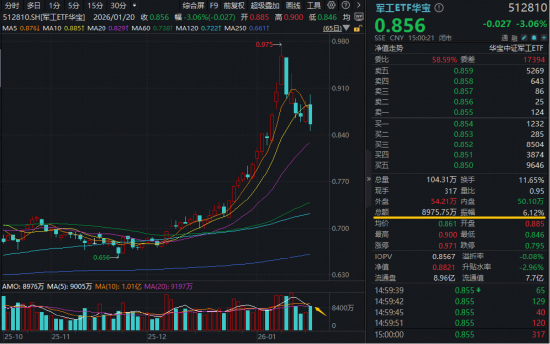
Core Viewpoint - The market experienced a collective decline on January 20, with a shift in investment style from high-valuation growth sectors to value sectors, leading to significant volatility in the military industry, particularly in the aerospace and low-altitude economy themes [1][5]. Military Industry Performance - The military ETF Huabao (512810) saw a trading range of 6.12% throughout the day, closing down 3.06%, erasing previous gains, with a trading volume of 89.76 million yuan [1][5]. - Leading stocks in the military ETF, particularly in commercial aerospace, faced significant declines, with Zhenlei Technology dropping nearly 9% and China Satellite Communications falling 7%, while several others dropped over 6% [3][13]. Market Analysis - Analysts attribute the volatility in the military sector to cautious liquidity expectations ahead of the Spring Festival and institutional portfolio adjustments, which have heightened risk aversion [5][15]. - The military sector is characterized by high growth potential, with small-cap stocks (market cap below 50 billion yuan) making up 56.47% of the military ETF's index, indicating high elasticity and volatility [5][15]. Investment Opportunities - The military sector is viewed as having high configuration value, with potential for investment during price dips, driven by historical opportunities in military trade, new quality-driven growth, and key timing catalysts [6][16]. - The global arms race is intensifying, with conflicts like India-Pakistan showcasing China's advanced equipment manufacturing capabilities, suggesting a historical opportunity for military trade to become a second growth curve for the industry [6][17]. - The new quality of combat power, characterized by intelligence, systematization, and informatization, is becoming a critical factor in strategic competition among major powers, with new production capabilities in commercial aerospace and low-altitude economy expected to further enhance military growth [7][16]. Future Outlook - The year 2026 marks the beginning of the "14th Five-Year Plan" and is a critical year for achieving the centenary goals of the military, indicating a potential new upward cycle for the military industry [6][17]. - The traditional military sector is expected to benefit from advantageous positioning, event catalysts, and improving fundamentals, presenting a significant opportunity for investment [7][17].


2026航天工业软件生态大会在京召开,新一代AVPLM产品正式发布
Zheng Quan Shi Bao Wang· 2026-01-20 09:39
人民财讯1月20日电,据中国航天科技(000901)集团官微消息,1月17日,2026航天工业软件生态大会 在京召开,发布新一代AVPLM产品,宣告这一国产大型工业软件正式启航。 ...
穿越者投资成立太空科技发展公司
Zheng Quan Shi Bao Wang· 2026-01-20 03:08
人民财讯1月20日电,企查查APP显示,穿越者太空(安吉)科技发展有限公司成立,经营范围包含:工程 和技术研究和试验发展;机械设备研发;工业设计服务;自然科学研究和试验发展;科技中介服务等。 企查查股权穿透显示,该公司由北京穿越者载人航天科技(000901)有限公司全资持股。 ...
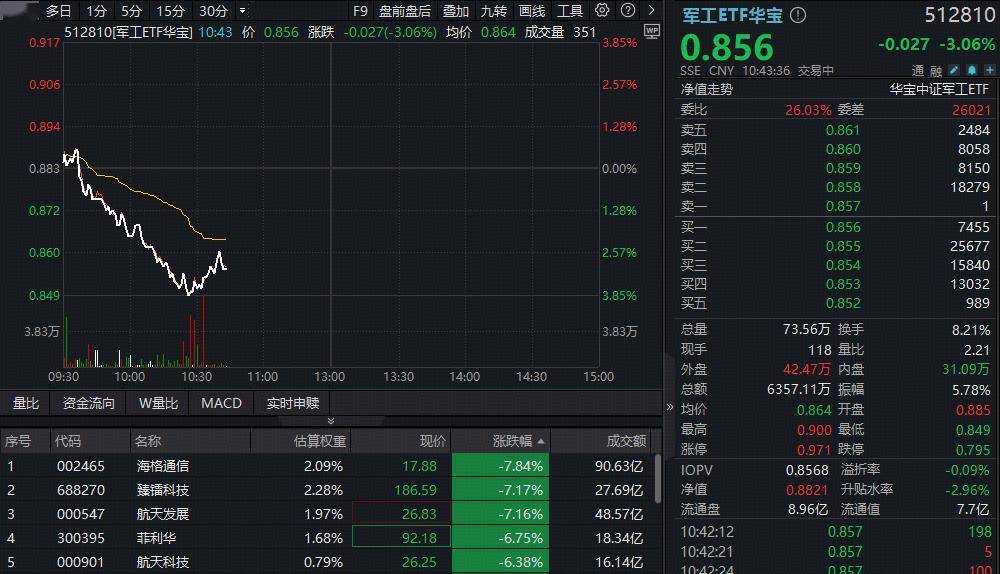
ETF盘中资讯|军工急跌,什么情况? 512810盘中下探3.85%!商业航天热门股齐挫,中国卫星跌超5%
Sou Hu Cai Jing· 2026-01-20 03:06
Core Viewpoint - The military industry sector experienced a decline in early trading on January 20, with the military ETF Huabao (512810) dropping by 3.85%, and several commercial aerospace stocks falling over 7% [1][3]. Market Performance - The A-share market saw a shift in market sentiment, with all three major indices declining, indicating a rapid change in risk appetite among investors [1]. - As of January 19, the financing balance in the A-share market was reported at 2.7059 trillion yuan, a decrease of 8.5 billion yuan, marking the first decline since December 31 of the previous year [3]. Industry Analysis - The military sector is characterized by high volatility and is significantly influenced by short-term sentiment, although the fundamental outlook remains positive [4]. - According to Fangzheng Securities, the military industry is expected to enter a new upward cycle driven by domestic demand and foreign trade, with ongoing orders anticipated due to the transition to mass production of new models [4]. - The military trade market in China is evolving from a focus on cost-effectiveness to becoming a technology benchmark and a rule-maker in the global arms race, presenting historical opportunities for growth [4]. Investment Opportunities - The military industry is expected to enter a long-term prosperous phase, with traditional military sectors showing advantages in positioning, event catalysts, and improving fundamentals [4]. - The Huabao military ETF (512810) covers various hot themes such as commercial aerospace, low-altitude economy, large aircraft, satellite navigation, military informationization, and controllable nuclear fusion, serving as an efficient tool for investing in core military assets [4][6].

航天科技:目前公司不存在应披露而未披露的重大信息
Zheng Quan Ri Bao· 2026-01-19 11:06
证券日报网讯 1月19日,航天科技在互动平台回答投资者提问时表示,公司未掌握投资者所提及的资产 注入相关事项,目前公司不存在应披露而未披露的重大信息。公司所有重大事项均以在指定信息披露媒 体发布的公告为准,敬请广大投资者注意投资风险。 (文章来源:证券日报) ...
航天科技 - 2026 展望:各系统准备就绪;评级调整-Space Technology-2026 Outlook All Systems Go; Ratings Changes
2026-01-19 02:32
Summary of Space Technology Industry Conference Call Industry Overview - The Space Technology industry is viewed as Attractive for 2026, with favorable trends from 2025 expected to continue [1][4][8] - The industry experienced record launch activity in 2025, with over 315 successful launches, representing a year-over-year increase of over 20% [3][20] - Significant growth in large constellations, including Amazon's Leo and SpaceX's Starlink, was noted [3] Key Companies and Ratings Changes - **Rocket Lab USA Inc (RKLB)**: Upgraded to Overweight (OW) from Equal-weight (EW) with a price target (PT) increase from $67 to $105, driven by improved risk-reward dynamics and a strong catalyst path [7][44] - **MDA Space Ltd (MDA)**: Upgraded to OW from EW with a PT increase from C$32 to C$46, reflecting a favorable valuation and growth potential [7][13] - **Iridium Communications Inc (IRDM)**: Downgraded to EW from OW with a PT decrease from $37 to $24 due to expected uncertainty amid strategic pivots [7][62] - **Firefly Aerospace Inc (FLY)**: PT raised from $27 to $33, with expectations for significant launches in 2026 [7][39] - **Viasat Inc (VSAT)**: PT increased from $12 to $51, reflecting a shift in valuation methodology [7][61] - **Gogo Inc (GOGO)**: PT lowered from $15 to $8, anticipating a low-growth year [7][11] Market Dynamics - The convergence of Space and Defense markets is expected to continue, with potential for significant contracts related to the Golden Dome initiative [8][19] - Geopolitical tensions, particularly between the US and China, are driving interest in sovereign solutions, benefiting commercial space companies [3][8] - The Direct-to-Device (D2D) market is maturing, with expectations for new services and spectrum scarcity to remain a focus [16] Launch Market Insights - The launch market is characterized by a few proven players, with RKLB expected to increase its launch cadence significantly in 2026 [10][35] - RKLB aims for 28 launches in 2026, up from 21 in 2025, while FLY is targeting 6 launches, a significant increase from 1 in 2025 [10][39] Competitive Landscape - The competitive landscape is shifting, with new entrants and established players facing pressure from emerging technologies and services [58] - IRDM is pivoting to address competition from LEO-based offerings, particularly from SpaceX's Starlink, which has led to a strategic shift and increased execution risk [62][67] - GOGO is also facing competitive pressures, particularly from NetJets' plans to implement Starlink [59] Financial Performance and Projections - The Space industry is expected to see continued growth, with RKLB projecting a compound annual growth rate (CAGR) of 40% through 2030 [56] - VSAT's stock performance was notably strong in 2025, driven by contract wins and a positive market reception [57] - The overall sentiment in the market is cautious, with some companies facing significant challenges amid competitive pressures and strategic pivots [62][68] Conclusion - The Space Technology industry is positioned for growth in 2026, with several companies receiving upgrades based on favorable market conditions and strategic developments. However, challenges remain, particularly for companies like IRDM and GOGO, which are navigating increased competition and strategic shifts.
一天两枚火箭发射失利!具体原因正在分析排查
Shen Zhen Shang Bao· 2026-01-19 02:04
Core Viewpoint - The recent failures of two rocket launches in China highlight the challenges faced by both state-owned and private aerospace companies in achieving reliable launch capabilities [1][3][5]. Group 1: Long March 3B Rocket - The Long March 3B rocket, developed by China Aerospace Science and Technology Corporation, experienced an anomaly during its third stage flight on January 17, leading to the failure of the launch of the Shijian-32 satellite [1][3]. - This rocket has a historical success rate, with 115 launches conducted, of which 110 were successful, 3 failed, and 2 were partially successful [3]. Group 2: Star River Dynamics - Star River Dynamics, a private commercial rocket company established in 2018, also faced a launch failure on January 17 with its Gushenxing-2 rocket during its maiden flight [5][6]. - The company has raised over 5.3 billion yuan through multiple funding rounds, with a notable 2.4 billion yuan raised in its D round, achieving a post-investment valuation of 15 to 16 billion yuan [6]. Group 3: Industry Context - The Chinese aerospace industry is experiencing a high launch frequency, with a record 92 launches in 2022, indicating a growing demand for satellite deployment [7]. - The commercial space sector is still transitioning from technology validation to large-scale operations, facing challenges such as low rocket supply, insufficient payload capacity, and high launch costs [8]. Group 4: Future Prospects - There is an expectation for private rocket companies to complement state efforts in meeting high-frequency launch demands, with a focus on developing reusable liquid rockets to reduce costs and increase launch frequency [9]. - The commercial aerospace index has seen a significant increase of over 40% since December, although many related stocks have diverged from their fundamental valuations [10].