SANHUA(002050)

Search documents
三花智控:关于部分限制性股票回购注销完成的公告
Zheng Quan Ri Bao Zhi Sheng· 2025-11-13 13:38
Core Points - Company completed the repurchase and cancellation of a total of 198,000 restricted stocks from 51 non-compliant incentive participants under the 2022 stock incentive plan at a repurchase price of 9.05 yuan per share [1] - Company also repurchased and canceled a total of 714,000 restricted stocks from 89 non-compliant incentive participants under the 2024 stock incentive plan at a repurchase price of 11.40 yuan per share [1] - The total number of repurchased and canceled stocks amounts to 912,000, representing 0.0217% of the total share capital before cancellation, with a total repurchase fund of 9,931,500 yuan [1] Summary by Category - **2022 Stock Incentive Plan**: - 198,000 shares repurchased from 51 participants at 9.05 yuan/share [1] - Cancellation date for shares was May 31, 2022 [1] - **2024 Stock Incentive Plan**: - 714,000 shares repurchased from 89 participants at 11.40 yuan/share [1] - Cancellation date for shares was May 13, 2024 [1] - **Overall Impact**: - Total of 912,000 shares canceled, reducing total share capital from 4,208,925,935 shares to 4,208,013,935 shares [1] - Repurchase completed with shares registered at the Shenzhen branch of China Securities Depository and Clearing Co., Ltd [1]
三花智控(02050.HK)11月13日耗资993万元回购91.2万股A股
Ge Long Hui· 2025-11-13 13:22
Core Viewpoint - Sanhua Intelligent Control (02050.HK) announced a private arrangement to repurchase 912,000 A-shares at a cost of RMB 9.93 million, with a repurchase price range of RMB 9.05 to 11.4 per share [1] Summary by Category - **Company Actions** - The company plans to repurchase a total of 912,000 A-shares [1] - The total expenditure for the repurchase is RMB 9.93 million [1] - The repurchase price per share is set between RMB 9.05 and 11.4 [1]
三花智控(02050)11月13日合共耗资993.15万元回购91.2万股A股
智通财经网· 2025-11-13 13:17
Group 1 - The company, Sanhua Intelligent Control (stock code: 02050), announced a share buyback plan involving a total expenditure of 9.9315 million yuan to repurchase 912,000 A-shares [1]
三花智控:已完成91.20万股限制性股票回购注销
Mei Ri Jing Ji Xin Wen· 2025-11-13 12:32
Core Viewpoint - Sanhua Intelligent Control (002050.SZ) has completed the repurchase and cancellation of 912,000 shares of restricted stock held by 114 incentive targets who did not meet the conditions of the 2022 and 2024 stock incentive plans, with a total repurchase amount of 9.93 million yuan [1] Group 1 - The total number of shares repurchased and canceled is 912,000 [1] - The total repurchase amount is 9.93 million yuan [1] - After the cancellation, the company's total share capital will decrease from 4.209 billion shares to 4.208 billion shares [1]
三花智控:完成91.2万股限制性股票回购注销
Xin Lang Cai Jing· 2025-11-13 12:25
三花智控公告称,已完成部分限制性股票回购注销。涉及2022、2024年限制性股票激励计划中114名不 符合条件的激励对象,合计91.20万股。其中,2022年计划回购注销19.80万股,回购价9.05元/股;2024 年计划回购注销71.40万股,回购价11.40元/股,回购资金总额993.15万元。回购注销后,公司总股本由 42.09亿股减至42.08亿股,不会对财务和经营产生较大影响。 ...
解密主力资金出逃股 连续5日净流出657股




Zheng Quan Shi Bao Wang· 2025-11-13 08:52
Core Insights - A total of 657 stocks in the Shanghai and Shenzhen markets have experienced net outflows of main funds for five consecutive days or more as of November 13 [1] - The stock with the longest continuous net outflow is Jianyan Institute, with 18 days, followed by Baoding Technology with 17 days [1] - The largest total net outflow amount is from Zhinan Zhen, with a cumulative outflow of 5.783 billion yuan over 11 days [1] Group 1: Stocks with Longest Net Outflows - Jianyan Institute has seen net outflows for 18 consecutive days [1] - Baoding Technology has experienced net outflows for 17 consecutive days [1] - Zhinan Zhen has the highest net outflow amount of 5.783 billion yuan over 11 days [1] Group 2: Stocks with Significant Net Outflows - Sanhua Intelligent Controls has a net outflow of 4.052 billion yuan over 5 days [1] - Shenghong Technology has a net outflow of 2.713 billion yuan over 5 days [1] - GuoDun Quantum has a net outflow of 2.001 billion yuan over 10 days [1] Group 3: Stocks with High Net Outflow Ratios - ST Jinhong has the highest net outflow ratio, with a 14.22% outflow over 5 days [1] - Zhongyou Capital has a net outflow ratio of 16.38% over 11 days [1] - Top Group has a net outflow ratio of 12.90% over 5 days [1]
家电零部件板块11月13日涨0.64%,宏昌科技领涨,主力资金净流出2.47亿元
Zheng Xing Xing Ye Ri Bao· 2025-11-13 08:44
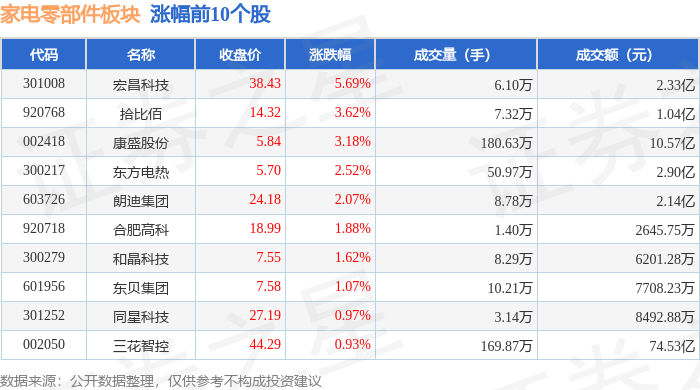
Core Insights - The home appliance components sector saw a rise of 0.64% on November 13, with Hongchang Technology leading the gains [1] - The Shanghai Composite Index closed at 4029.5, up 0.73%, while the Shenzhen Component Index closed at 13476.52, up 1.78% [1] Stock Performance - Hongchang Technology (301008) closed at 38.43, up 5.69% with a trading volume of 61,000 shares and a transaction value of 233 million [1] - Other notable performers include Shibizhi (920768) with a 3.62% increase, and Kangsheng Co. (002418) with a 3.18% increase [1] - The overall trading volume and transaction values for various stocks in the sector indicate active market participation [1] Capital Flow - The home appliance components sector experienced a net outflow of 247 million from institutional investors, while retail investors saw a net inflow of 305 million [2][3] - The detailed capital flow shows that Kangsheng Co. had a significant net outflow of 31.14 million from institutional investors [3] - In contrast, Longdi Group (603726) and Dongfang Electric (300217) had net inflows from retail investors, indicating varied investor sentiment across different stocks [3]


锂电板块继续上行,新能车ETF(515700)涨超6.0%冲击年内新高
Xin Lang Cai Jing· 2025-11-13 03:13
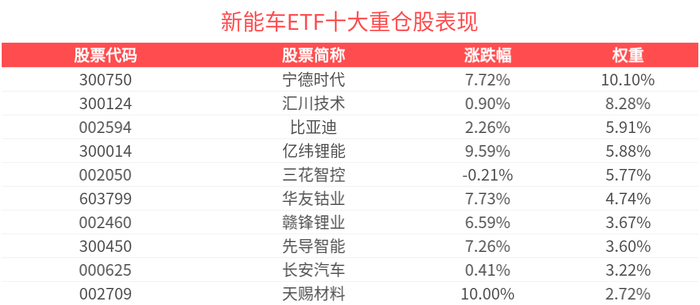
Group 1 - The China Securities New Energy Vehicle Industry Index (930997) has surged by 5.96% as of November 13, 2025, with significant gains in constituent stocks such as Xinzhou Bang (300037) up 17.19%, Wukuang New Energy (688779) up 16.90%, and Tianhua New Energy (300390) up 12.50% [1] - The New Energy Vehicle ETF (515700) increased by 5.89%, reaching a latest price of 2.61 yuan, benefiting from the recovery in lithium battery demand and advancements in solid-state batteries [1] - The New Energy Vehicle ETF closely tracks the China Securities New Energy Vehicle Industry Index, reflecting the overall performance of leading listed companies in the new energy vehicle sector [1] Group 2 - As of October 31, 2025, the top ten weighted stocks in the China Securities New Energy Vehicle Industry Index include CATL (300750), Huichuan Technology (300124), and BYD (002594), collectively accounting for 53.56% of the index [2] - The weightings of the top stocks are as follows: CATL at 10.10% with a rise of 7.72%, Huichuan Technology at 8.28% with a rise of 0.90%, and BYD at 5.91% with a rise of 2.26% [4] - Other notable stocks include EVE Energy (300014) at 5.88% with a rise of 9.59%, and Ganfeng Lithium (002460) at 3.67% with a rise of 6.59% [4]






涨超4.4%,新能车ETF(515700)近6个月强势上涨
Xin Lang Cai Jing· 2025-11-13 03:02
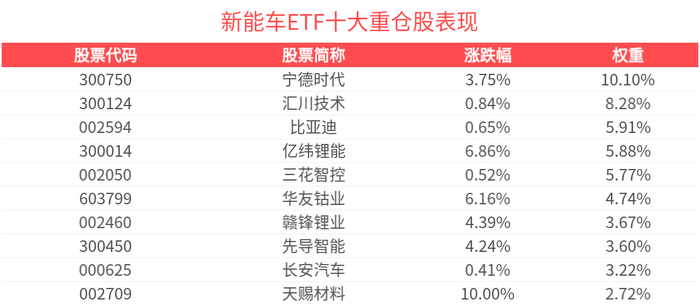
Core Insights - The China Securities New Energy Vehicle Industry Index (930997) has seen a strong increase of 4.49% as of November 13, 2025, with significant gains in constituent stocks such as Xinzhou Bang (300037) up 14.43%, Wukuang New Energy (688779) up 14.23%, and Xingyuan Material (300568) up 12.25% [1] Group 1 - The New Energy Vehicle ETF (515700) rose by 4.47%, with the latest price at 2.57 yuan, and has accumulated a 0.53% increase over the past week as of November 12, 2025 [1] - The New Energy Vehicle ETF closely tracks the China Securities New Energy Vehicle Industry Index, which includes 50 listed companies involved in various sectors of the new energy vehicle industry [1] Group 2 - As of October 31, 2025, the top ten weighted stocks in the China Securities New Energy Vehicle Industry Index are CATL (300750), Huichuan Technology (300124), Sanhua Intelligent Control (002050), BYD (002594), Yiwei Lithium Energy (300014), Huayou Cobalt (603799), Ganfeng Lithium (002460), Xian Dao Intelligent (300450), Changan Automobile (000625), and Tianqi Lithium (002466), collectively accounting for 53.56% of the index [2] - The weightings of the top stocks are as follows: CATL at 10.10%, Huichuan Technology at 8.28%, BYD at 5.91%, Yiwei Lithium Energy at 5.88%, Sanhua Intelligent Control at 5.77%, Huayou Cobalt at 4.74%, Ganfeng Lithium at 3.67%, Xian Dao Intelligent at 3.60%, Changan Automobile at 3.22%, and Tianqi Lithium at 2.72% [3]




拥抱人形机器人时代-首次覆盖双环传动、禾赛科技、拓普集团、三花智控及利达光电-Asia Emerging Robotics Embrace the Humanoid Era - Initiating Coverage of Shuanghuan, Hesai, Tuopu, Sanhua and Leader Drive
2025-11-13 02:49
Summary of the Conference Call on Asia Emerging Robotics Industry Overview - **Industry**: Humanoid Robotics - **Growth Forecast**: The humanoid robot industry is expected to grow significantly, with annual shipments projected to reach approximately 1 million units by 2031 (Total Addressable Market: ~USD 20 billion) and around 50 million units by 2050 (Total Addressable Market: ~USD 800 billion) [2][34] Key Companies Covered - **Shuanghuan**: Rated Outperform, recognized as a global leader in gears and reducers, well-prepared for the humanoid era [8][20] - **Hesai**: Rated Outperform, a frontrunner in "laser eyes" technology, expected to benefit from intelligent vehicles and robotics [11][20] - **Tuopu**: Rated Outperform, a leading auto parts supplier with strong capabilities in robotics [11][20] - **Sanhua**: Rated Market-Perform, has a high-quality core business but limited robotics experience [11][20] - **Leader Drive**: Rated Underperform, concerns over long-term market share and margins [11][20] Core Insights - **Investment Strategy**: Emphasizes investing in companies with broad robotics exposure, proven expertise expansion, and high-quality core businesses. The overarching theme is to "Make No Bet" on specific humanoid robots due to the industry's early-stage nature [4][7][64] - **China's Advantage**: China is positioned as a leader in the humanoid robot industry, benefiting from rapid product iteration, a broad user base, and a well-established supply chain. The approach contrasts with Western companies, which often pursue idealistic solutions [3][34][48] Market Dynamics - **Technological Maturity**: The humanoid robot industry is still evolving, with significant technological barriers remaining, particularly in robotic intelligence and cost [33][34] - **Competition**: The industry faces challenges from non-humanoid robots, which are already deployed in various applications. This competition may impact the adoption and market share of humanoid robots [64][78] Investment Recommendations - **Characteristics of Target Companies**: 1. **Upstream Winners**: Focus on key component suppliers rather than downstream players, as the latter are still too early to identify [9][66] 2. **Broad Robotics Exposure**: Companies should have capabilities beyond humanoid robots to mitigate risks from competition [9][66] 3. **Expertise Expansion**: Companies with a strong ability to adapt to technological changes are preferred [9][66] 4. **High-Quality Core Businesses**: Essential for sustainable cash flows and reasonable valuations [9][66] Conclusion - The humanoid robot industry presents substantial long-term potential, with significant growth expected in the coming decades. Investment strategies should focus on established companies with diversified capabilities and a strong market presence to navigate the evolving landscape effectively [7][64][66]