
SANHUA(002050)

Search documents
今日这些个股异动 主力加仓传媒板块 抛售有色金属板块



Di Yi Cai Jing· 2025-11-03 08:40
Volatility - A total of 6 stocks in the A-share market experienced a volatility exceeding 20% today [1] - N Danna recorded a volatility of 112.28%, with Deer Chemical and ST Cube also showing significant fluctuations [1] Turnover Rate - There were 20 stocks in the A-share market with a turnover rate exceeding 30% today [1] - N Danna, Rongxin Culture, and Fulongma had the highest turnover rates [1] Main Capital Flow - Main capital saw a net inflow into sectors such as media, agriculture, forestry, animal husbandry, military defense, construction decoration, and petroleum and petrochemicals, while there was a net outflow from non-ferrous metals, computers, electrical equipment, electronics, and communications [1] - The stocks with the largest net inflows included Sunshine Power (1.051 billion), 37 Interactive Entertainment (525 million), Aerospace Science and Technology (498 million), Demingli (479 million), and Taiji Industry (472 million) [1] - The stocks with the largest net outflows included BYD (1.142 billion), CATL (765 million), 360 Security Technology (758 million), Lead Intelligent (745 million), and Sanhua Intelligent Control (645 million) [1]
知名机构近一周(10.27-11.2)调研名单:机构扎堆这只特斯拉机器人龙头
Xuan Gu Bao· 2025-11-03 08:24
Summary of Key Points Core Viewpoint - A total of 115 companies were investigated by well-known institutions in the past week (October 27 to November 2), with the pharmaceutical and biological sector being the most researched, followed by basic chemicals and power equipment. The company with the highest number of institutional investigations was Sanhua Intelligent Control, with 284 institutions participating. Company Research Highlights - Sanhua Intelligent Control received the most attention with 284 institutional investigations [1] - Zhaoyi Innovation followed with 276 investigations [1][3] - Luxshare Precision garnered 222 investigations [1][3] - Other notable companies include Zhongmin Resources (185), Shanghai Jahwa (111), and New Industry (132) in the pharmaceutical sector [1][2] Industry Focus - The pharmaceutical and biological industry was the most researched, indicating strong interest from investors [1] - The electronics sector also saw significant attention, with multiple companies like TCL Technology and Pengding Holdings being investigated [2][3] - Basic chemicals and power equipment sectors were also highlighted, with companies like Hangzhou Oxygen and New Zhaobang receiving investigations [2][3] Institutional Interest - The institutions conducting the investigations included various well-known investment firms, indicating a broad interest in the companies listed [1][2] - The number of investigations reflects the market's focus on potential growth areas, particularly in technology and healthcare [1][2][3]





10月A股市场融资余额增加超900亿 这些个股被显著加仓
Zhong Guo Zheng Quan Bao· 2025-11-03 07:49
Core Insights - The A-share market experienced fluctuations in October, with the margin balance reaching a historical high of 24,864.02 billion yuan by October 31, and an increase of 905.30 billion yuan in financing balance during the month [1][2]. Industry Summary - In October, out of 31 industries, 28 saw an increase in financing balance, with the electronics, non-ferrous metals, and power equipment sectors leading in net financing purchases, amounting to 181.01 billion yuan, 115.01 billion yuan, and 79.76 billion yuan respectively [1][2]. - The only industries that experienced net selling were food and beverage, automotive, and light industry manufacturing, with net selling amounts of 17.15 billion yuan, 1.45 billion yuan, and 0.45 billion yuan respectively [1][2]. Individual Stock Performance - In October, 344 stocks saw net purchases exceeding 100 million yuan, with the top ten stocks being Zhongji Xuchuang, Shenghong Technology, ZTE Corporation, Sunshine Power, CITIC Securities, Cambricon Technologies, Zijin Mining, Lianqi Technology, Sanhua Intelligent Controls, and Dongfang Caifu, with net purchases of 29.43 billion yuan, 25.51 billion yuan, and so on [3][4]. - The stock with the highest increase was Sunshine Power, which rose by 17.94% during the month [3][4].







A股异动丨三花智控连续第三日下跌,遭高盛下调评级
Ge Long Hui A P P· 2025-11-03 06:49
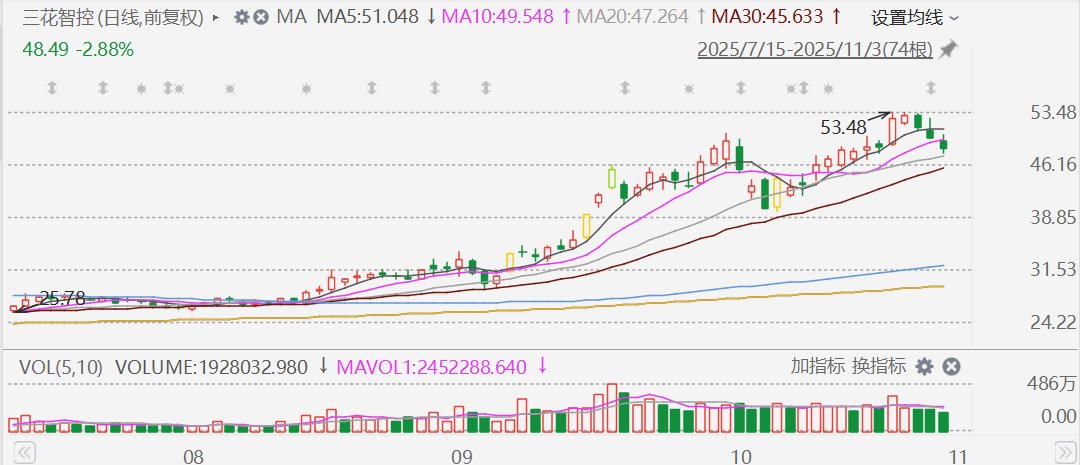
Core Viewpoint - Sanhua Intelligent Control (002050.SZ) experienced a decline of over 4% to 47.72 yuan during intraday trading, marking its third consecutive day of decline. Goldman Sachs downgraded the A-share rating to neutral due to the stock's recent outperformance against the market and overly optimistic expectations for humanoid robots [1] Group 1 - Sanhua Intelligent Control's stock price fell to 47.72 yuan, a drop of over 4% [1] - The stock has seen a continuous decline for three days [1] - Goldman Sachs issued a report on November 2, downgrading the stock rating to neutral [1] Group 2 - The downgrade was attributed to the stock's strong recent performance relative to the market [1] - There are concerns regarding overly high and premature expectations for humanoid robots [1] - A MACD golden cross signal has formed, indicating potential upward momentum for some stocks [1]
10月A股市场融资余额增加超900亿元,这些个股被显著加仓
Sou Hu Cai Jing· 2025-11-03 06:11
Core Insights - The A-share market experienced fluctuations in October, with the margin balance reaching a historical high of 24,864.02 billion yuan by October 31, reflecting an increase of 905.30 billion yuan during the month [1] - In October, 12 out of 17 trading days saw net buying in margin financing, indicating strong investor interest [1] - Among the 31 industries tracked, 28 saw an increase in margin financing, with the electronics, non-ferrous metals, and power equipment sectors leading in net buying amounts [1][2] Industry Summary - **Electronics**: Margin balance of 36,583.83 million yuan, with a net buying of 1,810.14 million yuan [2] - **Non-Ferrous Metals**: Margin balance of 11,998.06 million yuan, with a net buying of 1,150.12 million yuan [2] - **Power Equipment**: Margin balance of 20,770.89 million yuan, with a net buying of 797.62 million yuan [2] - **Food and Beverage**: Experienced a net selling of 171.54 million yuan [2] - **Automotive**: Experienced a net selling of 14.50 million yuan [2] - **Light Industry Manufacturing**: Experienced a net selling of 4.54 million yuan [2] Stock Performance - A total of 344 stocks saw over 100 million yuan in net buying, with the top ten stocks including Zhongji Xuchuang and Shenghong Technology, which had net buying amounts of 2,943.76 million yuan and 2,550.65 million yuan respectively [3][4] - The stock with the highest increase was Yangguang Electric, which rose by 17.94% [3][4] - Other notable stocks included Zhongxing Communication and Zhongxin Securities, with net buying amounts of 1,616.59 million yuan and 1,567.07 million yuan respectively [3][4]

这些股票 融资客加仓
Zhong Guo Zheng Quan Bao· 2025-11-03 05:57
Core Insights - The A-share market saw a significant increase in financing balance, reaching 24,689.20 billion yuan by October 31, with a net increase of 905.30 billion yuan in October [1][3][12] - The electronic industry led the financing balance increase, contributing over 18 billion yuan, while the largest net buying stock was Zhongji Xuchuang, with a net buying amount of 29.43 billion yuan [1][7][8] Financing Balance Overview - As of October 31, the total margin balance in the A-share market was 24,864.02 billion yuan, with the financing balance at 24,689.20 billion yuan, marking a historical high for both metrics [3][12] - In October, 12 out of 17 trading days recorded net buying, accounting for over 70% of the days [3] - Among 31 industries, 28 experienced an increase in financing balance, with the electronic, non-ferrous metals, and power equipment industries leading in net buying amounts of 18.10 billion yuan, 11.50 billion yuan, and 7.98 billion yuan respectively [3][4] Individual Stock Performance - The top ten stocks with the highest net buying amounts included Zhongji Xuchuang, Shenghong Technology, and Zhongxing Communication, with net buying amounts of 29.43 billion yuan, 25.51 billion yuan, and 16.17 billion yuan respectively [7][8] - The stocks that saw the most significant price increases included Yangguang Electric Power, which rose nearly 18% [7] - Conversely, the top ten stocks with the highest net selling amounts included Xian Dao Intelligent, Top Group, and China Ping An, with net selling amounts of 12.53 billion yuan, 11.72 billion yuan, and 11.57 billion yuan respectively [8][10] Margin Trading Overview - The margin trading balance for short selling reached 17.48 billion yuan, with an increase of 1.71 billion yuan in October [12][14] - The stocks with the highest short selling balances included Ningde Times, Shenghong Technology, and Xinyi Sheng, each with short selling balances of 1.17 billion yuan, 1.17 billion yuan, and 0.79 billion yuan respectively [12][15] Summary of Margin Trading Activity - The top three stocks with the highest net selling amounts in margin trading were Shenghong Technology, China Ping An, and Agricultural Bank, with net selling amounts of 53.72 million yuan, 33.47 million yuan, and 23.44 million yuan respectively [16][17]


三花智控_因近期表现强劲,将三花 A 评级下调至中性;类人机器人的预期过高、过早
2025-11-03 03:32
Summary of Sanhua Intelligent Controls (002050.SZ) Conference Call Company Overview - **Company**: Sanhua Intelligent Controls (002050.SZ) - **Market Cap**: Rmb210.2 billion / $29.5 billion - **Enterprise Value**: Rmb201.5 billion / $28.3 billion - **Industry**: China Industrial Tech & Machinery Key Points and Arguments 1. **Rating Downgrade**: Sanhua A has been downgraded from Buy to Neutral due to recent stock outperformance, while Sanhua H remains at Buy. The stock prices have increased by +51% for Sanhua A and +31% for Sanhua H since Tesla's Masterplan IV announcement on September 2, 2025, indicating market optimism regarding humanoid robot actuator revenue opportunities [1][16][19]. 2. **Market Expectations**: Current valuations imply that Sanhua A could achieve 0.9 million to 2.0 million units of Tesla Optimus sales, which is deemed unlikely within the next 12 months, especially given Tesla's target of 1 million units by 2030 [1][16][19]. 3. **Earnings Growth Moderation**: Anticipated earnings growth for Sanhua is expected to moderate over the next 2-3 quarters due to a high base effect in both HVAC and EV component segments, compounded by tighter trade-in subsidies [1][20][21]. 4. **3Q25 Financial Performance**: Sanhua reported a strong 3Q25 performance, primarily driven by effective control of SG&A expenses, leading to a revision of 2025-2030 EPS estimates upward by 4-8% [2][25]. 5. **Target Price Adjustments**: The 12-month target prices for Sanhua A and H have been set at Rmb40.90 and HK$43.10, respectively, reflecting an 18% downside for Sanhua A and a 5% upside for Sanhua H [2][25]. 6. **Valuation Multiples**: The target multiple has been increased from a 2030E P/E of 21x to 25x, based on a sum-of-the-parts (SOTP) analysis of core and humanoid robot businesses [2][27]. 7. **Revenue Forecasts**: Revenue projections for 2025-2027 are as follows: - 2025: Rmb32,023.4 million - 2026: Rmb36,563.1 million - 2027: Rmb44,918.0 million This indicates a growth rate of 14.6% in 2025 and 14.2% in 2026 [4][13]. 8. **Segment Performance**: The HVAC component segment is expected to face growth pressure, with revenue growth forecasted to slow to -2% in 4Q25, while the EV thermal management segment is projected to see modest growth of 12% in the same period [20][21][23]. 9. **Market Valuation Context**: Sanhua A/H is currently trading at 47x/37x 12-month forward P/E, which is significantly above the historical average, indicating potential overvaluation [28]. 10. **Future Checkpoints**: The next significant assessment of Sanhua's opportunities will occur in February/March 2026, coinciding with the planned launch of Tesla's Gen 3 product [1][19]. Additional Important Information - **Cash Flow and Financial Health**: Sanhua's free cash flow is projected to improve, with net income expected to rise from Rmb3,099.2 million in 2024 to Rmb6,005.8 million by 2027 [13][25]. - **Dividend Policy**: The dividend payout ratio is expected to remain stable at around 30% [13]. This summary encapsulates the critical insights from the conference call, highlighting the company's current standing, market expectations, and future outlook.
多家A股公司回购计划“加码”
Shang Hai Zheng Quan Bao· 2025-11-03 00:01
Core Viewpoint - Multiple listed companies in the A-share market have recently increased their share repurchase plans, either by raising the repurchase scale or the price ceiling, to convey confidence to the market [1][2]. Group 1: Repurchase Plan Adjustments - In October, a peak of repurchase plan adjustments was observed, with companies like SF Holding, Lanke Technology, and Sanhua Intelligent Control making significant changes [2]. - SF Holding announced an increase in its repurchase fund from "not less than 500 million yuan and not exceeding 1 billion yuan" to "not less than 1.5 billion yuan and not exceeding 3 billion yuan," extending the implementation period to 12 months [2]. - As of October 31, SF Holding had repurchased approximately 12.4 million shares for a total amount of about 500 million yuan [2]. Group 2: Price Ceiling Adjustments - Companies are increasingly adjusting their repurchase price ceilings to ensure the smooth implementation of their plans, with Sanhua Intelligent Control raising its ceiling from 35.75 yuan/share to 60.00 yuan/share [3]. - The stock price of Sanhua Intelligent Control has doubled since the announcement of its repurchase plan, reflecting a significant increase from 23.29 yuan/share to 49.93 yuan/share [3]. - Other companies, such as Lanke Technology and Ningbo Huaxiang, have also raised their repurchase price ceilings due to stock prices exceeding the original limits [3]. Group 3: Characteristics of Repurchase Adjustments - The adjustments in repurchase plans exhibit three notable characteristics: significant adjustment amplitudes, rapid implementation, and multiple adjustments within the year [4]. - For instance, Ningbo Huaxiang raised its price ceiling from 19.69 yuan/share to 51.42 yuan/share, an increase of over 160% [4]. - Companies like Macro Construction quickly implemented their adjusted repurchase plans, with Macro Construction announcing a repurchase shortly after adjusting its price ceiling [4]. Group 4: Multiple Repurchase Plans - Some companies have launched multiple repurchase plans within the year, such as Lanke Technology, which adjusted its price ceiling for the second time in October [5]. - Lanke Technology's first repurchase plan was completed in September, with an actual repurchase amount of 200 million yuan [5]. - Other companies, like Hunan Silver, have also adjusted their repurchase price ceilings multiple times throughout the year, reflecting a proactive approach to capital management [5].


麦格理将三花智控A股评级下调至中性,目标价45.10元
Xin Lang Cai Jing· 2025-11-02 23:50
Core Viewpoint - Macquarie has downgraded the rating of Sanhua Intelligent Control to Neutral, with a target price set at 45.10 yuan [1] Company Summary - The downgrade reflects concerns regarding the company's future performance and market conditions [1] - The target price indicates a cautious outlook on the stock's potential for growth [1] Industry Summary - The decision may signal broader trends in the industry, particularly in relation to market volatility and investor sentiment [1] - The adjustment in rating could influence other companies within the same sector, as analysts reassess their positions based on Sanhua's performance [1]
麦格理将三花智控A股评级下调至中性,目标价45.10元。
Xin Lang Cai Jing· 2025-11-02 23:36
Group 1 - Macquarie downgraded the rating of Sanhua Intelligent Control's A-shares to Neutral with a target price of 45.10 yuan [1]