Zhejiang Dahua Technology (002236)

Search documents
计算机行业研究:动态漫Agent,景气的极致
SINOLINK SECURITIES· 2026-01-25 07:50
Investment Rating - The report indicates a positive investment outlook for the industry, highlighting a "golden window period" for the short drama sector, with expectations for significant growth in the coming years [2][11]. Core Insights - The short drama industry has reached a scale of nearly 1 trillion yuan, surpassing both the film and long video sectors, with a projected compound annual growth rate (CAGR) of over 50% from 2023 to 2026 [11]. - The market for animated dramas is expected to exceed 22 billion yuan by 2026, contributing 50% of the incremental growth in the short drama industry [11]. - ByteDance is positioned as the absolute leader in the animated drama sector, leveraging its "traffic + IP + AI" integrated strategy to dominate the market [2][17]. - The application of AI technology is transforming the production paradigm of animated dramas, reducing production cycles from over 50 days to under 30 days and significantly lowering costs [3][21]. Summary by Sections Section 1: The Golden Window for Short Dramas - The short drama market has surpassed 1 trillion yuan, with user engagement increasing, and the average daily viewing time expected to exceed 100 minutes by 2025 [11]. - The market has entered a phase of rapid growth and commercialization, with significant increases in both supply and demand for animated dramas [11][12]. Section 2: AI Reshaping Production Paradigms - AI technologies are enabling a shift from manual production to industrialized generation, with production costs dropping to the thousand-yuan level [3][21]. - The integration of AI in production processes is expected to streamline workflows, reducing the number of steps from 11 to 5 and cutting costs by 60% [3][24]. Section 3: Trends in AI Applications - The report anticipates a significant uptick in AI applications by 2026, driven by the need for software to leverage substantial computational investments [4][31]. - Companies are increasingly integrating AI into their business models, with some reporting that AI-related revenues account for over 10% of total income [4][31]. Section 4: Related Investment Targets - Key investment targets include companies such as DeCai Co., Zhaochi Co., and Wanxing Technology, among others, which are positioned to benefit from the growth in the animated drama and AI sectors [5][40].


大华股份:2025年度业绩快报
Zheng Quan Ri Bao· 2026-01-23 14:26
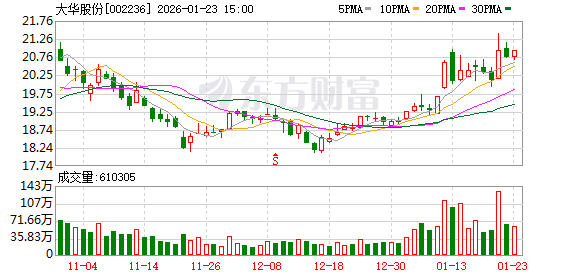
Group 1 - The company, Dahua Technology, announced a total operating revenue of 32,743,146,344.30 yuan for the year 2025, representing a year-on-year growth of 1.75% [2] - The net profit attributable to shareholders of the listed company reached 3,854,460,745.69 yuan, showing a significant year-on-year increase of 32.65% [2]


今日晚间重要公告抢先看——钧达股份称钙钛矿光伏技术在太空极端环境下的综合成本效益仍有待验证;奥特维称目前“太空光伏”尚处初期探索和研发阶段,产业化进程仍面临较大不确定性
Jin Rong Jie· 2026-01-23 14:10
Group 1 - JunDa Co., Ltd. announced that the comprehensive cost-effectiveness of perovskite photovoltaic technology in extreme space environments remains to be verified [2][5] - The company has invested 30 million yuan to acquire a 16.67% stake in Starwing Chip Energy, but no formal business agreement has been signed for space photovoltaic projects [2][5] - The technology shows potential advantages in lightweight, low cost, and high radiation resistance, but long-term reliability and cost-effectiveness in space are still uncertain [2][5] Group 2 - Aotewei stated that the "space photovoltaic" sector is still in the early exploration and research phase, with significant uncertainties in the industrialization process [3] - The company emphasized that product development to commercial application requires a considerable period, and the impact of related positive expectations on actual operating performance is highly uncertain [3] Group 3 - Tongyu Communications announced its participation in the A1 round financing of Beijing Blue Arrow Hongqing Technology, investing 30 million yuan for a 1.8293% stake [3] - The company will transition from direct to indirect ownership of Hongqing Technology through a partnership agreement [3] Group 4 - Huajin Technology received approval from the China Securities Regulatory Commission for the issuance of H-shares, planning to issue up to 101,573,100 shares [4] - Trina Solar announced a change in the use of remaining raised funds, reallocating 1.7 billion yuan to a new project for distributed smart photovoltaic power station construction [4][5] Group 5 - Yunnan City Investment plans to publicly transfer a 10.5% stake in Qicai Company with a base price of 293 million yuan [6] - Zijin Mining announced the completion of the second phase of the Giant Dragon Copper Mine, increasing production capacity to 350,000 tons per day [6] Group 6 - Shuaifeng Electric expects a net profit loss of 43 million to 62 million yuan in 2025, with potential delisting risk warnings for its stock [7] - Anqi Yeast plans to invest 222 million yuan in a green manufacturing project for yeast products with an annual output of 12,000 tons [7] Group 7 - Zhengzhou Coal and Electricity announced the cessation of production at the Chaohua Coal Mine due to resource depletion and safety risks, expecting a 311 million yuan impairment loss [8] - Oujing Technology announced partial production line shutdowns at its subsidiaries to reduce losses and operating costs [8] Group 8 - North Car Blue Valley plans to invest in the construction of a high-end platform model industrialization and digital upgrade project with a total investment of 1.991 billion yuan [9] - Jingzhida signed a significant contract worth 1.311 billion yuan for semiconductor testing equipment [9] Group 9 - Yanghe Co. announced a cash dividend plan for 2025-2027, committing to distribute no less than 100% of net profit each year [10] - Yanghe Co. also projected a net profit decline of 62.18% to 68.30% for 2025 due to market adjustments and increased channel inventory [10] Group 10 - Huitong Energy expects a net profit decrease of 69.51% to 75.82% for 2025, primarily due to the absence of non-recurring income from property relocation rewards [11] - Dahua Co. reported a net profit increase of 32.65% for 2025, driven by business optimization and cost control [12] Group 11 - Hangzhou Bank reported a net profit increase of 12.05% for 2025, maintaining a stable non-performing loan ratio [12] - Aotejia expects a net profit increase of 41.85% to 79.67% for 2025, supported by sales growth and cost control measures [12] Group 12 - Shenke Co. anticipates a net profit increase of 65.75% to 98.9% for 2025, benefiting from overseas strategy and revenue growth [13] - Pioneering Technology expects a net profit increase of 50.82% to 109.21% for 2025, driven by product technology iterations and market expansion [13] Group 13 - Shanchuang Technology expects a net profit increase of 81.77% to 134.78% for 2025, fueled by demand for enterprise-level storage products [14] - Anshuo Information anticipates a net profit increase of 52.44% to 98.83% for 2025, with government subsidies contributing to the growth [14] Group 14 - Zhongwei Company expects a net profit increase of 28.74% to 34.93% for 2025, driven by increased customer recognition of its plasma etching equipment [15] - Jingfang Technology anticipates a net profit increase of 44.41% to 52.32% for 2025, benefiting from the automotive industry's growth [16] Group 15 - Fuda Alloy expects a net profit increase of 119.14% to 219.95% for 2025, driven by strong demand in emerging applications [17] - Feirongda anticipates a net profit increase of 57.23% to 83.43% for 2025, supported by stable growth in communication and cooling business [17] Group 16 - Licheng Performing Arts expects a net profit decrease of 12.75% to 32.21% for 2025, impacted by regional travel environment fluctuations [22] - Lisheng Pharmaceutical anticipates a net profit increase of 116.77% to 138.44% for 2025, driven by market expansion and product sales [23] Group 17 - JMC reported a net profit decrease of 22.71% for 2025, despite a 2.07% increase in total revenue [27] - Daoshi Technology expects a net profit increase of 206.01% to 269.76% for 2025, driven by overseas business expansion [28] Group 18 - Jin Kai New Energy plans to repurchase shares worth 500 million to 600 million yuan, with a maximum repurchase price of 7.5 yuan per share [29] - Longyun Co. announced a stock suspension due to plans to acquire a 58% stake in Yuheng Film Industry [30]





大华股份业绩快报:2025年度净利润同比增长32.65%
Xin Lang Cai Jing· 2026-01-23 12:57
Core Viewpoint - Dahua Technology reported its performance for 2025, showing a modest revenue growth while significantly increasing net profit, indicating effective business optimization and cost management strategies [1][2] Financial Performance - The company achieved total operating revenue of 32.743 billion yuan, representing a year-on-year increase of 1.75% [1][2] - The net profit attributable to shareholders reached 3.854 billion yuan, marking a year-on-year growth of 32.65% [1][2] - Basic earnings per share stood at 1.18 yuan [1][2] Business Strategy - The company has been continuously optimizing its business structure and enhancing cost control [1][2] - There has been a focus on high-value business initiatives, contributing to an increase in overall gross profit margin [1][2] Cash Flow Management - Dahua Technology has strengthened its accounts receivable collection management, leading to rapid growth in operating cash flow [1][2]
大华股份(002236.SZ)业绩快报:2025年净利润38.54亿元 同比增长32.65%
Ge Long Hui A P P· 2026-01-23 11:03
Core Viewpoint - Dahua Technology (002236.SZ) reported a total operating revenue of 32.743 billion yuan for the fiscal year 2025, representing a year-on-year growth of 1.75%, and a net profit attributable to shareholders of 3.854 billion yuan, which is an increase of 32.65% compared to the previous year [1] Group 1: Financial Performance - The company achieved total operating revenue of 32.743 billion yuan in 2025, up 1.75% year-on-year [1] - The net profit attributable to shareholders reached 3.854 billion yuan, reflecting a significant increase of 32.65% year-on-year [1] Group 2: Reasons for Performance Changes - The performance growth is attributed to the company's commitment to "pragmatic growth, reshaping the pattern, enhancing efficiency, and adhering to high-quality development" [1] - Continuous optimization of business structure and cost control led to an increase in comprehensive gross profit margin, contributing to improved profitability [1] - The difference in growth rates between net profit attributable to shareholders and net profit after deducting non-recurring gains and losses is mainly due to the transfer of subsidiary equity and income from entrusted financial management during the reporting period [1]
大华股份:2025年营收327.43亿元,净利润同比增32.65%
Xin Lang Cai Jing· 2026-01-23 10:52
Core Viewpoint - The company reported a total operating revenue of 32.743 billion yuan for the year 2025, reflecting a year-on-year growth of 1.75% [1] Financial Performance - Operating profit reached 4.345 billion yuan, showing a significant year-on-year increase of 45.81% [1] - Total profit amounted to 4.351 billion yuan, with a year-on-year growth of 45.53% [1] - Net profit attributable to shareholders of the listed company was 3.854 billion yuan, representing a year-on-year increase of 32.65% [1] Growth Drivers - The growth in performance is primarily attributed to the company's efforts in business development, optimization of business structure, and enhanced cost control [1] - The difference in the growth rate between net profit attributable to shareholders and the net profit after deducting non-recurring gains and losses is due to the transfer of subsidiary equity and income from entrusted financial management [1]
大华股份(002236) - 2025 Q4 - 年度业绩
2026-01-23 10:45
Financial Performance - Total revenue for 2025 reached ¥32,743,146,344.30, an increase of 1.75% compared to the previous year[4] - Operating profit rose to ¥4,345,114,204.74, marking a significant increase of 45.81% year-over-year[4] - Net profit attributable to shareholders was ¥3,854,460,745.69, reflecting a growth of 32.65% compared to the same period last year[4] - The basic earnings per share increased to ¥1.18, up 31.11% from ¥0.90 in the previous year[4] - The weighted average return on equity improved to 10.41%, an increase of 2.22 percentage points from 8.19%[4] Assets and Equity - Total assets at the end of the reporting period were ¥53,145,108,745.11, a slight increase of 0.78% from the beginning of the period[4] - Shareholders' equity attributable to the company increased by 4.79% to ¥37,753,609,795.77[4] Business Strategy and Management - The company focused on optimizing its business structure and enhancing cost control, leading to improved profitability[6] - The increase in net profit was partly due to the transfer of subsidiary equity and income from entrusted financial management[6] - The company emphasized high-quality development and operational cash flow management during the reporting period[6]
【IPO前哨】华睿科技赴港:“大华系”双赛道布局,业绩波动大
Sou Hu Cai Jing· 2026-01-23 02:17
Core Viewpoint - The Hong Kong stock market continues to show strong interest in hard technology companies, with Zhejiang Huairui Technology Co., Ltd. recently filing for an IPO on the Hong Kong Stock Exchange, backed by CICC as the sole sponsor [2][3]. Company Background - Huairui Technology originated from the Dahua Group in 2016 and became an independent company in 2021 after integrating Dahua's AMR business [3]. - The company has attracted significant institutional interest, achieving a post-money valuation of 3.528 billion RMB in its latest funding round in December 2023 [3][4]. Business Focus - Huairui Technology specializes in AI-powered machine vision and AMR products, aiming to facilitate digital transformation across various manufacturing and logistics sectors [7]. - The machine vision segment provides core components and tailored solutions for industries such as consumer electronics, automotive parts, lithium batteries, PCB, and semiconductors [7][9]. - The AMR business focuses on automating in-plant logistics, serving key industries like lithium battery and automotive manufacturing [7][9]. Financial Performance - Revenue figures for Huairui Technology show fluctuations, with approximately 1.050 billion RMB in 2023, 902 million RMB in 2024, and 649 million RMB in the first three quarters of 2025 [11][12]. - The company reported a gross profit of around 353 million RMB in 2023, with a gross margin of 33.6%, but faced a net loss of 7.622 million RMB [11][13]. - The core revenue source is the machine vision segment, contributing 66.2% of total revenue in the first nine months of 2025 [11]. Market Position - Huairui Technology ranks fifth globally and third in China for industrial cameras based on 2024 sales revenue, while its AMR business ranks seventh globally and third in China [9]. - The company has served over 5,700 clients from 59 countries, achieving a customer satisfaction rate of 96.4% and a high core customer repurchase rate of 86.6% as of September 30, 2025 [9]. Future Prospects - The IPO is significant for Huairui Technology, with plans to use the raised funds to enhance its technology platforms, expand product offerings, and grow its marketing network [13][14]. - The company is well-positioned in the growing fields of machine vision and AMR, which are currently favored in the market [14].

大华股份(002236) - 关于为子公司提供担保的进展公告
2026-01-22 10:00
证券代码:002236 证券简称:大华股份 公告编号:2026-007 浙江大华技术股份有限公司 关于为子公司提供担保的进展公告 近日,公司向招商银行股份有限公司杭州分行(以下简称"招行杭州分行") 出具了《最高额不可撤销担保书》(编号:571XY260113T00012901)(以下简 称"担保书"),约定为子公司浙江华锐捷技术有限公司(以下简称"华锐捷") 在《授信协议》(编号:571XY260113T000129)项下所负担的所有债务承担连 带责任保证,保证范围为招行杭州分行在授信额度内向华锐捷提供的贷款及其他 授信本金余额之和(最高限额为人民币1,000万元)以及相关利息等其他费用, 保证期间为担保书生效之日起至《授信协议》项下每笔贷款或其他融资或招行杭 州分行受让的应收账款债权的到期日或每笔垫款的垫款日另加三年。 上述担保事项在公司董事会和股东会审议通过的担保额度范围内,无需再次 提交公司董事会或股东会审议。 三、累计对外担保数量及逾期担保的数量 截至 2026 年 1 月 22 日,公司及子公司对外实际担保余额为 895,621.93 万元, 占公司 2024 年末经审计净资产的 24.86%,全 ...
一图看懂 | 智能驾驶概念股
市值风云· 2026-01-21 10:14
Group 1 - The article discusses the recent policy measures issued by Guangdong province aimed at promoting high-quality development in transportation through artificial intelligence [4][5] - The policy encourages enterprises to focus on core technology breakthroughs and innovation in areas such as end-to-end remote driving, intelligent decision-making, and precise prediction and control [4][5] - The initiative aims to create high-quality data sets, toolchains, and algorithm libraries to facilitate the application of large models in autonomous driving [4][5] Group 2 - The article lists various companies involved in the development of key technologies related to autonomous driving, including 威帝股份, 凯众股份, and 大华股份 [6] - It highlights the importance of advanced systems such as steer-by-wire systems, vehicle-mounted cameras, and heads-up displays (HUD) in the context of intelligent driving [6]