
Sinobioway Medicine(002581)

Search documents
ST未名(002581) - 2025年半年度财务报告
2025-08-19 11:01
山东未名生物医药股份有限公司 2025 年半年度财务报告 山东未名生物医药股份有限公司 2025 年半年度财务报告 2025 年 8 月 1 山东未名生物医药股份有限公司 2025 年半年度财务报告 财务报告 一、审计报告 半年度报告是否经过审计 □是 否 公司半年度财务报告未经审计。 二、财务报表 3 山东未名生物医药股份有限公司 2025 年半年度财务报告 财务附注中报表的单位为:元 1、合并资产负债表 编制单位:山东未名生物医药股份有限公司 2025 年 06 月 30 日 单位:元 | 项目 | 期末余额 | 期初余额 | | --- | --- | --- | | 流动资产: | | | | 货币资金 | 456,022,275.73 | 506,403,730.00 | | 结算备付金 | | | | 拆出资金 | | | | 交易性金融资产 | | | | 衍生金融资产 | | | | 应收票据 | 8,095,107.10 | 14,156,358.57 | | 应收账款 | 53,704,505.65 | 73,056,270.54 | | 应收款项融资 | 3,596,789.44 | 6 ...

ST未名(002581) - 半年度非经营性资金占用及其他关联资金往来情况汇总表
2025-08-19 11:01
山东未名生物医药股份有限公司 2025年半年度非经营性资金占用及其他关联资金往来情况汇总表 | 非经营性资金占用 | 资金占用方名称 | 占用方与上市公司的关 | 上市公司核算的 | 期初占用资金余 | 报告期占用累计发生金 | 报告期占用资金的利 | 报告期偿还累 | 期末占用资金余 | 占用形成原因 | 占用性质 | | --- | --- | --- | --- | --- | --- | --- | --- | --- | --- | --- | | | | 联关系 | 会计科目 | 额 | 额(不含利息) | 息(如有) | 计发生额 | 额 | | | | 控股股东、实际控制人及其附属企业 无 | | | | | | | | | | 非经营性占用 | | 小计 | —— | —— | —— | - | - | - | - | - | —— | —— | | 前控股股东、实际控制人及其附属企业 无 | | | | | | | | | | 非经营性占用 | | 小计 | —— | —— | —— | - | - | - | - | - | —— | —— | | 其他关联方及其附属企业 | 无 | | ...
ST未名(002581) - 第六届董事会第一次独立董事专门会议决议
2025-08-19 11:00
山东未名生物医药股份有限公司 第六届董事会第一次独立董事专门会议 山东未名生物医药股份有限公司 第六届董事会第一次独立董事专门会议决议 山东未名生物医药股份有限公司(以下简称"公司")第六届董事会第一次独 立董事专门会议通知于 2025 年 8 月 19 日以电子邮件方式发出。2025 年 8 月 8 日会议以通讯方式召开,应参加表决独立董事 4 名,实际参加表决独立董事 4 人,分别为:张荣富、蔡艳红、夏阳、刘洋。会议由全体独立董事共同推举蔡艳 红女士召集并主持。本次独立董事专门会议的召集和召开符合国家有关法律、法 规、《独立董事专门会议工作细则》及《公司章程》的规定。本次会议审议了如 下议案: (一)审议通过了《关于 2025 年半年度非经营性资金占用及其他关联资金 往来情况的议案》 经核查,2025 年半年度公司与关联方发生的资金往来均为正常资金往来, 不存在控股股东及其他关联方违规占用公司资金的情况,不存在损害公司及中小 股东利益的情形。 表决情况:同意 4 票,反对 0 票,弃权 0 票。 表决结果:通过。 (本页以下无正文) 山东未名生物医药股份有限公司 第六届董事会第一次独立董事专门会议 (本页 ...
ST未名(002581) - 半年报董事会决议公告
2025-08-19 11:00
山东未名生物医药股份有限公司 第六届董事会第五次会议决议公告 本公司及董事会全体成员保证信息披露内容的真实、准确和完整,不存在虚假 记载、误导性陈述或重大遗漏。 一、董事会会议召开情况 山东未名生物医药股份有限公司(以下简称"公司")第六届董事会第五次会 议于 2025 年 8 月 19 日上午 10 时以通讯方式召开。应参加表决董事 11 名,实际 参加表决董事 11 人,分别为:岳家霖、刘文俊、徐隽雄、周婷、陈星、史晓如、 黄桂源、蔡艳红、张荣富、刘洋、夏阳。董事会会议通知已于 2025 年 8 月 8 日 以通讯方式发出,会议由公司董事长岳家霖先生主持。本次董事会的召集和召开 符合国家有关法律法规、《董事会议事规则》及《公司章程》的规定。本次会议 审议了如下议案: 二、董事会会议审议情况 (一)审议通过了《2025 年半年度报告全文及摘要》 证券代码:002581 证券简称:ST未名 公告编号:2025-062 表决结果:通过。 (三)审议通过了《关于注销 2023 年股票期权激励计划第一个行权期届满未 行权的股票期权的议案》 截至 2025 年 5 月 29 日,公司 2023 年股票期权激励计划第一 ...
未名医药(002581) - 2025 Q2 - 季度财报
2025-08-19 10:50
Section I Important Notes, Table of Contents, and Definitions [Important Notes](index=2&type=section&id=Important%20Notes) The board and senior management guarantee report accuracy, highlight risks, and confirm no half-year dividends or bonus shares are planned - The company's board of directors and senior management guarantee the truthfulness, accuracy, and completeness of the report content and assume legal responsibility[4](index=4&type=chunk) - All directors attended the board meeting to review this semi-annual report[5](index=5&type=chunk) - The company plans not to distribute cash dividends, bonus shares, or convert capital reserves into share capital for the half-year period[6](index=6&type=chunk) [Table of Contents](index=3&type=section&id=Table%20of%20Contents) This section lists the complete report structure, including nine main chapters and their starting page numbers, for quick navigation - The report contains nine main chapters, covering important notes, company profile, management discussion and analysis, corporate governance, significant matters, share changes, bond information, financial reports, and other submitted data[8](index=8&type=chunk) [Definitions](index=5&type=section&id=Definitions) This section defines common terms, company entities, and related parties to ensure clear understanding of the report content - "Company, the Company, Weiming Pharmaceutical" refers to Shandong Weiming Biopharmaceutical Co., Ltd[12](index=12&type=chunk) - "This Reorganization/Major Asset Reorganization" refers to the Company's acquisition of 100% equity in Weiming Biopharmaceutical Co., Ltd. held by 20 transaction parties, including Beijing Peking University Weiming Bioengineering Group Co., Ltd., through share issuance and cash payment[12](index=12&type=chunk) - Listed names and shareholding percentages of several subsidiaries and associated companies, such as Xiamen Weiming (wholly-owned subsidiary), Tianjin Weiming (controlled subsidiary, **60.57%** stake), and Beijing Sinovac (associate, **26.91%** stake)[12](index=12&type=chunk) Section II Company Profile and Key Financial Indicators [Company Profile](index=6&type=section&id=Company%20Profile) Listed as 'ST Weiming' (002581) on the Shenzhen Stock Exchange, the company's basic information and contact details remain unchanged Company Basic Information | Indicator | Content | | :--- | :--- | | Stock Abbreviation | ST Weiming | | Stock Code | 002581 | | Listing Exchange | Shenzhen Stock Exchange | | Chinese Name | Shandong Weiming Biopharmaceutical Co., Ltd. | | Legal Representative | Yue Jialin | - The company's contact information (registered address, office address, website, email) changed during the reporting period, and an announcement has been disclosed[16](index=16&type=chunk) [Key Accounting Data and Financial Indicators](index=7&type=section&id=Key%20Accounting%20Data%20and%20Financial%20Indicators) Operating revenue decreased by **66.42%**, net profit and non-recurring net profit showed significant losses, and operating cash flow was negative Key Accounting Data and Financial Indicators (Current Period vs. Prior Period) | Indicator | Current Period (yuan) | Prior Period (yuan) | YoY Change | | :--- | :--- | :--- | :--- | | Operating Revenue | 70,771,540.88 | 210,782,004.46 | -66.42% | | Net Profit Attributable to Shareholders of Listed Company | -67,302,664.90 | -29,614,917.07 | -127.26% | | Net Profit Attributable to Shareholders of Listed Company (Excluding Non-recurring Gains/Losses) | -67,192,431.81 | -26,993,371.81 | -148.92% | | Net Cash Flow from Operating Activities | -143,553,691.90 | -50,634,778.10 | -183.51% | | Basic Earnings Per Share (yuan/share) | -0.1020 | -0.0449 | -127.17% | | Diluted Earnings Per Share (yuan/share) | -0.1020 | -0.0449 | -127.17% | | Weighted Average Return on Net Assets | -3.55% | -1.45% | -2.10% | | **Period-End Indicators** | **Current Period-End (yuan)** | **Prior Year-End (yuan)** | **Change from Prior Year-End** | | Total Assets | 2,050,202,194.41 | 2,195,918,588.20 | -6.64% | | Net Assets Attributable to Shareholders of Listed Company | 1,864,941,323.24 | 1,923,634,393.24 | -3.05% | [Differences in Accounting Data under Domestic and Overseas Accounting Standards](index=7&type=section&id=Differences%20in%20Accounting%20Data%20under%20Domestic%20and%20Overseas%20Accounting%20Standards) No differences were reported in net profit or net assets between international/overseas and Chinese accounting standards during the period - The company reported no differences in net profit and net assets between financial reports disclosed under International Accounting Standards and Chinese Accounting Standards during the reporting period[19](index=19&type=chunk) - The company reported no differences in net profit and net assets between financial reports disclosed under overseas accounting standards and Chinese Accounting Standards during the reporting period[20](index=20&type=chunk) [Non-recurring Gains and Losses Items and Amounts](index=8&type=section&id=Non-recurring%20Gains%20and%20Losses%20Items%20and%20Amounts) Non-recurring gains and losses totaled **-110,233.09 yuan**, mainly from asset disposal, government grants, and other non-operating items Non-recurring Gains and Losses Items and Amounts | Item | Amount (yuan) | | :--- | :--- | | Gains/Losses from Disposal of Non-current Assets | 691,122.32 | | Government Grants Included in Current Profit and Loss | 135,820.51 | | Other Non-operating Income and Expenses Apart from the Above | -890,684.86 | | Less: Income Tax Impact | 14,372.90 | | Impact of Minority Interests (After Tax) | 32,118.16 | | **Total** | **-110,233.09** | Section III Management Discussion and Analysis [Main Businesses Engaged by the Company During the Reporting Period](index=9&type=section&id=Main%20Businesses%20Engaged%20by%20the%20Company%20During%20the%20Reporting%20Period) The company primarily engages in pharmaceutical manufacturing, producing biopharmaceutical products such as nerve growth factor, interferon, and vaccines - The company belongs to the pharmaceutical manufacturing industry, with industry classification code C27[24](index=24&type=chunk) - The company's business segments include biopharmaceutical products such as murine nerve growth factor, interferon, and vaccines[24](index=24&type=chunk) - The company conducts business through controlling and investing in enterprises or production bases such as Weiming Biopharmaceutical Co., Ltd., Tianjin Weiming Biopharmaceutical Co., Ltd., and Beijing Sinovac Biotech Co., Ltd[24](index=24&type=chunk) [Analysis of Core Competitiveness](index=9&type=section&id=Analysis%20of%20Core%20Competitiveness) Core competencies include mature market channels, strong R&D capabilities, a nationwide sales network, and active innovation in product development - The company possesses a nationwide sales network and a mature marketing model, demonstrating strong control over terminal hospitals[25](index=25&type=chunk) - The company closely follows national policies, researches innovative biopharmaceuticals, optimizes its product pipeline, and advances innovative drug R&D and clinical trials[26](index=26&type=chunk) - Wholly-owned subsidiary Shandong Yandu, relying on its high-expression recombinant protein platform, has established multiple biopharmaceutical drug R&D systems, with an innovative ophthalmic biopharmaceutical in preparation for Phase III clinical trials[26](index=26&type=chunk) [Analysis of Main Business](index=9&type=section&id=Analysis%20of%20Main%20Business) Main business revenue declined **66.42%** due to a subsidiary's production halt, with interferon revenue down **95.41%**, while nerve growth factor dominated sales Major Financial Data Year-on-Year Changes | Indicator | Current Period (yuan) | Prior Period (yuan) | YoY Change | Reason for Change | | :--- | :--- | :--- | :--- | :--- | | Operating Revenue | 70,771,540.88 | 210,782,004.46 | -66.42% | Due to subsidiary's production and sales suspension | | Operating Cost | 21,096,695.93 | 40,782,935.75 | -48.27% | Due to subsidiary's production and sales suspension | | Selling Expenses | 74,269,430.94 | 128,147,734.83 | -42.04% | Due to subsidiary's production and sales suspension | | Income Tax Expense | -8,010,372.70 | 1,495,427.18 | -635.66% | Due to subsidiary's production and sales suspension losses | | Net Cash Flow from Operating Activities | -143,553,691.90 | -50,634,778.10 | -183.51% | Due to subsidiary's production and sales suspension | Operating Revenue Composition (by Product) | Product | Current Period Amount (yuan) | Proportion of Operating Revenue | Prior Period Amount (yuan) | Proportion of Operating Revenue | YoY Change | | :--- | :--- | :--- | :--- | :--- | :--- | | Murine Nerve Growth Factor | 64,225,246.64 | 90.75% | 68,699,239.70 | 32.59% | -6.51% | | Interferon | 6,521,002.68 | 9.21% | 142,062,698.74 | 67.40% | -95.41% | - The gross profit margin for the biopharmaceutical manufacturing industry decreased by **10.46%** year-on-year to **70.19%**, with interferon's gross profit margin at **-16.10%**, a significant year-on-year decrease of **97.11%**[31](index=31&type=chunk)[32](index=32&type=chunk) [Analysis of Non-Core Business](index=11&type=section&id=Analysis%20of%20Non-Core%20Business) The company had no non-core business operations during the reporting period - The company had no non-core business operations during the reporting period[32](index=32&type=chunk) [Analysis of Assets and Liabilities](index=11&type=section&id=Analysis%20of%20Assets%20and%20Liabilities) Total assets and net assets decreased, long-term equity investments declined, while construction in progress and right-of-use assets increased Significant Changes in Asset Composition | Item | Current Period-End Amount (yuan) | Proportion of Total Assets | Prior Year-End Amount (yuan) | Proportion of Total Assets | Change in Proportion | | :--- | :--- | :--- | :--- | :--- | :--- | | Monetary Funds | 456,022,275.73 | 22.24% | 506,403,730.00 | 23.06% | -0.82% | | Long-term Equity Investments | 919,844,080.77 | 44.87% | 1,055,730,183.04 | 48.08% | -3.21% | | Construction in Progress | 51,285,053.72 | 2.50% | 38,109,424.71 | 1.74% | 0.76% | | Right-of-Use Assets | 4,314,976.69 | 0.21% | 262,200.06 | 0.01% | 0.20% | | Short-term Borrowings | 0 | 0.00% | 2,766,405.84 | 0.13% | -0.13% | | Contract Liabilities | 3,129,568.38 | 0.15% | 10,459,681.65 | 0.48% | -0.33% | | Lease Liabilities | 3,072,288.31 | 0.15% | 0 | 0.00% | 0.15% | - As of June 30, 2025, Weiming Biopharmaceutical Co., Ltd. had bank deposits of **7.69 yuan** frozen due to a dormant account and **1,366,982.68 yuan** restricted due to inability to change payment functions[34](index=34&type=chunk) - Weiming Biopharmaceutical (Hong Kong) Co., Ltd. had frozen bank deposits of **7,620.40 yuan**[35](index=35&type=chunk) [Analysis of Investment Status](index=12&type=section&id=Analysis%20of%20Investment%20Status) Investment decreased by **15.49%** year-on-year, with no significant equity, non-equity, securities, or derivative investments reported Investment Amount During the Reporting Period | Indicator | Amount (yuan) | | :--- | :--- | | Investment Amount for the Reporting Period | 919,844,080.77 | | Investment Amount for the Prior Period | 1,088,381,252.18 | | Change Percentage | -15.49% | - The company had no securities investments, derivative investments, or use of raised funds during the reporting period[37](index=37&type=chunk)[38](index=38&type=chunk)[39](index=39&type=chunk) [Major Asset and Equity Sales](index=12&type=section&id=Major%20Asset%20and%20Equity%20Sales) No significant asset or equity sales occurred during the reporting period - The company did not sell major assets during the reporting period[40](index=40&type=chunk) - The company did not sell major equity during the reporting period[41](index=41&type=chunk) [Analysis of Major Controlled and Invested Companies](index=13&type=section&id=Analysis%20of%20Major%20Controlled%20and%20Invested%20Companies) Key subsidiaries and associates, including Weiming Biopharmaceutical and Beijing Sinovac, all reported negative net profits Financial Data of Major Controlled and Invested Companies | Company Name | Company Type | Main Business | Registered Capital (yuan) | Total Assets (yuan) | Net Assets (yuan) | Operating Revenue (yuan) | Operating Profit (yuan) | Net Profit (yuan) | | :--- | :--- | :--- | :--- | :--- | :--- | :--- | :--- | :--- | | Weiming Biopharmaceutical Co., Ltd. | Subsidiary | R&D, production, and sales of biopharmaceuticals such as nerve growth factor | 131,369,000 | 246,736,787.87 | -164,356,848.05 | 64,680,979.10 | -3,495,436.17 | -5,397,007.60 | | Tianjin Weiming Biopharmaceutical Co., Ltd. | Subsidiary | R&D, production, and sales of biopharmaceuticals such as interferon | 228,234,104.70 | 246,059,193.65 | 197,663,601.46 | 6,521,002.68 | -61,912,790.55 | -52,890,111.26 | | Beijing Sinovac Biotech Co., Ltd. | Associate | R&D, production, and sales of human vaccines | 141,210,000 | 4,891,943,892.74 | 3,016,247,413.60 | 698,600,492.86 | -3,995,105.77 | -4,965,077.23 | - The company did not acquire or dispose of any subsidiaries during the reporting period[42](index=42&type=chunk) [Structured Entities Controlled by the Company](index=13&type=section&id=Structured%20Entities%20Controlled%20by%20the%20Company) The company did not control any structured entities during the reporting period - The company had no structured entities under its control during the reporting period[43](index=43&type=chunk) [Risks Faced by the Company and Countermeasures](index=13&type=section&id=Risks%20Faced%20by%20the%20Company%20and%20Countermeasures) The company addresses R&D, safety, market, production, and natural disaster risks through R&D investment, safety measures, and market competitiveness - New drug R&D is characterized by long cycles, high risks, and high investment; the company will strengthen R&D team building and prudently evaluate projects to mitigate risks[43](index=43&type=chunk) - Pharmaceutical manufacturing enterprises face dual risks in safety and environmental protection; the company has established safety production management systems to strengthen safety production management and emergency response capabilities[44](index=44&type=chunk)[45](index=45&type=chunk) - Intensified market competition may impact the company's performance; the company will continuously enhance competitiveness through brand communication, product quality, channel promotion, sales models, marketing networks, and operational management[46](index=46&type=chunk) - Controlling subsidiary Tianjin Weiming's production and sales were suspended due to non-compliance with GMP requirements, leading to "other risk warnings" for the company's stock; the company is actively cooperating with rectification efforts to resume production as soon as possible[47](index=47&type=chunk) - Natural disasters and force majeure events may damage the company's assets and profitability; the company will closely monitor asset conditions, timely accrue impairment provisions, and strengthen asset management[48](index=48&type=chunk) [Formulation and Implementation of Market Value Management System and Valuation Enhancement Plan](index=15&type=section&id=Formulation%20and%20Implementation%20of%20Market%20Value%20Management%20System%20and%20Valuation%20Enhancement%20Plan) A 'Market Value Management System' is in place to boost shareholder value, but a specific valuation improvement plan is pending - The company has formulated a "Market Value Management System" aimed at promoting the continuous enhancement of company value and shareholder equity, and standardizing market value management practices[49](index=49&type=chunk) - The company has not yet disclosed a valuation enhancement plan[49](index=49&type=chunk) [Implementation of "Quality and Return Dual Enhancement" Action Plan](index=15&type=section&id=Implementation%20of%20%E2%80%9CQuality%20and%20Return%20Dual%20Enhancement%E2%80%9D%20Action%20Plan) The company has not yet disclosed its 'Quality and Return Dual Enhancement' action plan - The company has not yet disclosed its "Quality and Return Dual Enhancement" action plan announcement[50](index=50&type=chunk) Section IV Corporate Governance, Environment, and Society [Changes in Directors, Supervisors, and Senior Management](index=15&type=section&id=Changes%20in%20Directors%2C%20Supervisors%2C%20and%20Senior%20Management) The board and senior management saw significant changes, with several directors departing and new executive appointments made - Yu Xiuyuan, Yu Wenjie, Zhao Hui, Yue Ying, and other directors resigned due to the expiration of their terms[51](index=51&type=chunk) - Xu Junxiong was appointed as Vice Chairman, Director, and Deputy General Manager[51](index=51&type=chunk) - Zhou Ting was appointed as Director and Chief Financial Officer, Shi Xiaoru as Director and Board Secretary, and Chen Xing as Director and Deputy General Manager[51](index=51&type=chunk) [Profit Distribution and Capital Reserve Conversion to Share Capital for the Current Reporting Period](index=15&type=section&id=Profit%20Distribution%20and%20Capital%20Reserve%20Conversion%20to%20Share%20Capital%20for%20the%20Current%20Reporting%20Period) The company plans no cash dividends, bonus shares, or capital increase from capital reserves for the half-year period - The company plans not to distribute cash dividends, bonus shares, or convert capital reserves into share capital for the half-year period[52](index=52&type=chunk) [Implementation of Share Incentive Plans, Employee Stock Ownership Plans, or Other Employee Incentive Measures](index=15&type=section&id=Implementation%20of%20Share%20Incentive%20Plans%2C%20Employee%20Stock%20Ownership%20Plans%2C%20or%20Other%20Employee%20Incentive%20Measures) The 2023 stock option plan saw cancellations due to unmet targets and departures; an incentive fund was established to boost employee motivation - The second exercise period of the company's 2023 stock option incentive plan did not meet the exercise conditions, and some incentive recipients resigned; the company plans to cancel a total of **29,715,486 stock options** for 76 individuals[54](index=54&type=chunk) - The company established an incentive fund and formulated the "Incentive Fund Management Measures" to fully mobilize employee enthusiasm, initiative, and creativity, thereby enhancing the company's core competitiveness[55](index=55&type=chunk) [Environmental Information Disclosure](index=16&type=section&id=Environmental%20Information%20Disclosure) The company and its two main subsidiaries are legally required to disclose environmental information, with reports available online - The company and its two main subsidiaries (Tianjin Weiming Biopharmaceutical Co., Ltd. and Weiming Biopharmaceutical Co., Ltd.) have been included in the list of enterprises required to disclose environmental information by law[56](index=56&type=chunk) - Environmental information disclosure reports can be accessed through designated websites[56](index=56&type=chunk) [Social Responsibility](index=16&type=section&id=Social%20Responsibility) The company actively fulfills social responsibilities, protecting stakeholder rights, enhancing safety, and engaging in significant charitable donations - The company strictly adheres to laws and regulations, improves its corporate governance structure, safeguards shareholders' rights to information and participation, and communicates with investors[58](index=58&type=chunk) - The company complies with the "Labor Law," respects and protects employee rights, pays various insurances and housing provident funds for employees, improves working conditions, and provides humanistic care[59](index=59&type=chunk) - The company has intensified its efforts in safety and environmental protection, establishing a sound safety production responsibility system, and reported no safety production accidents during the period[60](index=60&type=chunk) - The company actively participates in public welfare activities, collaborating with several foundations to donate a total of **40,800 units** of Enjingfu medicine and **250,000 yuan** in cash to patients with neurological disorders[61](index=61&type=chunk)[62](index=62&type=chunk) Section V Significant Matters [Commitments Fulfilled and Overdue Unfulfilled Commitments by Actual Controller, Shareholders, Related Parties, Acquirers, and the Company During and as of the End of the Reporting Period](index=19&type=section&id=Commitments%20Fulfilled%20and%20Overdue%20Unfulfilled%20Commitments%20by%20Actual%20Controller%2C%20Shareholders%2C%20Related%20Parties%2C%20Acquirers%2C%20and%20the%20Company%20During%20and%20as%20of%20the%20End%20of%20the%20Reporting%20Period) Controlling parties fulfilled commitments on control stability, governance, competition avoidance, and related party transactions, including asset restructuring performance pledges - Shenzhen Yilian Technology Co., Ltd. and Liu Xiang committed to maintaining control over the listed company through legal means for 36 months from July 25, 2022, including not voluntarily waiving board and shareholder meeting rights, not assisting other parties in seeking control, and potentially increasing shareholdings to stabilize control under legal compliance[64](index=64&type=chunk) - Shenzhen Yilian Technology Co., Ltd. and Shenzhen Jialian Private Securities Investment Fund Management Co., Ltd. - Jialian No. 1 Securities Investment Fund committed to ensuring the listed company's sound corporate governance structure and independent operation, maintaining independence in personnel, assets, business, finance, and organization[65](index=65&type=chunk) - The committing parties pledged to avoid horizontal competition, offering similar business opportunities to the listed company or its wholly-owned/controlled subsidiaries first[65](index=65&type=chunk)[66](index=66&type=chunk) - The committing parties pledged to minimize related party transactions, conducting unavoidable ones on "equivalent, fair, and mutually beneficial" principles, strictly adhering to approval procedures and disclosure obligations, and not harming the legitimate interests of the listed company and its shareholders through such transactions[66](index=66&type=chunk)[67](index=67&type=chunk) - Beijing Peking University Weiming Bioengineering Group Co., Ltd. and other committing parties' performance commitments and compensation arrangements for 2014-2017 have been strictly implemented as pledged[67](index=67&type=chunk)[68](index=68&type=chunk)[69](index=69&type=chunk)[70](index=70&type=chunk)[71](index=71&type=chunk)[72](index=72&type=chunk)[73](index=73&type=chunk)[74](index=74&type=chunk) [Non-Operating Funds Occupied by Controlling Shareholders and Other Related Parties of the Listed Company](index=30&type=section&id=Non-Operating%20Funds%20Occupied%20by%20Controlling%20Shareholders%20and%20Other%20Related%20Parties%20of%20the%20Listed%20Company) No non-operating funds were occupied by controlling shareholders or other related parties during the reporting period - The company reported no non-operating funds occupied by controlling shareholders or other related parties during the reporting period[76](index=76&type=chunk) [Irregular External Guarantees](index=30&type=section&id=Irregular%20External%20Guarantees) The company had no irregular external guarantees during the reporting period - The company reported no irregular external guarantees during the reporting period[77](index=77&type=chunk) [Appointment and Dismissal of Accounting Firms](index=30&type=section&id=Appointment%20and%20Dismissal%20of%20Accounting%20Firms) The company's semi-annual financial report was not audited - The company's semi-annual financial report was not audited[78](index=78&type=chunk) [Board of Directors' and Supervisory Committee's Explanation on "Non-Standard Audit Report" for the Current Reporting Period](index=30&type=section&id=Board%20of%20Directors%27%20and%20Supervisory%20Committee%27s%20Explanation%20on%20%E2%80%9CNon-Standard%20Audit%20Report%E2%80%9D%20for%20the%20Current%20Reporting%20Period) No non-standard audit report was issued for the company during this reporting period - The company reported no non-standard audit report during the reporting period[79](index=79&type=chunk) [Board of Directors' Explanation on "Non-Standard Audit Report" for the Prior Year](index=30&type=section&id=Board%20of%20Directors%27%20Explanation%20on%20%E2%80%9CNon-Standard%20Audit%20Report%E2%80%9D%20for%20the%20Prior%20Year) The board acknowledged the 2024 qualified audit opinion, committing to mitigate risks and protect shareholder interests - Shenzhen Guangchen Certified Public Accountants (General Partnership) issued a qualified audit report with an emphasis-of-matter paragraph on the company's 2024 financial statements[79](index=79&type=chunk) - The company's board of directors believes the audit opinion is objective and truthful, and pledges to actively take measures to eliminate risks and protect the interests of the company and all shareholders[79](index=79&type=chunk) [Bankruptcy Reorganization Matters](index=30&type=section&id=Bankruptcy%20Reorganization%20Matters) No bankruptcy reorganization matters occurred during the reporting period - The company reported no bankruptcy reorganization matters during the reporting period[81](index=81&type=chunk) [Litigation Matters](index=31&type=section&id=Litigation%20Matters) The company is involved in multiple lawsuits, including a criminal judgment for illegal equity acquisition and a contractual dispute with partial liability - Regarding Hangzhou Qiangxinsheng's investment in Xiamen Weiming, the court ruled that Pan Aihua and Luo Deshun committed crimes of embezzlement and misappropriation of funds, ordering the recovery of **34%** of Xiamen Weiming's equity illegally occupied by Hangzhou Qiangxin and its return to the company[82](index=82&type=chunk) - In a contractual fault dispute with Shen Xiangxin, the company was ordered in the second instance to bear half of the compensation liability for Beijing Peking University Weiming Bioengineering Group Co., Ltd.'s inability to return **60,960,436.85 yuan** to Shen Xiangxin[84](index=84&type=chunk) - The company's application for retrial filed with the Zhejiang Provincial High People's Court was rejected[84](index=84&type=chunk) - The company is also involved in multiple other litigation matters not meeting the threshold for major litigation, including cases as a defendant with an involved amount of **703,500 yuan** and as a plaintiff with an involved amount of **262,200 yuan**, all currently under trial[85](index=85&type=chunk) [Penalties and Rectification Status](index=34&type=section&id=Penalties%20and%20Rectification%20Status) No penalties or rectification situations occurred during the reporting period - The company reported no penalties or rectification situations during the reporting period[86](index=86&type=chunk) [Integrity Status of the Company, its Controlling Shareholder, and Actual Controller](index=34&type=section&id=Integrity%20Status%20of%20the%20Company%2C%20its%20Controlling%20Shareholder%2C%20and%20Actual%20Controller) No undisclosed integrity issues were found for the company, its controlling shareholder, or actual controller - The company reported no undisclosed integrity issues during the reporting period[87](index=87&type=chunk) [Significant Related Party Transactions](index=34&type=section&id=Significant%20Related%20Party%20Transactions) No significant related party transactions, including daily operations, asset/equity sales, or debt/credit, occurred during the period - The company reported no related party transactions related to daily operations during the reporting period[87](index=87&type=chunk) - The company reported no related party transactions involving asset or equity acquisition/disposal during the reporting period[88](index=88&type=chunk) - The company reported no related party credit and debt transactions during the reporting period[90](index=90&type=chunk) - The company had no deposits, loans, credit lines, or other financial business with related financial companies[91](index=91&type=chunk) [Significant Contracts and Their Performance](index=35&type=section&id=Significant%20Contracts%20and%20Their%20Performance) No significant contracts, including custodianship, leasing, guarantees, or wealth management, were in effect during the period - The company reported no custodianship situations during the reporting period[94](index=94&type=chunk) - The company reported no significant guarantee situations during the reporting period[97](index=97&type=chunk) - The company reported no entrusted wealth management during the reporting period[98](index=98&type=chunk) - The company reported no other significant contracts during the reporting period[100](index=100&type=chunk) [Explanation of Other Significant Matters](index=36&type=section&id=Explanation%20of%20Other%20Significant%20Matters) Key events include board elections, option cancellations, a **134.55 million yuan** dividend, a 51% acquisition of Sichuan Gukang, and 'other risk warnings' due to a subsidiary's production halt - The company completed the election of its Sixth Board of Directors, with Yue Jialin elected as Chairman and Xu Junxiong as Vice Chairman, and new senior management personnel were appointed[101](index=101&type=chunk)[102](index=102&type=chunk) - The second exercise period of the company's 2023 stock option incentive plan saw **29,715,486 stock options** canceled due to unmet performance targets and the departure of some incentive recipients[103](index=103&type=chunk) - In the lawsuit between the company and Shen Xiangxin, the Zhejiang Provincial High People's Court rejected the company's application for retrial, requiring the company to bear partial compensation liability[103](index=103&type=chunk)[104](index=104&type=chunk) - The company received a cash dividend of **134.55 million yuan** from its associate, Beijing Sinovac Biotech Co., Ltd[104](index=104&type=chunk) - The company's wholly-owned subsidiary, Peking University Weiming (Shanghai) Biopharmaceutical Co., Ltd., increased its capital by **45 million yuan** to acquire **51%** equity in Sichuan Gukang Pharmaceutical Co., Ltd., making Gukang Pharmaceutical a controlled subsidiary[105](index=105&type=chunk) - The company's controlling subsidiary, Tianjin Weiming Biopharmaceutical Co., Ltd., is expected to be unable to resume normal production and operation activities within three months, leading to the implementation of "other risk warnings" for the company's stock starting from July 8, 2025, and the stock abbreviation changing to "ST Weiming"[106](index=106&type=chunk) - The company signed a settlement agreement with Hangzhou Qiangxin Biotechnology Co., Ltd., recovering **34%** equity in Xiamen Weiming, making Xiamen Weiming **100%** owned by the company[107](index=107&type=chunk)[108](index=108&type=chunk) [Significant Matters of Subsidiaries](index=38&type=section&id=Significant%20Matters%20of%20Subsidiaries) Subsidiary Shandong Yandu signed a Phase III clinical trial agreement and received a **290 million yuan** capital increase; Tianjin Weiming faced production suspension and lost procurement eligibility - Wholly-owned subsidiary Shandong Yandu Biotechnology Co., Ltd. signed a technical service agreement for Phase III clinical trials of recombinant human nerve growth factor eye drops[109](index=109&type=chunk) - The company increased capital in its wholly-owned subsidiary Shandong Yandu Biotechnology Co., Ltd. by **290 million yuan**, raising its registered capital to **300 million yuan**[110](index=110&type=chunk) - Shandong Yandu Biotechnology Co., Ltd. signed a contract for the cleanroom and M&E general contracting project for the Shandong Weiming Biopharmaceutical Industrial Park, and procured the liquid preparation and chromatography systems required for the production workshop[111](index=111&type=chunk)[112](index=112&type=chunk) - The company increased capital in its wholly-owned subsidiary Shandong Weiming Tianan Biotechnology Co., Ltd. by **7 million yuan**, raising its registered capital to **10 million yuan**[114](index=114&type=chunk) - Controlling subsidiary Tianjin Weiming Biopharmaceutical Co., Ltd. had its production and sales suspended by the Tianjin Municipal Drug Administration due to non-compliance with GMP requirements[115](index=115&type=chunk) - Tianjin Weiming Biopharmaceutical Co., Ltd.'s human interferon a2b nasal spray was disqualified from the inter-provincial alliance procurement selection[116](index=116&type=chunk) Section VI Changes in Shares and Shareholder Information [Changes in Shares](index=40&type=section&id=Changes%20in%20Shares) Total share capital remained at **659,735,586 shares**; restricted and unrestricted share proportions were stable, with some releases and new additions Changes in Shares | Share Type | Number Before Change (shares) | Proportion | Increase/Decrease in This Change (shares) | Number After Change (shares) | Proportion | | :--- | :--- | :--- | :--- | :--- | :--- | | I. Restricted Shares | 258,944,425 | 39.25% | 0 | 258,944,425 | 39.25% | | II. Unrestricted Shares | 400,791,161 | 60.75% | 0 | 400,791,161 | 60.75% | | III. Total Shares | 659,735,586 | 100.00% | 0 | 659,735,586 | 100.00% | Changes in Restricted Shares | Shareholder Name | Restricted Shares at Period Start (shares) | Restricted Shares Released This Period (shares) | Restricted Shares Increased This Period (shares) | Restricted Shares at Period End (shares) | Reason for Restriction | | :--- | :--- | :--- | :--- | :--- | :--- | | Xiamen Hengxing Group Co., Ltd. | 49,400,000 | 0 | 0 | 49,400,000 | Restricted Stock Vesting | | Shenzhen Juyunlai Investment Partnership (Limited Partnership) | 0 | 0 | 16,609,418 | 16,609,418 | Restricted Stock Vesting | | Yang Yan | 0 | 0 | 7,163,837 | 7,163,837 | Restricted Stock Vesting | | Other Restricted Shareholders | 94,817,386 | -23,773,255 | 0 | 71,044,131 | Restricted shares for individuals after IPO, Restricted Stock Vesting | [Issuance and Listing of Securities](index=42&type=section&id=Issuance%20and%20Listing%20of%20Securities) No securities issuance or listing occurred during the reporting period - The company reported no securities issuance or listing during the reporting period[123](index=123&type=chunk) [Shareholder Numbers and Shareholding Information](index=42&type=section&id=Shareholder%20Numbers%20and%20Shareholding%20Information) The company had **41,002 common shareholders**; Gao Baolin is the largest at **11.19%**, with Shenzhen Yilian and Shenzhen Jialian acting in concert - The total number of common shareholders at the end of the reporting period was **41,002**[124](index=124&type=chunk) Shareholding of Shareholders with 5% or More or Top 10 Shareholders | Shareholder Name | Shareholder Nature | Shareholding Percentage | Shares Held at Period End (shares) | Restricted Shares Held (shares) | Unrestricted Shares Held (shares) | Pledged, Marked, or Frozen Shares (shares) | | :--- | :--- | :--- | :--- | :--- | :--- | :--- | | Gao Baolin | Overseas Natural Person | 11.19% | 73,822,800 | 0 | 73,822,800 | 0 | | Xiamen Hengxing Group Co., Ltd. | Domestic Non-State-Owned Legal Person | 7.49% | 49,400,000 | 49,400,000 | 0 | 39,220,000 (Pledged) | | Shenzhen Jialian Private Securities Investment Fund Management Co., Ltd. - Jialian No. 1 Securities Investment Fund | Domestic Non-State-Owned Legal Person | 4.85% | 32,000,000 | 32,000,000 | 0 | 0 | | Shenzhen Yilian Technology Co., Ltd. | Domestic Non-State-Owned Legal Person | 3.82% | 25,204,000 | 25,204,000 | 0 | 0 | | Liu Kaili | Domestic Natural Person | 3.64% | 24,000,000 | 24,000,000 | 0 | 0 | | Yang Yan | Domestic Natural Person | 3.04% | 20,051,267 | 7,163,837 | 12,887,430 | 0 | | Shenzhen Juyunlai Investment Partnership (Limited Partnership) | Domestic Non-State-Owned Legal Person | 2.52% | 16,609,418 | 16,609,418 | 0 | 16,609,418 (Pledged) | | Beijing Peking University Weiming Bioengineering Group Co., Ltd. | State-Owned Legal Person | 1.52% | 10,000,000 | 10,000,000 | 0 | 10,000,000 (Pledged), 10,000,000 (Frozen) | | Zheng Zuoping | Domestic Natural Person | 1.30% | 8,600,000 | 8,600,000 | 0 | 0 | | Shi Tingbo | Domestic Natural Person | 1.30% | 8,571,800 | 0 | 8,571,800 | 0 | - Shenzhen Yilian Technology Co., Ltd. and Shenzhen Jialian Private Securities Investment Fund Management Co., Ltd. - Jialian No. 1 Securities Investment Fund signed a "Supplementary Clause to the Authorization Letter," agreeing to form a concerted action relationship[125](index=125&type=chunk) [Changes in Shareholdings of Directors, Supervisors, and Senior Management](index=44&type=section&id=Changes%20in%20Shareholdings%20of%20Directors%2C%20Supervisors%2C%20and%20Senior%20Management) No changes in shareholdings of directors, supervisors, and senior management occurred during the reporting period - The company's directors, supervisors, and senior management had no changes in their shareholdings during the reporting period[128](index=128&type=chunk) [Changes in Controlling Shareholder or Actual Controller](index=44&type=section&id=Changes%20in%20Controlling%20Shareholder%20or%20Actual%20Controller) No changes in the controlling shareholder or actual controller occurred during the reporting period - The company's controlling shareholder did not change during the reporting period[129](index=129&type=chunk) - The company's actual controller did not change during the reporting period[129](index=129&type=chunk) [Preferred Shares Related Information](index=45&type=section&id=Preferred%20Shares%20Related%20Information) The company had no preferred shares during the reporting period - The company had no preferred shares during the reporting period[130](index=130&type=chunk) Section VII Bond Related Information [Bond Related Information](index=46&type=section&id=Bond%20Related%20Information) This section provides information regarding the company's bond-related matters - The company reported no bond-related matters during the reporting period[132](index=132&type=chunk) Section VIII Financial Report [Audit Report](index=47&type=section&id=Audit%20Report) The company's semi-annual financial report was not audited - The company's semi-annual financial report was not audited[134](index=134&type=chunk) [Financial Statements](index=47&type=section&id=Financial%20Statements) This section presents the 2025 semi-annual consolidated and parent company financial statements, detailing financial position, operating results, and cash flows [Consolidated Balance Sheet](index=47&type=section&id=Consolidated%20Balance%20Sheet) As of June 30, 2025, consolidated total assets were **2.05 billion yuan** (**-6.64%**), with total liabilities at **107 million yuan** and owner's equity at **1.94 billion yuan** Major Data of Consolidated Balance Sheet | Item | Period-End Balance (yuan) | Period-Start Balance (yuan) | | :--- | :--- | :--- | | Total Assets | 2,050,202,194.41 | 2,195,918,588.20 | | Total Current Assets | 706,821,025.29 | 747,007,338.19 | | Total Non-current Assets | 1,343,381,169.12 | 1,448,911,250.01 | | Total Liabilities | 107,312,815.27 | 173,612,003.09 | | Total Owner's Equity | 1,942,889,379.14 | 2,022,306,585.11 | | Total Owner's Equity Attributable to Parent Company | 1,864,941,323.24 | 1,923,634,393.24 | [Parent Company Balance Sheet](index=49&type=section&id=Parent%20Company%20Balance%20Sheet) As of June 30, 2025, parent company total assets were **3.99 billion yuan**, liabilities **527 million yuan**, and owner's equity **3.46 billion yuan** Major Data of Parent Company Balance Sheet | Item | Period-End Balance (yuan) | Period-Start Balance (yuan) | | :--- | :--- | :--- | | Total Assets | 3,986,132,039.71 | 3,905,056,737.71 | | Total Current Assets | 774,526,347.80 | 848,594,349.95 | | Total Non-current Assets | 3,211,605,691.91 | 3,056,462,387.76 | | Total Liabilities | 526,877,750.41 | 429,607,252.79 | | Total Owner's Equity | 3,459,254,289.30 | 3,475,449,484.92 | [Consolidated Income Statement](index=52&type=section&id=Consolidated%20Income%20Statement) For H1 2025, consolidated operating revenue was **70.77 million yuan** (**-66.42%**), net profit **-88.16 million yuan**, and basic EPS **-0.1020 yuan/share** Major Data of Consolidated Income Statement | Item | H1 2025 (yuan) | H1 2024 (yuan) | | :--- | :--- | :--- | | Total Operating Revenue | 70,771,540.88 | 210,782,004.46 | | Total Operating Costs | 163,798,158.53 | 235,965,383.68 | | Operating Profit | -95,279,409.67 | -24,256,926.20 | | Total Profit | -96,170,094.53 | -23,319,213.24 | | Net Profit | -88,159,721.83 | -24,814,640.42 | | Net Profit Attributable to Parent Company Shareholders | -67,302,664.90 | -29,614,917.07 | | Basic Earnings Per Share (yuan/share) | -0.1020 | -0.0449 | [Parent Company Income Statement](index=54&type=section&id=Parent%20Company%20Income%20Statement) For H1 2025, parent company operating revenue was zero, net profit was **-24.94 million yuan**, a narrowed loss due to management expenses and investment income Major Data of Parent Company Income Statement | Item | H1 2025 (yuan) | H1 2024 (yuan) | | :--- | :--- | :--- | | Operating Revenue | 0.00 | 0.00 | | Administrative Expenses | 20,505,189.01 | 27,561,541.91 | | Investment Income | -1,336,102.27 | 300,608.11 | | Operating Profit | -24,934,259.87 | -27,857,512.90 | | Net Profit | -24,937,711.48 | -27,860,556.93 | [Consolidated Cash Flow Statement](index=55&type=section&id=Consolidated%20Cash%20Flow%20Statement) For H1 2025, operating cash flow was **-144 million yuan**, investing cash flow **94.46 million yuan**, and net cash increase **-49.69 million yuan** Major Data of Consolidated Cash Flow Statement | Item | H1 2025 (yuan) | H1 2024 (yuan) | | :--- | :--- | :--- | | Net Cash Flow from Operating Activities | -143,553,691.90 | -50,634,778.10 | | Net Cash Flow from Investing Activities | 94,459,838.10 | 294,336,399.08 | | Net Cash Flow from Financing Activities | -595,869.63 | -1,111,718.82 | | Net Increase in Cash and Cash Equivalents | -49,689,723.43 | 242,590,176.59 | [Parent Company Cash Flow Statement](index=56&type=section&id=Parent%20Company%20Cash%20Flow%20Statement) For H1 2025, parent company operating cash flow was **167 million yuan**, investing cash flow **-155 million yuan**, and net cash increase **11.32 million yuan** Major Data of Parent Company Cash Flow Statement | Item | H1 2025 (yuan) | H1 2024 (yuan) | | :--- | :--- | :--- | | Net Cash Flow from Operating Activities | 166,808,763.28 | -203,604,678.19 | | Net Cash Flow from Investing Activities | -155,489,467.91 | 269,016,839.01 | | Net Cash Flow from Financing Activities | 0 | -944,745.34 | | Net Increase in Cash and Cash Equivalents | 11,319,295.37 | 64,467,415.48 | [Consolidated Statement of Changes in Owner's Equity](index=57&type=section&id=Consolidated%20Statement%20of%20Changes%20in%20Owner%27s%20Equity) As of June 30, 2025, consolidated owner's equity was **1.94 billion yuan**, a **79.42 million yuan** decrease, primarily due to net losses Consolidated Owner's Equity Changes | Item | Period-Start Balance (yuan) | Change in Current Period (yuan) | Period-End Balance (yuan) | | :--- | :--- | :--- | :--- | | Total Owner's Equity Attributable to Parent Company | 1,923,634,393.24 | -58,693,070.00 | 1,864,941,323.24 | | Minority Interests | 98,672,191.87 | -20,724,135.97 | 77,948,055.90 | | Total Owner's Equity | 2,022,306,585.11 | -79,417,205.97 | 1,942,889,379.14 | [Parent Company Statement of Changes in Owner's Equity](index=61&type=section&id=Parent%20Company%20Statement%20of%20Changes%20in%20Owner%27s%20Equity) As of June 30, 2025, parent company owner's equity was **3.46 billion yuan**, a **16.20 million yuan** decrease, due to reduced retained earnings and increased capital reserves Parent Company Owner's Equity Changes | Item | Period-Start Balance (yuan) | Change in Current Period (yuan) | Period-End Balance (yuan) | | :--- | :--- | :--- | :--- | | Total Owner's Equity | 3,475,449,484.92 | -16,195,195.62 | 3,459,254,289.30 | | Capital Reserve | 2,471,678,708.18 | 8,742,515.86 | 2,480,421,224.04 | | Retained Earnings | 254,349,719.71 | -24,937,711.48 | 229,412,008.23 | [Company Basic Information](index=65&type=section&id=Company%20Basic%20Information) Renamed in 2015, the company has a registered capital of **659,735,586.00 yuan**, with Shenzhen Yilian as controlling shareholder and Liu Xiang as actual controller - The company's name was changed to "Shandong Weiming Biopharmaceutical Co., Ltd." in October 2015[166](index=166&type=chunk) - The company's registered capital is **659,735,586.00 yuan**[170](index=170&type=chunk) - Shenzhen Yilian is the controlling shareholder, and Liu Xiang became the actual controller[169](index=169&type=chunk)[170](index=170&type=chunk) - The company's business scope includes biotechnology research, biological products, pharmaceutical intermediates, biopharmaceuticals, traditional Chinese medicine, chemical drugs, and the R&D, production, and sales of medical devices[170](index=170&type=chunk) - As of the end of the reporting period, a total of **8 subsidiaries** were included in the scope of consolidated financial statements[171](index=171&type=chunk) [Basis of Financial Statement Preparation](index=66&type=section&id=Basis%20of%20Financial%20Statement%20Preparation) Financial statements are prepared on a going concern basis, adhering to Chinese Accounting Standards, with no significant doubts about future operations - The company's financial statements are prepared on a going concern basis, in accordance with the "Enterprise Accounting Standards" issued by the Ministry of Finance and the "Information Disclosure and Reporting Rules for Companies Issuing Securities No. 15 - General Provisions for Financial Reports (Revised 2023)" issued by the China Securities Regulatory Commission[172](index=172&type=chunk) - The company evaluated its ability to continue as a going concern for 12 months from the end of the reporting period and found no significant doubts or circumstances regarding its going concern ability[173](index=173&type=chunk) [Significant Accounting Policies and Estimates](index=67&type=section&id=Significant%20Accounting%20Policies%20and%20Estimates) This section details accounting policies and estimates for fixed assets, revenue recognition, and financial instruments, adhering to Chinese Accounting Standards - The company adheres to Enterprise Accounting Standards, uses the calendar year as its accounting period, a 12-month operating cycle, and RMB as its functional currency[175](index=175&type=chunk)[176](index=176&type=chunk)[177](index=177&type=chunk)[178](index=178&type=chunk) - The company classifies financial assets into three categories: measured at amortized cost, measured at fair value with changes recognized in other comprehensive income, and measured at fair value with changes recognized in profit or loss, based on business model and contractual cash flow characteristics[194](index=194&type=chunk) - For financial assets measured at amortized cost, debt investments measured at fair value with changes recognized in other comprehensive income, etc., the company recognizes loss provisions based on expected credit losses[201](index=201&type=chunk) - The company recognizes revenue when customers obtain control of the related goods and uses different revenue recognition methods based on the nature of the performance obligation (satisfied over time or at a point in time)[259](index=259&type=chunk)[265](index=265&type=chunk) - The company's fixed assets are categorized into buildings and structures, machinery and equipment, transportation vehicles, and office electronic equipment, with depreciation calculated using the straight-line method[230](index=230&type=chunk)[232](index=232&type=chunk) [Taxes](index=97&type=section&id=Taxes) The company's main taxes include VAT, corporate income tax, and property tax, with varying rates for subsidiaries based on qualifications Major Tax Categories and Rates | Tax Category | Tax Basis | Tax Rate | | :--- | :--- | :--- | | Value-Added Tax | Sales of goods, taxable sales services income | 3%, 5%, 6%, 9%, 13% | | Urban Maintenance and Construction Tax | Actual paid turnover tax amount | 7% | | Corporate Income Tax | Taxable income | 15%, 16.50%, 25% | | Education Surcharge | Actual paid turnover tax amount | 3% | | Local Education Surcharge | Actual paid turnover tax amount | 2% | | Property Tax | 70% of original property value as tax base | 1.2% | - Tianjin Weiming Biopharmaceutical Co., Ltd. obtained a high-tech enterprise certificate, enjoying a **15%** corporate income tax rate from 2022 to 2024[279](index=279&type=chunk) - Weiming Biopharmaceutical Co., Ltd. changed its corporate income tax rate to **25%** in 2024 due to non-compliance of R&D personnel with relevant regulations[279](index=279&type=chunk) - The company's grandchild company, Weiming Biopharmaceutical (Hong Kong) Co., Ltd., is subject to a **16.50%** profits tax[280](index=280&type=chunk) [Notes to Consolidated Financial Statement Items](index=98&type=section&id=Notes%20to%20Consolidated%20Financial%20Statement%20Items) This section details consolidated financial statement items, including cash, revenue, costs, and expenses, reflecting operational challenges and significant changes Monetary Funds Information | Item | Period-End Balance (yuan) | Period-Start Balance (yuan) | | :--- | :--- | :--- | | Bank Deposits | 456,022,275.73 | 506,403,730.00 | | Total | 456,022,275.73 | 506,403,730.00 | - As of June 30, 2025, Weiming Biopharmaceutical Co., Ltd. had bank deposits of **7.69 yuan** frozen due to a dormant account and **1,366,982.68 yuan** restricted due to inability to change payment functions[283](index=283&type=chunk) Operating Revenue and Operating Costs | Item | Current Period Revenue (yuan) | Current Period Cost (yuan) | Prior Period Revenue (yuan) | Prior Period Cost (yuan) | | :--- | :--- | :--- | :--- | :--- | | Main Business | 70,746,249.33 | 21,093,690.09 | 210,761,938.44 | 40,762,869.73 | | Other Business | 25,291.55 | 3,005.84 | 20,066.02 | 20,066.02 | | Total | 70,771,540.88 | 21,096,695.93 | 210,782,004.46 | 40,782,935.75 | Administrative Expenses and Selling Expenses | Item | Current Period Administrative Expenses (yuan) | Prior Period Administrative Expenses (yuan) | Current Period Selling Expenses (yuan) | Prior Period Selling Expenses (yuan) | | :--- | :--- | :--- | :--- | :--- | | Human Resources Costs | 20,566,369.27 | 16,142,492.67 | 7,593,123.14 | 9,597,911.38 | | Market Development and Academic Promotion Fees | - | - | 64,159,994.86 | 113,938,489.70 | | Professional Agency Service Fees | 5,041,713.85 | 16,383,415.90 | - | - | | Inventory Write-off Losses | 19,193,670.76 | - | - | - | | Total | 58,694,658.23 | 52,561,938.92 | 74,269,430.94 | 128,147,734.83 | Net Profit Composition | Item | Current Period Amount (yuan) | Prior Period Amount (yuan) | | :--- | :--- | :--- | | Operating Profit | -95,279,409.67 | -24,256,926.20 | | Total Profit | -96,170,094.53 | -23,319,213.24 | | Net Profit | -88,159,721.83 | -24,814,640.42 | | Net Profit Attributable to Parent Company Owners | -67,302,664.90 | -29,614,917.07 | | Minority Interest Income/Loss | -20,857,056.93 | 4,800,276.65 | [Research and Development Expenses](index=150&type=section&id=Research%20and%20Development%20Expenses) Total R&D expenditure was **9.26 million yuan**, fully expensed, a **22.88% decrease**, mainly for outsourced R&D, testing, and personnel costs R&D Expenditure Information | Item | Current Period Amount (yuan) | Prior Period Amount (yuan) | | :--- | :--- | :--- | | R&D Expenditure | 9,257,790.47 | 12,003,697.01 | | Of which: Expensed R&D Expenditure | 9,257,790.47 | 12,003,697.01 | - R&D expenditure primarily comprises outsourced R&D fees, testing and experimentation fees, human resources costs, material costs, and depreciation and amortization expenses[517](index=517&type=chunk) [Changes in Consolidation Scope](index=151&type=section&id=Changes%20in%20Consolidation%20Scope) The consolidated financial statement scope remained unchanged, with no business combinations or loss of subsidiary control during the period - The scope of consolidated financial statements did not change during this reporting period[171](index=171&type=chunk) - The company reported no non-common control business combinations during the reporting period[561](index=561&type=chunk) - The company reported no common control business combinations during the reporting period[564](index=564&type=chunk) - There were no transactions or events resulting in the loss of control over subsidiaries during this period[568](index=568&type=chunk) [Interests in Other Entities](index=154&type=section&id=Interests%20in%20Other%20Entities) The company holds interests in 8 subsidiaries and an associate, Beijing Sinovac, with Tianjin Weiming being a significant non-wholly owned subsidiary - The company owns **8 subsidiaries**, including Weiming Biopharmaceutical Co., Ltd., Tianjin Weiming Biopharmaceutical Co., Ltd., and Shandong Weiming Tianyuan Biotechnology Co., Ltd[171](index=171&type=chunk)[569](index=569&type=chunk) - Tianjin Weiming Biopharmaceutical Co., Ltd. is a significant non-wholly owned subsidiary, with a minority shareholder stake of **39.43%**, and the loss attributable to minority shareholders for this period was **-20.86 million yuan**[573](index=573&type=chunk) - The company's associate, Beijing Sinovac Biotech Co., Ltd., has a **26.91%** shareholding and is accounted for using the equity method[579](index=579&type=chunk) Major Financial Information of Beijing Sinovac Biotech Co., Ltd | Item | Period-End Balance/Current Period Amount (yuan) | Period-Start Balance/Prior Period Amount (yuan) | | :--- | :--- | :--- | | Total Assets | 4,891,943,892.74 | 5,539,714,038.16 | | Total Liabilities | 1,875,696,479.14 | 2,060,311,783.23 | | Equity Attributable to Parent Company Shareholders | 3,016,247,413.60 | 3,479,402,254.93 | | Operating Revenue | 698,600,492.86 | 742,714,669.03 | | Net Profit | -4,965,077.23 | 1,117,086.99 | | Dividends Received from Associates This Year | 134,550,000.00 | 269,100,000.00 | [Government Grants](index=160&type=section&id=Government%20Grants) Government grants include **3.29 million yuan** in asset-related deferred income and **2.20 million yuan** in income-related deferred income, with **135,820.51 yuan** recognized as other income Liability Items Involving Government Grants | Accounting Account | Period-Start Balance (yuan) | Period-End Balance (yuan) | Related to Assets/Income | | :--- | :--- | :--- | :--- | | Deferred Income | 3,293,692.10 | 3,293,692.10 | Related to Assets | | Deferred Income | 2,200,000.00 | 2,200,000.00 | Related to Income | Government Grants Included in Current Profit and Loss | Accounting Account | Current Period Amount (yuan) | Prior Period Amount (yuan) | | :--- | :--- | :--- | | Other Income | 135,820.51 | 589,435.65 | - Current period government grants primarily originated from handling fees for withholding individual income tax, employment internship stabilization subsidies, and Tianjin Binhai New Area Finance Bureau's social and job subsidies[519](index=519&type=chunk)[520](index=520&type=chunk) [Risks Related to Financial Instruments](index=160&type=section&id=Risks%20Related%20to%20Financial%20Instruments) Financial instruments face credit, liquidity, and market risks, managed through bank selection, debtor monitoring, and cash flow forecasting - The company's main financial instruments are monetary funds, accounts receivable, and accounts payable, with primary risks being credit risk, liquidity risk, and market risk[588](index=588&type=chunk) - The company manages the credit risk of bank deposits by placing them in state-owned banks and other large and medium-sized listed banks, and controls the credit risk of accounts receivable by regularly monitoring debtor credit records[592](index=592&type=chunk) - The interest rate risk faced by the company primarily arises from bank borrowings, managed by determining the relative proportion of fixed-rate and floating-rate contracts[593](index=593&type=chunk) - The company's main business does not involve overseas markets, so there is no foreign exchange risk[594](index=594&type=chunk) - The company manages liquidity risk by monitoring cash balances, readily marketable securities, and rolling forecasts of future cash flows to ensure sufficient funds to repay debts[594](index=594&type=chunk) [Fair Value Disclosure](index=164&type=section&id=Fair%20Value%20Disclosure) Assets measured at fair value continuously totaled **3.60 million yuan**, all Level 3, primarily accounts receivable financing Fair Value of Assets and Liabilities Measured at Fair Value at Period End | Item | Level 3 Fair Value Measurement (yuan) | Total (yuan) | | :--- | :--- | :--- | | Accounts Receivable Financing | 3,596,789.44 | 3,596,789.44 | | Total Assets Measured at Fair Value Continuously | 3,596,789.44 | 3,596,789.44 | - The book value of financial assets and liabilities not measured at fair value differs very little from their fair value[599](index=599&type=chunk) [Related Parties and Related Party Transactions](index=165&type=section&id=Related%20Parties%20and%20Related%20Party%20Transactions) Shenzhen Yilian is the parent, Liu Xiang the ultimate controller; no significant related party transactions occurred with other identified affiliates - The company's parent company is Shenzhen Yilian Technology Co., Ltd., with a shareholding ratio of **3.82%** and voting rights ratio of **8.67%**, and the ultimate controlling party is Liu Xiang[600](index=600&type=chunk)[601](index=601&type=chunk) - Other related parties include Xiamen Hengxing Group Co., Ltd. (shareholder), Gao Baolin (major individual shareholder), Beijing Sinovac Biotech Co., Ltd. (associate), and directors, supervisors, and other senior management personnel[602](index=602&type=chunk) - During the reporting period, the company had no related party transactions involving the purchase and sale of goods or the provision and acceptance of labor services[603](index=603&type=chunk) - During the reporting period, the company had no related party entrusted management/contracting or entrusted management/outsourcing situations[606](index=606&type=chunk) - During the reporting period, the company had no related party leases, related party guarantees, related party fund transfers, related party asset transfers, debt restructuring, or other related party transactions[607](index=607&type=chunk)[610](index=610&type=chunk)[611](index=611&type=chunk)[612](index=612&type=chunk) [Share-Based Payment](index=169&type=section&id=Share-Based%20Payment) The 2023 stock option plan saw **1,250,000 options** expire (**15.44 million yuan**); equity-settled share-based payment expenses were **8.74 million yuan** Overall Share-Based Payment Information | Grantee Category | Number Granted This Period (shares) | Amount Granted This Period (yuan) | Number Exercised This Period (shares) | Amount Exercised This Period (yuan) | Number Unlocked This Period (shares) | Amount Unlocked This Period (yuan) | Number Expired This Period (shares) | Amount Expired This Period (yuan) | | :--- | :--- | :--- | :--- | :--- | :--- | :--- | :--- | :--- | | Certain Senior Management, Middle Management, and Core Technical (Business) Personnel (2024 Stock Option Incentive Plan) | 0 | 0.00 | 0 | 0.00 | 0 | 0.00 | 1,250,000 | 15,437,500.00 | | Total | 0 | 0.00 | 0 | 0.00 | 0 | 0.00 | 1,250,000 | 15,437,500.00 | - The fair value of equity instruments on the grant date is determined using the Black-Scholes model, with key parameters including the share price on the grant date, exercise price, historical volatility, risk-free interest rate, and dividend yield[620](index=620&type=chunk) - The cumulative amount of equity-settled share-based payments recognized in capital reserve for this period is **15.59 million yuan**, and the total expense recognized for this period is **8.74 million yuan**[620](index=620&type=chunk)[622](index=622&type=chunk) [Commitments and Contingencies](index=170&type=section&id=Commitments%20and%20Contingencies) No significant commitments or contingent liabilities requiring disclosure existed during the reporting period - The company reported no significant commitments requiring disclosure[622](index=622&type=chunk) - The company reported no significant contingent liabilities requiring disclosure[623](index=623&type=chunk) [Post-Balance Sheet Events](index=170&type=section&id=Post-Balance%20Sheet%20Events) Post-balance sheet, subsidiary北大未名(上海) completed a **45 million yuan** capital increase in Sichuan Gukang, acquiring **51%** equity, with registration finalized - The company's wholly-owned subsidiary, Peking University Weiming (Shanghai) Biopharmaceutical Co., Ltd., increased its capital in Gukang Pharmaceutical by **45 million yuan**, acquiring **51%** equity in Gukang Pharmaceutical[171](index=171&type=chunk) - Gukang Pharmaceutical has completed the relevant industrial and commercial change registration and filing procedures[171](index=171&type=chunk) [Other Significant Matters](index=171&type=section&id=Other%20Significant%20Matters) No prior accounting errors, debt restructurings, or discontinued operations occurred; operating segments include chemical and pharmaceutical businesses - The company reported no prior period accounting error corrections, debt restructurings, asset exchanges, annuity plans, or discontinued operations[626](index=626&type=chunk)[628](index=628&type=chunk)[629](index=629&type=chunk)[630](index=630&type=chunk) - The company's operating segments include the chemical business segment and the pharmaceutical business segment[631](index=631&type=chunk)[634](index=634&type=chunk) - The company's former chairman Pan Aihua and others, without due deliberation, changed Hangzhou Qiangxin Biotechnology Co., Ltd. to a shareholder of subsidiary Xiamen Weiming, despite Hangzhou Qiangxin not actually contributing capital; the company has reported the case and received a criminal judgment[635](index=635&type=chunk) [Notes to Major Items in Parent Company Financial Statements](index=173&type=section&id=Notes%20to%20Major%20Items%20in%20Parent%20Company%20Financial%20Statements) This section details parent company financial items, including receivables and long-term equity investments; the parent company reported no revenue and a net loss - The parent company had no operating revenue and operating costs[679](index=679&type=chunk) Parent Company Long-term Equity Investment Information | Item | Period-End Book Value (yuan) | Period-Start Book Value (yuan) | | :--- | :--- | :--- | | Investments in Subsidiaries | 2,266,088,925.88 | 1,974,460,778.43 | | Investments in Associates and Joint Ventures | 919,844,080.77 | 1,055,730,183.04 | | Total | 3,185,933,006.65 | 3,030,190,961.47 | - The parent company's investment income was **-1,336,102.27 yuan**, primarily from long-term equity investments accounted for using the equity method[684](index=684&type=chunk) Top Five Other Receivables of Parent Company | Unit Name | Nature of Amount | Period-End Balance (yuan) | Proportion of Total Other Receivables at Period End | | :--- | :--- | :--- | :--- | | Weiming Biopharmaceutical Co., Ltd. | Related party within consolidation scope | 374,376,768.70 | 47.97% | | Peking University Weiming (Hefei) Biopharmaceutical Co., Ltd. | Related party within consolidation scope | 218,815,914.75 | 28.04% | | Shandong Qiying Industrial Investment Development Co., Ltd. | Project cooperation deposit | 100,000,000.00 | 12.81% | [Supplementary Information](index=182&type=section&id=Supplementary%20Information) This section provides supplementary information, including non-recurring gains and losses totaling **-110,233.09 yuan** and key profitability metrics Non-recurring Gains and Losses Details | Item | Amount (yuan) | | :--- | :--- | | Gains/Losses from Disposal of Non-current Assets | 691,122.32 | | Government Grants Included in Current Profit and Loss | 135,820.51 | | Other Non-operating Income and Expenses Apart from the Above | -890,684.86 | | Less: Income Tax Impact | 14,372.90 | | Impact of Minority Interests (After Tax) | 32,118.16 | | Total | -110,233.09 | Return on Net Assets and Earnings Per Share | Profit for the Reporting Period | Weigh
ST未名(002581) - 关于注销2023年股票期权激励计划第一个行权期届满未行权的股票期权的公告
2025-08-19 10:49
证券代码:002581 证券简称:ST 未名 公告编号:2025-063 山东未名生物医药股份有限公司 关于注销 2023 年股票期权激励计划第一个行权期届满 未行权的股票期权的公告 本公司及董事会全体成员保证信息披露内容的真实、准确和完整,不存在虚假记 载、误导性陈述或重大遗漏。 山东未名生物医药股份有限公司(以下简称"公司")于 2025 年 8 月 19 日召 开了第六届董事会第五次会议、第六届薪酬与考核委员会第二次会议,审议通过了 《关于注销 2023 年股票期权激励计划第一个行权期届满未行权的股票期权的议案》, 现将相关情况公告如下: 3、2023 年 5 月 10 日起至 2023 年 5 月 19 日,公司对授予的激励对象的姓名 和职务在公司内部进行了公示。截至 2023 年 5 月 19 日公示期满,公司监事会未 收到任何对本次拟激励对象提出的异议。2023 年 5 月 20 日,公司在巨潮资讯网 (www.cninfo.com.cn)披露了《监事会关于公司 2023 年股票期权激励计划授予 激励对象名单的审核意见及公示情况说明》。 4、2023 年 5 月 25 日,公司召开 2023 年第 ...
ST未名(002581) - 浙江天册(深圳)律师事务所关于山东未名生物医药股份有限公司2023年股票期权激励计划注销部分股票期权事项的法律意见书
2025-08-19 10:48
浙江天册(深圳)律师事务所 2023 年股票期权激励计划 注销部分股票期权事项的 法律意见书 广东省深圳市南山区科发路 222 号康泰创新广场 34 层 邮编:518057 电话:0755-26907494 传真:0755-26906383 网址:http://www.tclawfirm.com 法律意见书 致:山东未名生物医药股份有限公司 关于 山东未名生物医药股份有限公司 浙江天册(深圳)律师事务所(以下简称本所)受山东未名生物医药股份有 限公司(以下简称未名医药或公司)委托,担任公司实施 2023 年股票期权激励 计划(以下简称本次激励计划)的专项法律顾问。本所根据《中华人民共和国公 司法》(以下简称《公司法》)、《中华人民共和国证券法》(以下简称《证券 法》)、《上市公司股权激励管理办法》(以下简称《管理办法》)等法律、行 政法规、部门规章及其他规范性文件(以下合称法律法规)及《山东未名生物医 药股份有限公司章程》(以下简称《公司章程》)、《山东未名生物医药股份有 限公司 2023 年股票期权激励计划(草案)》(以下简称《激励计划(草案)》) 的有关规定,就未名医药本次激励计划注销部分股票期权(以下简 ...
生物制品板块8月19日涨0.27%,欧林生物领涨,主力资金净流入2.5亿元
Zheng Xing Xing Ye Ri Bao· 2025-08-19 08:32
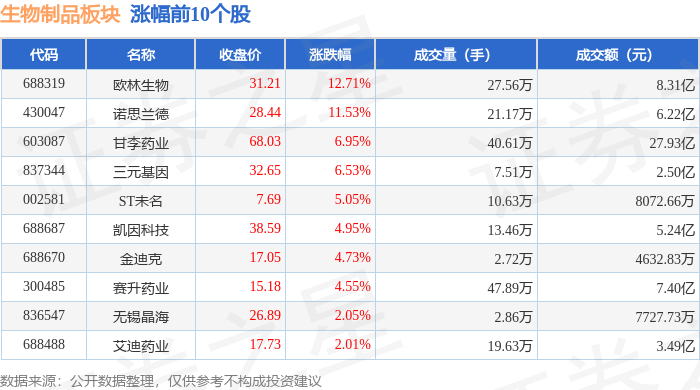
Market Overview - The biopharmaceutical sector increased by 0.27% on August 19, with Olin Bio leading the gains [1] - The Shanghai Composite Index closed at 3727.29, down 0.02%, while the Shenzhen Component Index closed at 11821.63, down 0.12% [1] Top Performers - Olin Bio (688319) closed at 31.21, up 12.71% with a trading volume of 275,600 shares and a transaction value of 831 million [1] - Nossland (430047) closed at 28.44, up 11.53% with a trading volume of 211,700 shares and a transaction value of 622 million [1] - Ganli Pharmaceutical (603087) closed at 68.03, up 6.95% with a trading volume of 406,100 shares and a transaction value of 2.793 billion [1] Underperformers - Junshi Biosciences (688180) closed at 45.32, down 3.70% with a trading volume of 210,400 shares and a transaction value of 977 million [2] - ZhiXiangQuanTai (688443) closed at 33.05, down 3.42% with a trading volume of 77,200 shares and a transaction value of 260 million [2] - SanShengGuoJian (688336) closed at 54.10, down 2.50% with a trading volume of 85,900 shares and a transaction value of 477 million [2] Capital Flow - The biopharmaceutical sector saw a net inflow of 250 million from institutional investors, while retail investors experienced a net outflow of 379 million [2][3] - Major stocks like Shenzhou Cell (688520) had a net inflow of 1.39 billion from institutional investors, but a net outflow of 1.08 billion from retail investors [3]


ST未名: 浙江天册(深圳)律师事务所关于未名医药2025年第一次临时股东会的法律意见书
Zheng Quan Zhi Xing· 2025-08-15 16:24
Core Viewpoint - The legal opinion letter confirms the legality and validity of the procedures, qualifications of attendees, and voting results of the 2025 first extraordinary general meeting of Shandong Weiming Bio-Pharmaceutical Co., Ltd. [1][11] Group 1: Meeting Procedures - The meeting was proposed and convened by the board of directors, with the notice published on July 31, 2025, in designated media and on the Shenzhen Stock Exchange website [2][3] - The meeting combined on-site voting and online voting, held on August 15, 2025, at a specified location in Zibo City, Shandong Province [2][3] Group 2: Attendee Qualifications - Attendees included all registered shareholders of the Shenzhen branch, with the option to appoint proxies [5] - A total of 323 participants attended the meeting, representing 143,261,055 shares, which is 21.7149% of the total voting shares [5] Group 3: Voting Procedures and Results - The voting process adhered to legal and regulatory requirements, with results announced immediately after voting [6][9] - The voting results showed that the proposals received overwhelming support, with significant majorities in favor, including 97.8610% for one proposal and 97.4201% for another [6][8][9]
ST未名: 2025年第一次临时股东会决议公告
Zheng Quan Zhi Xing· 2025-08-15 16:24
Meeting Details - The meeting was held on August 15, 2025, at 2:30 PM, with online voting available from 9:15 AM to 3:00 PM on the same day [1] - A total of 323 shareholders participated, representing 143,261,055 shares, which is 21.7149% of the total voting shares [1] Shareholder Participation - Among the participants, 9 shareholders voted in person, representing 135,985,362 shares (20.6121% of total voting shares), while 314 shareholders voted online, representing 7,275,693 shares (1.1028% of total voting shares) [2][3] Proposal Voting Results - Proposal 1: Amendment to the Articles of Association - Votes in favor: 140,196,722 shares (97.8610%) - Votes against: 3,022,233 shares (2.1096%) - Abstentions: 0.0294% [2] - Proposal 2: Amendment to the Rules of Procedure for Shareholders' Meetings - Votes in favor: 139,565,062 shares (97.4201%) - Votes against: 3,653,893 shares (2.5505%) - Abstentions: 0.0294% [3][4] - Proposal 3: Amendment to the Rules of Procedure for Board Meetings - Votes in favor: 139,565,262 shares (97.4202%) - Votes against: 3,653,693 shares (2.5504%) - Abstentions: 0.0294% [4] - Proposal 4: Amendment to the Independent Director Work Rules - Votes in favor: 139,565,762 shares (97.4206%) - Votes against: 3,653,693 shares (2.5504%) - Abstentions: 0.0290% [5] - Proposal 5: Establishment of the Senior Management Compensation System - Votes in favor: 140,125,922 shares (97.8116%) - Votes against: 3,065,033 shares (2.1395%) - Abstentions: 0.0489% [5] - Proposal 6: Sixth Board Compensation Plan - Votes in favor: 140,122,122 shares (97.8089%) - Votes against: 3,069,333 shares (2.1425%) - Abstentions: 0.0486% [6] Legal Opinion - The legal opinion confirmed that the qualifications of the attendees and the voting procedures complied with legal and regulatory requirements, making the voting results valid [6]