
ASK PHARM(002755)

Search documents
奥赛康10月22日获融资买入1360.95万元,融资余额2122.58万元
Xin Lang Cai Jing· 2025-10-23 01:39
Core Insights - On October 22, Aosai Kang's stock increased by 0.93%, with a trading volume of 245 million yuan [1] - The company reported a financing buy amount of 13.61 million yuan and a net financing buy of 7.71 million yuan on the same day [1][2] - As of October 22, the total financing and securities lending balance for Aosai Kang was 21.23 million yuan, accounting for 0.12% of its market capitalization [2] Financial Performance - For the first half of 2025, Aosai Kang achieved a revenue of 1.007 billion yuan, representing a year-on-year growth of 9.20% [2] - The net profit attributable to the parent company was 160 million yuan, showing a significant year-on-year increase of 111.64% [2] Shareholder Information - As of September 30, the number of shareholders for Aosai Kang was 27,200, an increase of 35.87% compared to the previous period [2] - The average number of circulating shares per shareholder was 34,075, which decreased by 26.40% from the previous period [2] Dividend Distribution - Since its A-share listing, Aosai Kang has distributed a total of 721 million yuan in dividends, with 111 million yuan distributed over the past three years [3] Institutional Holdings - As of June 30, 2025, the sixth largest circulating shareholder was Yongying Medical Innovation Mixed Fund, holding 11.69 million shares as a new shareholder [3] - Other notable shareholders include Penghua Medical Technology Stock A and E Fund Healthcare Industry Mixed A, with slight reductions in their holdings [3]

奥赛康跌2.09%,成交额8945.80万元,主力资金净流出914.48万元
Xin Lang Cai Jing· 2025-10-21 02:18
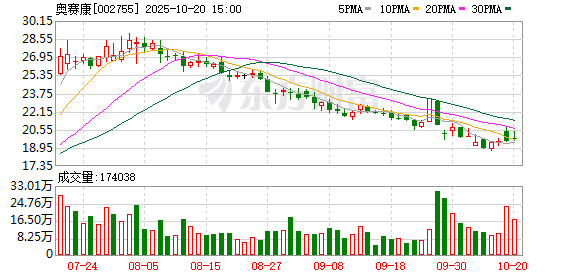
Core Viewpoint - As of October 21, Osai Kang's stock price has experienced fluctuations, with a year-to-date increase of 52.90%, but a recent decline over the past 20 and 60 days, indicating volatility in investor sentiment and market performance [1]. Financial Performance - For the first half of 2025, Osai Kang reported a revenue of 1.007 billion yuan, representing a year-on-year growth of 9.20%. The net profit attributable to shareholders was 160 million yuan, showing a significant increase of 111.64% [2]. - Cumulatively, since its A-share listing, Osai Kang has distributed a total of 721 million yuan in dividends, with 111 million yuan distributed over the past three years [3]. Shareholder and Market Activity - As of September 30, the number of shareholders for Osai Kang increased by 35.87% to 27,200, while the average number of circulating shares per person decreased by 26.40% to 34,075 shares [2]. - The stock has seen significant trading activity, with a net outflow of 9.1448 million yuan in principal funds on October 21, and notable fluctuations in large order buying and selling [1]. Business Overview - Osai Kang, established on December 24, 1996, and listed on May 15, 2015, is based in Nanjing, Jiangsu Province. The company specializes in the research, production, and sales of pharmaceuticals, with a revenue composition of 38.28% from anti-tumor drugs, 24.74% from anti-infection drugs, 21.65% from chronic disease medications, and 12.33% from digestive drugs [1]. - The company operates within the pharmaceutical and biotechnology sector, focusing on innovative drugs, cancer treatment, and biopharmaceuticals [1].
奥赛康:截至9月30日,公司股东人数为27238户
Zheng Quan Ri Bao· 2025-10-20 10:40
Core Insights - As of September 30, the number of shareholders for the company Aosaikang is reported to be 27,238 [2] Company Summary - The company Aosaikang has engaged with investors through an interactive platform, providing transparency regarding its shareholder count [2]

10月20日晚间重要公告一览
Xi Niu Cai Jing· 2025-10-20 10:35
Group 1 - Yonghe Co., Ltd. reported a net profit of 469 million yuan for the first three quarters, a year-on-year increase of 220.39% [1] - Jinli Permanent Magnet achieved a net profit of 515 million yuan, reflecting a year-on-year growth of 161.81% [1][2] - Sanhe Pharmaceutical Auxiliary's net profit increased by 8.28% year-on-year, reaching 133 million yuan [2] Group 2 - Jiahuan Technology experienced a net profit decline of 26.53%, totaling 55.35 million yuan [3] - Wuchan Huaneng reported a net profit decrease of 15.10%, amounting to 453 million yuan [3] - Chuan Investment Energy's net profit fell by 4.54%, totaling 4.22 billion yuan [4][5] Group 3 - Dayang Bio's net profit grew by 56.12%, reaching 80 million yuan [5] - Weili Medical reported a net profit increase of 14.94%, totaling 192 million yuan [6] - People's Tongtai's net profit decreased by 45.69%, amounting to 112 million yuan [7] Group 4 - Jiuhuan Bio received a medical device registration certificate for its NT-proBNP test kit [8] - Jincheng Pharmaceutical's subsidiary obtained a drug registration certificate for a specific injection [9] - Guangdian Yuntong's subsidiary acquired a money service operator license in Hong Kong [10] Group 5 - Dash Intelligent won a bid for a project worth 96 million yuan related to the Shijiazhuang subway [10] - Alloy Investment's net profit increased by 124.87%, reaching 7.26 million yuan [11] - Kaile Co., Ltd. reported a net profit growth of 159.14%, totaling 21.63 million yuan [12] Group 6 - Chuanjinno's net profit surged by 175.61%, reaching 304 million yuan [14] - Rijiu Optoelectronics reported a net profit increase of 36.54%, totaling 76.91 million yuan [15] - Dazhu CNC's net profit grew by 142.19%, amounting to 492 million yuan [15] Group 7 - Nairui Radar expects a net profit increase of 181% for the first three quarters [17] - Suzhou Tianmai successfully acquired land use rights for a new manufacturing project [19] - Aokai Pharmaceutical announced clinical research data for its innovative drug at a major conference [21][22] Group 8 - Jilin Aodong's subsidiary passed the consistency evaluation for a specific injection [24] - Qinxin Environment announced the resignation of a board member [25] - *ST Baoying is planning a change in control, leading to a stock suspension [26] Group 9 - Jianlang Hardware's director plans to reduce holdings by up to 500,000 shares [27] - Taihe Technology's director intends to reduce holdings by up to 606,000 shares [29] - Zhongyuan Securities announced a cash dividend of 0.008 yuan per share [31] Group 10 - Beijing-Shanghai High-Speed Railway plans to distribute a cash dividend of 0.0385 yuan per share [32] - Zhuhai Guanyu expects a net profit increase of 36.88%-55.54% for the first three quarters [34] - Shenglong Co., Ltd. reported a net loss of 72.95 million yuan for the first three quarters [36] Group 11 - Shuangyuan Technology plans to distribute a cash dividend of 0.125 yuan per share [38] - Shaanxi Guotou A reported a net profit increase of 6.6%, totaling 996 million yuan [40] - Sunshine Nuohua intends to invest 15 million yuan in a biotech company [41] Group 12 - Yangjie Technology's net profit increased by 45.51%, reaching 974 million yuan [42] - Xingwang Yuda reported a net profit growth of 260%, totaling 38.37 million yuan [43] - Tongyou Technology turned a profit with a net profit of 9.29 million yuan [44]



奥赛康(002755) - 自愿披露创新药ASKB589在2025年ESMO年会公布临床研究数据的公告
2025-10-20 08:00
北京奥赛康药业股份有限公司 自愿披露创新药 ASKB589 在 2025 年 ESMO 年 会公布临床研究数据的公告 本公司及董事会全体成员保证信息披露内容的真实、准确和完 整,没有虚假记载、误导性陈述或重大遗漏。 北京奥赛康药业股份有限公司(以下简称"公司")的子公司 ASKGENE LIMITED 于 2025 年 10 月 19 日在德国柏林召开的欧洲肿瘤内科学会(ESMO) 年会上,以壁报形式公布在研生物创新药 ASKB589(靶向 CLDN18.2 单克隆抗 体)联合 CAPOX 及 PD-1 抑制剂在晚期胃癌一线治疗中的最新研究成果,相关 情况如下: 一、壁报内容概要 证券代码:002755 证券简称:奥赛康 公告编号:2025-054 剂量扩展研究中,CLDN18.2 中高表达的 IV 期 G/GEJ 腺癌受试者确认的肿 瘤客观缓解率 (cORR)为 76.1%,中位肿瘤缓解时长(mDOR)为 13.9 个月,疾 病控制率 (DCR)为 100%。截止 2025 年 8 月 30 日,受试者中位随访 26.71 个月(范 围:19.9-28.8),61.7%(29/47)的受试者发生疾病进展或死 ...
奥赛康:创新药ASKB589在ESMO年会公布临床研究数据
Zheng Quan Shi Bao Wang· 2025-10-20 07:59
Core Viewpoint - ASKGENE LIMITED, a subsidiary of Aosaikang (002755), presented promising results for its investigational drug ASKB589 at the ESMO annual meeting, indicating significant potential in treating advanced gastric cancer [1] Group 1: Clinical Research Findings - ASKB589, a monoclonal antibody targeting CLDN18.2, combined with CAPOX (oxaliplatin and capecitabine) and PD-1 inhibitors, showed deep and durable tumor responses in patients with locally advanced, recurrent, or metastatic gastric and gastroesophageal junction adenocarcinoma [1] - The Ib/II phase clinical study demonstrated sustained disease control and clear survival benefits with longer follow-up [1] - These findings support the ongoing pivotal phase III clinical trials of ASKB589 in combination with chemotherapy and PD-1 inhibitors [1]
奥赛康(002755.SZ):创新药ASKB589在2025年ESMO年会公布临床研究数据
智通财经网· 2025-10-20 07:55
Core Viewpoint - The announcement highlights the promising results of ASKGENE LIMITED's investigational drug ASKB589 in combination with CAPOX and PD-1 inhibitors for the first-line treatment of advanced gastric cancer, showcasing significant survival benefits and reinforcing the drug's market competitiveness [1] Group 1: Clinical Research Findings - ASKB589, a monoclonal antibody targeting CLDN18.2, demonstrated deep and durable tumor responses and disease control in a Phase Ib/II clinical study for patients with locally advanced, recurrent, or metastatic gastric and gastroesophageal junction adenocarcinoma [1] - The latest data presented at the ESMO conference confirmed the significant and lasting anti-tumor activity of the ASKB589 combination therapy, marking the first report of overall survival (OS) benefits in advanced first-line gastric cancer patients [1] Group 2: Future Implications - The positive clinical data supports the ongoing pivotal Phase III clinical trials of ASKB589 in combination with chemotherapy and PD-1 inhibitors, enhancing the potential for market competitiveness of the company's product [1]
10月20日早间重要公告一览
Xi Niu Cai Jing· 2025-10-20 03:58
Group 1 - Xuedilong plans to invest no more than 400 million yuan to build an innovation industrial base in Changping District, Beijing, focusing on chromatography and mass spectrometry production lines [1] - The project aims to enhance research and production capabilities in carbon monitoring and measurement systems [1] Group 2 - Zejing Pharmaceutical's tri-specific antibody drug ZGGS34 has received clinical trial approval from the National Medical Products Administration for treating MUC17 positive advanced solid tumors [2] - The drug shows strong anti-tumor activity and good safety in preclinical studies [2] Group 3 - Aosaikang's new cMET inhibitor ASK202 will present clinical research data at the 2025 ESMO annual meeting, showing an objective response rate of 68.8% and a disease control rate of 93.8% in advanced non-small cell lung cancer patients [2][3] Group 4 - China Life expects a net profit of 156.785 billion to 177.689 billion yuan for the first three quarters of 2025, representing a year-on-year increase of 50% to 70% [4] Group 5 - Silan Microelectronics plans to jointly invest 5.1 billion yuan to build a 12-inch high-end analog chip production line, with a total project investment of 20 billion yuan [5][6] Group 6 - New City intends to use 156.65 million yuan of remaining fundraising to invest in a "Building Green Energy and Zero Carbon Park" project, with a total investment of 257 million yuan [8] Group 7 - Yidao Information plans to acquire control of Guangzhou Langguo Electronic Technology and Shenzhen Chengwei Information through a combination of share issuance and cash payment [9] Group 8 - Xiling Information's controlling shareholder has received a notice of lifting restrictions, allowing normal business operations to resume [10] Group 9 - Dongpeng Holdings' first batch of rock slab products has passed the highest level 5A quality inspection, becoming one of the first companies to meet the new national standard [11] Group 10 - Aonlikang's levofloxacin tablets have received approval from the National Medical Products Administration, classified as a chemical drug of category 4 [15] Group 11 - Haizheng Pharmaceutical's Taizhou factory has had its GMP non-compliance declaration revoked by the EU, confirming compliance with EU GMP requirements [17][18] Group 12 - Hongfuhan's shareholder plans to reduce its stake by up to 1.5% through various trading methods due to asset integration and funding needs [19] Group 13 - Purang Co. plans to establish a wholly-owned subsidiary in Hong Kong to enhance its international competitiveness and service levels [20] Group 14 - Tianhe Magnetic Materials' subsidiary has signed an investment agreement for a project worth 850 million yuan focused on high-performance rare earth permanent magnets [22] Group 15 - Xiangfenghua reported a 64.64% year-on-year decline in net profit for the first three quarters, despite an 8.16% increase in revenue [23] Group 16 - Darui Electronics reported a 26.84% year-on-year increase in net profit for the first three quarters, with total revenue growing by 28.59% [24] Group 17 - Xiangsheng Medical reported a 4.56% year-on-year decline in net profit for the first three quarters, despite a 41.95% increase in net profit for the third quarter [25]



医药生物行业周报(10月第3周):创新药出海,BD热度不减-20251020
Century Securities· 2025-10-20 00:44
Investment Rating - The report does not explicitly state an investment rating for the industry [2] Core Insights - The pharmaceutical and biotechnology sector experienced a decline of 2.48% from October 13 to October 17, underperforming the broader market index, the CSI 300, which fell by 2.22% [3][8] - There is a sustained enthusiasm for business development (BD) transactions in innovative drugs, with several companies entering agreements with international pharmaceutical firms [3][12] - The ESMO conference held from October 17 to 21 showcased positive advancements in multiple studies, particularly in immunotherapy and antibody-drug conjugates (ADCs), highlighting the potential of domestic biotech companies [3][11] Market Weekly Review - The pharmaceutical and biotechnology sector saw a weekly decline of 2.48%, with offline pharmacies and traditional Chinese medicine showing slight gains of 0.59% and 0.38%, respectively [8] - Medical research outsourcing, medical devices, and other biological products faced significant declines, with drops of 6.46%, 5.37%, and 3.6% respectively [8][9] - Notable stock performances included Asia-Pacific Pharmaceutical with a rise of 36.7%, while Betta Pharmaceuticals saw a decline of 17.0% [11] Industry News and Key Company Announcements Important Industry Events - On October 18, Kangfang Biologics presented data on a PD-1/VEGF dual antibody in non-small cell lung cancer at the ESMO conference, showing significant improvement in progression-free survival (PFS) [11] - On October 16, Hansa Biopharma announced a licensing agreement with Roche for the global exclusive rights to develop and commercialize HS-20110, with an upfront payment of $80 million [12] - On October 16, Prigen Biologics entered a collaboration with Gilead's Kite Pharma, receiving an upfront payment of $120 million [12][13] Company Announcements - Huayuan Biologics reported a slight decrease in total revenue for the third quarter, amounting to 936 million yuan, a 0.2% year-on-year decline [14] - Shanghai Pharmaceuticals received FDA approval for Doxycycline capsules, with projected sales of approximately $130 million in the U.S. for 2024 [14][16]



奥赛康创新药ASKC202在2025年ESMO年会公布临床研究数据
Bei Jing Shang Bao· 2025-10-19 10:28
Core Viewpoint - The company announced the presentation of clinical trial data for its new cMET inhibitor ASK202 in combination with Lapatinib at the ESMO annual meeting, indicating potential for effective treatment in patients with advanced non-small cell lung cancer who have failed EGFR-TKI therapy [1] Group 1 - The clinical trial data was presented in poster format at the European Society for Medical Oncology (ESMO) annual meeting held in Berlin on October 18 [1] - The combination of ASK202 (cMET inhibitor) and Lapatinib (third-generation EGFR TKI) aims to provide a solution for lung cancer patients who are resistant to EGFR-TKI, potentially extending their survival [1] - The collaboration of these two innovative drug projects enhances the company's pipeline in the oncology sector, positively impacting its strategic layout [1]