Wangsu Science & Technology (300017)

Search documents
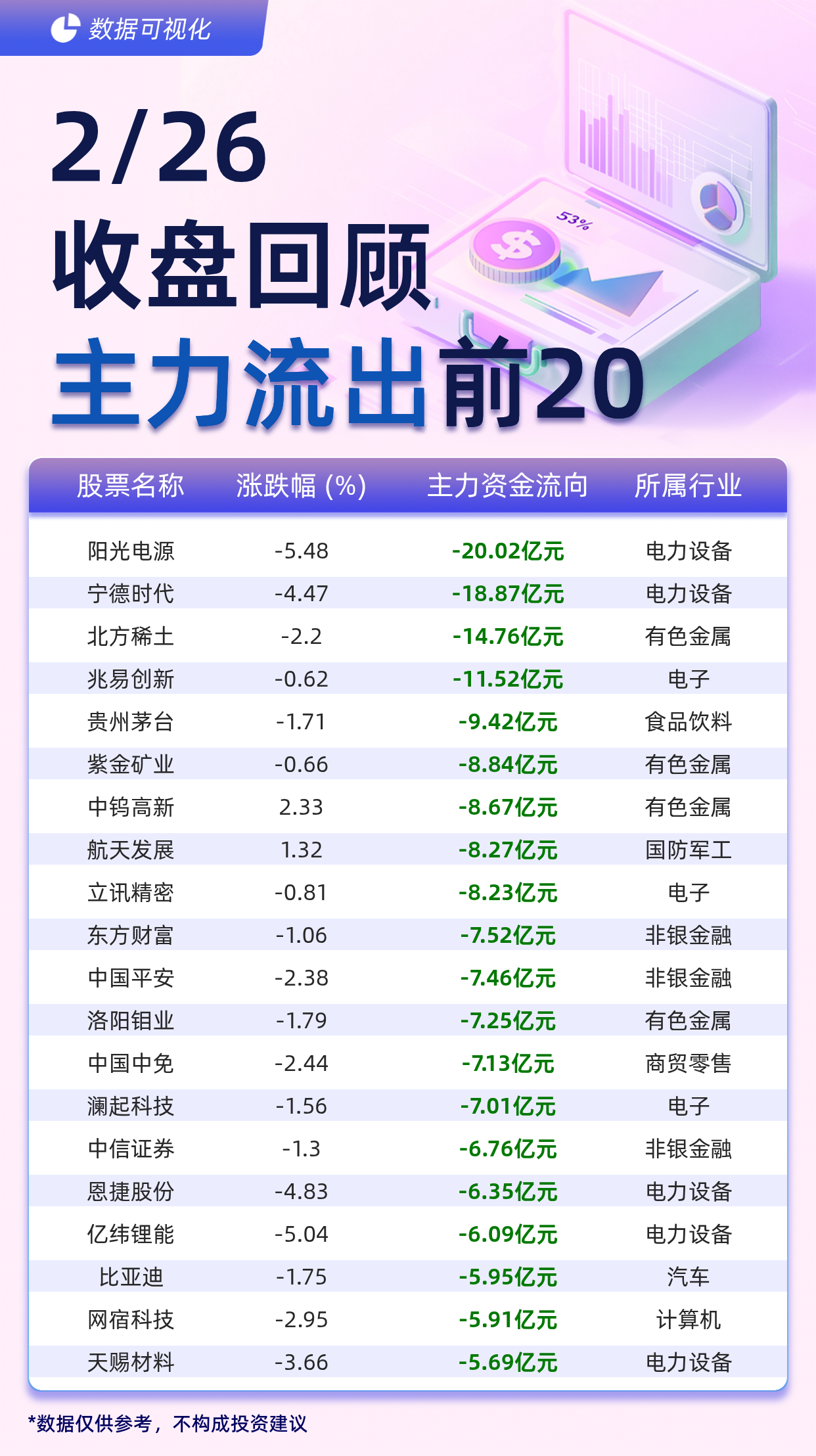
主力个股资金流出前20:阳光电源流出20.02亿元、宁德时代流出18.87亿元




Jin Rong Jie· 2026-02-26 07:11
Core Viewpoint - The data indicates significant outflows of main funds from various stocks, with notable amounts in the energy, materials, and financial sectors [1][2][3] Group 1: Stock Outflows - The stock with the highest outflow is 阳光电源, with a total of -20.02 billion yuan [1][2] - 宁德时代 follows closely with an outflow of -18.87 billion yuan [1][2] - Other significant outflows include 北方稀土 at -14.76 billion yuan and 兆易创新 at -11.52 billion yuan [1][2] Group 2: Sector Analysis - The electric equipment sector shows substantial outflows, with 阳光电源 and 宁德时代 leading [2] - The non-ferrous metals sector is also impacted, with 北方稀土 and 紫金矿业 experiencing notable outflows [2][3] - The financial sector, represented by 中国平安 and 中信证券, also shows significant fund outflows [2][3] Group 3: Additional Notable Stocks - 贵州茅台 has an outflow of -9.42 billion yuan, indicating a decline in investor interest [1][3] - 立讯精密 and 恩捷股份 also report outflows of -8.23 billion yuan and -6.35 billion yuan respectively, reflecting trends in the electronics and energy sectors [1][3] - 比亚迪, a key player in the automotive sector, shows an outflow of -5.95 billion yuan, suggesting potential shifts in market sentiment [1][3]

AI 重塑网络结构,CDN 转型“分布式大脑”
CAITONG SECURITIES· 2026-02-26 02:40
Investment Rating - The report maintains a "Positive" investment rating for the industry [2] Core Insights - The CDN industry is undergoing a transformation driven by AI, evolving from static caching to intelligent computing, with a projected global market growth from $27.8 billion in 2025 to over $79.2 billion by 2034, reflecting a compound annual growth rate (CAGR) of 12.3% [7][19] - The rise of AI is reshaping the CDN landscape, as service providers transition from low-margin bandwidth intermediaries to high-stickiness edge cloud suppliers, emphasizing the importance of technology and compliance in the new ecosystem [71] Summary by Sections CDN Transition to AI Era - The CDN market is entering the AI and computing 4.0 era, evolving from static resource acceleration to intelligent edge services [11] - The CDN industry is positioned in the midstream of the network service value chain, with upstream hardware vendors and telecom operators providing foundational infrastructure [14] - The global CDN market is expected to grow significantly due to demands from video streaming, gaming, and AI, with North America leading the market [19][23] AI and Edge Computing - The demand for "CDN + edge computing" is reshaping the industry ecosystem, as traditional roles of CDN and origin servers are evolving to meet the needs of real-time interactions and AI inference [28][37] - CDN providers are becoming essential platforms for edge computing, leveraging their extensive global nodes to facilitate real-time processing and reduce upstream traffic costs [42] CDN and Edge Preprocessing - The industry is entering a "Tokens explosion" era, with token consumption expected to increase tenfold by 2026, prompting CDNs to shift towards edge preprocessing [44] - Data sovereignty issues are leading CDNs to potentially act as intermediaries in value exchanges between AI and content creators, allowing for new revenue models [49] Financial Metrics of Major CDN Providers - Cloudflare is rapidly growing its revenue through a subscription model, while Akamai focuses on large enterprise clients, showcasing different business strategies [52] - In 2025, Cloudflare's revenue is projected to reach $2.168 billion, with a year-on-year growth of 29.8%, while Akamai's revenue is expected to be $4.208 billion, growing at 5.4% [55][56] Investment Recommendations - The report suggests focusing on technologically advanced and commercially viable CDN service providers such as Cloudflare, Akamai, Fastly, and Wangsu Technology [69]

“Token”出海:中国AI的全球定价权与算力黄金时代
Jin Rong Jie· 2026-02-26 02:29
Core Insights - The article highlights China's dominance in the global AI market, with Chinese models accounting for 61% of the total token volume, which amounts to 5.3 trillion tokens out of 8.7 trillion globally, marking a significant shift from being a follower to a leader in AI technology [1][2]. Group 1: Token as Digital Power - Tokens are described as the universal currency of the AI era, representing a new form of digital energy that allows for cross-border value delivery without physical logistics [2]. - The cost structure of AI services heavily relies on electricity and computing power, which together account for over 70% of the costs, benefiting from China's low-cost green energy and large-scale computing clusters [2]. Group 2: Market Dynamics and Pricing Structure - A significant price increase in cloud services has been observed, with companies like UCloud raising prices across the board and AWS breaking a two-decade trend of price reductions with a 15% increase, indicating a shift in the supply-demand balance [3]. - The competitive edge of Chinese models is attributed to their cost efficiency and engineering capabilities, leading to a global preference for Chinese AI solutions [3]. Group 3: Industry Ecosystem and Key Players - Key players in the ecosystem include: - **Zhipu AI**: A core supplier of computing power, expanding GPU clusters to meet increasing demand [3]. - **ByteDance**: Known for its elastic computing capabilities, supporting large-scale token processing [4]. - **Ascend**: Focused on domestic computing infrastructure, benefiting from the rise of token exports [5]. - **Edge and Transmission**: Companies like Shunwang Technology and Wangsu Technology are positioned as critical channels for AI traffic, enhancing the efficiency of token computation [6]. Group 4: Long-term Outlook - The article suggests that while there may be short-term market fluctuations, the long-term outlook remains positive, with China's global market share expected to grow beyond the current 61% due to its cost and technological advantages [7]. - The demand for computing power is projected to increase exponentially, with token consumption per user potentially rising by 10-50 times as multi-modal AI applications become more prevalent [8]. - The pricing power in the cloud computing sector is shifting, with Chinese computing resources transitioning from a cost advantage to a value premium, indicating a significant opportunity for revenue generation in the global market [9].





主力个股资金流出前20:昆仑万维流出18.58亿元、兆易创新流出12.62亿元



Jin Rong Jie· 2026-02-25 07:31
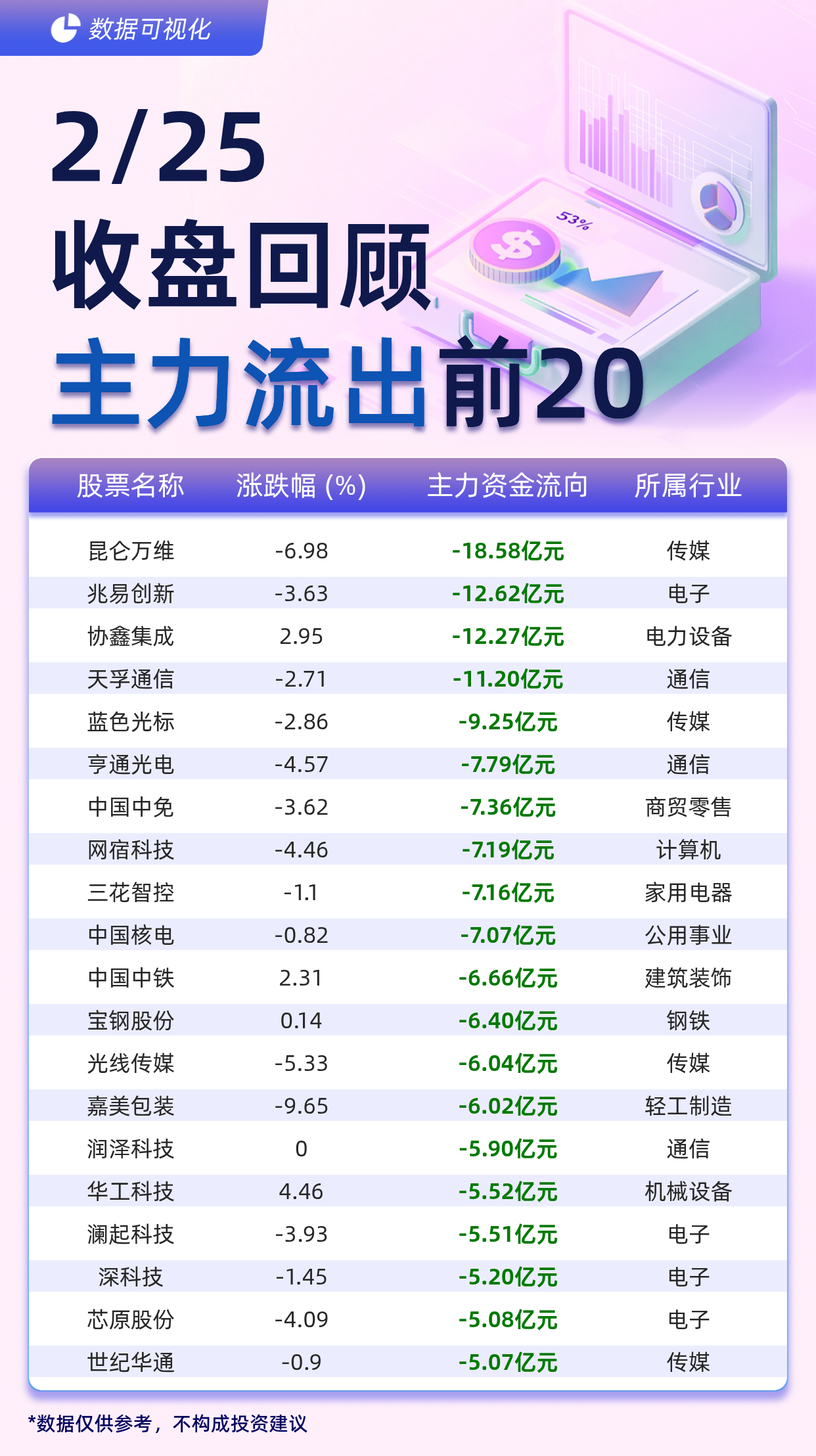
Group 1 - The main stocks with significant capital outflows include Kunlun Wanwei (-1.858 billion), Zhaoyi Innovation (-1.262 billion), and Xiexin Integration (-1.227 billion) [1][2] - The sectors affected by the capital outflows include Media, Electronics, Power Equipment, and Communication [2][3] - Notable declines in stock prices were observed, with Kunlun Wanwei down by 6.98%, Zhaoyi Innovation down by 3.63%, and BlueFocus down by 2.86% [2][3] Group 2 - Other companies with substantial capital outflows include China Zhongmian (-0.736 billion), Wangsu Technology (-0.719 billion), and China Nuclear Power (-0.707 billion) [1][2] - The data indicates a trend of capital leaving the Media and Electronics sectors, with companies like Guanghua Media and Chip Original also experiencing significant outflows [3] - The overall market sentiment appears to be negative, as reflected in the stock price declines across multiple sectors [2][3]
主力个股资金流出前20:昆仑万维流出18.26亿元、兆易创新流出11.75亿元
Jin Rong Jie· 2026-02-25 06:34
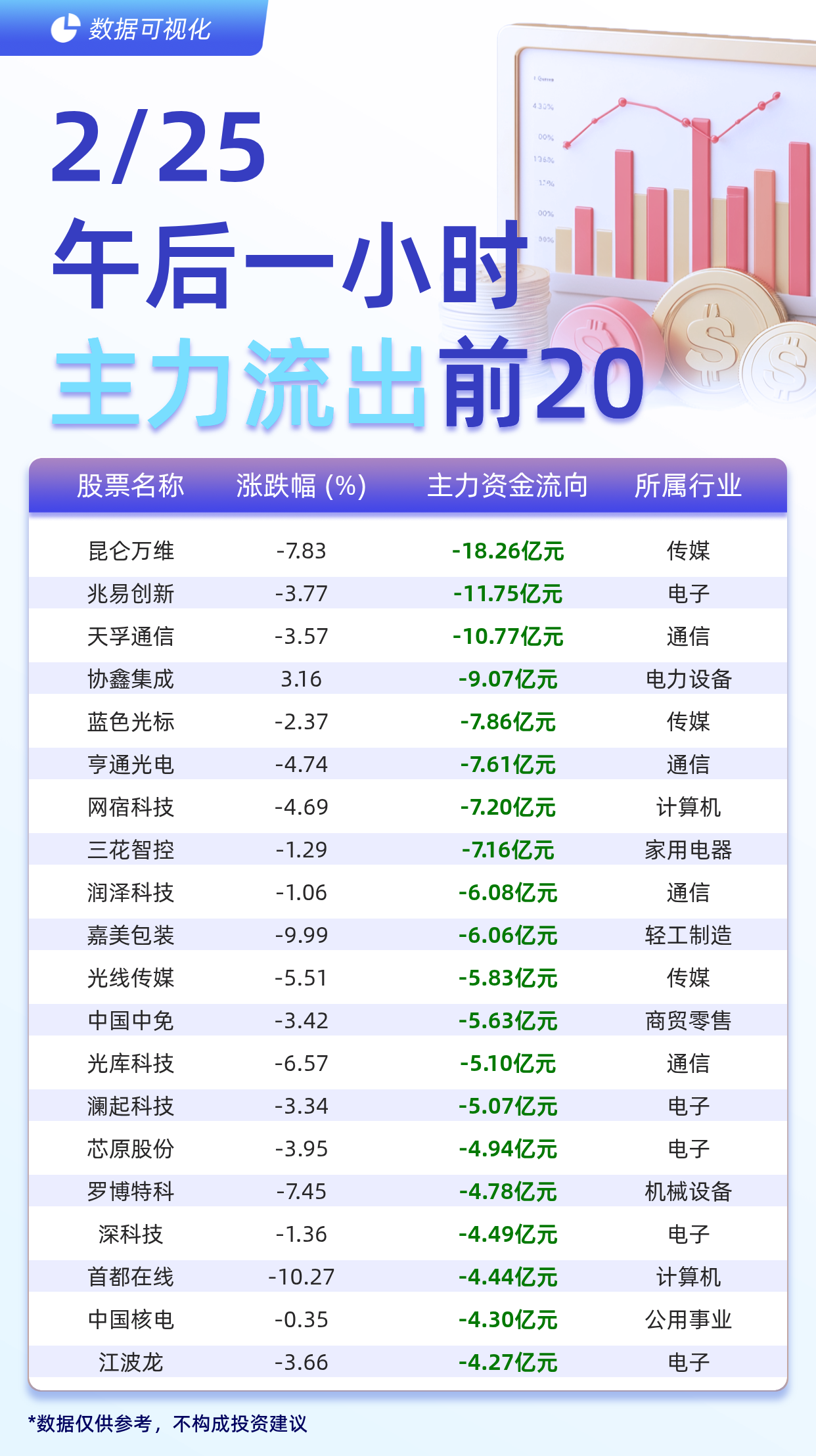
Group 1 - The main stocks with significant capital outflow include Kunlun Wanwei (-1.83 billion), Zhaoyi Innovation (-1.175 billion), and Tianfu Communication (-1.077 billion) [1] - The sectors affected by the capital outflow include Media, Electronics, and Communication, with notable declines in stock prices for companies like Kunlun Wanwei (-7.83%), Zhaoyi Innovation (-3.77%), and Tianfu Communication (-3.57%) [2][3] - Other companies experiencing substantial capital outflow include GCL-Poly Energy (-0.907 billion), BlueFocus (-0.786 billion), and Hengtong Optic-Electric (-0.761 billion) [1] Group 2 - The total capital outflow from the top 20 stocks indicates a trend of investor withdrawal from these sectors, particularly in Media and Electronics [1][2] - Companies like China Duty Free (-0.563 billion) and Guangku Technology (-0.510 billion) also show significant capital outflow, reflecting broader market concerns [3] - The overall market sentiment appears negative, with many stocks experiencing declines in both capital flow and stock price [2][3]




0224狙击龙虎榜
2026-02-25 04:07
Summary of Key Points from Conference Call Records Industry Overview - The market is experiencing a high-level fluctuation with a trading volume of 219.4 billion, indicating strong capital inflow post-holiday. However, short-term sentiment is weakening, suggesting a potential adjustment in the index soon [1] - The oil and gas sector is benefiting from geopolitical tensions in the Middle East, leading to rising oil prices, which are now driven more by geopolitical risks than supply-demand dynamics. High price volatility is expected in the coming month [1] - The chemical industry is at a dual bottom in supply and demand, with expectations of a sector reversal this year due to the end of capital expenditure peaks and policies aimed at reducing competition [1] Company-Specific Insights Huanghe Xuanfeng - Akash Systems delivered the world's first commercial AI server equipped with Diamond Cooling® technology to India's NxGen AI Pvt Ltd, marking a significant milestone in the deployment of diamond thermal management in AI servers. This delivery is backed by a long-term contract worth $27 million signed in December 2024 [3] - Huanghe Xuanfeng has developed an 8-inch diamond heat sink, set to enter mass production in February 2026, and has passed validation from Huawei, indicating strong market potential [3] Wangsu Technology - The cost structure of Token services shows that electricity and computing power account for over 70%. Utilizing China's relatively low electricity costs for AI inference provides a pricing advantage for global AI services [4] - Wangsu Technology has transitioned from a traditional CDN provider to a comprehensive platform integrating edge AI computing, security, and intelligent storage, positioning itself as a crucial infrastructure partner for Chinese AI companies expanding globally [4] Jieput - In AI training clusters, the demand for high-bandwidth interconnections is increasing, leading to a surge in the number of switches and fiber optics. The MMC's ultra-high-density characteristics are becoming essential for CPO solutions, as space for fiber connections is limited [5] - Jieput's MMC products have received US certification and the company is ramping up production to meet strong customer demand, aiming to enhance automation efficiency and secure more major client orders [5] Market Trends and Predictions - The AI sector is experiencing a shift, with applications and computing power rental showing weakness, but the long-term logic of Token expansion is expected to materialize this year [1] - The focus for future investments may revolve around resource products and technology hardware, indicating a dual strategy in market positioning [1] Stock Performance - Notable stock movements include: - Huanghe Xuanfeng: +9.98% - Jieput: +1.80% - Wangsu Technology: -5.42% [6] This summary encapsulates the key insights and trends from the conference call, highlighting the dynamics within the industry and specific companies that are poised for growth or facing challenges.


算力租赁板块短线跳水,浙数文化、网宿科技、人民网跌超9%
Mei Ri Jing Ji Xin Wen· 2026-02-24 11:20
Core Viewpoint - The computing power leasing sector experienced a sharp decline on February 24, with several companies seeing significant drops in their stock prices [1] Group 1: Company Performance - Zhejiang Shuju Culture, Wangsu Science and Technology, and People’s Daily all fell by over 9% [1] - Aofei Data, Tongniu Information, and Qingyun Technology also reported notable declines, leading the market in losses [1]


算力租赁概念震荡下挫
Di Yi Cai Jing· 2026-02-24 11:15
Group 1 - Major declines observed in the stock prices of several companies, including Dawi Technology, which hit the daily limit down, and Guanghuan Xinwang and Yuntian Lifeng, both dropping over 10% [1] - Other companies experiencing significant declines include Aofei Data, Wangsu Technology, Dataport, Qingyun Technology, Yunsai Zhili, Dongfang Guoxin, Yakang Co., and Hang Steel, all of which are among the top losers [1]




「数据看盘」多路资金联手抢筹深南电路,顶级游资扎堆通源石油
Sou Hu Cai Jing· 2026-02-24 10:27
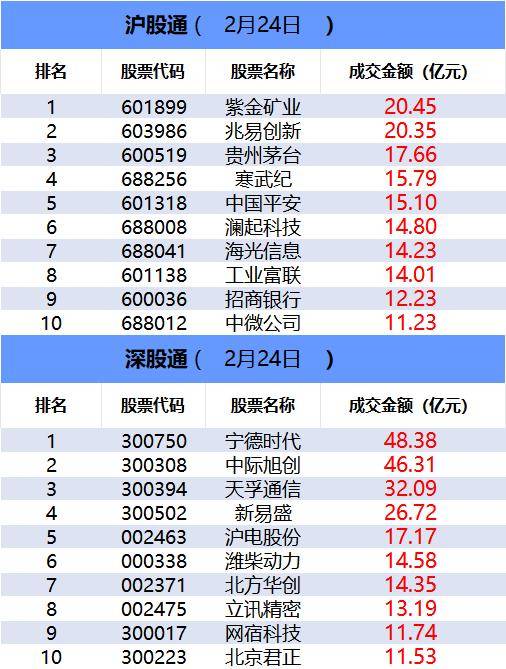
Market Overview - The stock market saw significant activity with deep South Circuit's strong performance, closing at the daily limit with institutional purchases totaling 96.32 million and a deep stock connection buying 413 million [1][12] - Oil and gas stocks led the market, with Tongyuan Petroleum hitting the daily limit and attracting a total of 154 million from three major institutional investors [1][13] Trading Volume - The total trading volume for the Shanghai Stock Connect was 145.275 billion, while the Shenzhen Stock Connect reached 171.886 billion [2] Top Stocks by Trading Volume - In the Shanghai Stock Connect, the top traded stocks included Zijin Mining at 2.045 billion, followed by Zhaoyi Innovation at 2.035 billion and Kweichow Moutai at 1.766 billion [3] - In the Shenzhen Stock Connect, the leading stocks were CATL at 4.838 billion, followed by Zhongji Xuchuang at 4.631 billion and Tianfu Communication at 3.209 billion [3] Sector Performance - The oil and gas, precious metals, cultivated diamonds, and chemical sectors showed the highest gains, while the film and television, AI applications, and other sectors experienced declines [4] Fund Flow Analysis - The non-ferrous metals sector saw the highest net inflow of funds, while the computer sector experienced the largest net outflow, totaling -12.407 billion [6] - The top stocks with net inflows included Zhongji Xuchuang at 2.218 billion and Huagong Technology at 1.33 billion [7] - Conversely, the stocks with the highest net outflows included Huasheng Tiancai at -1.638 billion and Dazhi Technology at -1.532 billion [8] ETF Trading - The top ETFs by trading volume included A500 ETF Fund at 8.3719 billion, Gold ETF at 8.2416 billion, and A500 ETF Huatai at 7.9285 billion [9] - The ETFs with the highest growth in trading volume compared to the previous trading day included S&P Oil and Gas ETF at 1.5465 billion, showing a 367.86% increase [10] Futures Market - In the futures market, the main contracts for IH, IF, and IC saw both long and short positions decrease, while the IM contract saw an increase in short positions [11]




新易盛、中际旭创均获融资资金买入约百亿元丨资金流向周报
2 1 Shi Ji Jing Ji Bao Dao· 2026-02-24 03:12
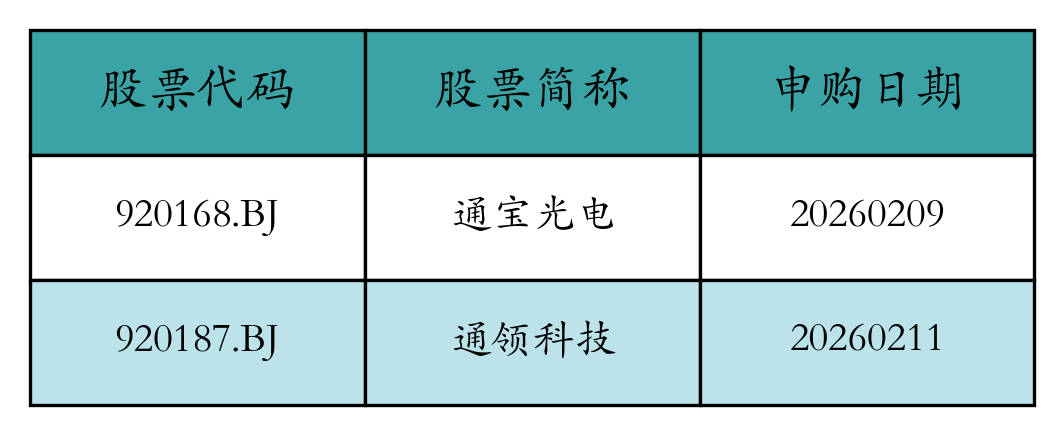
Market Overview - The Shanghai Composite Index increased by 0.41% to close at 4082.07 points, with a weekly high of 4142.56 points [1] - The Shenzhen Component Index rose by 1.39% to 14100.19 points, reaching a peak of 14296.48 points [1] - The ChiNext Index saw a 1.22% increase, closing at 3275.96 points, with a high of 3348.48 points [1] - In the global market, the Nasdaq Composite fell by 2.1%, the Dow Jones Industrial Average decreased by 1.23%, and the S&P 500 dropped by 1.39% [1] - In the Asia-Pacific region, the Hang Seng Index rose by 0.03%, while the Nikkei 225 Index increased by 4.96% [1] New Stock Issuance - Two new stocks were issued during the week: Tongbao Optoelectronics (920168.BJ) on February 9, 2026, and Tongling Technology (920187.BJ) on February 11, 2026 [2] Margin Trading - The total margin trading balance in the Shanghai and Shenzhen markets was 25,797.58 billion yuan, with a financing balance of 25,640.12 billion yuan and a securities lending balance of 157.46 billion yuan [3] - The margin trading balance decreased by 752.4 billion yuan compared to the previous week [3] - The Shanghai market's margin trading balance was 13,113.7 billion yuan, down by 356.66 billion yuan, while the Shenzhen market's balance was 12,683.88 billion yuan, down by 395.74 billion yuan [3] - A total of 3,486 stocks had margin buying, with 184 stocks having over 1 billion yuan in buying amounts, led by Xinyi Technology (103.25 billion yuan), Zhongji Xuchuang (98.63 billion yuan), and Wangsu Science and Technology (74.22 billion yuan) [3] Fund Issuance - Seven new funds were issued during the week, including Guoshou Anbao Enhanced Return Bond E, Huafu Anhua Bond D, Dongfanghong Monetary F, Bank of China Health Life Mixed C, Huitianfu Tiantianle Double Win Bond E, Nuoan Selected Return Mixed C, and Changsheng Electronic Information Theme Mixed C [5] Share Buybacks - Eight companies announced share buybacks, with the highest amounts executed by Luxshare Precision (002475), Hengyi Petrochemical (000703), Linyang Energy (601222), Kaiying Network (002517), and Huitai Medical (688617) [7] - The industries with the highest buyback amounts were electronics, petroleum and petrochemicals, and public utilities [8]