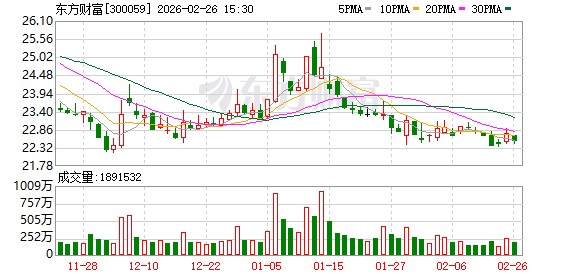
EASTMONEY(300059)

Search documents
东方财富证券:把握券商“价值修复”与“成长兑现”的双重机遇
智通财经网· 2026-02-27 07:13
Core Viewpoint - The current market conditions indicate that a new round of market rally is set to begin, supported by a combination of valuation, policy, and macroeconomic factors that exhibit greater endogenous stability [1][2] Valuation Insights - The brokerage sector is significantly undervalued in static terms and possesses upward potential in dynamic terms, with a configuration logic described as having "three layers of bottom protection" and dual recovery space for profits and valuations [1] - The historical context shows that brokerage market trends typically start from a "triple bottom resonance" leading to profit realization, with valuation bottoms corresponding to historical low PB levels, providing a price safety net and rebound elasticity [2] Policy Environment - Expectations for the "14th Five-Year Plan" capital market reforms are anticipated to intensify, shifting the focus from counter-cyclical support to pro-cyclical institutional construction, which is expected to systematically release institutional dividends [2] Macroeconomic Factors - Economic stabilization, marginal recovery in inflation, and strong expectations for monetary policy easing create a favorable environment for equity assets, supporting continued transaction recovery alongside the trend of "deposit migration" [2] Structural Issues - The mismatch of "high ROE - low PB" highlights structural contradictions within the industry, with the brokerage sector's annualized ROE reaching approximately 8.7% in Q1-Q3 2025, the best performance since 2022, while the sector's PB remains at 1.39, significantly below historical valuation levels [3] - Concerns regarding the current profit structure being overly reliant on market conditions and homogeneous competition are seen as temporary, with potential for business and institutional restructuring to reshape market perceptions of brokerage ROE's "value" [3]

其实,将捐赠市值4.5亿元股票
Xin Lang Cai Jing· 2026-02-27 05:31
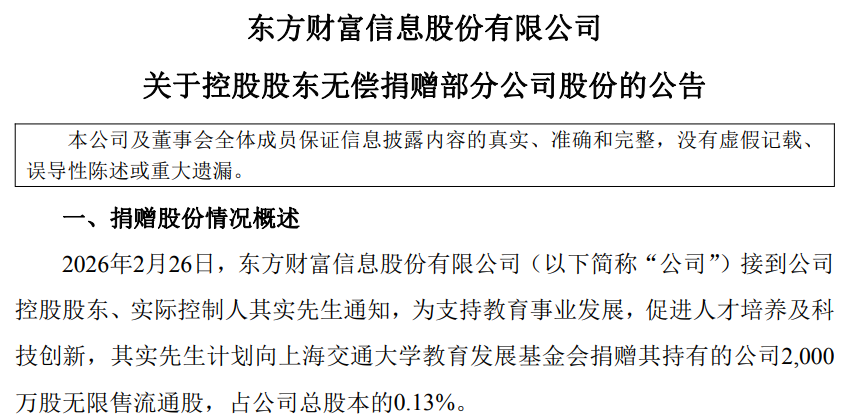
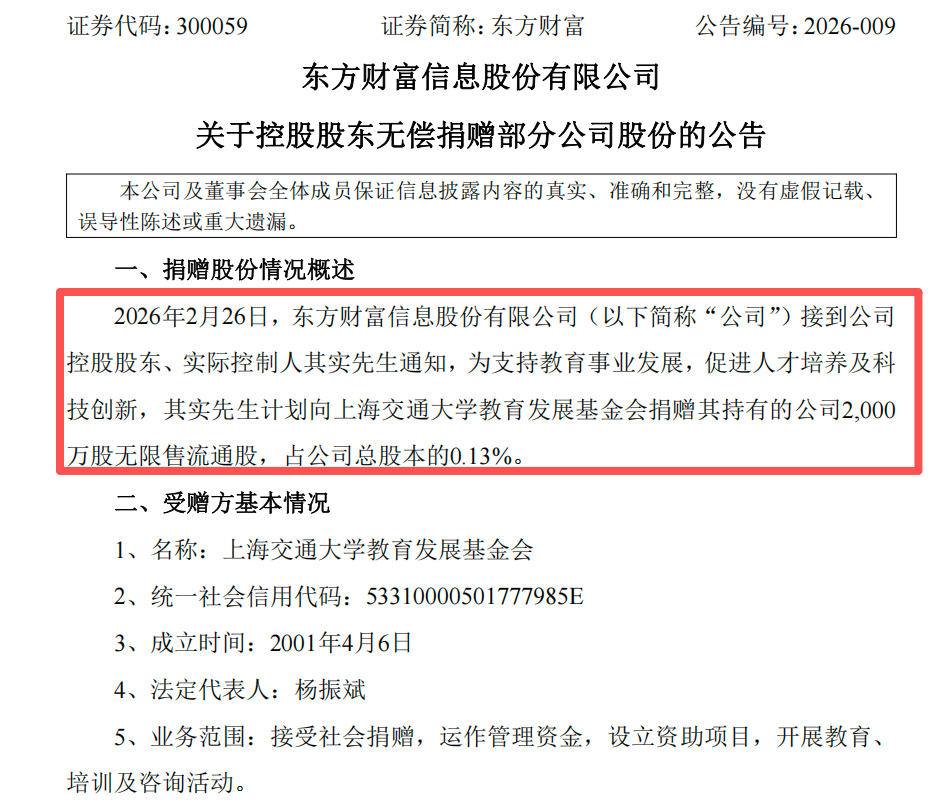
Core Viewpoint - The company, Dongfang Caifu Information Co., Ltd., announced a plan by its controlling shareholder, Qishi, to donate 20 million shares, representing 0.13% of the total share capital, to the Shanghai Jiao Tong University Education Development Foundation to support educational development and talent cultivation [1][7]. Group 1: Donation Details - The planned donation consists of 20 million shares, which accounts for 0.13% of the company's total share capital [3][9]. - The shares will be transferred through a non-trading transfer, sourced from shares issued before the company's initial public offering [3][9]. Group 2: Shareholder Impact - Following the donation, Qishi's shareholding will decrease from 3,062,162,258 shares (19.38%) to 3,042,162,258 shares (19.25%) [4][10]. - The total shareholding of all shareholders will decrease from 3,222,038,464 shares (20.39%) to 3,202,038,464 shares (20.26%) [4][10]. Group 3: Financial Implications - As of the announcement date, the share price of Dongfang Caifu was 22.50 yuan per share, estimating the value of the donated shares at approximately 450 million yuan [4][10]. - The company stated that this donation will not lead to a change in the controlling shareholder and will not significantly impact the company's governance structure or ongoing operations [4][10]. Group 4: Background Information - Qishi, originally named Shen Jun, graduated from Shanghai Jiao Tong University in 1993 and founded Dongfang Caifu in 2005. He was appointed as a school trustee of Shanghai Jiao Tong University in October 2022 [4][10].

又一A股实控人股份捐赠,近年已近20例,背后有一套税务逻辑
Xin Lang Cai Jing· 2026-02-27 04:34
Core Viewpoint - The trend of listed company controlling shareholders donating shares or cash to support educational institutions has become increasingly common, reflecting a normalization of such philanthropic activities in the capital market [6][9][10]. Group 1: Recent Donations - On February 26, Dongfang Caifu announced that its controlling shareholder plans to donate 20 million shares, representing 0.13% of the company's total equity, to Shanghai Jiao Tong University, with a market value of 450 million yuan [1][8]. - On the same day, Ji Qi, founder of Huazhu Group and an alumnus of Shanghai Jiao Tong University, donated 100 million yuan to support the university's development [4]. - A total of at least 18 A-share listed companies' controlling shareholders or major shareholders have donated, with total donations amounting to 41.139 billion yuan, with 2025 being a particularly active year for such donations [4][10]. Group 2: Donation Statistics - Historical data indicates that there have been over 24 instances of donations from controlling shareholders or major shareholders of A-share companies, totaling 41.139 billion yuan [10]. - Share donations are the predominant form, accounting for 87.5% of total donations, with a total market value of approximately 40.539 billion yuan [11]. - The majority of donations have been directed to educational foundations, with 79.2% of donations going to such institutions [12]. Group 3: Motivations Behind Donations - These donations reflect not only the social responsibility and philanthropic intentions of entrepreneurs but also provide benefits such as tax optimization, improvement of shareholding structure, and stabilization of market expectations [7][14]. - Tax policies incentivize these donations, allowing for significant tax deductions and exemptions, which enhances the willingness of controlling shareholders to donate [15][16]. - From a corporate governance perspective, donations can help optimize shareholding structures while signaling confidence in the company's long-term value, thus stabilizing stock prices [17]. Group 4: Future Implications - The integration of "capital + charity + education" is expected to deepen, with more controlling shareholders likely to engage in share donations to support educational and technological advancements [18].
再捐4.5亿!其实学长持续支持交大科技创新!
Xin Lang Cai Jing· 2026-02-27 04:02
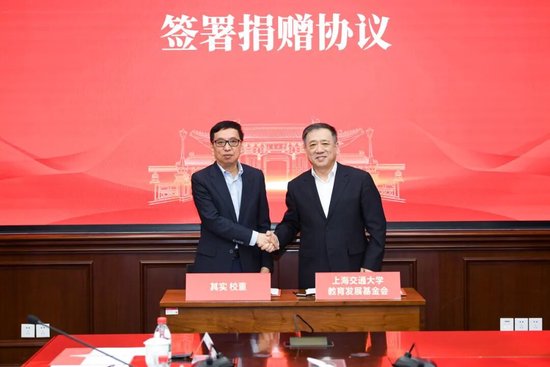
Core Viewpoint - The chairman of Dongfang Caifu Information Co., Ltd., Qi Shi, donated 20 million shares of Dongfang Caifu stock (valued at approximately 450 million yuan) to support the educational development of his alma mater, Shanghai Jiao Tong University, focusing on talent cultivation and technological innovation [1][7]. Group 1: Donation Details - The donation signing ceremony for the "Qiushi Innovation Development Education Fund" took place on February 26 at Shanghai Jiao Tong University [1][7]. - Qi Shi has a history of supporting the university, including a previous donation of 100 million yuan to establish the "Qi Shi Medical Innovation Development Fund" in October 2022 [4][10]. Group 2: Personal Reflections and Contributions - Qi Shi reflected on his university days, emphasizing the importance of comprehensive growth during college, which laid a solid foundation for his future endeavors [4][9]. - He founded the Shanghai Jiao Tong University Social Practice Center during his studies, highlighting the significance of practical experience alongside academic learning [4][9]. Group 3: Impact on Education and Innovation - Qi Shi aims to leverage finance to empower technological innovation and promote industrial upgrades, facilitating the transition of cutting-edge technologies from laboratories to commercialization [4][9]. - The donation is seen as a commitment to the spirit of "drinking water and thinking of its source," which will be passed down through generations of Jiao Tong University students [5][10].
普元信息、格尔软件双双涨停,低费率的金融科技ETF华夏(516100)上涨1.38%
Sou Hu Cai Jing· 2026-02-27 03:33
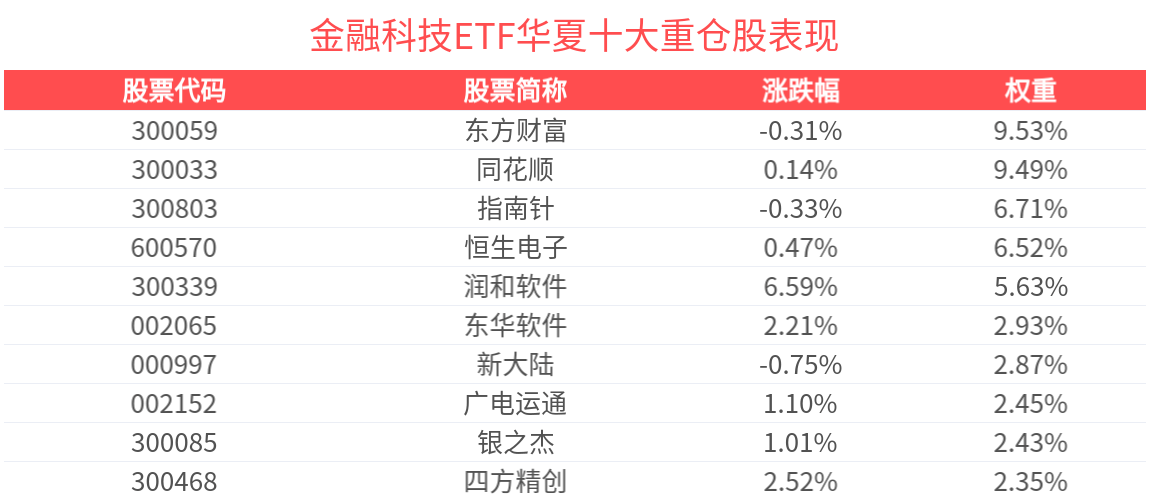
Core Viewpoint - The digital security and software sectors are experiencing significant growth, with the financial technology ETF Huaxia (516100) rising by 1.38% as of 11:01 AM, indicating a positive market sentiment towards fintech stocks [1] Group 1: Market Performance - The financial technology ETF Huaxia (516100) reported a latest price of 1.4 yuan, with key holdings such as Puyuan Information and Geer Software reaching their daily price limits [1] - Other stocks in the sector, including Xin'an Century and Runhe Software, also saw notable increases, with Xin'an Century rising by 7.58% [1] Group 2: Industry Outlook - Brokerages are optimistic about the long-term prospects of the fintech sector, anticipating a transition from "crypto accessories" to "global financial infrastructure" under a clearer regulatory framework [1] - Investment opportunities are primarily focused on compliant issuance platforms, cross-border payment service providers, and technologies and services related to the RWA ecosystem [1] Group 3: ETF Details - The management fee for the financial technology ETF Huaxia is 0.15%, and the custody fee is 0.05%, making it the lowest among comparable funds [1] - The ETF closely tracks the CSI Financial Technology Theme Index, which includes sectors such as software development, internet finance, and digital currency [1] - As of January 30, 2026, the top ten weighted stocks in the CSI Financial Technology Theme Index account for 51.68% of the index, with significant players including Tonghuashun, Dongfang Wealth, and Hengsheng Electronics [1][2]



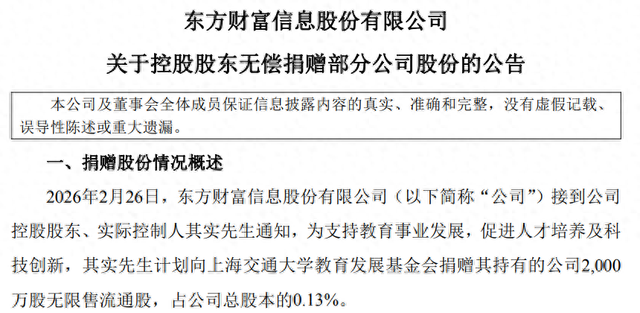
东方财富实控人拟向上海交大捐赠2000万股公司股票
Zhong Zheng Wang· 2026-02-27 03:09
Group 1 - The core point of the article is that Dongfang Caifu (300059) announced a plan by its controlling shareholder and actual controller to donate 20 million shares of unrestricted circulating stock to the Shanghai Jiao Tong University Education Development Foundation, which represents 0.13% of the company's total share capital [1] - The market value of the donated shares is approximately 450 million yuan, based on the closing price of 22.50 yuan per share on February 26 [1]
东方财富其实向上海交大捐赠4.5亿元股份
Cai Jing Wang· 2026-02-27 02:39
Core Viewpoint - Dongfang Caifu announced a plan for its controlling shareholder, Qishi, to donate 20 million shares, representing 0.13% of the total share capital, to the Shanghai Jiao Tong University Education Development Foundation, valued at 450 million yuan based on the closing price of 22.50 yuan per share on February 26 [1] Group 1 - The donation aims to support the development of education, talent cultivation, and technological innovation [1] - Before the donation, Qishi held 3.062 billion shares, accounting for 19.38% of the total share capital, while his associate, Lu Lili, held 160 million shares, representing 1.01% [1] - After the donation, Qishi's shareholding will decrease to 3.042 billion shares, reducing his ownership percentage to 19.25%, and the combined shareholding of his associates will change from 20.39% to 20.26% [1] Group 2 - Qishi, born in October 1970, is an alumnus of Shanghai Jiao Tong University and holds a PhD in journalism from Fudan University [1] - He is involved in various social roles, including being a member of the All-China Federation of Industry and Commerce and the vice president of the Shanghai General Chamber of Commerce [1] - Qishi founded Dongfang Caifu in 2005 and has been a representative in the 14th National People's Congress [1]

东方财富实控人其实拟向上海交大捐赠2000万股,市值4.5亿元
Xin Lang Cai Jing· 2026-02-27 01:29
Core Viewpoint - The controlling shareholder of Dongfang Caifu Information Co., Ltd. plans to donate 20 million shares, representing 0.13% of the company's total share capital, to the Shanghai Jiao Tong University Education Development Foundation to support educational development and talent cultivation [1][5]. Group 1: Donation Details - The donation will be made through a non-trading transfer of shares that were issued before the company's initial public offering [3]. - The total number of shares held by the controlling shareholder, actually, will decrease from 3,062,162,258 shares (19.38%) to 3,042,162,258 shares (19.25%) after the donation [4]. - The estimated market value of the donated 20 million shares is approximately 450 million yuan, based on a share price of 22.50 yuan [5]. Group 2: Background Information - Actually, originally named Shen Jun, graduated from Shanghai Jiao Tong University in 1993 and founded Dongfang Caifu Wang in 2005 [5]. - Actually was appointed as a school director at Shanghai Jiao Tong University in October 2022 [5]. - On January 20, 2026, a library funded by Actually at the Shanghai Jiao Tong University School of Medicine will hold a plaque unveiling ceremony [5].
财经早报:中方回应第六轮中美经贸磋商,中德已达成十余项商业协议丨2026年2月27日
Xin Lang Cai Jing· 2026-02-26 23:38
Group 1 - China and the US are maintaining communication through the economic consultation mechanism, aiming for stable and sustainable development of bilateral trade relations [2] - German Chancellor Merz's visit to China resulted in over ten commercial agreements, emphasizing cooperation in AI and other advanced fields [3][51] - China has implemented export controls on Japan to prevent its militarization and nuclear ambitions, reflecting concerns over regional peace [4][52][53] Group 2 - The deployment of 11 US F-22 stealth fighters in Israel marks a significant military presence in the Middle East [5][54] - Indirect negotiations between the US and Iran have reportedly made significant progress, with further discussions scheduled [7][55] - China's AI model usage surged, surpassing the US for the first time, with a notable increase in model calls [8][56] Group 3 - New regulations for online food safety will take effect on June 1, requiring platforms to take responsibility for food safety throughout their operations [9][57] - The offshore RMB has appreciated significantly, breaking the 6.83 mark, indicating a strong upward trend in the currency [10][58] - Shanghai's gold recovery industry may soon require mandatory real-name registration to enhance security and traceability [11][59] Group 4 - Ctrip Group announced a change in leadership, with the resignation of its president and a significant increase in revenue for Q4 2025 [16][62] - The Guotou Ruijin silver fund compensation process has begun, with over 10,000 users engaging in the resolution process via an online platform [17][63] - The rumor regarding Sanzi Yang's successful backdoor listing has been officially denied, clarifying the company's current status [18][64] Group 5 - Nvidia reported record revenue for Q4 2026, driven by its data center business, which has seen substantial growth since the launch of ChatGPT [19][66] - Longcheng High-tech's new drug for treating boys' developmental issues has led to a significant increase in its stock price, reflecting market excitement [22][68] - The actual controller of Dongfang Fortune plans to donate a substantial amount of shares to Shanghai Jiao Tong University, highlighting corporate social responsibility [23][69]



东方财富实控人其实向母校赠股2000万股 市值达4.5亿
Nan Fang Du Shi Bao· 2026-02-26 15:51
Group 1 - Dongfang Caifu Information Co., Ltd. announced a donation of 20 million shares by its controlling shareholder, Mr. Qi Shi, to support education and innovation, representing 0.13% of the company's total share capital [2] - After the donation, Mr. Qi's shareholding will decrease from 19.38% to 19.25%, maintaining control over the company [2] - The market value of the donated shares is approximately 450 million yuan, based on the closing price of 22.50 yuan per share [2] Group 2 - Mr. Qi Shi, born in October 1970, is a graduate of Shanghai Jiao Tong University and holds a Ph.D. in journalism from Fudan University, and he founded Dongfang Caifu in 2005 [6] - In 2024, Mr. Qi's compensation reached 5.0198 million yuan, an increase of 747,600 yuan from 2023, making him the highest-paid among major brokerages [6] - Donations of shares to educational institutions are not uncommon in the A-share market, with examples including donations from other companies like Ningde Times and Haowei Group [6][7]