
EASTMONEY(300059)

Search documents
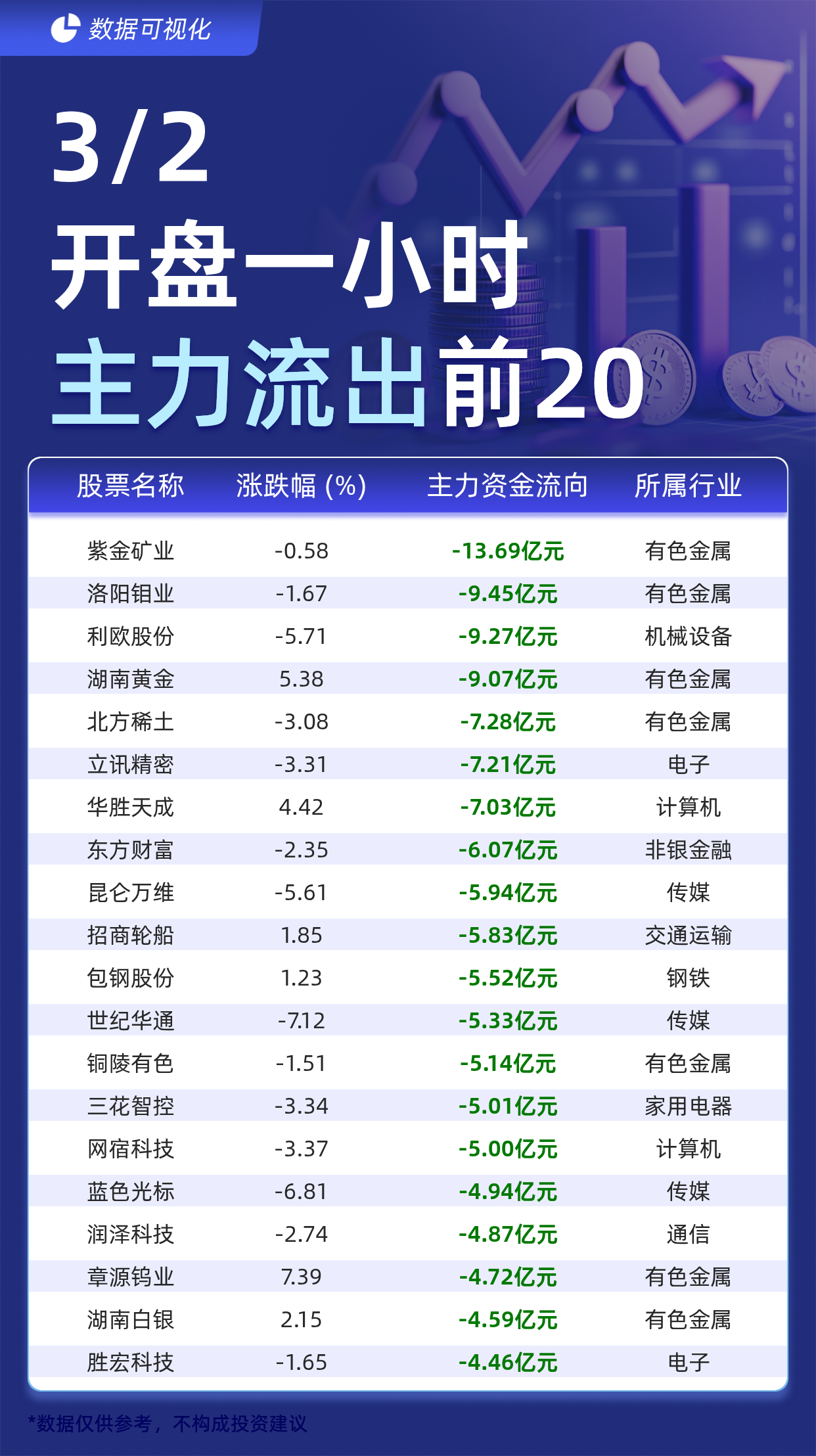
主力个股资金流出前20:紫金矿业流出13.69亿元、洛阳钼业流出9.45亿元


Jin Rong Jie· 2026-03-02 02:59
Core Viewpoint - The data indicates significant outflows of capital from various stocks, particularly in the metals and machinery sectors, reflecting investor sentiment and market dynamics as of March 2. Group 1: Stock Performance and Capital Outflow - Zijin Mining experienced a capital outflow of 1.369 billion, with a decline of 0.58% in stock price [1][2] - Luoyang Molybdenum saw a capital outflow of 0.945 billion, with a stock price decrease of 1.67% [1][2] - LEO Group had a capital outflow of 0.927 billion, with a significant drop of 5.71% in stock price [1][2] - Hunan Gold reported a capital outflow of 0.907 billion, despite a stock price increase of 5.38% [1][2] - Northern Rare Earth faced a capital outflow of 0.728 billion, with a decline of 3.08% in stock price [1][2] - Luxshare Precision recorded a capital outflow of 0.721 billion, with a decrease of 3.31% in stock price [1][2] Group 2: Additional Notable Stocks - Huasheng Tiancheng had a capital outflow of 0.703 billion, with a stock price increase of 4.42% [1][2] - Dongfang Fortune experienced a capital outflow of 0.607 billion, with a decline of 2.35% in stock price [1][2] - Kunlun Wanwei saw a capital outflow of 0.594 billion, with a stock price drop of 5.61% [1][2] - China Merchants Energy reported a capital outflow of 0.583 billion, with a stock price increase of 1.85% [1][2] - Baosteel had a capital outflow of 0.552 billion, with a slight increase of 1.23% in stock price [1][2] Group 3: Further Capital Outflows - Century Huatong faced a capital outflow of 0.533 billion, with a stock price decrease of 7.12% [3] - Tongling Nonferrous Metals reported a capital outflow of 0.514 billion, with a decline of 1.51% in stock price [3] - Sanhua Intelligent Control had a capital outflow of 0.501 billion, with a decrease of 3.34% in stock price [3] - Wangsu Science & Technology experienced a capital outflow of 0.500 billion, with a decline of 3.37% in stock price [3] - BlueFocus Communication Group saw a capital outflow of 0.494 billion, with a significant drop of 6.81% in stock price [3] - Runze Technology reported a capital outflow of 0.487 billion, with a decline of 2.74% in stock price [3] - Changyuan Tungsten had a capital outflow of 0.472 billion, with a notable increase of 7.39% in stock price [3] - Hunan Silver reported a capital outflow of 0.459 billion, with a stock price increase of 2.15% [3] - Shenghong Technology faced a capital outflow of 0.446 billion, with a decline of 1.65% in stock price [3]

中国券商与资管:2025 年第四季度预览- 业绩持续改善,但分化显现-China Brokers & Asset Managers_ 4Q preview_ Performance continues to improve, but divergence emerges
2026-03-01 17:22
Summary of Key Points from the Conference Call Industry Overview - The report focuses on the **Chinese brokerage and asset management industry**, specifically analyzing the performance of traditional brokers and their outlook for 4Q25 and 2026. - The **A-share average daily trading volume (ADTV)** for 4Q25 was **Rmb 2.4 trillion**, reflecting an **18% year-on-year increase** and a **2% quarter-on-quarter decrease**, maintaining high levels from 3Q25 [1][13][17]. Core Insights and Arguments 1. **Broker Performance Outlook**: - Strong performance is expected for the brokerage sector in 4Q25 and throughout 2026, driven by high ADTV and a robust IPO pipeline in Hong Kong [1][4]. - Profit growth forecasts for major brokers in 4Q25 are as follows: - **CICC**: +19% year-on-year - **GFS**: +48% year-on-year - **East Money**: -10% year-on-year - **Hundsun**: +29% year-on-year [1][12]. 2. **Impact of Market Volatility**: - Recent volatility in the tech sector is not expected to negatively impact brokers' performance, as increased trading activity during such periods can enhance commission earnings [6][9]. - Historical data shows that brokers experienced robust earnings growth during previous market pullbacks, indicating resilience [6][9]. 3. **Divergence Among Brokers**: - Performance divergence among brokers is attributed to factors such as leverage capacity, return on equity (ROE) improvement potential, and the proportion of international business [4][21]. - CICC is highlighted for its higher international business contribution, which is expected to enhance its ROE [4][27]. 4. **Fund Fee Reduction Policy**: - The implementation of a new fund fee reduction policy starting January 2026 is anticipated to negatively affect East Money's fund distribution business, compressing profit margins and weakening its competitive edge in actively managed funds [43][46]. - The policy includes significant reductions in subscription and service fees, which could lead to a structural decline in fund distribution income [43][46]. 5. **Hundsun's Performance and Future Outlook**: - Hundsun's preliminary results for 4Q25 showed revenue below expectations, primarily driven by investment income rather than core business growth [5][49]. - Despite short-term challenges, a positive outlook for 2026-27 is maintained, with expected core revenue growth of **18%** in 2026 and **13%** in 2027, supported by improved operational efficiency and accelerated implementation of IT innovations [49][54]. Additional Important Insights - The proportion of ETFs in trading volume increased from **16% in 3Q25 to 20% in 4Q25**, indicating a shift in investor preferences towards lower-cost investment vehicles [19]. - The average revenue and profit growth for traditional brokers and East Money is projected to be **+26%** and **+37%** year-on-year in 1Q26, respectively [1][6]. - The report maintains **Buy ratings** on CICC-H, GFS-A, and Hundsun, while a **Sell rating** is reiterated for East Money due to the anticipated negative impacts from the fee reduction policy and increasing ETF proportions [5][32][48]. Conclusion - The Chinese brokerage sector is poised for continued growth, supported by high trading volumes and a favorable IPO environment, although challenges such as regulatory changes and market volatility remain pertinent. The divergence in performance among brokers will largely depend on their strategic positioning and adaptability to market conditions.





金融行业周报(2026、03、01):外资机构座谈会召开,坚定金融市场改革决心-20260301
Western Securities· 2026-03-01 09:06
Investment Rating - The report does not explicitly state an investment rating for the non-bank financial sector, but it provides insights into various segments such as insurance, brokerage, and banking, indicating potential investment opportunities and strategies [1][2][3]. Core Insights - The non-bank financial index decreased by 1.18% this week, underperforming the CSI 300 index by 2.26 percentage points. The insurance sector saw a decline of 3.74%, while the brokerage sector fell by 0.39%. In contrast, the diversified financial index increased by 3.90% [1][10]. - The insurance sector is experiencing a short-term adjustment due to profit-taking, a shift of funds towards growth sectors, and a lack of policy and earnings reports. However, the medium-term outlook remains positive as insurance companies are expected to increase equity allocations in 2026, supported by economic recovery and low valuations [2][14]. - The brokerage sector is expected to benefit from the recent capital market planning discussions, which emphasize market openness and reform. The report suggests that leading brokerages with strong cross-border capabilities will likely gain from these developments [2][16]. - The banking sector is viewed as a potential investment opportunity, particularly as macroeconomic conditions improve. The report recommends focusing on banks with high earnings elasticity, high dividend yields, and those expected to benefit from convertible bond catalysts [3][19]. Summary by Sections Insurance Sector - The insurance sector's index fell by 3.74%, underperforming the CSI 300 index by 4.82 percentage points. The decline is attributed to profit-taking and a shift in market sentiment towards growth sectors [2][13]. - Despite the short-term pullback, the long-term outlook for the insurance sector is optimistic, with expectations of increased equity allocations and a favorable economic environment supporting valuation recovery [14][15]. - Recommended stocks include New China Life Insurance, China Pacific Insurance, China Ping An, and China Life Insurance [15]. Brokerage Sector - The brokerage sector index decreased by 0.39%, underperforming the CSI 300 index by 1.47 percentage points. The sector's price-to-book (PB) ratio is currently at 1.33x, indicating a mismatch between earnings and valuations [2][16][17]. - The report highlights the importance of selecting brokerages based on their strengths and potential for mergers and acquisitions, recommending firms like Guotai Junan and Huatai Securities [17][18]. - The recent discussions by the China Securities Regulatory Commission signal a commitment to market reform and openness, which could benefit leading brokerages [16]. Banking Sector - The banking sector index fell by 0.92%, underperforming the CSI 300 index by 2.00 percentage points. The sector's PB ratio is at 0.50x, suggesting potential undervaluation [3][18]. - The report emphasizes the banking sector's resilience and potential for recovery as macroeconomic conditions improve, recommending banks with strong earnings potential and high dividend yields [19]. - Suggested banks for investment include Hangzhou Bank, Ningbo Bank, and China Merchants Bank, among others [19].



AI助力金融公司降本增效,板块波动后迎配置机遇
GF SECURITIES· 2026-03-01 08:06
Core Insights - The report emphasizes that AI technology is driving cost reduction and efficiency improvements in financial companies, presenting a configuration opportunity for the sector after recent volatility [1] - The report highlights the ongoing influx of incremental capital into the market, suggesting that the stability of the capital market enhances the sector's tool attributes, making it a favorable investment opportunity [1] Group 1: Market Performance - As of February 28, 2026, the Shanghai Composite Index rose by 1.98%, while the Shenzhen Component Index increased by 2.80% [9] - The average daily trading volume in the Shanghai and Shenzhen markets reached 2.44 trillion yuan, a 15.60% increase month-on-month [4] Group 2: Industry Dynamics and Weekly Commentary Insurance Sector - Short-term stock price fluctuations do not alter the positive long-term fundamentals of the insurance sector, with expectations for improved long-term premium and fee differentials [14] - The approval of AI applications in insurance pricing has raised concerns about potential disruptions in the core insurance value chain, leading to a temporary decline in domestic insurance stocks [14] - The report suggests that leading insurance companies are likely to accelerate digital transformation through AI applications, enhancing their competitive edge [14] Securities Sector - The "15th Five-Year" planning meeting for foreign capital institutions was held, indicating a deepening of capital market openness [15] - The meeting aims to incorporate foreign institutions' suggestions into the planning process, enhancing the market's internationalization and stability [16] - The report anticipates that the capital market's institutional opening will accelerate, creating new opportunities for securities firms, particularly in cross-border business [20] Group 3: Investment Recommendations - The report recommends focusing on specific stocks within the insurance sector, including China Ping An, China Life, and New China Life, due to their strong fundamentals and growth potential [14] - In the securities sector, firms such as Guotai Junan, Huatai Securities, and CITIC Securities are highlighted as having significant investment opportunities due to their competitive advantages and market positioning [4][14]



9点1氪丨语音误关大灯致车祸,领克道歉;OpenAI获1100亿美元融资;米哈游内部通报员工意外离世
3 6 Ke· 2026-02-28 01:12
Group 1 - Lynk & Co apologized for a car accident caused by a voice command that mistakenly turned off the headlights of a Lynk Z20 vehicle, and they have implemented a cloud-based update to prevent this issue in the future [1] - OpenAI announced a significant funding round of $110 billion, with major contributions from SoftBank, NVIDIA, and Amazon, and a pre-money valuation of $730 billion [1] - MiHoYo responded to the unexpected death of a 36-year-old programmer, clarifying that the employee did not work excessive hours and that rumors about compensation were false [1] Group 2 - Doubao Mobile addressed claims of security vulnerabilities, stating that they have upgraded protective measures and have not received detailed reports of any issues [2] - Yingshi Innovation announced the conclusion of a 337 investigation by the US International Trade Commission, confirming that their products do not infringe on GoPro patents, allowing them to continue importing and selling in the US [3] - Meizu denied rumors of exiting the smartphone market, stating they are seeking third-party hardware partnerships while their existing business remains unaffected [5] Group 3 - The Shanghai police reported the arrest of three individuals for leaking unreleased game content from MiHoYo, marking a significant case in combating illegal game leaks [6] - China Post has halted a collaboration with the mobile game "Dust White Zone" following public controversy over the game's content [7] - ByteDance's subsidiary, Dongche Emperor, is reportedly considering an IPO in Hong Kong, aiming to raise between $1 billion and $1.5 billion [7] Group 4 - NVIDIA warned of a potential shortage of gaming GPUs in the first half of the fiscal year, which may lead to price increases [8] - Tesla completed road tests of its latest autonomous driving technology in Abu Dhabi under regulatory supervision [8] - The first generic versions of the weight-loss drug Semaglutide are expected to enter the Chinese market soon, potentially leading to a price war [8] Group 5 - Warner Bros. has signed a $110 billion agreement with Paramount for acquisition, which includes approximately $29 billion in debt, marking one of the largest mergers in Hollywood [8] - The Hong Kong Stock Exchange reported a net profit of HKD 17.75 billion for 2025, a 36% increase year-on-year, with a dividend of HKD 12.52 per share [16] - JinkoSolar reported its first loss in 12 years, with a net loss of CNY 6.786 billion for 2025, a significant decline from previous profits [17]




其实,拟向上海交大捐赠2000万股,市值4.5亿元
Xin Lang Cai Jing· 2026-02-28 00:40
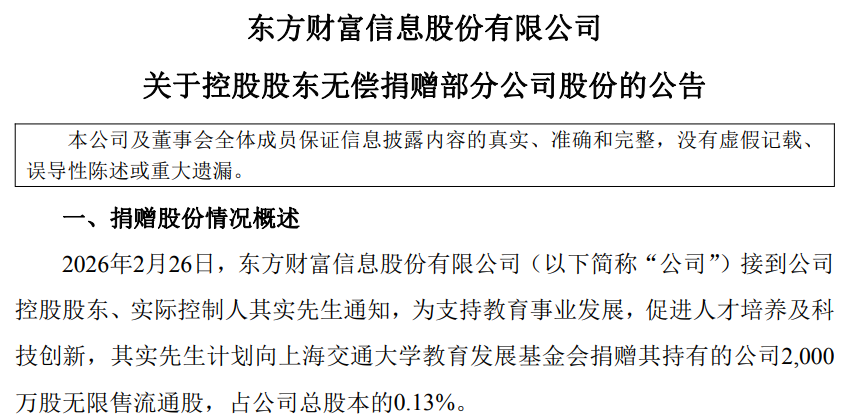
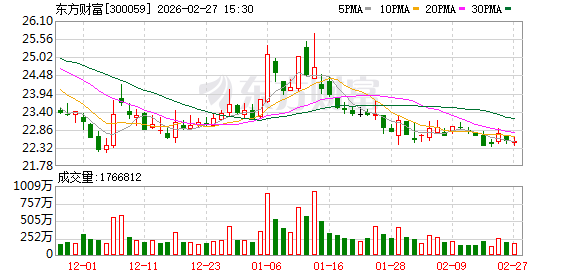
据智通财经消息,2月26日,东方财富信息股份有限公司(以下简称"东方财富")发布公告称,接到公司控股股东、实际控制人其实通知,为支持教育事 业发展,促进人才培养及科技创新,其实计划向上海交通大学教育发展基金会捐赠其持有的公司2000万股无限售流通股,占公司总股本的0.13%。 东方财富关于控股股东无偿捐赠部分公司股份的公告。 截至当日收盘,东方财富报22.50元/股,据此粗略估算,所捐赠的2000万股对应市值4.5亿元。 | 捐赠主体 | 计划捐赠股份 | 计划捐赠股份数 | 捐赠方式 | 股份来源 | | --- | --- | --- | --- | --- | | | 数量(股) | 量占总股本比例 | | | | 其本 | 20,000,000 | 0.13% | 非交易过户 | 首次公开发行前已 | | | | | (捐赠) | 发行的公司股份 | | 股东名称 | 捐赠前 | | 捐赠后 | | | --- | --- | --- | --- | --- | | | 持股数量(股) | 持股比例 | 持股数量(股) | 持股比例 | | 其实 | 3,062,162,258 | 19.38% | ...
3500亿上海券商巨头,老板豪捐4.5亿给母校
2 1 Shi Ji Jing Ji Bao Dao· 2026-02-27 16:40
2月26日,东方财富公告,控股股东、实控人其实计划,向母校上海交通大学教育发展基金会,捐赠 2000万股公司股票,市值约4.5亿元。 (文章来源:21世纪经济报道) ...
1月1.84亿股民涌入炒股软件
2 1 Shi Ji Jing Ji Bao Dao· 2026-02-27 13:29
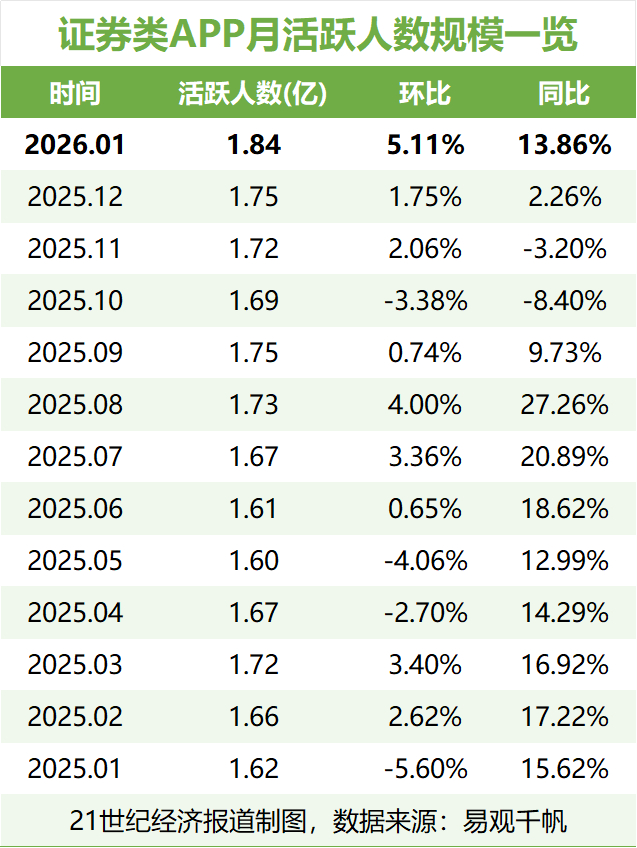
Core Insights - The A-share market is experiencing a "spring rally" in 2026, leading to increased trading activity and a surge in active users of stock trading apps, reaching 184 million in January 2026, a year-on-year increase of 13.86% and a month-on-month increase of 5.11% [1][2][3] User Activity Trends - The monthly active users of securities apps showed a fluctuating upward trend from January 2025 to January 2026, with a peak of 172 million in March 2025, followed by a decline to 160 million in May 2025, before rising again to 184 million in January 2026 [1][2] - The significant growth in January 2026 is attributed to the spring market conditions and a low base effect from the previous year's January due to fewer trading days caused by the Spring Festival [3] Leading Apps and Market Dynamics - Among the top 30 apps, "Tonghuashun" leads with 38.75 million active users in January 2026, followed by "Dongfang Caifu" and "Dazhihui" with 19.29 million and 13.76 million users, respectively [5][6] - The overall active user growth for securities apps is stable, with most apps experiencing a month-on-month growth rate between 5% and 7%, and year-on-year growth rates generally between 10% and 20% [5][6] Market Sentiment and New Accounts - The number of new accounts opened in January 2026 increased by 213% year-on-year, indicating strong investor interest in entering the market [7] - The balance of margin trading has reached historical highs, with new margin trading accounts totaling 190,500 in January, reflecting a month-on-month increase of 29.5% and a year-on-year increase of 157% [7] AI Integration in Securities Apps - The integration of AI tools into investment decision-making processes is enhancing user engagement, with over 30 securities firms deploying localized AI models for various services [9] - Major brokerages are utilizing AI for stock diagnosis, industry analysis, and asset allocation, transitioning from mere trading tools to comprehensive wealth management platforms [9][10] Future Trends in Securities Apps - The competition among securities apps is shifting from user scale to service value, with a focus on long-term client trust and the integration of AI capabilities into advisory services [10][11] - The industry is expected to see three key trends: deepening intelligent services, upgrading content ecosystems, and accelerating scenario integration to enhance user stickiness [11]




东方财富创始人其实,回馈母校市值4.5亿元股份
Sou Hu Cai Jing· 2026-02-27 09:42
Group 1 - The core point of the news is that Dongfang Caifu plans to donate 20 million shares of its stock, valued at approximately 450 million yuan, to support the development of education and technology innovation at Shanghai Jiao Tong University [2] - This donation represents 0.13% of the total share capital of Dongfang Caifu, calculated based on the opening price of 22.46 yuan per share [2] - In the past two months, several alumni from Shanghai Jiao Tong University, including Dongfang Caifu's actual controller and Ji Qi from Huazhu, have made significant donations totaling over 800 million yuan in anticipation of the university's 130th anniversary [3] Group 2 - The chairman of Dongfang Caifu, who graduated from Shanghai Jiao Tong University, emphasizes the importance of education and social practice during his university years, which laid a solid foundation for his career [5][9] - In addition to the recent donation, the chairman previously donated 100 million yuan to establish the "Qishi Medical Innovation Development Fund" to support the construction of the new medical campus of Shanghai Jiao Tong University [9] - Other notable alumni, such as Ji Qi and Chen Guangming, have also made substantial donations to the university, with Ji Qi donating 100 million yuan and Chen Guangming donating 130 million yuan for various educational initiatives [11][13]

东方财富实控人,将捐赠市值4.5亿元股票
Zhong Guo Jing Ji Wang· 2026-02-27 08:24
Group 1 - The core point of the news is that the controlling shareholder of Dongfang Caifu plans to donate 20 million shares, which represents 0.13% of the total share capital, through a non-trading transfer of shares [2][5] - The donation will not lead to a change in the controlling shareholder of the company and will not have a significant impact on the company's governance structure or ongoing operations [5] - As of February 26, the stock price of Dongfang Caifu was 22.5 yuan per share, giving the donated shares a market value of 450 million yuan [3][5] Group 2 - Before the donation, the controlling shareholder held 3,062,162,258 shares, representing 19.38% of the total shares, which will decrease to 3,042,162,258 shares, or 19.25%, after the donation [3] - The total shares held by the controlling shareholder and others will decrease from 3,222,038,464 shares (20.39%) to 3,202,038,464 shares (20.26%) post-donation [3] - The donor, originally named Shen Jun, graduated from Shanghai Jiao Tong University in 1993 and founded Dongfang Caifu in 2005 [5]