ZHONGJI INNOLIGHT(300308)

Search documents
英伟达算力架构持续迭代升级,行业高景气度不断夯实,高速光模块需求确定性极强,CPO步入实质落地阶段
Xin Lang Cai Jing· 2026-02-26 10:27
Group 1 - Zhongji Xuchuang (300308) is a leading global player in the high-speed optical module sector, deeply tied to major North American cloud providers like Nvidia, Microsoft, and Google, making it a core beneficiary during the AI computing power explosion [1][24] - The company maintains a strong position in the global market for 800G and 1.6T high-speed optical module shipments, with a continuous upgrade in product structure towards high-end offerings, leading to steady improvements in gross margin and profitability [1][24] - With the large-scale rollout of Nvidia's GB300 and Rubin next-generation computing platforms, the demand for optical modules per machine has significantly increased, driving a sustained high growth in orders for the company [1][24] Group 2 - Xinyi Technology (300502) focuses on the research, production, and sales of high-speed optical modules, ranking among the few domestic companies with global competitiveness, particularly in the 400G and 800G high-end module sectors [2][25] - The company has a high proportion of overseas revenue and is closely tied to major global cloud providers and equipment manufacturers, resulting in high order visibility and outstanding delivery capabilities [2][25] - Benefiting from the accelerated construction of AI data centers and the explosive demand for high-speed interconnects, the company is seeing a continuous increase in the proportion of high-end products and an ongoing optimization of profitability [2][25] Group 3 - Luxshare Precision (002475) has rapidly entered the high-speed optical module market, becoming an important partner for leading international companies like Nvidia, leveraging its advanced manufacturing and supply chain integration capabilities [3][26] - The company has significant advantages in optical module structural components, packaging processes, and thermal solutions, allowing it to quickly respond to large-volume orders from major clients [3][26] - As AI computing demand continues to surge, the optical module business is emerging as a new growth curve for the company, supported by stable cash flow and technological synergies from its experience in consumer and automotive electronics [3][26] Group 4 - Shengyi Technology (600183) is a global leader in the field of copper-clad laminates and high-frequency materials, serving as a core upstream supplier for optical modules, servers, and data center hardware [4][27] - The demand for high-frequency and high-speed copper-clad laminates is continuously increasing due to the growth of high-speed optical modules, with the company maintaining a leading position in related materials technology and comprehensive customer coverage [4][27] - The company benefits from the accelerated construction of AI computing infrastructure and the rapid iteration of data center hardware, leading to a steady improvement in profitability [4][27] Group 5 - Pengding Holdings (002938) is a global leader in high-end printed circuit board (PCB) research, production, and sales, holding a significant position in the PCB market for high-speed communication, servers, and optical modules [5][28] - The requirements for PCB layers, precision, and signal integrity have significantly increased due to 800G and 1.6T high-speed optical modules, with the company demonstrating industry-leading technical strength and process levels [5][28] - The company is experiencing rapid growth in high-speed PCB demand as AI data center construction accelerates, leading to improvements in revenue and gross margin [5][28] Group 6 - Hengtong Optic-Electric (600487) has become a domestic industry leader by leveraging its advantages across the entire optical communication industry chain, with core competitiveness in optical modules, optical fibers, and marine communications [6][29] - The company’s high-speed optical module products cover 400G and 800G high-speed rates, achieving bulk shipments in data centers and computing interconnect scenarios [6][29] - With significant investments in silicon photonics and CPO co-packaging optical technology, the company is well-positioned to benefit from the increased global investment in computing infrastructure and the explosive demand for optical modules [6][29]


OpenClaw之父预言2026年Agentic Coding将彻底爆发,同类费率最低创业板人工智能
Mei Ri Jing Ji Xin Wen· 2026-02-26 07:01
Group 1 - The core viewpoint of the articles highlights the significant rise in AI-related stocks, particularly in the hardware sector, driven by advancements in AI coding capabilities and the anticipated growth of AI applications by 2026 [1][2] - The AI coding capability is expected to lead to an exponential increase in the volume of effective code globally, indicating a new phase of competition and market dynamics that investors should consider [2] - OpenAI's interview with Peter Steinberger emphasizes the transformative potential of AI in software development, suggesting that the focus will shift from coding to defining intentions, with a prediction of a breakthrough in Agentic Coding by 2026 [1][2] Group 2 - The communication ETF Huaxia (515050) focuses on electronic and communication sectors, with top holdings including Zhongji Xuchuang and Xinyi Sheng, indicating a strong emphasis on hardware related to AI [3] - The entrepreneurial AI ETF Huaxia (159381) has a balanced allocation between hardware and AI software applications, with significant holdings in Zhongji Xuchuang and Xinyi Sheng, and a fund size nearing 2 billion [3] - The cloud computing ETF Huaxia (516630) emphasizes domestic AI software and hardware, with a high combined weight in computer software, cloud services, and computer equipment, showcasing a strong focus on AI capabilities [4]

TMTETF(512220)涨1.60%,半日成交额1469.62万元
Xin Lang Cai Jing· 2026-02-26 03:39
TMTETF(512220)业绩比较基准为中证科技传媒通信150指数,管理人为景顺长城基金管理有限公 司,基金经理为金璜,成立(2014-07-18)以来回报为211.16%,近一个月回报为-0.66%。 声明:市场有风险,投资需谨慎。本文基于第三方数据库自动发布,不代表新浪财经观点,任何在本文 出现的信息均只作为参考,不构成个人投资建议。如有出入请以实际公告为准。如有疑问,请联系 biz@staff.sina.com.cn。 2月26日,截止午间收盘,TMTETF(512220)涨1.60%,报3.113元,成交额1469.62万元。TMTETF (512220)重仓股方面,中际旭创截止午盘涨0.34%,新易盛涨0.58%,立讯精密跌0.19%,寒武纪涨 1.22%,工业富联涨1.24%,中芯国际跌0.68%,海光信息涨0.15%,北方华创跌1.08%,胜宏科技涨 9.23%,兆易创新跌0.61%。 来源:新浪基金∞工作室 ...




沪深300ESGETF招商(561900)跌0.60%,半日成交额97.94万元
Xin Lang Cai Jing· 2026-02-26 03:39
Group 1 - The core viewpoint of the article highlights the performance of the HuShen 300 ESG ETF (561900), which experienced a decline of 0.60% to 0.990 yuan with a trading volume of 979,400 yuan as of the midday close [1] - Major holdings in the ETF include Kweichow Moutai, which fell by 1.23%, Contemporary Amperex Technology Co., Ltd. (CATL) down by 4.94%, and Ping An Insurance down by 2.03% [1] - The ETF's performance benchmark is the HuShen 300 ESG Index return, managed by China Merchants Fund Management Co., Ltd., with a return of -0.24% since its inception on July 6, 2021, and a return of 0.90% over the past month [1]





数据看盘多家机构和游资激烈博弈通源石油,量化联手一线游资抢筹东岳硅材
Xin Lang Cai Jing· 2026-02-25 09:49
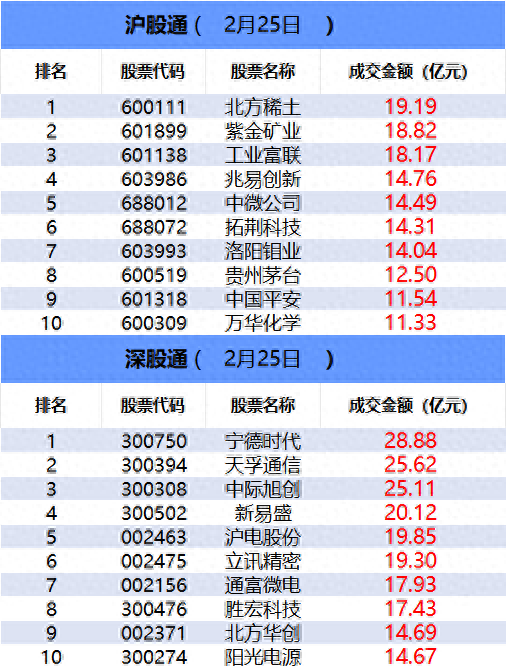
Core Insights - The total trading volume of the Shanghai and Shenzhen Stock Connect reached 319.54 billion, with Northern Rare Earth and CATL leading in trading volume for the Shanghai and Shenzhen markets respectively [1][2] - The non-ferrous metals sector saw the highest net inflow of funds, indicating strong investor interest [4][5] - The Brazilian ETF from E Fund experienced a remarkable 489% increase in trading volume compared to the previous trading day [10] Trading Volume Summary - The total trading amount for the Shanghai Stock Connect was 151.32 billion, while the Shenzhen Stock Connect totaled 168.22 billion [2] - The top traded stocks in the Shanghai market included Northern Rare Earth (1st, 19.19 billion), Zijin Mining (2nd, 18.82 billion), and Industrial Fulian (3rd, 18.17 billion) [3] - In the Shenzhen market, CATL topped the list with 28.88 billion, followed by Tianfu Communication (25.62 billion) and Zhongji Xuchuang (25.11 billion) [3] Sector Fund Flow Summary - The non-ferrous metals sector led with a net inflow of 5.36 billion, representing a net inflow rate of 3.23% [4] - Other sectors with significant net inflows included the communication sector (4.63 billion, 3.29%) and electrical grid equipment (3.75 billion, 4.33%) [4] - The computer sector experienced the highest net outflow at -12.41 billion, with a net outflow rate of -5.86% [5] Individual Stock Activity - Tongyuan Petroleum saw a significant increase of 14.51% with institutional purchases totaling 385 million [12] - Dongyue Silicon Materials achieved a strong limit-up, attracting 102 million from quantitative funds [15] - The top net inflow stocks included Zhongji Xuchuang (2.22 billion) and Huagong Technology (1.33 billion) [7] ETF Trading Summary - The A500 ETF Fund (512050) had the highest trading volume at 10.65 billion, with a 27.23% increase from the previous trading day [9] - The Brazilian ETF from E Fund (520870) had a staggering 489% increase in trading volume, making it the top performer in terms of growth [10]




稀土永磁概念涨幅居前,2月25日有20位基金经理发生任职变动
Jin Rong Jie· 2026-02-25 08:59
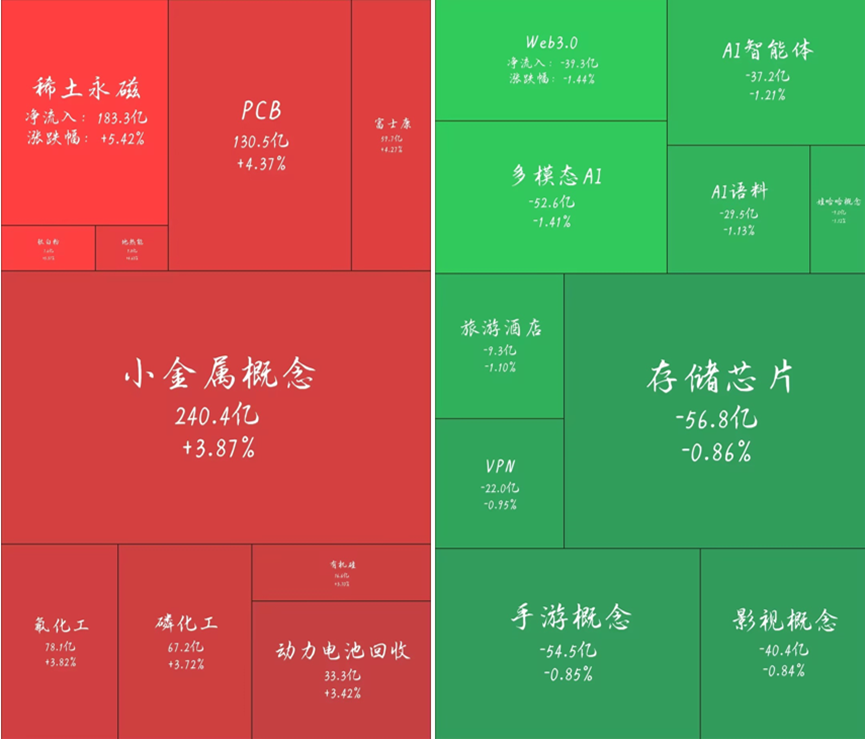
Market Performance - On February 25, the A-share market indices collectively rose, with the Shanghai Composite Index increasing by 0.72% to 4147.23 points, the Shenzhen Component Index rising by 1.29% to 14475.87 points, and the ChiNext Index up by 1.41% to 3354.82 points [1] - The sectors that performed well included rare earth permanent magnets, small metal concepts, and PCB, while Web 3.0, AI agents, and storage chips saw declines [1] Fund Manager Changes - On February 25, 20 fund managers experienced changes in their positions, with a total of 530 fund products having manager departures in the past 30 days [3][5] - The reasons for the changes included personal reasons, job changes, product expirations, and the end of agency roles [3] Fund Manager Details - Specific fund managers who left include Feng Mubao, who managed multiple funds that expired, and Chen Qiming, who left for personal reasons [4] - New fund managers appointed on February 25 include Liu Lili, who has managed funds with significant returns, such as a mixed fund that achieved a 233.63% return over nearly three years [5][6] Fund Research Activity - In the past month, Bosera Fund conducted the most company research, engaging with 39 listed companies, followed by Huaxia Fund and Penghua Fund with 31 and 29 companies respectively [7] - The most researched industry was specialized equipment, with 131 instances of research, followed by consumer electronics with 115 instances [7] Individual Stock Research - The most scrutinized stock in the past month was Tian Shun Wind Power, with 67 fund management companies participating in its research, followed by Ying Tang Zhi Kong and Zhong Ji Xu Chuang with 61 and 59 companies respectively [8]


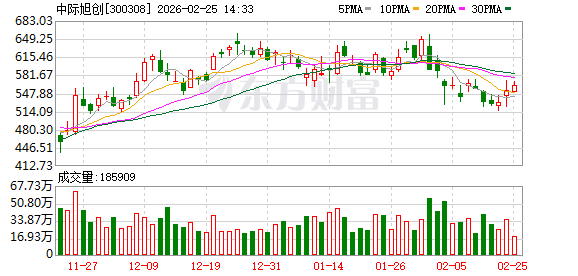
中际旭创成交额达100亿元,现涨1.44%
Mei Ri Jing Ji Xin Wen· 2026-02-25 06:32
每经AI快讯,2月25日,中际旭创成交额达100亿元,现涨1.44%。 (文章来源:每日经济新闻) ...
中际旭创:模型更新
2026-02-25 04:08
Summary of Innolight (300308.SZ) Conference Call Company Overview - **Company**: Innolight (300308.SZ) - **Industry**: Optical Transceivers Key Financial Projections - **Shipment Forecasts**: - 400G shipments expected to reach **1.8 million** units in 2026 and **990,000** units in 2027 - 800G shipments projected at **15 million** units in 2026 and **20 million** units in 2027 - 1.6T shipments anticipated to be **10 million** units in 2026 and **25 million** units in 2027 [1] - **Revenue Growth**: - Projected revenues for 2025, 2026, and 2027 are **Rmb37.0 billion**, **Rmb92.7 billion**, and **Rmb138.6 billion** respectively - Year-over-year growth rates are forecasted at **56%** for 2025, **155%** for 2026, and **50%** for 2027 [1] - **Gross Margin**: - Expected gross margins are **41.4%** in 2025, **48.6%** in 2026, and **51.3%** in 2027, driven by a better product mix with the ramp-up of 1.6T products [1] - **Net Profit**: - Forecasted net profits are **Rmb10.8 billion** in 2025, **Rmb34.3 billion** in 2026, and **Rmb54.7 billion** in 2027, reflecting increases of **109%**, **217%**, and **60%** year-over-year respectively [1] Earnings Summary - **2023A**: Net profit of **Rmb2.174 billion**, diluted EPS of **Rmb1.970**, and P/E ratio not available - **2024A**: Net profit of **Rmb5.171 billion**, diluted EPS of **Rmb4.630**, P/E ratio of **114.7** - **2025E**: Net profit of **Rmb10.814 billion**, diluted EPS of **Rmb9.744**, P/E ratio of **54.5** - **2026E**: Net profit of **Rmb34.282 billion**, diluted EPS of **Rmb30.854**, P/E ratio of **17.2** - **2027E**: Net profit of **Rmb54.739 billion**, diluted EPS of **Rmb49.265**, P/E ratio of **10.8** [4] Market Capitalization - **Market Cap**: **Rmb590.004 million** (approximately **US$85.401 million**) [2] Investment Rating - **Current Rating**: Suspended [7] Risks and Considerations - Potential conflicts of interest due to Citigroup's involvement with Innolight in investment banking services [11][12] - The report emphasizes the importance of considering this analysis as one factor in investment decisions [5] Additional Notes - The report includes a detailed breakdown of financial metrics, including gross profit, EBITDA, and cash flow projections for the upcoming years [6] - Analysts have highlighted the significant growth potential in the optical transceiver market, particularly with the introduction of higher capacity products [1]
沪深300ETF中金(510320)涨0.95%,半日成交额657.98万元
Xin Lang Cai Jing· 2026-02-25 03:46
Group 1 - The core point of the article highlights the performance of the HuShen 300 ETF managed by CICC, which saw a 0.95% increase, closing at 1.281 yuan with a trading volume of 6.5798 million yuan [1] - Major holdings in the HuShen 300 ETF include notable stocks such as Ningde Times, which rose by 0.99%, Kweichow Moutai by 2.59%, and Ping An Insurance by 1.75% [1] - The fund's performance benchmark is the HuShen 300 Index return, with a total return of 26.82% since its inception on April 16, 2025, and a recent one-month return of 0.17% [1]
价格狂飙,光纤赛道为什么火了?丨每日研选
Shang Hai Zheng Quan Bao· 2026-02-25 03:43
Core Viewpoint - The optical fiber and cable market is experiencing a significant price surge driven primarily by the demand from AI data centers, rather than traditional drivers like FTTH or 5G construction [1][2]. Group 1: Market Dynamics - Since the end of 2025, the price of G.652.D bare fiber has been continuously rising, surpassing 30 yuan per core kilometer by February 2026, with actual transaction prices concentrated between 40 to 50 yuan per core kilometer, reflecting an increase of 94% to 144% [1]. - The demand structure for optical fibers has fundamentally changed due to the high consumption levels and specifications required by AI data centers, which exceed those of traditional telecom networks [1]. - The demand for special fibers like G.657.A2 and hollow-core fibers has surged to meet the low-latency and high-bandwidth interconnection needs of GPU clusters [1]. Group 2: Supply Constraints - The core raw material for optical fibers, optical preform, accounts for about 70% of the fiber's cost and has a long production cycle of 1.5 to 2 years, leading to tight supply constraints [2]. - Following previous years of price wars and supply clearances, there has been little large-scale expansion in production capacity, causing a mismatch between rising demand and constrained supply [2]. - As high-end special fiber demand surges, preform manufacturers prioritize capacity for higher-margin products, further squeezing the production of standard fibers like G.652.D [2]. Group 3: Investment Opportunities - Companies with optical preform production capacity, such as Yangtze Optical Fibre and Cable, Hengtong Optic-electric, Zhongtian Technology, FiberHome, and Hangzhou Hikvision, are expected to benefit significantly from the price increase [3]. - Key suppliers in the upstream of the computing power supply chain, particularly in the optical module sector like Zhongji Xuchuang and NewEase, as well as optical device manufacturers like Tianfu Communication and Shijia Photon, are also highlighted as potential investment targets [3]. - Companies with advanced technological reserves, particularly those involved in next-generation technologies like hollow-core fibers, are likely to see valuation catalysts as these technologies enter operator trials [3].