ALAE(300585)

Search documents
奥联电子(300585) - 2025 Q4 - 年度业绩预告
2026-01-30 10:12
Financial Performance Expectations - The company expects a net profit loss of between 60 million and 68 million yuan for the year 2025, compared to a loss of 8.506 million yuan in the same period last year[3]. - The net profit after deducting non-recurring gains and losses is expected to be a loss of between 6.5 million and 9.5 million yuan, compared to a loss of 11.926 million yuan in the previous year[3]. - The main reason for the profit change is the impact of non-recurring gains and losses, with an estimated non-recurring loss of between 58.5 million and 53.5 million yuan due to provisions for investor litigation cases[5]. Revenue and Market Strategy - The company achieved a revenue growth of approximately 6% year-on-year, focusing on product innovation and technology upgrades amid fierce competition in the automotive electronics industry[6]. - The company is actively expanding its market and enhancing customer collaboration while implementing cost reduction and efficiency improvement initiatives[6]. - The company aims to improve overall operational effectiveness and optimize subsidiary asset structures to gradually enhance business performance[6]. Financial Reporting and Compliance - The financial data presented is preliminary and has not been audited by the accounting firm, with final figures to be disclosed in the 2025 annual report[7]. - The company has communicated with the accounting firm regarding the earnings forecast, and there are no discrepancies between the company and the firm on this matter[4]. - Investors are advised to make cautious decisions due to uncertainties related to ongoing litigation cases that may affect estimated liabilities[7]. - The company will adhere to legal and regulatory requirements for timely information disclosure[7].
奥联电子索赔倒计时 此前已有投资者获赔
Xin Lang Cai Jing· 2026-01-26 02:01
Core Viewpoint - The ongoing lawsuit against Nanjing Aolian Automotive Electronics Co., Ltd. (Aolian Electronics) for securities false statements is progressing, with some investors already receiving compensation [1][4]. Group 1: Legal Proceedings - The China Securities Regulatory Commission (CSRC) found that Aolian Electronics made misleading statements regarding the performance of Xu Mingjun in the perovskite sector, leading to a fine of 3 million yuan and warnings for responsible personnel [2][4]. - Investors affected by the false statements can file lawsuits for compensation, which may include losses from investment differences, commissions, and stamp duty [2][4]. Group 2: Compensation Eligibility - Investors who purchased Aolian Electronics stock between December 12, 2022, and February 21, 2023, and sold or held the stock after February 21, 2023, are eligible to claim compensation [5]. - Required documentation for claims includes original securities account information, stock reconciliation statements from December 1, 2022, to the end of December 2023, and contact information [5].
锂矿股走强,赣锋锂业、金圆股份涨超4%
Ge Long Hui· 2026-01-23 03:40
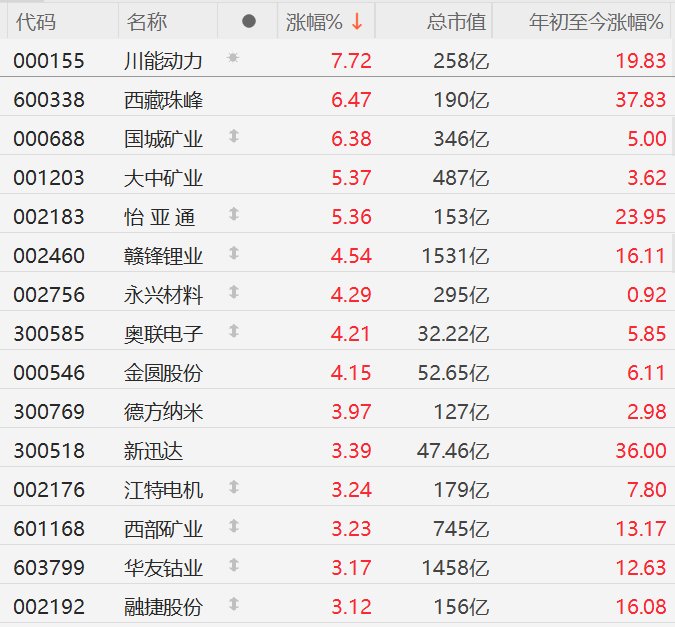
Group 1 - The A-share market saw a strong performance in lithium mining stocks, with notable gains from companies such as Chuaneng Power, which rose over 7%, and Tibet Summit and Guocheng Mining, which increased by over 6% [1] - The main contract for lithium carbonate surged by more than 5%, reaching a new high of 178,000 yuan per ton [1] Group 2 - Chuaneng Power's stock increased by 7.72%, with a total market capitalization of 25.8 billion yuan and a year-to-date increase of 19.83% [2] - Tibet Summit's stock rose by 6.47%, with a market cap of 19 billion yuan and a year-to-date increase of 37.83% [2] - Guocheng Mining's stock increased by 6.38%, with a market cap of 34.6 billion yuan and a year-to-date increase of 5.00% [2] - Other notable performers include Dazhong Mining (up 5.37%), Yiyaton (up 5.36%), and Ganfeng Lithium (up 4.54%) [2]


A股锂矿股走强,赣锋锂业、金圆股份涨超4%
Ge Long Hui A P P· 2026-01-23 03:33
Group 1 - The A-share market saw a strong performance in lithium mining stocks, with notable gains from companies such as Chuaneng Power, which rose over 7%, and Tibet Summit and Guocheng Mining, which increased by over 6% [1] - The main contract for lithium carbonate surged by over 5%, reaching a new high of 178,000 yuan per ton [1] Group 2 - Chuaneng Power's market capitalization is 25.8 billion yuan, with a year-to-date increase of 19.83% [2] - Tibet Summit has a market capitalization of 19 billion yuan and a year-to-date increase of 37.83% [2] - Guocheng Mining's market capitalization stands at 34.6 billion yuan, with a year-to-date increase of 5.00% [2] - Other companies like Dazhong Mining and Yiyaton also reported gains of over 5%, with market capitalizations of 48.7 billion yuan and 15.3 billion yuan respectively [2] - Ganfeng Lithium, with a market capitalization of 153.1 billion yuan, saw a year-to-date increase of 16.11% [2] - Yongxing Materials and Aolian Electronics reported increases of 4.29% and 4.21% respectively, with market capitalizations of 29.5 billion yuan and 3.22 billion yuan [2] - The overall trend indicates a positive momentum in the lithium sector, supported by the MACD golden cross signal [2]

买方锁定期5年、高自有资金门槛,上市公司控制权转让现新变化
第一财经· 2026-01-22 15:37
Core Viewpoint - Recent changes in the transfer of control rights in listed companies indicate a shift towards more structured and regulated transactions, aiming to prevent speculative behaviors and ensure that only capable buyers engage in acquisitions [4][11][12]. Group 1: Changes in Control Rights Transfer - The transfer of control rights in listed companies has seen a significant increase, with new practices emerging, such as shareholders relinquishing voting rights and committing to long lock-up periods [3][7]. - For instance, Huashi Technology (301218.SZ) reported a transfer of 11.32% of its shares while the original shareholders gave up 33.97% of their voting rights, indicating a trend away from voting rights delegation [3][9]. - New shareholders in companies like ST Keli Da (603828.SH) and Tian Chuang Fashion (603608.SH) are committing to a 60-month lock-up period, while original shareholders are agreeing to a 36-month lock-up [3][9]. Group 2: Regulatory and Market Implications - The recent changes are seen as a response to the explosive growth in control rights transactions, which have led to excessive stock price increases and potential market manipulation [4][11]. - Analysts suggest that these commitments will lead to a restructuring of evaluation standards and a more complex design of transaction schemes, promoting a competitive environment where only strong, demand-driven buyers prevail [5][12]. - The introduction of regulations by the China Securities Regulatory Commission (CSRC) prohibiting the delegation of voting rights further emphasizes the move towards stricter control in these transactions [10]. Group 3: Long-term Commitments and Financial Integrity - The new requirements, such as a 60-month non-transfer period and a minimum of 50% self-funding for acquisitions, aim to create a "risk firewall" and prevent the transfer of risks to the listed companies [13][14]. - These measures are intended to protect the integrity of listed companies and ensure that funds are used to enhance core business operations rather than for personal asset support [14]. - The shift signifies a transition from valuing control rights as mere power to recognizing the long-term responsibilities associated with governance and shareholder value creation [14].



A股控制权交易现新动向,五家公司收购方集体承诺60个月超长锁定期
Mei Ri Jing Ji Xin Wen· 2026-01-22 10:42
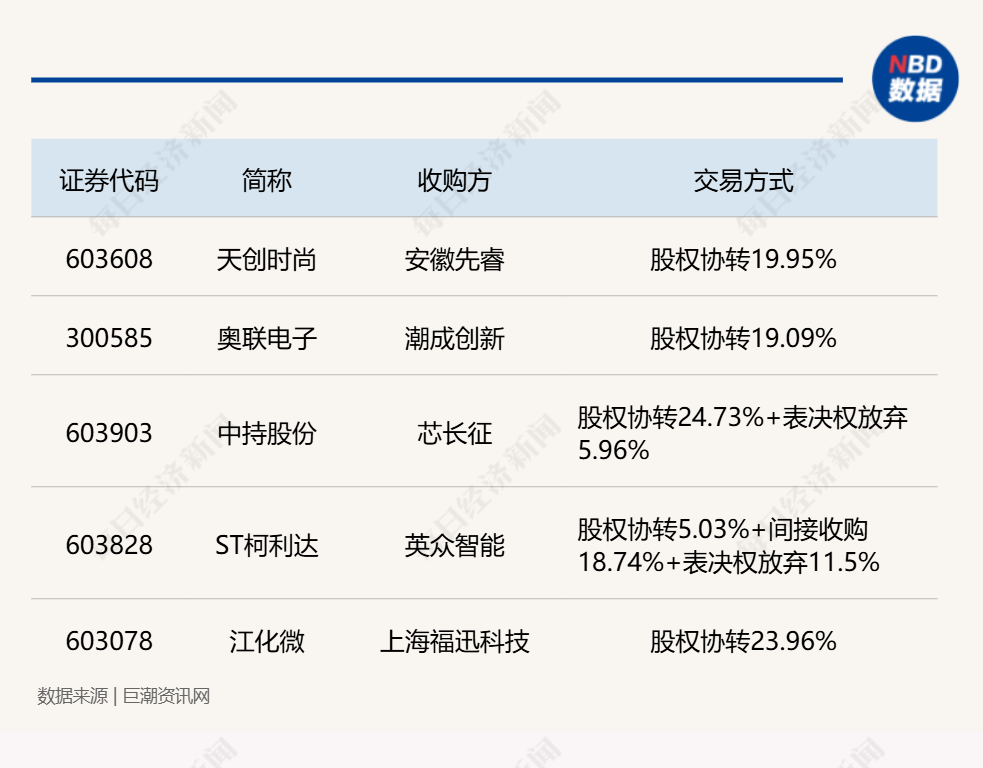
Group 1 - The core viewpoint of the article highlights a new trend in A-share control transactions, where five companies have collectively committed to a 60-month lock-up period for their acquisitions, significantly exceeding the 18-month legal minimum [1] - The companies involved in this trend include Tianchuang Fashion, Aolian Electronics, Zhongzhi Holdings, ST Keli Da, and Jianghua Micro, all of which have announced the extension of their share lock-up periods [1] - A private equity insider indicated that many recent acquisition projects have failed to materialize due to disagreements over lock-up period terms, contrasting sharply with the booming A-share merger and acquisition market since 2025 [1] Group 2 - Since the implementation of supportive policies like the "merger and acquisition six guidelines," the number of A-share merger cases and transaction volumes has significantly increased, showcasing various innovations in acquisition methods and structural entities [1] - The emergence of cases with 60-month extended lock-up periods marks a notable departure from the previously common short-term lock-up practices in the market [1] - The article suggests that the recent concentration of such long lock-up period cases reflects a shift in capital logic and market behavior in the context of A-share acquisitions [1]

奥联电子维权时效告急,需抓紧最后机会
Xin Lang Cai Jing· 2026-01-22 07:44
Group 1 - The company faced regulatory penalties for disclosing false information, leading to investor lawsuits for compensation [1][3] - The compensation claims stem from a cross-industry cooperation announcement made by the company in December 2022 [1][5] - A clarification statement from Huaneng Qingneng Institute on February 21, 2023, denied the company's claims about its partner's achievements, causing a significant drop in the company's stock price [2][6] Group 2 - Many affected investors have initiated lawsuits after the penalty decision, seeking compensation for losses incurred due to the company's misleading disclosures [3][7] - Investors who purchased shares between December 9, 2022, and February 20, 2023, and sold or still hold shares after February 21, 2023, are eligible to participate in the compensation claims [3][7] - The statute of limitations for these claims will expire on February 20, 2026, emphasizing the urgency for eligible investors to act quickly [3][7]
A股控制权交易现新动向:五家公司收购方集体承诺60个月超长锁定期,资本逻辑几何?
Mei Ri Jing Ji Xin Wen· 2026-01-22 06:56
Core Viewpoint - The announcement of a proposed change in control for Jianghua Microelectronics by Shanghai Fuxun Technology, which includes a 60-month share lock-up period, has sparked significant discussion in the capital market regarding extended lock-up periods, which exceed the statutory 18-month requirement by more than double [1]. Group 1: Control Change Cases - Jianghua Microelectronics is the fifth case in the A-share market within a month to feature a 60-month extended lock-up period for control changes, alongside Tianchuang Fashion, Aolian Electronics, Zhongchi Co., and ST Keli Da [1]. - The trend of extending lock-up periods to 60 months reflects a collective shift in the capital logic behind these transactions, indicating a focus on long-term investment strategies [1][11]. Group 2: Transaction Characteristics - The five cases predominantly utilized equity agreement transfers without employing the previously common voting rights entrustment model, likely due to regulatory uncertainties surrounding the latter [2]. - All five cases feature a 60-month lock-up commitment, signaling a strong long-term investment orientation from the acquirers [4]. - The funding sources for these transactions are primarily from the acquirers' own funds, with at least 50% of the total transaction amount being self-funded, enhancing transaction security [5][6]. Group 3: Pricing and Valuation - The transactions generally involved discounted pricing, with the transfer prices being lower than the closing prices prior to the announcements, which helps balance the interests of both parties involved [7][8]. - Jianghua Microelectronics' transfer price was set at 20 yuan per share, reflecting a discount of 6.63% compared to the previous closing price [8]. Group 4: Company Fundamentals - The companies involved are primarily small to mid-cap firms, with Jianghua Microelectronics having a market capitalization close to 10 billion yuan, while the others range between 3 billion to 5 billion yuan [9][10]. - Financial performance indicates that these companies are generally under pressure, with many facing declining profitability or losses, highlighting the need for strategic control changes [9][10].
奥联电子:截至2026年1月20日股东人数合计15583户
Zheng Quan Ri Bao Wang· 2026-01-21 12:44
Group 1 - The core point of the article is that Aolian Electronics (300585) reported a total of 15,583 shareholders as of January 20, 2026 [1]
1月21日重要公告一览
Xi Niu Cai Jing· 2026-01-21 03:07
Group 1 - Northeast Securities expects a net profit of 1.477 billion yuan in 2025, a year-on-year increase of 69.06% [1] - Gansu Energy anticipates a net profit of 1.95 billion to 2.1 billion yuan in 2025, representing a year-on-year growth of 18.6% to 27.72% [2] - Ningbo Bank reports a projected net profit of 29.333 billion yuan in 2025, with an 8.13% year-on-year increase [3] Group 2 - Qianyuan Power forecasts a net profit of 567 million to 633 million yuan in 2025, indicating a year-on-year growth of 160% to 190% [5] - Batian Co. expects a net profit of 890 million to 980 million yuan in 2025, reflecting a year-on-year increase of 117.53% to 139.53% [6] - Tongfu Microelectronics anticipates a net profit of 1.1 billion to 1.35 billion yuan in 2025, with a year-on-year growth of 62.34% to 99.24% [7] Group 3 - Zhongyuan Nepe expects a net profit of 368 million to 428 million yuan in 2025, representing a year-on-year increase of 80.47% to 109.9% [8] - Huajin Co. predicts a net loss of 1.6 billion to 1.9 billion yuan in 2025, compared to a loss of 2.795 billion yuan in the previous year [9] - Xinghua Co. anticipates a net loss of 420 million to 560 million yuan in 2025, up from a loss of 380 million yuan in the previous year [4] Group 4 - Huayuan Holdings expects a net profit of 107 million to 118 million yuan in 2025, a year-on-year increase of 50.98% to 66.82% [12] - Taishan Petroleum forecasts a net profit of 130 million to 165 million yuan in 2025, indicating a year-on-year growth of 30.88% to 66.11% [13] - Jiuqi Software anticipates a net profit of 40 million to 60 million yuan in 2025, recovering from a loss of 156 million yuan in the previous year [21] Group 5 - Jin Fang Energy expects a net profit of 109 million to 143 million yuan in 2025, reflecting a year-on-year increase of 123.97% to 193.7% [16] - He Sheng New Materials anticipates a net profit of 152 million to 171 million yuan in 2025, representing a year-on-year growth of 55% to 75% [24] - Yuedong Microelectronics predicts a net loss of 340 million to 425 million yuan in 2025 [14] Group 6 - Aibo Medical plans to acquire at least 51% of Demai Medical, with an estimated valuation of the target company not exceeding 1 billion yuan [26] - Zhaoshang Shipping intends to build four 3000TEU container ships with a total investment of no more than 1.324 billion yuan [18] - Zhongtung High-tech's subsidiary has confirmed an increase in mineral resources, adding significant quantities of tungsten and other metals [27]