
Dynanonic(300769)

Search documents
德方纳米:公司的主要客户为锂电池制造企业
Zheng Quan Ri Bao· 2025-11-05 09:10
Group 1 - The core viewpoint of the article is that Defang Nano's main customers are lithium battery manufacturers [2]

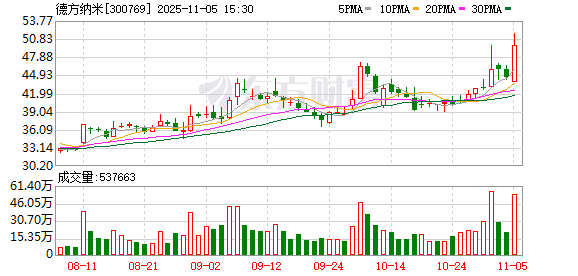
德方纳米:2025年前三季度,公司的补锂增强剂销量同比翻倍增长
Zheng Quan Ri Bao Wang· 2025-11-05 08:47
Core Viewpoint - The company, Defang Nano (300769), has developed a lithium replenishment enhancer that significantly improves the performance of various lithium-ion batteries, including cycle performance, calendar life, energy density, and efficiency in low-temperature conditions [1] Group 1: Product Performance - The lithium replenishment enhancer enhances the cycle performance and calendar life of lithium-ion batteries [1] - It effectively increases the energy density and improves the energy efficiency of battery cells [1] - The product also enhances charging and discharging efficiency, fast charging performance, and reduces self-discharge of batteries [1] Group 2: Market Development - In the first three quarters of 2025, the sales volume of the lithium replenishment enhancer doubled year-on-year [1] - The company has gradually increased the number of exclusive designated projects [1] - Orders have started to be delivered in fields such as fast charging, long-life energy storage, and semi-solid batteries, indicating a phase of market expansion [1]
德方纳米(300769.SZ):公司和山东烁燊目前没有合作
Ge Long Hui· 2025-11-05 08:02
Core Viewpoint - The company, 德方纳米 (Deyang Nano), has confirmed that it currently has no collaboration with 山东烁燊 (Shandong Shuoshen) [1] Group 1 - The company is actively engaging with investors through an interactive platform [1]
德方纳米(300769.SZ):公司与业内主流的锂电池制造企业均有合作
Ge Long Hui· 2025-11-05 08:02
Core Viewpoint - 德方纳米 has established collaborations with major lithium battery manufacturers in the industry [1] Company Summary - 德方纳米 is actively engaging with leading companies in the lithium battery manufacturing sector, indicating a strong position within the market [1]
【A股收评】绝杀!三大指数低开高走,电网概念继续走强!
Sou Hu Cai Jing· 2025-11-05 07:30
Market Performance - The three major indices opened lower but closed higher, with the Shanghai Composite Index rising by 0.23%, the Shenzhen Component Index by 0.37%, the ChiNext Index by 1.03%, and the STAR Market 50 Index by 0.23% [2] - Over 3,100 stocks in the two markets rose, with a total trading volume of approximately 1.87 trillion yuan [2] Hainan Sector - The Hainan sector saw significant gains, with companies like Hainan Development, Haima Automobile, and Hainan Strait Holdings experiencing substantial increases [3] - A new duty-free shopping policy in Hainan, effective from November 1, expands the range of duty-free goods and increases the annual duty-free allowance for travelers to 100,000 yuan, enhancing shopping options for tourists [3] - The Hainan Free Trade Port is set to officially start operations on December 18, further boosting the sector [3] Electric Equipment Sector - The electric equipment sector performed strongly, with companies like Zhongneng Electric and Jinpan Technology seeing gains of nearly 20% [3] - Microsoft CEO Satya Nadella highlighted a power shortage as a key issue for the AI industry, indicating a potential increase in demand for electric equipment to support GPU operations [3] Energy Storage and Lithium Battery Sector - Dongwu Securities revised its forecast for U.S. energy storage installations in 2026 to 76 GWh, a year-on-year increase of nearly 44%, with significant contributions from data centers [4] - The lithium battery supply chain is experiencing active orders, with a year-on-year production increase of 35% reported for major battery manufacturers [4] - Prices for key lithium battery materials have seen a rebound, with lithium carbonate rising to 80,600 yuan per ton and lithium hexafluorophosphate increasing by 46.4% [4] Coal and Steel Sector - The coal and steel sectors showed strong performance, with companies like Antai Group and Vanadium Titanium Holdings rising by 10% [5] - CITIC Securities anticipates a quarter-on-quarter increase of over 15% in the average price of thermal coal at ports, with potential price peaks exceeding 850 yuan per ton [5] - The sector is expected to maintain a rebound due to improvements in policy, coal prices, and earnings expectations [5] Weak Sectors - The innovative drug and semiconductor sectors faced declines, with companies like 3SBio and Hua Hong Semiconductor experiencing significant drops [5] - The liquor and gaming sectors also weakened, with Perfect World and Kweichow Moutai seeing notable declines [5]







20cm速递|14项电解质标准定调!固态电池迎爆发期,创业板新能源ETF华夏(159368)成交额同类第一,持仓股德方纳米强势领涨!
Mei Ri Jing Ji Xin Wen· 2025-11-05 06:57
Core Viewpoint - The A-share market showed positive performance with significant gains in the new energy sector, particularly in solid-state battery concepts, driven by recent government standards and industry growth potential [1][2]. Group 1: Market Performance - The three major A-share indices turned positive on November 5, with the ChiNext New Energy ETF (Hua Xia, 159368) experiencing a maximum increase of 3.85% [1]. - Notable stocks included Defang Nano, which surged over 13.67%, and Penghui Energy, which rose over 9%, with other companies like Yiwei Lithium Energy and Sunshine Power also seeing gains exceeding 6% [1]. - The ChiNext New Energy ETF (Hua Xia, 159368) recorded a trading volume exceeding 58 million yuan, ranking first among similar products [1]. Group 2: Industry Standards and Future Outlook - On November 4, the Ministry of Industry and Information Technology released the fourth batch of industry standards for 2025, focusing on new energy storage and the metaverse, with 15 recommended standards primarily targeting solid-state lithium battery electrolytes [1]. - The standards aim to clarify technical specifications for core materials in solid-state lithium batteries, facilitating industrial innovation and supporting high-quality development in the new energy and storage sectors [1]. - According to CITIC Securities, solid-state batteries are expected to become a growth engine for new energy, with lithium and nickel demand projected to surge [2]. - By 2025, the demand for lithium in solid-state batteries is estimated at 14,600 tons LCE, increasing to 660,000 tons LCE by 2030, representing a significant rise compared to traditional battery technologies [2]. Group 3: ETF Characteristics - The ChiNext New Energy ETF (Hua Xia, 159368) is the largest ETF tracking the ChiNext New Energy Index, covering various sectors including batteries and photovoltaics [2]. - It offers the highest elasticity with a potential increase of up to 20%, and the lowest fees, with a combined management and custody fee of only 0.2% [2]. - As of October 31, 2025, the ETF's scale reached 829 million yuan, with an average daily trading volume of 90.05 million yuan over the past month, and it has a storage content of 51% and solid-state battery content of 30% [2].
回暖趋势明显!近20家锂电材料上市公司业绩公布
Sou Hu Cai Jing· 2025-11-03 01:50
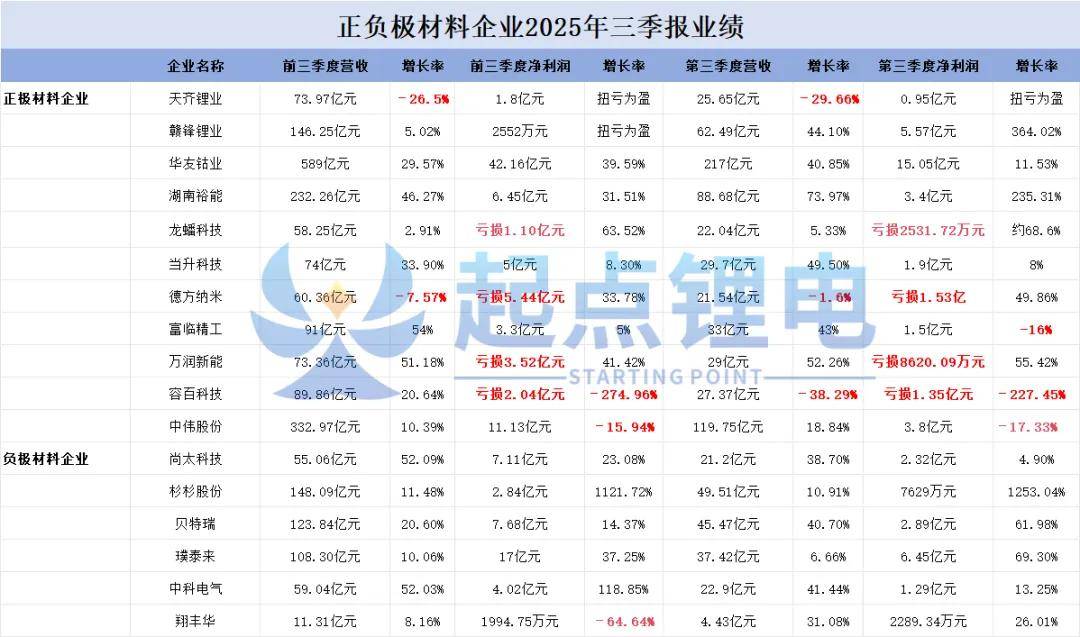
Core Insights - The lithium battery materials industry has shown significant improvement in the third quarter of 2025, with many companies turning losses into profits and a clear trend of recovery in the sector [1][3] Group 1: Performance of Positive Electrode Material Companies - Tianqi Lithium's revenue for the first three quarters was 7.397 billion yuan, down 26.5%, but it achieved a net profit of 180 million yuan, marking a turnaround [2] - Ganfeng Lithium reported a revenue of 14.625 billion yuan, a growth of 5.02%, with a net profit of 2.552 billion yuan, also a turnaround [2] - Huaneng Technology and other companies have seen significant profit increases, with Huaneng's revenue reaching 23.226 billion yuan, up 46.27%, and a net profit of 645 million yuan, up 31.51% [2][3] Group 2: Trends in Positive Electrode Materials - High-pressure compact lithium iron phosphate has become a focal point for companies, driven by strong demand in the energy storage sector and advancements in technology [3][4] - The price of battery-grade lithium carbonate has rebounded, maintaining a range of 80,300 to 81,700 yuan per ton, contributing to the positive performance of many positive electrode material companies [4] - Major companies like Longpan Technology have secured large orders from leading firms, enhancing their market position [4] Group 3: Performance of Negative Electrode Material Companies - The negative electrode materials sector has also seen a recovery, with a total shipment of 201.1 million tons in the first nine months of 2025, a year-on-year increase of 35.1% [7] - Shanshan Co. achieved a net profit of 33.14 million yuan in Q1, marking a successful turnaround, and its stock price has rebounded significantly [7][8] - Companies like BTR and Putailai are expanding their overseas business and solid-state battery technology, contributing to their recovery and growth [8]



锂电材料三季报透视:盈利能力仍待提升,价格回暖催生全年业绩转机
Di Yi Cai Jing· 2025-11-02 11:48
Group 1 - The lithium battery materials industry showed mixed results in Q3 2025, with over 80% of listed companies reporting quarter-on-quarter revenue growth, while 60% experienced a decline in net profit, indicating ongoing challenges in profitability [1][2] - The average year-on-year growth rates for revenue and net profit among 41 companies were 19.78% and 20.08%, respectively, a significant improvement from the previous year's declines of -15.96% and -168.07% [2] - The performance of the positive electrode material segment remains under pressure, while the negative electrode segment shows signs of stabilization and recovery [3][4] Group 2 - Major companies like Minmetals New Energy and Keda Technology reported significant quarter-on-quarter revenue increases of 43.72% and 54.21%, respectively, reflecting a recovery in industry demand and material prices [2] - Despite revenue growth, 24 out of 41 companies reported a decline in net profit, with notable drops from Rongbai Technology (-155.35%) and Minmetals New Energy (-81.84%) [2][3] - The negative electrode material segment saw strong performance, with companies like Shanshan Co. and Puli Technology reporting substantial profit increases, indicating a positive trend in this area [4] Group 3 - The capital market remains optimistic about the lithium battery materials sector, with an average price increase of 66.95% for the battery materials sector from the beginning of 2025 to the latest closing date [7] - Prices for battery-grade lithium carbonate and hexafluorophosphate have rebounded sharply, with hexafluorophosphate prices exceeding 110,000 yuan/ton, reflecting a significant increase from earlier in the year [7] - The anticipated growth in demand for energy storage solutions is expected to drive further increases in lithium battery demand, with projections of over 2,700 GWh in total lithium battery demand next year, a year-on-year growth rate exceeding 30% [8]


固态电池概念拉升,海科新源20%涨停,新宙邦等大涨
Zheng Quan Shi Bao Wang· 2025-10-31 03:39
Core Viewpoint - The solid-state battery concept is experiencing a strong surge in the market, with several companies seeing significant stock price increases, indicating growing investor interest and confidence in this technology [1] Company Developments - Haike New Energy has reached a 20% limit-up in stock price, while Xingyuan Material and Defang Nano have increased by over 13%, and companies like New Zobang and others have also seen gains exceeding 10% [1] - BAK Battery showcased its in-situ solidification technology at the 32nd China Society of Automotive Engineers annual conference, achieving an energy density of 390Wh/kg with a liquid electrolyte content below 10% [1] - Sunwoda released its "Xin·Bixiao" solid-state battery, which has an energy density of 400Wh/kg (with laboratory samples reaching 520Wh/kg) and maintains over 70% capacity at -30℃ [1] - Zhuhai Guanyu reported successful mass production of high-silicon anode batteries with a volume energy density of 900Wh/L due to increased silicon content [1] Industry Trends - According to Open Source Securities, solid-state batteries are transitioning from laboratory stages to mass production validation, with expectations to complete small batch vehicle testing by the end of 2025 and widespread vehicle testing between 2026 and 2027 [1] - Emerging application scenarios such as low-altitude, robotics, and AI are expected to expand the market for solid-state batteries, potentially accelerating industrialization [1]



德方纳米:预计明年磷酸铁锂市场仍将维持高速增长
Zheng Quan Shi Bao Wang· 2025-10-31 01:37
Core Viewpoint - The company expects continued growth in the lithium iron phosphate market, driven by increasing domestic installation rates and global demand in both the automotive and energy storage sectors [1] Group 1: Automotive Market - In the domestic market, the installation rate of lithium iron phosphate batteries has reached 80% this year [1] - Overseas automakers are gradually switching to lithium iron phosphate batteries, indicating a shift in global automotive trends [1] Group 2: Energy Storage Market - The global demand for energy storage has seen a significant surge this year, with rapid growth in markets outside of China, including North America, Europe, the Middle East, Southeast Asia, and South America [1] - The company anticipates that the lithium iron phosphate market will maintain high growth rates next year [1]