AMD(AMD)

Search documents
Prediction: These 2 Artificial Intelligence (AI) Stocks Will Be Worth More Than Palantir by the End of 2026
The Motley Fool· 2025-12-11 08:21
Core Viewpoint - Palantir Technologies has shown significant stock growth, but smaller AI companies like Alibaba and AMD may outperform it in the near future, potentially surpassing its valuation by the end of 2026 [1][2][9]. Palantir Technologies - Palantir's stock has increased by 167% in 2023 and 340% in 2024, with a year-to-date rise of approximately 148%, leading to a market cap of $448 billion [1]. - The company achieved a revenue growth of 63% and an adjusted operating margin of 51%, resulting in a Rule of 40 score of 114, indicating strong growth and profitability [4]. - Despite its profitability and growth exceeding analyst expectations, the stock price has declined following the release of its third-quarter earnings [5]. - Palantir's stock trades at nearly 100 times analysts' revenue expectations for 2026 and 250 times expected forward earnings, suggesting that future growth is already priced in [7]. - Analysts have raised their price targets for Palantir, with a median target of $200, but most maintain a hold or sell rating, indicating skepticism about further price increases [8]. Alibaba Group - Alibaba is not only a leading e-commerce platform but also the largest cloud infrastructure provider in China, with AI services revenue growing at a triple-digit pace for nine consecutive quarters, contributing to a 34% increase in total cloud revenue [10]. - The company has invested approximately $17 billion into AI and cloud infrastructure over the past year, although it faces challenges in meeting the demand for AI services [11]. - Alibaba's market cap is currently $378 billion, and if it continues to grow, it could surpass Palantir's valuation [15]. - The market may be undervaluing Alibaba's growth potential, as its forward P/E ratio is under 24, significantly lower than other AI stocks [14]. Advanced Micro Devices (AMD) - AMD is making strides in the GPU market, competing effectively with Nvidia, and expects its data center revenue to grow by an average of 60% over the next three to five years, with AI-specific solutions projected to grow at an annualized rate of 80% [16][17]. - The company anticipates capturing at least 10% of the AI compute market, which is expected to reach $1 trillion by 2030, potentially leading to higher gross margins and stronger earnings growth [17]. - AMD's forward P/E ratio is around 55, but it trades for only 21 times expectations for 2027 earnings, suggesting it could be undervalued if long-term earnings projections are met [20]. - With a current market cap of $360 billion, AMD will need continued strong performance to surpass Palantir, but the upcoming release of its MI450 series could serve as a catalyst for growth [21].



黑天鹅突袭!刚刚,全线杀跌!
券商中国· 2025-12-11 06:14
Core Viewpoint - The recent interest rate cut by the Federal Reserve, which was expected to be a positive factor, has instead led to market declines, raising concerns about potential AI bubbles and future monetary policy directions [1][5]. Group 1: Federal Reserve Actions - The Federal Reserve cut interest rates but maintained a forecast of only one rate cut by 2026, indicating a hawkish stance [5]. - The Fed's decision to expand its balance sheet by purchasing $40 billion in the first month is seen as a move to enhance market liquidity [5]. - Fed Chairman Jerome Powell suggested that current interest rates are at a "neutral level," which may limit future rate cuts [5]. Group 2: Oracle's Earnings Report - Oracle's stock plummeted by 11.55% after disappointing earnings, with concerns that AI orders may take longer to fulfill [3]. - The company's cloud business revenue grew by 34% to $7.98 billion, while infrastructure revenue increased by 68% to $4.08 billion, both slightly below analyst expectations [3]. - Oracle reported a free cash flow of -$10 billion for the second fiscal quarter, with capital expenditures reaching $12 billion, raising concerns about cash flow management [3]. Group 3: Japanese Monetary Policy - The Bank of Japan's potential for up to four interest rate hikes by 2027 has been highlighted, with expectations of a rate increase next week [7]. - The strengthening of the yen may reduce import cost sensitivity for Japanese companies, potentially impacting global commodity prices [7]. - Recent bond auction results showed strong demand for Japanese 20-year bonds, indicating market resilience despite previous volatility [7].



AMD大中华区纪朝晖:AI Agent推动AI从对话工具向生产力跃迁
Zheng Quan Shi Bao Wang· 2025-12-11 04:45
Core Insights - MINISFORUM and AMD jointly hosted an event showcasing new AI computing products, emphasizing the impact of AI innovation on businesses and individuals [1] - AMD's VP highlighted the significance of the "AIAgent" era starting in 2025, marking a transition in AI capabilities from chatbots to productivity tools [1] - MINISFORUM's chairman noted the collaboration with AMD enhances their ability to integrate advanced AI processor technology, aiming to elevate productivity and creativity for users [1] Product Highlights - The MS-S1MAX mini AI workstation is designed for high performance in a compact form, capable of running large models locally and processing complex tasks efficiently [1] - The workstation can handle models like Llama109B and DeepSeek-R170B, and a four-machine cluster can process the Deepseek 6710 billion parameter Q4 model [1] - Compared to traditional servers, the MS-S1MAX cluster reduces volume by approximately 65%, power consumption by 80%, and overall costs by up to 77% when running large models [1]
AMD: The OpenAI Partnership, Data Center Dominance - And A Breakout To $300? (NASDAQ:AMD)
Seeking Alpha· 2025-12-11 01:10
For years, I have been keeping close tabs on Advanced Micro Devices, Inc. ( AMD ), and I must say, the transformation witnessed under CEO Lisa Su has been incredible. What initially was a chipmaker impeded inI am a 20-year-old international wealth and investment manager, Associate (ACSI) at the Chartered Institute for Securities & Investment (CISI), with a strong focus on traditional markets and cryptoassets. My approach combines rigorous technical and fundamental analysis with a genuine passion for financi ...
AMD: The OpenAI Partnership, Data Center Dominance - And A Breakout To $300?
Seeking Alpha· 2025-12-11 01:10
Core Insights - The transformation of Advanced Micro Devices, Inc. (AMD) under CEO Lisa Su has been remarkable, shifting from a struggling chipmaker to a more competitive player in the semiconductor industry [1]. Company Overview - AMD has undergone significant changes in its operational strategy and product offerings, enhancing its market position and competitiveness [1]. Leadership Impact - CEO Lisa Su's leadership has been pivotal in driving AMD's transformation, focusing on innovation and strategic growth [1].

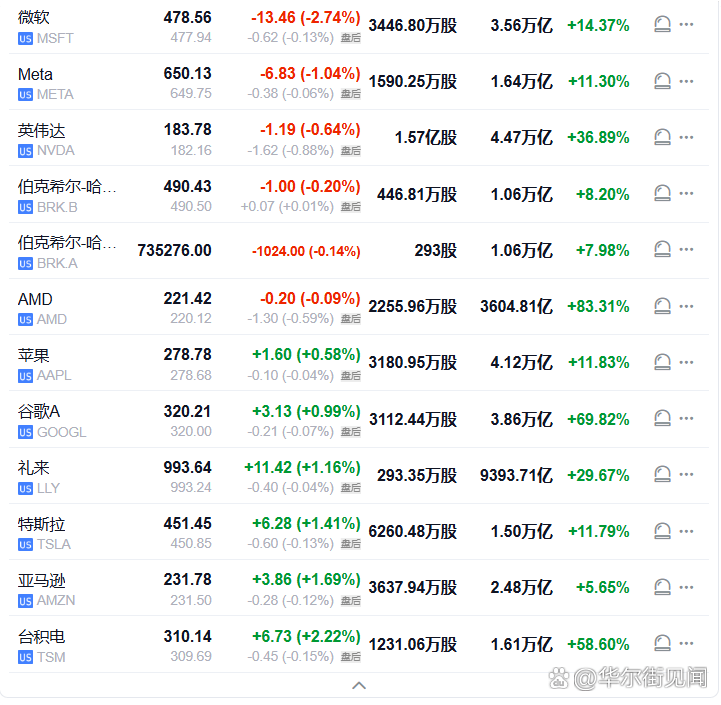
美股七巨头收盘播报|周三(12月10日),美国科技股七巨头(Magnificent 7)指数跌0.16%,报208.22点,大部分时间处于低位震荡状态,美联储主席鲍威尔新闻发布会之初还曾跌向日低。“超大”市值科技股指数涨0.23%,报407.45点。
Sou Hu Cai Jing· 2025-12-10 21:24
Group 1 - The Magnificent 7 index of major US tech stocks closed down 0.16% at 208.22 points, experiencing low volatility for most of the day [1] - The "super" market capitalization tech stock index increased by 0.23% to 407.45 points [1] Group 2 - Microsoft shares closed at 478.56, down 2.74% with a trading volume of 34.468 million shares [2] - Meta Platforms shares closed at 650.13, down 1.04% with a market capitalization increase of 11.30% [2] - Nvidia shares closed at 183.78, down 0.64% with a market capitalization increase of 36.89% [2] - Berkshire Hathaway Class B shares closed at 490.43, down 0.20% with a market capitalization increase of 8.20% [2] - AMD shares closed at 221.42, down 0.09% with a market capitalization increase of 83.31% [2] - Apple shares closed at 278.78, up 0.58% with a market capitalization increase of 11.83% [2] - Alphabet Class A shares closed at 320.21, up 0.99% with a market capitalization increase of 69.82% [2] - Eli Lilly shares closed at 993.64, up 1.16% with a market capitalization increase of 29.67% [2] - Tesla shares closed at 451.45, up 1.41% with a market capitalization increase of 11.79% [2] - Amazon shares closed at 231.78, up 1.69% with a market capitalization increase of 5.65% [2] - TSMC shares closed at 310.14, up 2.22% with a market capitalization increase of 58.60% [2]



Intel, AMD Accused of Allowing Chips in Russian Missiles
Yahoo Finance· 2025-12-10 21:08
Core Viewpoint - Microchip manufacturers Intel, AMD, and Texas Instruments are facing lawsuits for allegedly allowing their technology to be used in Russian-made weapons that have harmed civilians in Ukraine [1][2]. Group 1: Lawsuits and Allegations - The lawsuits, filed by a law firm on behalf of Ukrainian civilians, accuse the companies of "willful ignorance" regarding the resale of restricted chips to Russia, which were used in drones and missiles [2]. - Specific incidents cited in the lawsuits include attacks between 2023 and 2025 that resulted in civilian casualties, with some attacks involving Iranian-made drones containing components from Intel and AMD [2]. - The lawsuits claim that the companies exhibited "domestic corporate negligence" by failing to implement adequate export control and diversion-prevention systems [5]. Group 2: Company Responses - Intel stated that it does not conduct business in Russia and suspended all shipments to Russia and Belarus following the outbreak of the war, asserting compliance with U.S. export laws and sanctions [4]. - Texas Instruments and AMD have also claimed compliance with sanctions and have ceased business in Russia since the war began, with Texas Instruments expressing strong opposition to the use of its chips in Russian military equipment [5]. - The attorney representing the plaintiffs referred to the companies as "merchants of death," criticizing them for undermining U.S. sanctions [5].


Advanced Micro Devices, Inc. (AMD) Presents at Barclays 23rd Annual Global Technology Conference Transcript
Seeking Alpha· 2025-12-10 20:52
To ensure this doesn’t happen in the future, please enable Javascript and cookies in your browser.If you have an ad-blocker enabled you may be blocked from proceeding. Please disable your ad-blocker and refresh. ...

Advanced Micro Devices (NasdaqGS:AMD) FY Conference Transcript
2025-12-10 19:27
Summary of Advanced Micro Devices (AMD) FY Conference Call - December 10, 2025 Industry Overview - The discussion centers around the AI industry, highlighting a significant investment cycle with over $3 trillion in announced AI spending, particularly in compute and networking sectors [3][4] - AMD views AI as a transformational technology that will fundamentally change the global economy, indicating a long-term growth opportunity [4] Key Points on AMD's Position and Strategy - AMD is experiencing increased demand for its compute capabilities, both in GPU and CPU segments, driven by hyperscale companies that are well-capitalized and funding their investments through free cash flow [4] - The company believes that the data center market represents a trillion-dollar opportunity, with 20%-25% of that market being custom silicon (ASICs) and the remainder being general-purpose compute [5][11] - AMD maintains that the majority of the market will continue to favor general-purpose GPUs due to their flexibility and ability to support various workloads [10][11] Customer Engagement and Partnerships - AMD has established a significant partnership with OpenAI, committing to a multi-year agreement for six gigawatts of deployment, which is expected to ramp up in 2027 [16][17] - The collaboration with OpenAI has enhanced AMD's visibility in the competitive landscape against NVIDIA and Broadcom, positioning AMD as a key player in providing real compute solutions [15][21] Financial Performance and Market Dynamics - AMD's client business has seen a 60% revenue increase over the last three quarters, primarily driven by average selling price (ASP) expansion as the company moves into premium PC and enterprise markets [36] - The company is focused on market share expansion and improving gross margins, with a long-term target of achieving 55%-58% gross margin across its business segments [24][23] Competitive Landscape - AMD acknowledges the competitive nature of the AI hardware market, emphasizing the importance of flexibility in silicon design to meet diverse customer needs [10][27] - The company is cautious about the evolving landscape, particularly regarding custom silicon developments by competitors like NVIDIA, but remains committed to its programmable architecture [27][29] Challenges and Risks - The situation with China remains dynamic, with uncertainties regarding product demand and export controls impacting AMD's revenue forecasts [34][35] - AMD is monitoring the market closely to ensure compliance with U.S. government regulations while addressing customer demand in China [34] Conclusion - AMD is strategically positioned to capitalize on the growing AI market, leveraging partnerships and a strong product portfolio to drive future growth while navigating competitive and regulatory challenges [39]
Will Strong Data Center Growth Push Up AMD's Stock Higher in 2026?
ZACKS· 2025-12-10 15:41
Core Insights - Advanced Micro Devices (AMD) shares have increased by 70.3% over the past year, significantly outperforming the Zacks Computer and Technology sector's 24.7% return and the Zacks Computer – Integrated Systems industry's 68.8% appreciation [1] - The growth is driven by strong demand for EPYC processors and Instinct MI350 and MI300 series GPUs, with expectations for double-digit growth in Data Center revenues in Q4 2025 [1][9] Data Center Market Potential - AMD anticipates the data center total addressable market to reach $1 trillion by 2030, indicating a compound annual growth rate (CAGR) of over 40% from an estimated $200 billion in 2025 [2] - Data center AI revenues are projected to grow at a CAGR of over 80% in the next 3-5 years, supported by demand for Instinct GPUs and a growing customer base [2] Product Adoption and Partnerships - The adoption of fifth-generation EPYC processors is strong, with hyperscalers launching over 160 EPYC-powered instances in Q3 2025, marking a 50% year-over-year increase in public EPYC cloud instances [4] - New partnerships and product launches, such as Oracle's MI355X instances and the adoption of MI300 series by companies like IBM and OpenAI, are expected to drive further growth [5][6] Financial Performance and Guidance - AMD expects Q4 2025 revenues to be around $9.6 billion, reflecting approximately 25% year-over-year growth and 4% sequential growth [7] - The Zacks Consensus Estimate for Q4 2025 revenues is $9.64 billion, indicating a 25.9% increase from the previous year [8] Competitive Landscape - AMD faces significant competition from NVIDIA, Broadcom, and Intel, with NVIDIA's AI and high-performance computing growth posing a particular challenge [10][11] - Over the past year, AMD shares have underperformed compared to Broadcom and Intel, which returned 121.7% and 101.3%, respectively, while AMD outperformed NVIDIA's 32.5% return [12] Valuation Concerns - AMD's stock is currently considered overvalued, with a forward 12-month price/sales ratio of 8.49X compared to the sector's 6.79X, indicating a stretched valuation [16] - The company's near-term prospects are viewed as dull due to competitive pressures and valuation concerns [19]