Basf(BASFY)

Search documents
BASF SE (BASFY) Discussion on Coatings Transaction with Carlyle Transcript
Seeking Alpha· 2025-10-10 14:59
Core Points - BASF and Carlyle announced a Coatings Transaction, which is the primary focus of the conference call [1][2] - The call is structured to first address questions from financial market participants, followed by questions from media attendees [1][2] - The conference call is being recorded for transparency and future reference [2] Company and Industry Summary - The conference call is specifically limited to discussions regarding the Coatings Transaction, indicating a focused approach to investor relations [2] - Forward-looking statements were made during the presentation, highlighting the reliance on current estimates and projections from the Board of Executive Directors [3] - The company acknowledges that forward-looking statements involve risks and uncertainties, which may affect the accuracy of the assumptions made [3]



深度 | 情绪护肤,国际原料巨头们的“新能源”?
FBeauty未来迹· 2025-10-10 11:40
Core Insights - The international beauty raw material companies are facing significant challenges in 2025 due to global economic fluctuations and unfavorable currency exchange rates, which have become the primary obstacle to growth [2][5] - Despite some growth in the beauty and personal care sectors, these companies are encountering new competitive pressures in the Chinese market, prompting a focus on innovation driven by scientific research [3][11] Financial Performance - The financial reports for the first half of 2025 show varying degrees of performance among international raw material companies, with overall sales and EBITDA experiencing fluctuations [5][6] - For instance, BASF reported a slight decline in overall sales by 1.48% but a growth of 3.6% in beauty raw materials, while DSM-Firmenich saw a 3.37% increase in overall sales but a decline in beauty raw materials by 0.89% [6] Market Trends - The Chinese market is viewed as a key opportunity for international raw material companies, despite increasing competition, as consumer preferences shift towards scientifically validated ingredients rather than trendy components [11][12] - The trend towards "scientific skincare" is pushing companies to develop active ingredients with clear scientific backing and clinical validation [14][21] Innovation and R&D - Companies are investing in advanced technologies and innovative ingredients tailored to the unique demands of the Chinese market, such as neurocosmetics that address emotional well-being and skin health [17][18] - The rise of neurocosmetics is evident, with a significant increase in products that offer emotional benefits, reflecting a shift in consumer focus from mere efficacy to sensory experiences [19][20] Strategic Approaches - International raw material companies are adopting a long-term approach to innovation, emphasizing foundational research and the development of a comprehensive scientific framework for their products [21][24] - Companies like DSM and Clariant are localizing their R&D efforts in China, aiming to create products that resonate with local consumer needs while building a robust scientific communication framework [26][27]


估值近70亿欧元,巴斯夫瘦身重组,涂料业务或将花落凯雷
Feng Huang Wang· 2025-10-09 12:12
Group 1 - BASF is in exclusive negotiations with Carlyle Group to sell its coatings business for an estimated valuation of nearly €7 billion (approximately ¥579.47 billion) [1] - The potential sale is part of BASF's long-term strategic adjustment in response to high energy costs in Europe and weak global chemical demand [1][2] - The coatings business is significant, with projected sales of approximately €3.8 billion (around ¥314.57 billion) in 2024, covering automotive OEM coatings, automotive refinish coatings, and surface treatment [1] Group 2 - The sale could help BASF reduce debt and accelerate investments in green technologies [2] - Other potential bidders for the coatings business include Lone Star Funds, Anacap, Bain Capital, and Blackstone [2] - Carlyle Group has a history in the chemical sector, having acquired AkzoNobel's specialty chemicals business for €10.1 billion in 2018 [2]
巴斯夫已布局!刷屏的“诺奖”MOF材料,一文读懂
DT新材料· 2025-10-08 16:04
Core Viewpoint - The awarding of the 2025 Nobel Prize in Chemistry to Susumu Kitagawa, Richard Robson, and Omar M. Yaghi for their development of Metal-Organic Frameworks (MOFs) signifies a major recognition for the new materials sector, potentially accelerating the industrialization of MOFs [2] Group 1: MOFs Overview - MOFs, or Metal-Organic Frameworks, are porous compounds formed by metal ions or clusters and organic ligands, exhibiting unique structural properties and high application potential [3][5] - Since their inception in the 1990s, over 100,000 types of MOFs have been synthesized, although naming conventions vary across research teams [5] Group 2: Structural Characteristics and Advantages - MOFs possess a highly porous structure with porosity exceeding 90%, allowing for significant molecular adsorption capabilities, making them suitable for applications in gas separation, catalysis, and drug delivery [8] - The structural tunability of MOFs enables customization of properties such as porosity and crystallinity through formulation adjustments, enhancing their functional applications [9] Group 3: Synthesis Methods - Various synthesis methods for MOFs have been developed, including mechanochemical, hydrothermal, and spray-drying methods, with mechanochemical and spray-drying methods showing the most promise for large-scale production [10][12] Group 4: Applications of MOFs - MOFs are widely used in gas storage, separation, and adsorption due to their tunable pore sizes, making them ideal for capturing gases like hydrogen and carbon dioxide [15][16] - They can also serve as electrode materials and battery separators, enhancing the performance of energy storage devices like lithium-ion and lithium-sulfur batteries [18] - MOFs have applications in water purification and recovery, demonstrating high adsorption capacities for dissolved metal ions and enabling water extraction from air in arid regions [20] - Additionally, MOFs are utilized in drug delivery systems and as sensors, benefiting from their high surface area and tunable structures for targeted therapeutic applications [21]

巴斯夫,百亿级两大业务出售
DT新材料· 2025-10-08 06:44
Core Insights - BASF is strategically divesting from certain business segments to optimize its product portfolio and focus on priority market growth areas, particularly in nutrition and health [4][5]. Group 1: Business Divestitures - BASF has sold its decorative coatings business in Brazil to Sherwin-Williams for $1.15 billion (approximately 8.187 billion RMB), marking the largest single acquisition in the global coatings industry in 2025 [2]. - The decorative coatings business generated approximately $525 million in sales in 2024 and was BASF's only large B2C operation, primarily operating in Brazil with limited synergy with other coatings businesses [2]. - BASF has also completed the sale of its food and health functional ingredients business to Louis Dreyfus Company (LDC), which includes a production site in Germany and three application laboratories outside Germany, along with around 300 employees [3]. Group 2: Strategic Focus Areas - BASF aims to enhance its focus on the nutrition and health sectors, particularly in vitamins and carotenoids, as part of its strategic initiatives [4]. - The company plans to retain its Environmental Catalysts and Metal Solutions (ECMS) business, which is projected to generate €7 billion in sales in 2024 and approximately €4 billion in cumulative cash flow from 2024 to 2030 [5]. - The battery materials division, expected to generate €600 million in sales in 2024, is undergoing significant cost reductions and is exploring collaborative opportunities along the value chain [5][6]. - BASF is considering strategic options for its remaining coatings business, which generated €3.8 billion in sales in 2024, with a decision expected by the fourth quarter of 2025 [6]. - The Agricultural Solutions division aims to prepare for an IPO by 2027, with projected sales of €9.8 billion in 2024 [7]. Group 3: Capital Allocation Strategy - BASF is implementing a stringent capital allocation strategy, reducing expected payments for real estate, plants, equipment, and intangible assets from approximately €17 billion to €16 billion between 2025 and 2028 [7]. - The total capital expenditure for the integrated site in Zhanjiang, southern China, has been reduced by €1.3 billion to approximately €8.7 billion, with most plants expected to be operational by the end of 2025 [7].
BASF Fields of Purpose program helps growers give back to their communities
Globenewswire· 2025-10-07 17:07
Core Insights - BASF Agricultural Solutions Canada has launched the Fields of Purpose program aimed at enhancing rural impact through community-led initiatives that support Canadian growers and retailers [1][2] - The program focuses on donating 100% of crops grown by local growers to benefit rural communities and organizations, emphasizing the importance of community involvement [1][3] Financial Contributions - In 2025, BASF contributed $100,000 in seed and crop protection products to support charitable fields, ensuring maximum yield and crop quality [2] - The program supported 36 initiatives across Alberta, Saskatchewan, Manitoba, and Ontario, showcasing BASF's commitment to community engagement [2] Community Engagement - The Leduc & District Growing Project, which has been active for 20 years, exemplifies the program's impact, with all inputs and labor for seeding and harvesting donated [3] - Funds generated from the sale of crops are directed to the Canadian Food Grains Bank, highlighting the program's role in addressing food security [3] Company Overview - BASF Agricultural Solutions Canada employs over 625 individuals across three production facilities and several research farms, positioning itself as a leader in agricultural research and product development [5] - The division generated sales of €9.8 billion in 2024, reflecting its significant role in the agricultural sector [6] Sustainability Commitment - BASF is dedicated to integrating sustainability into its business decisions, investing €919 million in R&D in 2024 to develop innovative agricultural solutions [6] - The company aims to combine economic success with environmental protection and social responsibility, reinforcing its commitment to sustainable agriculture [8]
【聚焦】交易价高达582亿元!巴斯夫涂料业务或将出售给美国私募股权公司
Sou Hu Cai Jing· 2025-10-07 13:32
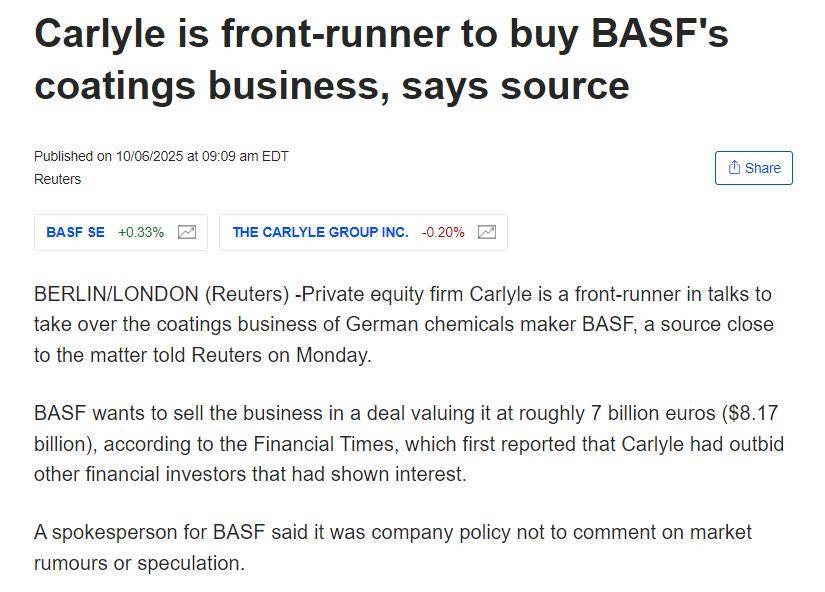
Core Viewpoint - Carlyle Group is set to acquire BASF's coatings business for approximately €7 billion ($8.17 billion or ¥58.2 billion), marking a record for M&A in the chemical industry this year and raising concerns about the restructuring of the global coatings industry [1][3]. Company Summary - Carlyle's bid exceeds that of other financial investors interested in BASF's coatings division, which has over 10,300 employees and generated €3.8 billion in revenue last year, primarily from automotive coatings [1][3]. - BASF has been exploring strategic options for this business since the second quarter and plans to make a decision by the end of the year [1][3]. - The potential sale could enable BASF to initiate a previously announced stock buyback of at least €4 billion ahead of schedule [3]. Industry Summary - The global coatings market is characterized by "head concentration and regional dispersion," with major players like AkzoNobel and PPG competing against local firms [3]. - Carlyle's acquisition could strengthen its position in the high-end market through capital operations and resource integration [3]. - Analysts predict that Carlyle may drive synergies between BASF's coatings business and its existing portfolio, potentially linking automotive coatings technology with the new energy vehicle supply chain and expanding into emerging markets in Asia-Pacific [3]. Competitive Landscape - Other strategic buyers such as Sherwin-Williams, PPG, AkzoNobel, Nippon Paint, and Axalta may also play a role in the acquisition process, although Carlyle is currently the leading bidder [6][11]. - The coatings division's last year's sales were approximately €4.3 billion, with around 12,000 employees, indicating its significant market presence [6]. - Regulatory challenges, particularly antitrust scrutiny, may impact the acquisition, given BASF's substantial market share in Europe and North America [4][11]. Financial Implications - The funds from the sale could be used for early stock buybacks and portfolio realignment for BASF [11]. - Private equity firms like Carlyle can act more swiftly than strategic buyers, facing fewer constraints related to product overlap or integration issues [10].

BASF SE (BASFY) Capital Market Update 2025 (Transcript)
Seeking Alpha· 2025-10-03 12:46
ConversationStefanie WettbergSenior Vice President of Investor Relations Good morning, everybody. Welcome to our Capital Market Update. It's a pleasure to have you join us here in Antwerp as well as online. We are streaming this first part of today's event, the keynote and the subsequent Q&A live, from our Verbund site in Belgium. The other parts of the program will not be live streamed. However, PDFs of all presentations will be available shortly before they begin. And later today, you will find replays on ...
BASF SE (BASFY) Analyst/Investor Day Transcript
Seeking Alpha· 2025-10-02 21:02
ConversationStefanie WettbergSenior Vice President of Investor Relations Good morning, everybody. Welcome to our Capital Market Update. It's a pleasure to have you join us here in Antwerp as well as online. We are streaming this first part of today's event, the keynote and the subsequent Q&A live, from our Verbund site in Belgium. The other parts of the program will not be live streamed. However, PDFs of all presentations will be available shortly before they begin. And later today, you will find replays on ...

解码慕尼黑对话:奔驰、宝马、巴斯夫与宁德时代看准的新机遇是什么?
市值风云· 2025-09-30 11:54
Core Viewpoint - The automotive industry is at a critical juncture, transitioning from a linear economy to a circular economy, emphasizing resource reduction, reuse, and recycling as key drivers for innovation and high-quality development [3][4]. Group 1: European Market Challenges - The European electric vehicle market is facing significant challenges, with a projected 5.9% decline in electric vehicle sales in 2024, indicating a slowdown in the electrification process [6]. - Europe heavily relies on imports for battery raw materials, with 98% of lithium and 80% of natural graphite sourced externally, leading to increased supply chain risks and costs [7]. - The EU's stringent new battery regulations require comprehensive lifecycle management, including carbon footprint reporting and recycling targets, which pose significant pressure on local automotive manufacturers [8][12]. Group 2: Potential in European Electrification - Despite challenges, the European electric vehicle market holds substantial potential, with 1.45 million new pure electric vehicles expected to be registered in 2024, and a total of 5.87 million pure electric vehicles by year-end [12]. - The EU's new carbon emission targets necessitate that manufacturers achieve at least 20% of their sales from pure electric vehicles to avoid hefty fines, driving the urgency for electrification [12]. - The first five months of 2024 saw a 25% increase in electric vehicle registrations in the EU compared to the previous year, indicating a growing acceptance of electric vehicles [12]. Group 3: Opportunities for Industry Collaboration - The global energy circular plan is seen as a potential platform for collaboration between Chinese and European companies, leveraging China's established battery recycling capabilities and Europe's regulatory expertise [15]. - Chinese companies, such as CATL, have developed a comprehensive closed-loop system for battery production, usage, recycling, and material regeneration, positioning them favorably in the global market [16][17]. - European automotive giants like Mercedes and BMW are increasingly recognizing the benefits of collaborating with established Chinese supply chains to accelerate their electrification efforts and meet regulatory requirements [19][21]. Group 4: Strategic Shifts in the Battery Materials Industry - The battery materials industry is undergoing a transformation, with companies shifting from being mere consumers of raw materials to providers of integrated solutions that include recycling and material regeneration [23][24]. - The collaboration between Chinese battery companies and European automakers is not just about procurement but serves as a strategic lever to navigate regulatory, cost, and technological challenges [22][24]. - Early involvement in global initiatives like the energy circular plan allows companies to transition from compliance followers to co-shapers of industry standards and technologies, enhancing their competitive positioning [25].