BeiGene(BGNE)

Search documents
BeiGene(BGNE) - 2025 Q4 - Annual Report
2026-02-26 11:09
Revenue Projections - BRUKINSA's global revenues for BTK inhibitors were approximately $12 billion in 2025 and are projected to exceed $15 billion by 2028[36]. - TEVIMBRA's global revenues for PD-1/PD-L1 antibody medicines exceeded $50 billion in 2025, with the China PD-1/L1 market at approximately $4 billion[43]. Regulatory Approvals - BRUKINSA has received approvals in five indications and is approved in 77 markets, with reimbursement in 58 markets[38]. - TEVIMBRA has received regulatory approvals in multiple geographies, including the EU and 23 countries across North America, Europe, and Asia Pacific[45]. - XGEVA is approved in over 70 countries and was included in the NRDL in China for GCTB and SRE indications[49]. - BLINCYTO has been approved in 60 countries for acute lymphoblastic leukemia and was commercialized in China starting August 2021[50]. - KYPROLIS was approved in China for R/R multiple myeloma in July 2021 and included in the NRDL in March 2023[51]. - SYLVANT was approved in China in December 2021 for idiopathic multicentric Castleman disease and included in the NRDL starting January 2024[53]. - QARZIBA received conditional approval in China for high-risk neuroblastoma and began commercialization in December 2021[54]. - POBEVCY is a biosimilar to Avastin approved for various cancers in China, developed by Bio-Thera Solutions[55]. - POBEVCY was launched in late 2021 for treating advanced cancers and has been approved for commercialization in China, including Hong Kong, Macau, and Taiwan[56]. - BAITUOWEI, the world's first approved microsphere formulation of Goserelin, was approved in June 2023 for prostate cancer and in September 2023 for breast cancer, with inclusion in the NRDL planned for 2024[57]. - TEVIMBRA has been included in the NRDL effective January 1, 2026, for multiple indications, including treatment for NSCLC and HCC[62]. - Sonrotoclax received approval in China for adult patients with R/R MCL and CLL/SLL who have received at least one systemic therapy[82]. Clinical Development - The global BRUKINSA clinical development program includes over 7,900 patients enrolled across more than 45 trials, with BRUKINSA approved in over 75 markets and more than 265,000 patients treated globally[73]. - The company is pursuing regulatory approvals for BRUKINSA globally, with ongoing Phase 3 studies including MANGROVE and MAHOGANY[80][79]. - The company has multiple trials with registration potential for sonrotoclax, including a Phase 3 study comparing sonrotoclax plus zanubrutinib with venetoclax plus obinutuzumab in TN CLL/SLL[84]. - The HERIZON-GEA-01 trial showed a 37% reduction in the risk of disease progression and a greater than 4-month improvement in median progression-free survival (mPFS) when TEVIMBRA was added to ZIIHERA and chemotherapy[93]. - As of December 2025, over 15,800 subjects have been enrolled in clinical trials of tislelizumab, with data indicating it was generally well-tolerated and exhibited anti-tumor activity[94]. Manufacturing and Capacity - The manufacturing facility in Suzhou has an annual production capacity of approximately 600 million tablets and capsules, operational since May 2025, while the Guangzhou facility has increased its total biologics manufacturing capacity to approximately 65,000 liters following recent expansions[124][125]. - The U.S. manufacturing facility in New Jersey has over 1 million square feet of developable real estate and 8,000 liters of large molecule biologics manufacturing capacity, now fully operational[123]. - The Guangzhou facility's Phase 3 capacity was qualified in 2024, increasing its bioreactor capacity to 64,000 liters, supporting the commercial manufacturing of TEVIMBRA for the China market[125]. - The company has established a strategy to maintain sufficient safety stock of products, ensuring no anticipated disruptions to supply despite reliance on third-party contract manufacturing organizations[127]. - The company has a manufacturing base in Suzhou that meets or exceeds regulatory requirements in the U.S., EU, and China, operational for clinical product supply since early 2024[124]. Intellectual Property - The company owns 68 issued U.S. patents and has pending patent applications in multiple regions, with key patents expiring between 2031 and 2043 for various drug candidates[140]. - ZIIHERA patents in China are set to expire between 2031 and 2039, with key patents covering composition of matter and method of use[143]. - BLINCYTO has method of use and combination use patents in China expiring in 2029 and 2031, respectively[143]. - SPCs have been granted in several European countries, extending patent terms to 2036 and 2038 in some cases[146]. Market Competition - The company is facing strong competition from major biopharmaceutical firms and regional companies in the global market, necessitating robust R&D and commercialization strategies[145]. - Competitors for late-stage pipeline products include Ascentage Pharma and Nurix Therapeutics, with products in various clinical trial phases[149]. - The company must continuously invest in R&D and marketing to compete effectively against well-capitalized larger firms[150]. - The long-term success of products relies on demonstrating value to physicians, patients, and payers, necessitating a strong sales force and promotional strategies[151]. Regulatory Compliance - Regulatory compliance is critical, with extensive oversight from authorities in the U.S., Europe, and China regarding drug development and marketing[152]. - The FDA's approval process involves multiple phases, including preclinical studies, clinical trials, and compliance with Good Laboratory Practices (GLP) and Good Clinical Practices (GCP)[154]. - The FDA may issue a complete response letter if an NDA or BLA does not meet approval criteria, which could require additional data or clinical trials[164]. - Products receiving regulatory approval may have limitations on specific diseases and dosages, affecting their commercial value[165]. - The FDA employs expedited programs such as fast track designation and priority review, aiming for action within six months for significant improvements in treatment[168]. - A product may qualify for accelerated approval if it provides meaningful therapeutic benefits and demonstrates effects on surrogate endpoints[169]. - The FDA can withdraw product approval or impose restrictions if compliance with regulatory requirements is not maintained[176]. Pricing and Reimbursement - Third-party payors significantly influence the coverage and reimbursement of approved products, which can vary widely[184]. - The process for determining coverage may differ from setting reimbursement rates, impacting the financial viability of product development[185]. - Third-party payors are increasingly challenging the cost-effectiveness and medical necessity of medical products, which may require expensive pharmacoeconomic studies for coverage and reimbursement[186]. - The proposed pricing for drugs in foreign countries must often be approved before marketing, with the EU allowing member states to control prices and reimbursement, leading to historically lower prices compared to the U.S.[187]. - The Affordable Care Act (ACA) includes provisions that may reduce drug profitability, such as increased Medicaid rebates and mandatory discounts for Medicare beneficiaries[188]. - The Bipartisan Budget Act of 2018 increased the point-of-sale discount for Medicare Part D from 50% to 70%, impacting pharmaceutical manufacturers' revenues[189]. - The Inflation Reduction Act of 2022 reduces the out-of-pocket spending cap for Medicare Part D beneficiaries from $7,050 to $2,000 starting in 2025, affecting drug pricing strategies[190]. - The proposed GUARD Model would test alternative Medicare rebate calculations based on international pricing metrics, starting January 1, 2027[192]. - The 340B drug pricing program has seen changes that may expand patient access to discounted medications, impacting revenue for manufacturers[195]. - State-level regulations are increasingly controlling pharmaceutical pricing, including Upper Payment Limits (UPLs) on high-priced drugs, which may pressure future revenues[196]. Legal and Compliance Risks - The federal Anti-Kickback Statute and False Claims Act impose significant compliance risks and potential penalties for pharmaceutical manufacturers, affecting marketing and sales practices[197]. - State privacy laws may impose stricter requirements than HIPAA, complicating compliance and increasing litigation risks for the company[198]. - The company may utilize patient assistance programs and co-pay coupon programs to help patients afford approved products, but these programs are under increased scrutiny from government enforcement agencies[201]. - The Centers for Medicare & Medicaid Services (CMS) has issued guidance encouraging qualified health plans to reject patient cost-sharing support from third parties, which could negatively affect patient support programs and sales[201]. - The company faces potential sanctions under federal laws if it does not exclude certain beneficiaries from using co-pay coupons, which could adversely impact sales and financial condition[201]. - Enhanced scrutiny on third-party patient assistance programs has led to multiple government enforcement actions and settlements related to their legality[202]. - The company must comply with various federal and state healthcare laws, which may involve substantial costs and could lead to investigations or sanctions if practices are deemed non-compliant[203]. European Regulatory Framework - The European Medicines Agency (EMA) coordinates the scientific evaluation and monitoring of medicinal products, requiring compliance with EU regulations for product approval[204]. - The centralized marketing authorization procedure in the EU can take up to 210 days for evaluation, excluding potential delays, with accelerated assessments available in exceptional cases[214]. - New medicinal products containing a new active substance benefit from eight years of data exclusivity, with a potential extension to 11 years if new therapeutic indications are approved[215]. - Orphan medicinal product designation may be granted for products intended for rare conditions affecting fewer than five in 10,000 persons in the EU, providing significant clinical benefits[217]. - The EU grants 10 years of market exclusivity for orphan medicinal products after marketing authorization, with potential reduction to 6 years if criteria are no longer met[218]. - The PRIME scheme facilitates accelerated assessment for innovative products addressing unmet medical needs, providing early regulatory dialogue and support[219]. - Marketing authorization holders must maintain a pharmacovigilance system and report serious adverse reactions promptly[220]. - New marketing authorization applications must include a risk management plan to minimize associated risks[221]. - EU governments control medicinal product pricing and reimbursement, creating high barriers for new product entry due to cost-effectiveness assessments[224]. - The EU is reforming its regulatory framework for medicines, with new rules expected to be applicable by 2028[225]. - Post-Brexit, the UK has established its own regulatory framework for medicines, independent of EU laws[226]. - The UK marketing authorization is initially valid for five years, with potential for unlimited renewal unless specific pharmacovigilance issues arise[230]. Data Protection and Compliance - The General Data Protection Regulation (GDPR) imposes strict requirements on data processing, with penalties up to €20 million or 4% of global revenue for non-compliance[231]. - The Drug Administration Law of the PRC regulates drug development and marketing, establishing a Marketing Authorization Holder (MAH) system with new compliance requirements[234].
百济神州(06160) - 2025 - 年度业绩
2026-02-26 11:05
BeOne Medicines Ltd. 百濟神州有限公司 (根據瑞士法律註冊成立的公司) (股份代號:06160) 內幕消息 百濟神州有限公司 截至2025年12月31日止三個月未經審核業績 及截至2025年12月31日止全年經審核業績以及 業務進展 本公告乃根據香港聯合交易所有限公司證券上市規則(「上市規則」)第13.09條及 根據證券及期貨條例(香港法例第571章)第XIVA部而刊發。 香港交易及結算所有限公司及香港聯合交易所有限公司對本公告的內容概不負責,對其準確性 或完整性亦不發表任何聲明,並明確表示概不就因本公告全部或任何部分內容而產生或因依賴 該等內容而引致的任何損失承擔任何責任。 本公告附件一是本公司於2026年2月26日就季度業績及全年業績以及業務進展發 佈的新聞稿的全文(除另有規定外,下文所列全部金額均以美元計值),其中若干 信息可能構成本公司的重要內幕消息。 1 本公司預期於2026年3月31日或之前根據上市規則發佈截至2025年12月31日止年 度的全年業績,其中將載有一份聲明,顯示本公司根據美國公認會計準則及國際 財務報告準則報告的財務報表之間的任何重大差異的財務影響。 本公告所載財 ...
BeiGene(BGNE) - 2025 Q4 - Annual Results
2026-02-26 11:04
Revenue Growth - Total global revenues reached $1.5 billion and $5.3 billion for the fourth quarter and full year 2025, representing increases of 33% and 40% from the prior-year periods[5] - Global BRUKINSA revenues were $1.1 billion and $3.9 billion for the fourth quarter and full year 2025, reflecting growth of 38% and 49% compared to the prior-year periods[11] - Total revenues for the full year 2025 were $5,343,033, up 40.4% from $3,810,241 in 2024[32] - BeOne's product revenue for Q4 2025 reached $1,476,442, a 32.2% increase from $1,118,035 in Q4 2024[32] Profitability - GAAP net income for the fourth quarter and full year 2025 was $67 million and $287 million, an increase of $218 million and $932 million over the prior-year periods[10] - Adjusted net income for the fourth quarter and full year 2025 was $225 million and $918 million, representing increases of 1297% and 1771% compared to the prior-year periods[3] - BeOne reported a net income of $66,502 for Q4 2025, a turnaround from a net loss of $151,881 in Q4 2024[32] - GAAP net income for Q4 2025 was $66,502, compared to a loss of $151,881 in Q4 2024, indicating a significant recovery[38] - Adjusted earnings per share (EPS) for Q4 2025 was $0.16, up from $0.01 in Q4 2024, reflecting improved profitability[39] Cash Flow - Free cash flow for the fourth quarter of 2025 was $380 million, an increase of $397 million over the prior-year period, while full year free cash flow was $942 million, up $1.6 billion[13] - Free cash flow for Q4 2025 was $379,825, a substantial increase from a negative $17,320 in Q4 2024, demonstrating strong cash generation capabilities[40] Expenses - Research and development expenses for the fourth quarter of 2025 were $615 million, a 14% increase from the prior-year period[8] - Selling, general and administrative expenses for the fourth quarter of 2025 were $555 million, a 10% increase from the prior-year period[9] - Total GAAP research and development expenses for 2025 were $2,145,868, up from $1,953,295 in 2024, indicating increased investment in innovation[38] - Total adjusted operating expenses for 2025 were $3,599,097, compared to $3,218,232 in 2024, indicating a rise in operational costs associated with growth initiatives[38] Gross Margin - Gross margin as a percentage of global product sales for the fourth quarter and full year 2025 was 90.4% and 87.3%, compared to 85.6% and 84.3% in the prior-year periods[7] - The company expects to achieve a gross margin percentage improvement as it scales its operations and product offerings[29] - Adjusted cost of sales for products in Q4 2025 was $137,403, slightly down from $141,288 in Q4 2024, reflecting cost management efforts[38] Clinical Trials and Product Development - The company presented significant clinical trial results for BRUKINSA and TEVIMBRA, confirming sustained benefits for patients with chronic lymphocytic leukemia and HER2-positive gastroesophageal adenocarcinoma[15] - The company plans to submit supplemental Biologics License Applications for TEVIMBRA in the U.S. and China in 1H 2026[24] - BeOne is set to initiate a Phase 3 trial for Sonrotoclax in 2H 2026, targeting adult patients with R/R multiple myeloma[24] Financial Health - The company’s cash, cash equivalents, and restricted cash increased to $4,609,647 as of December 31, 2025, compared to $2,638,747 in 2024[34] - BeOne's total assets grew to $8,188,573 in 2025, up from $5,920,910 in 2024, indicating strong financial health[34] Operational Turnaround - The company reported a GAAP loss from operations of $79,425 in Q4 2024, which improved to a profit of $185,035 in Q4 2025, showcasing operational turnaround[38] - The impairment of equity investments added $75,626 to the adjusted net income for 2025, highlighting the impact of market conditions on investment valuations[38] - The company recorded share-based compensation expenses of $510,247 for the full year 2025, compared to $441,793 in 2024, reflecting increased employee incentives[38]
港股创新药板块持续下挫
Di Yi Cai Jing· 2026-02-26 10:36
Group 1 - The stock prices of BeiGene fell over 8%, WuXi Biologics dropped over 7%, and Tigermed and CR-CCM both declined over 5% [1] - Other companies such as Junshi Biosciences, WuXi AppTec, and Innovent Biologics also experienced declines in their stock prices [1]

港股医药股集体大跌,百济神州市值跌破3000亿港元
Di Yi Cai Jing· 2026-02-26 10:00
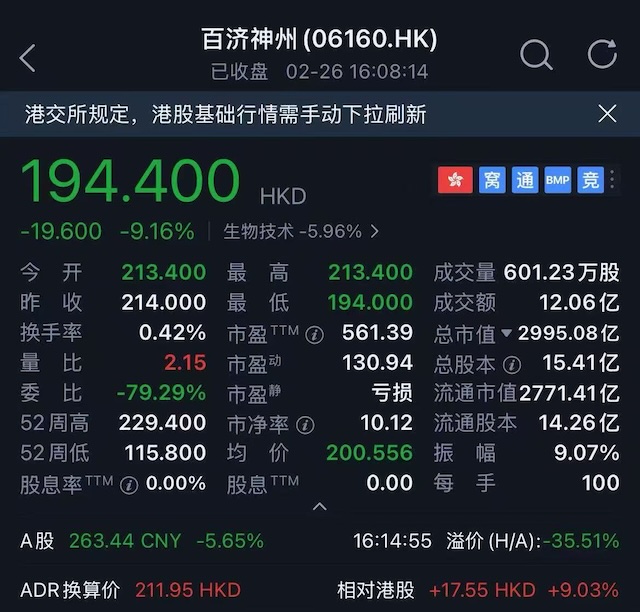
伴随着股价大跌,百济神州2月26日在港股市场的市值跌破3000亿港元,最后报2995亿港元。 http://mapi/0026p7eXgy1iao2r2bal7j60hs0h041v02 【#港股医药股集体大跌#,#百济神州市值跌破3000亿港元#】2月26日下午,港股医疗保健板块内的290 只个股,六成以上出现下跌,其中有61只个股跌幅超过4%,其中德琪医药(06996.HK)、百济神州 (06160.HK)、药明合联(02268.HK)三只个股跌幅领衔,分别大跌10.44%、9.16%、8.69%。 ...
百济神州跌5.65% 东莞证券等在其历史最高点唱多
Zhong Guo Jing Ji Wang· 2026-02-26 09:11
中国经济网北京2月26日讯 百济神州(688235.SH)今日收报263.44元,跌幅5.65%。 东吴证券股份有限公司研究员朱国广、张翀翯2025年9月2日发布研报《百济神州(688235)2025年中报点 评:业绩超预期 上调全年业绩指引》称,维持百济神州"买入"评级。 百济神州2025年9月2日盘中股价创下历史高点346.00元。 东莞证券股份有限公司研究员谢雄雄2025年9月2日发布研报《百济神州(688235):Q2业绩保持稳定增 长》称,给予对公司"增持"评级。 ...
港股医药股集体大跌 百济神州市值跌破3000亿
Di Yi Cai Jing· 2026-02-26 09:08
2月26日下午,港股医疗保健板块内的290只个股,六成以上出现下跌,其中有61只个股跌幅超过4%, 其中德琪医药(06996.HK)、百济神州(06160.HK)、药明合联(02268.HK)三只个股跌幅领衔,分 别大跌10.44%、9.16%、8.69%。 按照百济神州前期的公告,该公司将于2月26日港股股价收盘后公布其根据美国公认会计原则及美国证 券交易委员会适用规则编制的2025年第四季度及全年的财务业绩。 截至记者发稿之际,百济神州尚未发布财报。 伴随着股价大跌,百济神州2月26日在港股市场的市值跌破3000亿港元,最后报2995亿港元。 | 百济神州 (06160.HK) | | C | | | --- | --- | --- | --- | | 已收盘 02-26 16:08:14 | | | | | 港交所规定,港股基础行情需手动下拉刷新 | | | × | | 194.400 HKD | | | ☆ 窝 通 BMP 竞 : | | -19.600 -9.16% 生物技术 -5.96% > | | | | | 今 开 最 高 213.400 | 213.400 | | 成交量 601.23万股 ...

港股医药股集体大跌,百济神州市值跌破3000亿
Di Yi Cai Jing· 2026-02-26 08:48
2月26日下午,港股医疗保健板块内的290只个股,六成以上出现下跌,其中有61只个股跌幅超过4%, 其中德琪医药(06996.HK)、百济神州(06160.HK)、药明合联(02268.HK)三只个股跌幅领衔,分 别大跌10.44%、9.16%、8.69%。 伴随着股价大跌,百济神州2月26日在港股市场的市值跌破3000亿港元,最后报2995亿港元。 | 自杀神州(06160.HK) | | | | | --- | --- | --- | --- | | 已收盘 02-26 16:08:14 | | | | | 港交所规定,港股基础行情需手动下拉刷新 | | | | | 194.400 HKD | | gr | 窝 通 BMP | | -19.600 -9.16% 生物技术 -5.96% > | | | | | 今 开 最 高 213.400 | 213.400 | | 成交量 601.23万股 | | 昨 收 最 低 194.000 | 214.000 | | 成交额 12.06亿 | | 换手率 市盈 TM (2 561.39 | 0.42% | | 总市值 ▼ 2995.08亿 | | 量 比 而容动 ...
港股创新药板块持续走弱,百济神州跌超8%
Xin Lang Cai Jing· 2026-02-26 07:31
港股创新药板块持续走弱,百济神州跌超8%,药明生物跌超7%,泰格医药、康龙化成、诺诚健华跟 跌。 ...
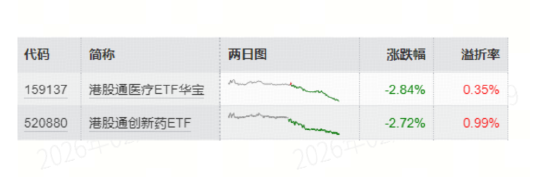
什么情况?百济神州绩前挫逾6%!港股通创新药ETF(520880)、港股通医疗ETF(159137)跌近3%
Xin Lang Ji Jin· 2026-02-26 07:04
Group 1 - The core viewpoint of the article highlights a significant decline in Hong Kong pharmaceutical stocks, particularly in the innovative drug sector, with the Hong Kong Stock Connect Innovative Drug ETF (520880) and the Hong Kong Stock Connect Medical ETF (159137) both dropping over 2% [1][2] - The leading company, BeiGene, experienced a drop of over 6% and is set to disclose its 2025 financial report today. It holds significant weight in the aforementioned ETFs, accounting for 11.27% and 2.13% of their respective portfolios [2] - According to Kaiyuan Securities, the Chinese innovative drug sector is transitioning from "scale accumulation" to "value release," indicating a shift from pipeline expectations to performance realization. The innovative drug sector has seen a two-quarter correction, but many quality stocks are now considered to have attractive valuations, suggesting increased attention is warranted [2] Group 2 - The article suggests that investors should consider low-positioned opportunities in Hong Kong pharmaceutical stocks through ETFs for higher efficiency and flexibility, particularly recommending the Hong Kong Stock Connect Innovative Drug ETF (520880) and its associated funds [2] - The Hong Kong Stock Connect Medical ETF (159137) is recommended for its focus on medical innovation, covering hot concepts such as brain-computer interfaces, AI healthcare, and internet pharmacies, while also encompassing leading companies across the entire innovative drug supply chain [2]