
GM(GM)

Search documents
Harley-Davidson Tops Q1 Earnings Estimates, Withdraws Guidance
ZACKS· 2025-05-02 13:25
Core Insights - Harley-Davidson, Inc. reported first-quarter 2025 adjusted earnings of $1.07 per share, exceeding the Zacks Consensus Estimate of 80 cents, but down from $1.72 per share in the same quarter last year [1] - Consolidated revenues for the quarter were $1.33 billion, a decline of 23% year-over-year [1] Segmental Highlights - Revenues from the Motorcycle and Related Products segment fell 27% year-over-year to $1.08 billion, missing the forecast of $1.17 billion due to lower motorcycle shipments [2] - Worldwide motorcycle shipments decreased by 33% to 38,600 units, below the estimate of 43,571 units [2] - Revenues from motorcycle sales were $864 million, down 29% year-over-year, with operating income plunging 51% to $116 million, falling short of the estimate of $165.2 million [2] Retail Performance - Harley-Davidson retailed 31,000 motorcycle units globally, a decline of 21% year-over-year, and below expectations of 38,000 units [3] - Retail motorcycle sales in North America decreased by 24% to 20,900 units, while sales in EMEA declined by 2%, and Asia Pacific and Latin America saw declines of 28% and 6%, respectively [3] Parts and Accessories - Revenues from parts and accessories fell 14% year-over-year to $143 million, missing the estimate of $162.2 million [4] - Revenues from apparel decreased by 11% year-over-year to $57 million, also falling short of the forecast of $63 million [4] Financial Services - Revenues for Harley-Davidson Financial Services totaled $245 million, a decline of 2% year-over-year, missing the forecast of $273 million [5] - Operating income increased by 19% to $64 million, surpassing the estimate of $51.4 million due to lower provisions for credit losses and reduced operating expenses [5] LiveWire Performance - Total shipments for LiveWire were 33 units, a decline of 72% from the previous year, with revenues down 42% to $3 million, missing the estimate of $6.5 million [6] - Operating loss narrowed from $29 million to $20 million, which was better than the projected loss of $29.7 million [6] Financial Position - As of March 31, 2025, Harley-Davidson had cash and cash equivalents of $1.93 billion, up from $1.59 billion at the end of 2024 [7] - Long-term debt increased to $4.96 billion from $4.46 billion as of December 31, 2024 [7] - The company withdrew its 2025 guidance amid macroeconomic uncertainties and tariff issues [7]




Pangea Provides Supplemental Disclosure in Connection with Annual General Meeting of Shareholders
Thenewswire· 2025-05-02 11:30
Vancouver, British Columbia – TheNewswire - May 2, 2025 – Pangea Natural Foods Inc. (CSE: PNGA) (OTC: PNGAF) (“Pangea” or the “Company”) wishes to provide supplemental and corrective disclosure to the management information circular of the Company dated April 3, 2025 (the “Circular”) in respect of the Company’s annual general meeting of shareholders to be held on May 8, 2025 (the “Meeting”). On October 31, 2024, MNP LLP (“MNP”) resigned as auditors of the Company at the request of the Company. Effectiv ...

【美股盘前】热门中概股多数上涨,小鹏汽车涨超6%;预计因关税将面临9亿美元损失,苹果跌超2%;利润指引疲软,亚马逊跌超2%;Q1利润超预期,壳牌涨超3%
Mei Ri Jing Ji Xin Wen· 2025-05-02 09:53
Group 1: Market Performance - Dow futures rose by 0.41%, S&P 500 futures increased by 0.35%, and Nasdaq futures gained 0.14% [1] - Popular Chinese stocks mostly saw gains, with XPeng up over 6%, Alibaba rising more than 4%, and NIO, Li Auto, and JD.com all increasing over 3% [1] Group 2: Company Earnings and Forecasts - Apple reported Q2 revenue of $95.4 billion, exceeding analyst expectations of $94.66 billion, but faced a projected $900 million increase in costs due to tariffs, leading to a 2.78% drop in stock price [1] - Amazon's Q1 earnings surpassed expectations, but the company provided a weak outlook for Q2, estimating revenue between $13 billion and $17.5 billion, below the consensus of $17.64 billion, resulting in a 2.25% decline in stock price [1] - Shell's Q1 adjusted profit was $5.58 billion, exceeding the expected $5.09 billion, and announced a $3.5 billion stock buyback, leading to a 3.33% increase in stock price [2] - McDonald's reported a 3.6% decline in U.S. same-store sales, the largest drop since Q2 2020, which was worse than the anticipated 1.7% decline [2] - General Motors updated its financial guidance, citing potential tariff impacts of up to $5 billion, lowering its adjusted EBIT forecast to a range of $8.2 billion to $10 billion, down from $11 billion to $12 billion [2] Group 3: Banking Sector - ING reported a strong Q1 performance with a net profit of €1.46 billion, surpassing the market expectation of €1.4 billion, and announced a €2 billion stock buyback, resulting in a 4.67% increase in stock price [3]


BW Energy: 2025 Annual General Meeting – Notice
GlobeNewswire News Room· 2025-05-02 07:00
Company Overview - BW Energy is a growth exploration and production (E&P) company focusing on proven offshore oil and gas reservoirs through low-risk phased developments [1] - The company has access to existing production facilities, which allows for reduced time to first oil and cash flow with lower investments compared to traditional offshore developments [1] Assets and Interests - BW Energy holds a 73.5% interest in the producing Dussafu Marine licence offshore Gabon [1] - The company has a 100% interest in the Golfinho and Camarupim fields, a 76.5% interest in the BM-ES-23 block, a 95% interest in the Maromba field in Brazil, and a 95% interest in the Kudu field in Namibia, all operated by BW Energy [1] - Additionally, BW Energy owns approximately 6.6% of the common shares in Reconnaissance Energy Africa Ltd. and a 20% non-operating interest in the onshore Petroleum Exploration License 73 (PEL 73) in Namibia [1] Reserves and Resources - Total net 2P+2C reserves and resources were reported at 599 million barrels of oil equivalent at the start of 2025 [1]

美国中产消费信心暴跌,麦当劳、好时、哈雷摩托车等销售已受冲击
Hua Er Jie Jian Wen· 2025-05-02 01:22
Group 1: Consumer Sentiment and Spending - The Trump tariff policy has severely impacted consumer confidence in the U.S., particularly among middle and low-income groups, leading to reduced spending [1] - Companies that primarily target middle-class consumers, such as McDonald's, General Motors, Harley-Davidson, and Hershey, are experiencing declining sales and profit pressures [1] - McDonald's reported its lowest sales in mature U.S. restaurants since the pandemic, attributing this to cautious spending by lower-income customers [1] Group 2: Automotive Industry Impact - Harley-Davidson's motorcycle sales fell by 24% year-over-year, with the CEO citing economic uncertainty and high interest rates as key factors [2] - General Motors, despite initial sales growth, has lowered its annual profit forecast by $2 billion to $3 billion due to tariff costs of $4 billion to $5 billion [2] - GM plans to increase North American prices by up to 1%, reversing an earlier expectation of a price decrease [2] Group 3: Confectionery Sector Challenges - Hershey reported a 15% decline in sales of candy, mints, and gum, with executives noting a growing consumer focus on value [3] - The company anticipates a loss of $15 million to $20 million in the current quarter due to tariffs on key raw materials like cocoa, which cannot be grown domestically [3] Group 4: Technology Sector Performance - Apple reported strong second-quarter sales driven by increased iPhone demand, potentially due to panic buying before new tariffs took effect [4] - Analysts warn that ongoing economic uncertainty poses real risks to both domestic and global economies, with signs of declining business and consumer confidence [4]


GM(GM) - 2025 Q1 - Quarterly Report
2025-05-01 20:13
Financial Performance - For the year ending December 31, 2025, General Motors expects net income attributable to stockholders to be between $8.2 billion and $10.1 billion, with EBIT-adjusted between $10.0 billion and $12.5 billion[137]. - Total net sales and revenue for the three months ended March 31, 2025, increased to $44.020 billion, a 2.3% increase from $43.014 billion in the same period of 2024[158]. - GM North America (GMNA) reported total net sales and revenue of $37.388 billion, up 3.6% from $36.099 billion year-over-year, driven by increased wholesale volumes and favorable pricing[172]. - EBIT-adjusted for the three months ended March 31, 2025, decreased to $3.286 billion, a decline of 14.4% from $3.840 billion in the prior year[170]. - Net income attributable to stockholders for Q1 2025 was $2,784 million, a decrease of 6.6% from $2,980 million in Q4 2024[240]. - EBIT-adjusted for Q1 2025 was $3,490 million, down from $3,871 million in Q4 2024, reflecting a decline of 9.8%[240]. - Diluted earnings per share for Q1 2025 were $3.36, compared to $2.97 in Q1 2024, representing an increase of 13.2%[247]. - The effective tax rate for Q1 2025 was 20.1%, slightly improved from 20.5% in Q1 2024[249]. - Return on equity (ROE) for the trailing four quarters ended March 31, 2025, was 8.6%, down from 15.1% in the previous year[250]. - ROIC-adjusted for the four quarters ended March 31, 2025, was 20.7%, an increase from 16.7% in the prior year[253]. Sales and Market Share - In the first quarter of 2025, U.S. industry sales increased by 4.6% to 4.0 million units, while General Motors' total vehicle sales in the U.S. reached 0.7 million units, capturing a market share of 17.2%, up 1.8 percentage points from the previous year[141][142]. - General Motors' total vehicle sales in China were 0.4 million units, resulting in a market share of 7.6%, which is a decrease of 0.2 percentage points compared to the same period in 2024[144]. - Total vehicle sales outside of China were 0.2 million units, with a market share of 2.9%, reflecting a decrease of 0.3 percentage points compared to the previous year[145]. - General Motors' wholesale vehicle sales in North America for the three months ended March 31, 2025, were 827,000 units, representing a 4.4% increase from 792,000 units in the same period in 2024[149]. - In the three months ended March 31, 2025, wholesale vehicle sales for Automotive China JVs increased to 454,000 units from 322,000 units in the same period of 2024, representing a 41% increase[181]. - Total net sales and revenue for Automotive China JVs rose to $5.065 billion, up from $4.111 billion, marking a 23.3% increase year-over-year[181]. Costs and Expenses - Increased manufacturing costs contributed $0.4 billion to the overall cost increase, alongside $0.2 billion in material and freight costs, and $0.2 billion in warranty-related costs[162]. - Automotive and other selling, general and administrative expenses decreased to $1.985 billion, a reduction of 8.7% from $2.175 billion in the previous year[164]. - GM Financial's provision for loan losses rose by 60.8% to $328 million, reflecting increased loan origination volume and moderating credit performance[184]. Cash Flow and Liquidity - Operating cash flow for the Automotive segment was $2.4 billion, a decrease from $3.6 billion in the same period of 2024[208]. - Total Automotive available liquidity decreased to $32.8 billion as of March 31, 2025, down from $35.5 billion at the end of 2024[205]. - Net automotive cash provided by operating activities was $2.4 billion, down from $3.6 billion in the same period in 2024, reflecting a decrease of $1.2 billion[213][214]. - Capital expenditures for the three months ended March 31, 2025, were $1.8 billion, compared to $2.7 billion in the same period in 2024, indicating a reduction of $0.9 billion[213][214]. - Net cash provided by Cruise's financing activities was $0.3 billion for the three months ended March 31, 2025, compared to no cash flow in the same period in 2024[219]. - GM Financial's available liquidity increased to $36.8 billion as of March 31, 2025, up from $29.3 billion at December 31, 2024, representing a growth of $7.5 billion[221]. Strategic Initiatives - The company completed the acquisition of noncontrolling interests in Cruise in February 2025 and is focusing on developing advanced driver-assistance systems (ADAS) for personal vehicles[133][146]. - The company is prioritizing cost discipline and improving profitability in its electric vehicle (EV) portfolio while navigating challenges such as competitive pressures and regulatory changes[133][136]. - The company plans to fund substantial cash requirements through available liquidity, cash flows from operations, and potential additional liquidity measures[186]. - The company anticipates investing $1.8 billion in Ultium Cells LLC to facilitate loan prepayment under the U.S. Department of Energy's program[195]. Risk and Compliance - The company continues to face risks related to competition, supply chain disruptions, and regulatory changes impacting future performance[255]. - No significant changes in market risk exposure since December 31, 2024[259]. - Disclosure controls and procedures are designed to ensure timely reporting of required information[260]. - CEO and CFO concluded that disclosure controls and procedures were effective as of March 31, 2025[261]. - No changes in internal control over financial reporting that materially affected the reporting during the three months ended March 31, 2025[262].
美国发布公告,宣布特朗普汽车进口关税减免
news flash· 2025-05-01 19:20
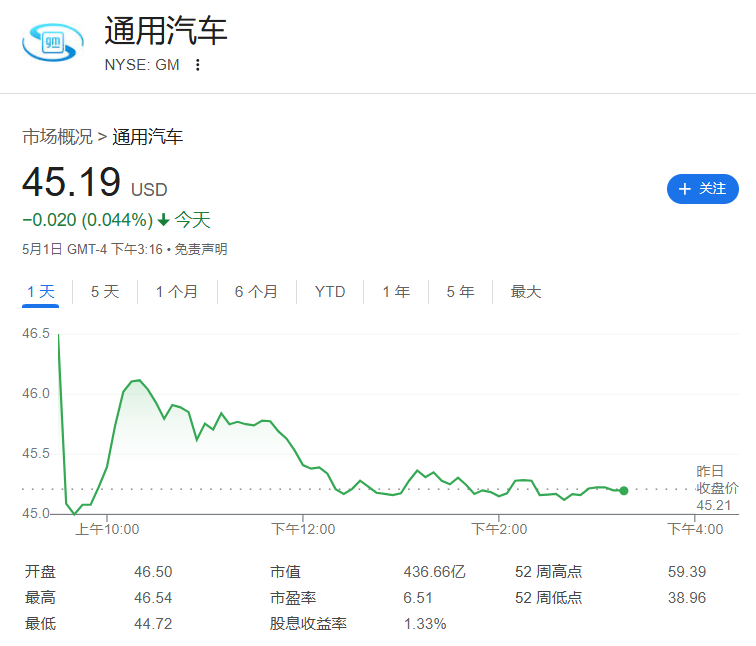
Group 1 - The U.S. has announced measures to offset tariffs on automobiles, as previously stated by President Trump [1] - Manufacturers assembling vehicles in the U.S. are eligible for an import adjustment offset of 3.75% of the suggested retail price from April 3, 2025, to April 30, 2026 [1] - From May 1, 2026, to April 30, 2027, manufacturers can apply for an import adjustment offset of 2.5% of the suggested retail price [1] Group 2 - These adjustment measures aim to more effectively eliminate the national security threats posed by imports of automobiles and auto parts [1] - General Motors (GM) experienced a reversal of earlier gains, with half of the trading time on May 1 remaining flat [1]
General Motors CEO Mary Barra warns Trump's tariffs will cost automaker up to $5B this year
New York Post· 2025-05-01 15:47
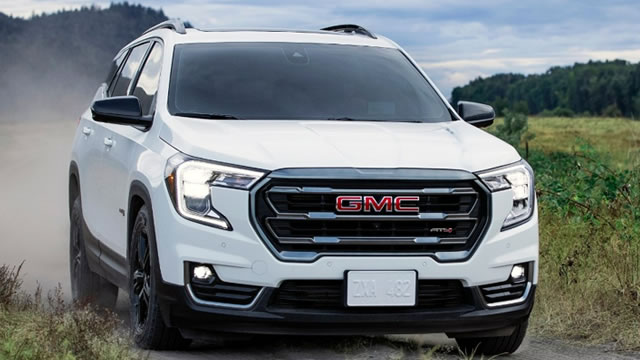
Group 1: Financial Forecast and Impact of Tariffs - General Motors has reduced its full-year profit forecast to between $8.2 billion and $10.1 billion, down from previous estimates of $11.2 billion to $12.5 billion, due to a projected tariff exposure of $4 billion to $5 billion [1][4] - The company expects adjusted earnings to be between $8.25 and $10 per share, a decrease from the earlier forecast of $11 to $12 per share [2][4] Group 2: Capital Spending and Management's Response - Despite the anticipated financial hit from tariffs, General Motors plans to maintain capital spending between $10 billion and $11 billion for the year [4] - CEO Mary Barra expressed appreciation for the Trump administration's efforts to understand the automotive industry and its challenges, indicating ongoing discussions with the President and his team [5][4] Group 3: Market Dynamics and Sales Trends - In the first quarter, General Motors reported a 2.3% increase in revenue, driven by a surge in consumer demand as buyers rushed to purchase vehicles ahead of expected price hikes due to tariffs [12][13] - The automotive industry experienced a 13% growth in US car sales in March, although analysts caution that this may be a temporary spike as price increases are anticipated in response to tariffs [14]
General Motors slashes guidance as it expects up to $5M tariff hit
Proactiveinvestors NA· 2025-05-01 15:11
About this content About Emily Jarvie Emily began her career as a political journalist for Australian Community Media in Hobart, Tasmania. After she relocated to Toronto, Canada, she reported on business, legal, and scientific developments in the emerging psychedelics sector before joining Proactive in 2022. She brings a strong journalism background with her work featured in newspapers, magazines, and digital publications across Australia, Europe, and North America, including The Examiner, The Advocate, ...

GM(GM) - 2025 Q1 - Earnings Call Transcript
2025-05-01 12:30
Financial Data and Key Metrics Changes - Total company revenue for Q1 was $44 billion, up 2% year over year, with EBIT adjusted at $3.5 billion and EBIT adjusted margins at 7.9% [26][27] - EPS diluted adjusted was $2.78, with EBIT adjusted slightly down from last year's Q1 performance [26][27] - The company updated its full year EBIT adjusted guidance to a range of $10 billion to $12.5 billion, reflecting a current tariff exposure of $4 billion to $5 billion [8][41] Business Line Data and Key Metrics Changes - U.S. deliveries were up 17% year over year, with market share growing to 17.2%, marking a nearly two-point improvement from the prior year [24][32] - EV sales achieved over 90% year-over-year growth, securing the number two position in the U.S. EV market [28][42] - The margin in North America was 8.8%, well within the target range of 8% to 10% [32][16] Market Data and Key Metrics Changes - The company gained almost two full points of market share year over year in the U.S., with a first-quarter share of the U.S. EV market at 10%, rising to 12% in March [15][32] - Sales of new energy vehicles in China increased by 53% year over year, contributing positively to equity income [33] Company Strategy and Development Direction - The company is focused on increasing U.S. manufacturing capability and supply chains, with a 27% increase in direct purchases in the U.S. for North American production since 2019 [9][10] - GM is moderating EV production to align with consumer demand and avoid heavy discounts, focusing on efficiency and cost reductions across the value chain [12][13] - The company is developing a next-generation software-defined vehicle platform and enhancing Super Cruise capabilities [20][21] Management's Comments on Operating Environment and Future Outlook - Management expressed confidence in adapting to the new trade policy environment and maintaining strong consumer demand for vehicles [14][40] - The company anticipates a $4 billion to $5 billion impact from tariffs, with expectations to offset at least 30% through self-help initiatives [41][67] - Management highlighted the importance of maintaining cost discipline and focusing on profitable growth despite challenges [30][46] Other Important Information - The company has invested $60 billion in U.S. manufacturing over the last five years and operates a network of 50 manufacturing plants [7][8] - GM Financial performed well with Q1 EBT adjusted of almost $700 million, in line with last year [33] Q&A Session Summary Question: Is there scope for the industry to receive relief on imported vehicle tariffs? - Management expressed hope for continued trade agreements and indicated that implementing offsets will take time [51][52] Question: How does the pace of investments in AV and AI change due to recent disruptions? - Management confirmed ongoing investments in AV and AI, with a focus on personal autonomy and leveraging partnerships to improve efficiency [60][61] Question: Can you clarify the tariff impact and mitigation strategies? - The estimated tariff impact is $4 billion to $5 billion, with a 30% offset from self-help initiatives, not including pricing increases [67][68] Question: How does the company manage vehicles assembled outside the U.S.? - Management stated that they have excess capacity in the U.S. and can adjust production quickly based on market conditions [92] Question: What are the expectations for capital expenditures and potential shifts in production? - The capital expenditure outlook remains unchanged at $10 billion to $11 billion, with decisions on production and capacity being made independently based on returns [95][96]