Kraft Heinz(KHC)

Search documents
伯克希尔一笔投资巨亏50亿美元!帮主郑重:巴菲特踩雷记!50亿学费买来的三个教训
Sou Hu Cai Jing· 2025-08-02 16:15
Group 1: Core Issues with Kraft Heinz - Kraft Heinz has seen a decline in sales, with North American sales dropping for three consecutive years, including a 3.4% decrease in Q2 this year, attributed to outdated products that fail to appeal to younger consumers [3][4] - Internal management conflicts have led to significant operational issues, including drastic cost-cutting measures that have harmed research and development, resulting in a lack of innovation compared to competitors [3][4] - The company is burdened by a substantial debt of $18 billion from a previous leveraged buyout, with annual interest payments consuming $1 billion of profits, severely limiting cash flow and investment in growth [4] Group 2: Buffett's Lessons from the Investment - Buffett's experience with Kraft Heinz highlights the dangers of "control-type investments," where delegating management can lead to poor financial decisions and significant losses, as evidenced by a 60% drop in stock price [4] - The decision to write down $5 billion this year, following a $3 billion write-down in 2019, indicates a recognition of the investment's failure, with the current book value of the investment at $8.4 billion, suggesting a valuation of only 30% of the company's market value [4] - Buffett's withdrawal from the board signals a lack of confidence in the company's direction, serving as a warning to investors about the potential risks of companies with unstable governance [4] Group 3: Competitive Landscape in the Food Industry - Competitors like Mondelez International are gaining market share with innovative products, such as zero-sugar snacks, while Kraft Heinz's offerings are perceived as outdated and unhealthy [5] - Private label products from retailers like Walmart are undercutting Kraft Heinz's pricing, appealing to budget-conscious consumers amid rising inflation [5] - The rise of social media-driven food trends is shifting consumer purchasing behavior away from traditional grocery stores, further challenging Kraft Heinz's market position [5]



深夜重磅!巴菲特最新报告透露“持股变数”
Sou Hu Cai Jing· 2025-08-02 14:23
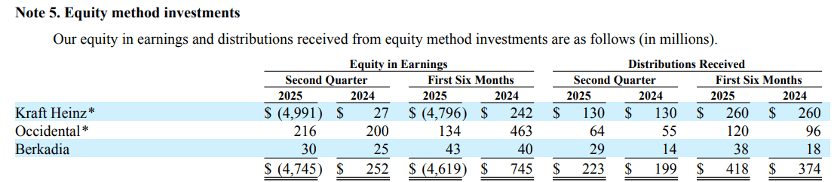
Core Viewpoint - Berkshire Hathaway's Q2 2025 report reveals a mixed performance with a significant drop in net profit and a slight decrease in cash reserves, while maintaining a concentrated investment strategy in key stocks [2][3]. Group 1: Investment Portfolio - As of June 30, 2025, the top five holdings of Berkshire Hathaway accounted for 67% of the total fair value of its stock securities, with American Express, Apple, Bank of America, Coca-Cola, and Chevron being the primary investments [6]. - The concentration of these top five holdings has slightly decreased from 71% at the end of 2024 [7]. Group 2: Equity Method Investments - Berkshire holds significant equity method investments in Kraft Heinz and Occidental Petroleum, owning 27.4% and 28.1% of their common stock, respectively [8]. - The report indicates a $5 billion impairment loss related to Kraft Heinz during the quarter [11]. Group 3: Changes in Governance - A notable change occurred with Berkshire's representation on the Kraft Heinz board, which may affect the financial information received from the company, leading to a lag in reporting equity method impacts [10]. Group 4: Stock Buyback Activity - The report states that there were no stock buybacks in the first half of 2025, despite the company's ongoing buyback program, which allows repurchases when the stock price is below its intrinsic value [14].


伯克希尔,重大发布!
Zheng Quan Shi Bao· 2025-08-02 14:23
Core Viewpoint - Berkshire Hathaway's Q2 financial report shows a decline in revenue and net profit, reflecting challenges in investment returns and specific losses in key holdings like Kraft Heinz [2][4]. Financial Performance - Total revenue for Q2 was $92.515 billion, down from $93.653 billion year-over-year, a decrease of 1.2% [2][3]. - Net earnings attributable to Berkshire shareholders were $12.370 billion, a significant drop of 59% from $30.348 billion in the same quarter last year [2][3]. - Operating profit decreased by 3.8% to $11.616 billion compared to $12 billion in the previous year [2][3]. Investment and Holdings - Berkshire's cash and cash equivalents fell to $344.1 billion from $347.68 billion as of March 31 [4]. - The company has sold $4.5 billion in stocks in the first half of 2025, marking the 11th consecutive quarter of net stock sales [4]. - 67% of Berkshire's equity holdings are concentrated in five companies: American Express, Apple, Bank of America, Coca-Cola, and Chevron [4]. Specific Losses - Berkshire wrote down the book value of its Kraft Heinz shares to $8.4 billion, reflecting a loss of $3.76 billion [4]. - The investment in Kraft Heinz, initiated in 2013, has faced ongoing challenges, including declining sales and goodwill impairment, leading to a stock price drop of over 50% [4]. Management Changes - This is the first financial report since Warren Buffett announced his retirement plans for the end of 2025, with Greg Abel set to take over as CEO [2][5]. - Berkshire has reduced its involvement in Kraft Heinz's board, signaling a potential withdrawal from day-to-day operations [5]. Economic Outlook - Berkshire's report indicates concerns about the impact of tariffs and international trade tensions on the U.S. economy and the company's future performance [5].
伯克希尔突发!一笔投资,巨亏50亿美元
Shang Hai Zheng Quan Bao· 2025-08-02 14:20
Core Points - Berkshire Hathaway reported a significant decline in net profit for Q2 2025, with a net profit of $12.37 billion, down 59.24% from $30.35 billion in the same period last year [2][4][6] - The decline in net profit was largely attributed to substantial investment losses, particularly a $5 billion pre-tax impairment loss related to its investment in Kraft Heinz [2][8][9] Financial Performance - For Q2 2025, Berkshire's revenue was $92.515 billion, a decrease of 1.22% from $93.653 billion in Q2 2024 [4] - The company's operating earnings for Q2 2025 were $11.16 billion, a 3.8% decrease from $11.598 billion in Q2 2024 [6][7] - For the first half of 2025, Berkshire's total net profit was $16.973 billion, down from $43.05 billion in the same period last year [4][5] Investment Performance - Berkshire's investment gains for Q2 2025 were $4.97 billion, compared to $18.75 billion in Q2 2024, indicating a significant drop in investment performance [5][6] - The impairment loss on Kraft Heinz was recognized as non-temporary due to ongoing economic uncertainties and the company's declining fair value [9][10] Business Segment Analysis - The decline in operating earnings was primarily driven by a drop in insurance underwriting income, which fell to $1.992 billion, down approximately 12% year-over-year [7] - In contrast, the BNSF railway segment showed strong performance with operating income of $1.466 billion, a year-over-year increase of 19.48% [7] Cash Reserves and Stock Activity - As of June 30, 2025, Berkshire's cash and cash equivalents stood at $344.1 billion, a slight decrease from $347.7 billion at the end of Q1 2025 [14] - The company has been cautious in the stock market, having net sold approximately $3 billion in stocks over the past 11 quarters and refraining from stock buybacks for four consecutive quarters [14]
伯克希尔,重大发布!
证券时报· 2025-08-02 14:19
Core Viewpoint - Berkshire Hathaway's Q2 financial report shows a decline in revenue and net profit, reflecting challenges in investment returns and specific losses in key holdings like Kraft Heinz [1][5]. Financial Performance Summary - Q2 revenue was $92.515 billion, down from $93.653 billion year-over-year, a decrease of 1.2% [2]. - Net profit for the quarter was $12.370 billion, a significant drop of 59% from $30.348 billion in the same period last year [2]. - Operating profit decreased by 3.8% to $11.16 billion compared to $11.6 billion in Q2 2024 [1][2]. Investment and Holdings - Berkshire's cash and cash equivalents fell to $344.1 billion from $347.68 billion as of March 31, 2025, marking the 11th consecutive quarter of net stock sales, totaling $4.5 billion in the first half of 2025 [3]. - The company's equity holdings are heavily concentrated, with 67% in five companies: American Express, Apple, Bank of America, Coca-Cola, and Chevron [4]. Specific Investment Challenges - Berkshire recorded a significant impairment on its Kraft Heinz investment, reducing its book value to $8.4 billion, resulting in a loss of $3.76 billion [5]. - The company has reduced its board involvement in Kraft Heinz, signaling a potential exit from daily operations [5]. Economic Outlook - Berkshire's report indicates concerns about the impact of tariffs and international trade tensions on the U.S. economy and its future performance, highlighting significant uncertainty [5].
深夜!伯克希尔,重大突发!
券商中国· 2025-08-02 14:03
Core Viewpoint - Berkshire Hathaway's Q2 financial results show a mixed performance with strong revenue but significant declines in net profit and investment income, highlighting challenges in certain business segments and investment decisions [2][4][5]. Financial Performance - Q2 revenue reached $92.515 billion, exceeding market expectations of $91.963 billion, but down from $93.653 billion year-on-year [4]. - Net profit was $12.37 billion, a 59% year-on-year decline, yet above market expectations of $10.703 billion [4]. - Investment income fell to $4.97 billion, down over 73% year-on-year [2][4]. - Cash reserves slightly decreased from $347 billion to $344.1 billion, marking the first decline in three years [2][4]. Business Segment Analysis - BNSF Railway reported operating income of $1.47 billion, a 19% increase year-on-year, reflecting a recovery in U.S. goods transportation demand [4]. - Berkshire's energy segment contributed $702 million in operating profit, up 7.2% year-on-year [4]. - Manufacturing, service, and retail sectors generated $3.6 billion in profit, a 6.5% increase year-on-year [4]. - Insurance underwriting profit was $2.5 billion, impacted by $1.2 billion in losses from Southern California wildfires, with insurance revenue down 12% year-on-year [5]. Investment Decisions - A significant impairment loss of $3.8 billion was recognized on the investment in Kraft Heinz, marking it as one of Buffett's few investment missteps [7][8]. - Berkshire's stake in Kraft Heinz has seen a 62% decline since the merger in 2015, while the S&P 500 has risen over 200% in the same period [7][8]. - Berkshire has been net selling stocks for 11 consecutive quarters, with $3 billion in stock sales in Q2, and did not engage in stock buybacks during this period [11]. Market Sentiment and Future Outlook - Concerns over the transition of leadership as Buffett plans to step down as CEO by the end of 2025 have led to a decline in stock price, with a drop of over 12% since the announcement [12][13]. - Analysts express worries about the "Buffett premium" diminishing, alongside fears of a peak in the property casualty insurance cycle and a lack of new investment activities [14].

伯克希尔对卡夫亨氏投资再减值38亿美元
news flash· 2025-08-02 13:41
Group 1 - Berkshire Hathaway has recorded a $3.8 billion impairment on its investment in Kraft Heinz, marking a significant challenge for the iconic consumer goods deal made by Warren Buffett in 2015 [1] - This is the second impairment for Berkshire on Kraft Heinz, following a $3 billion write-down in 2019 [1] - As of the end of June, the book value of this investment has been reduced to $8.4 billion, indicating a rare disappointment for Buffett despite the investment still being profitable [1] Group 2 - Kraft Heinz's stock price has declined by 62% since the merger of Kraft and Heinz in 2015, while the S&P 500 index has increased by 202% during the same period [1] - The company is currently considering splitting off some of its business segments to address challenges such as inflation suppressing consumer demand and the trend towards healthier eating [1]
Kraft Heinz: Empty Bottle
Seeking Alpha· 2025-08-01 12:08
The Kraft Heinz Company, or in brief also known just as Kraft Heinz (NASDAQ: KHC ), was formed in 2015 through a merger of the former Kraft Foods Group and H.J. Heinz Company. The conglomerateAlways on the hunt for undervalued, promising stocks with a focus on risk and reward. Limited risks and decent to high upside by knowing what one's owning. I strongly believe that the best investment ideas are often the simplest. If contrarian, the better.Analyst’s Disclosure:I/we have a beneficial short position in th ...

Kraft Heinz (KHC) Q2 EPS Beats Falls 12%
The Motley Fool· 2025-08-01 02:22
Core Insights - Kraft Heinz reported non-GAAP EPS of $0.69, exceeding analyst estimates of $0.64, while GAAP revenue reached $6.35 billion, slightly above the consensus of $6.27 billion, despite year-over-year declines in both metrics [1][2] - The company faced challenges in core North American volume and persistent margin pressure, highlighted by a significant non-cash impairment charge of $9.3 billion [1][8] Financial Performance - Non-GAAP EPS decreased by 11.5% year-over-year from $0.78 to $0.69 [2] - GAAP revenue fell by 1.9% from $6.48 billion to $6.35 billion [2] - Adjusted gross profit margin declined by 1.4 percentage points to 34.1% [2] - Adjusted operating income decreased by 7.5% from $1.38 billion to $1.28 billion [2] - Free cash flow increased by 28.2% year-over-year, reaching $1.50 billion [2] Business Overview - Kraft Heinz produces a wide range of food products and beverages, including cheese, sauces, cold cuts, and ready meals, with a strong portfolio of recognized brands [3] Strategic Focus - The company's strategy emphasizes growth in emerging markets, managing raw material costs, and leveraging brand strength through effective marketing and product innovation [4] Market Trends - Organic net sales declined by 2.0% in Q2 FY2025, primarily due to a 2.7 percentage point drop in volume/mix [6] - North America experienced a 3.3% decrease in net sales, with a 3.4 percentage point decline in volume/mix [6] - Emerging markets showed a positive trend with net sales up 4.2% and organic net sales rising 7.6% [7] Margin Analysis - Adjusted gross profit margin fell to 34.1%, driven by rising input costs that outpaced cost-efficiency initiatives [8] - The significant impairment charge overshadowed underlying profitability, resulting in a net loss for the quarter [9] Shareholder Returns - The company paid out $951 million in dividends and repurchased $435 million in shares year-to-date for FY2025 [10] - Capital expenditures decreased by 21.8% year-over-year, indicating a focus on shareholder returns [10] Future Guidance - Kraft Heinz expects organic net sales to decline by 1.5% to 3.5% and adjusted operating income to fall by 5% to 10% in FY2025 [11] - The adjusted EPS range for FY2025 is projected at $2.51 to $2.67 [11] - The effective tax rate on adjusted EPS is anticipated to rise to 26% due to new global minimum tax requirements [11]
Kraft Heinz tops Q2 estimates, maintains profit guidance as analysts see signs of recovery
Proactiveinvestors NA· 2025-07-30 16:14
Company Overview - Proactive is a financial news publisher that provides fast, accessible, informative, and actionable business and finance news content to a global investment audience [2] - The company has a team of experienced and qualified news journalists who produce independent content [2] Market Focus - Proactive specializes in medium and small-cap markets while also covering blue-chip companies, commodities, and broader investment stories [3] - The news team delivers insights across various sectors including biotech and pharma, mining and natural resources, battery metals, oil and gas, crypto, and emerging digital and EV technologies [3] Technology Adoption - Proactive is recognized for its forward-looking approach and enthusiastic adoption of technology to enhance workflows [4] - The company utilizes automation and software tools, including generative AI, while ensuring that all content is edited and authored by humans [5]