
Kraft Heinz(KHC)

Search documents
巴菲特“最大失败之一”:账面没了50%!但股神仍是股神,已大赚近60%,发生了什么?
华尔街见闻· 2025-08-03 11:28
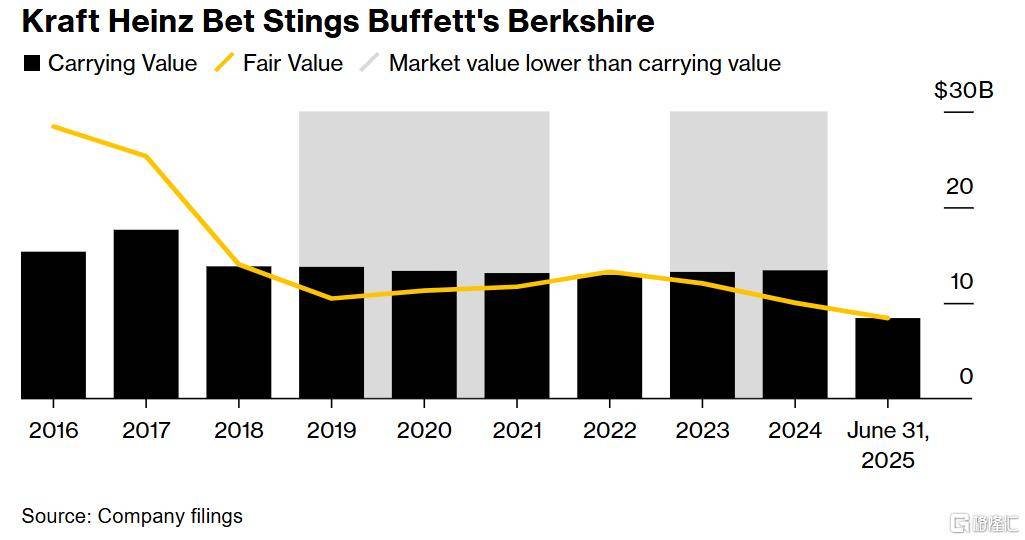
Core Viewpoint - Warren Buffett's investment in Kraft Heinz has seen a significant write-down, but due to favorable terms negotiated by Buffett, the overall outcome remains profitable for him despite the apparent loss [1][4][8]. Group 1: Investment Write-Down - Berkshire Hathaway disclosed a $3.8 billion write-down on its investment in Kraft Heinz, reducing its book value to $8.4 billion from over $17 billion at the end of 2017 [1]. - The write-down reflects a 62% decline in Kraft Heinz's stock price since its merger, contrasting sharply with a 202% increase in the S&P 500 during the same period [4]. - Analysts have described this write-down as one of Buffett's largest mistakes in decades, suggesting it was overdue [5]. Group 2: Overall Investment Performance - Despite the write-down, Buffett's total return on the investment is nearly 60% when accounting for dividends received, totaling approximately $6.3 billion over the years [8]. - Berkshire initially invested $4.3 billion in Heinz and increased its stake to $9.8 billion during the merger, with the current market value of its 27.4% stake at about $8.8 billion [8]. - Buffett also purchased $8 billion in preferred shares, which paid over $2 billion in dividends and were fully redeemed after three years, contributing to his overall profit [8]. Group 3: Comparison with Other Shareholders - Other shareholders who held Kraft Heinz stock since the merger have seen a total return of only 8% over ten years, highlighting Buffett's superior negotiating position [10]. - If those shareholders had invested in Unilever instead, their investment could have nearly doubled, illustrating the challenges faced by Kraft Heinz in a changing consumer landscape [11]. - The merger of two mediocre companies did not yield a strong entity, as Kraft Heinz is now facing a projected 3% revenue decline this year due to shifts towards healthier food options [11].


“近几十年来最大的失误之一”,巴菲特投错了?
Di Yi Cai Jing Zi Xun· 2025-08-03 10:18
Core Insights - Berkshire Hathaway, led by Warren Buffett, continues its conservative investment strategy by reducing stock holdings and increasing cash reserves [2][6] - The company reported a net stock sell-off of $6.92 billion in Q2, marking the 11th consecutive quarter of net stock sales [2][6] - Berkshire's cash reserves reached a record high of $344 billion by the end of June, up from $333 billion at the end of March [2][6] - The company has suspended its stock buyback program for the fourth consecutive quarter [2] Investment Write-Downs - Berkshire wrote down approximately $5 billion in its investment in Kraft Heinz, resulting in a $3.8 billion investment loss [2][3] - The book value of Berkshire's 27.4% stake in Kraft Heinz was significantly reduced from $13.5 billion to $8.4 billion [3][4] - This marks the second write-down of Kraft Heinz's value since the merger in 2015, which Buffett acknowledged as one of his biggest investment mistakes [3][4] Financial Performance - Kraft Heinz reported a 1.9% decline in net sales and an operating loss of $8 billion in Q2 [4] - Berkshire's operating profit decreased by 3.8% year-over-year to $11.2 billion, with a 12% decline in core insurance business profits [6] Market Position and Strategy - Berkshire's cautious approach is reflected in its high cash balance, which is seen as a reason for its underperformance compared to the S&P 500 [6] - Analysts suggest that Buffett's reluctance to make new investments indicates limited attractive capital allocation opportunities [6] External Challenges - The company faces challenges from geopolitical and macroeconomic factors, including U.S. government tariffs affecting its consumer goods segment [7] - Berkshire has warned that uncertainties related to international trade policies and tariffs may impact its performance in the near future [7]
“近几十年来最大的失误之一”,巴菲特投错了?
第一财经· 2025-08-03 10:07
2025.08. 03 本文字数:2227,阅读时长大约4分钟 作者 | 第一财 经 高雅 "股神"沃伦·巴菲特执掌的伯克希尔·哈撒韦(Berkshire Hathaway)延续其保守的投资策略,持续 减持股票资产并扩大现金储备。 根据8月2日发布的第二季度财报,该集团已连续第11个季度保持股票净卖出态势,该季度卖出69.2 亿美元股票,买入39亿美元。伯克希尔的现金储备在6月底攀升至3440亿美元的历史新高,较3月底 的3330亿美元继续增长。与此同时,该公司已连续第四个季度暂停股票回购计划。 值得注意的是,本季度伯克希尔对其持有的卡夫亨氏(Kraft Heinz)股份进行了约50亿美元的资产 减记,导致38亿美元的投资损失。 今年5月,巴菲特宣布将于年底卸任首席执行官职务,由现任伯克希尔所有非保险业务负责人阿贝尔 (Greg Abel)接任。自该消息公布以来,伯克希尔A类股已累计下跌12%,而同期标普500指数上 涨10%。 "巴菲特近几十年来最大的失误之一" 根据最新财报,伯克希尔将其持有的卡夫亨氏27.4%股份的账面价值从第一季度的135亿美元大幅 下调至84亿美元。这是继2019年30亿美元减记后, ...
巴菲特,“犯错”!
Sou Hu Cai Jing· 2025-08-03 08:38
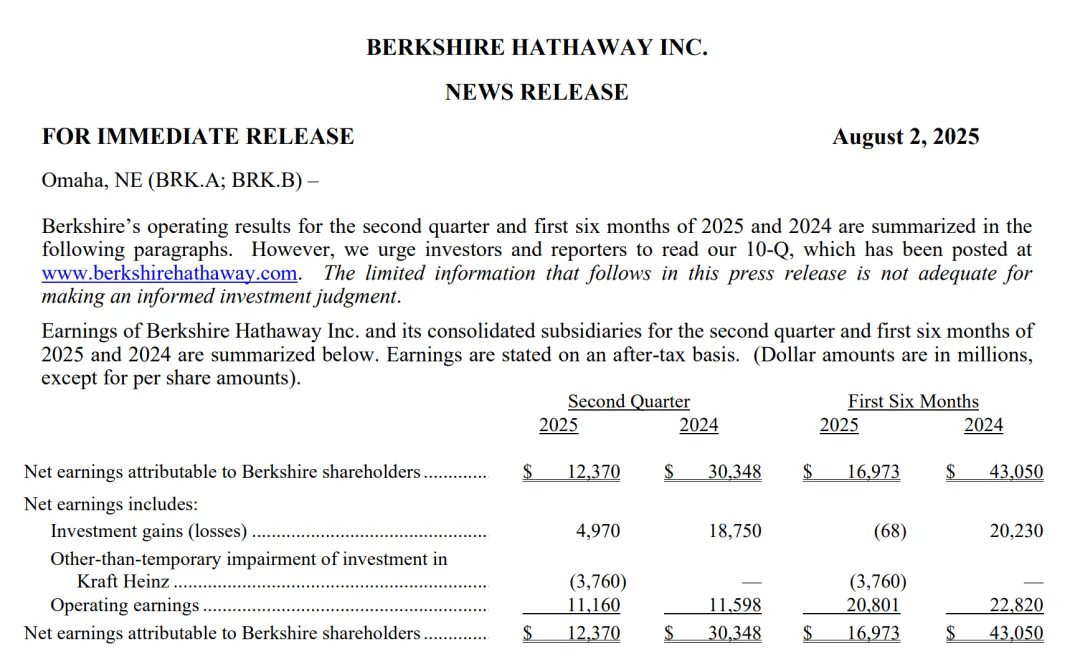
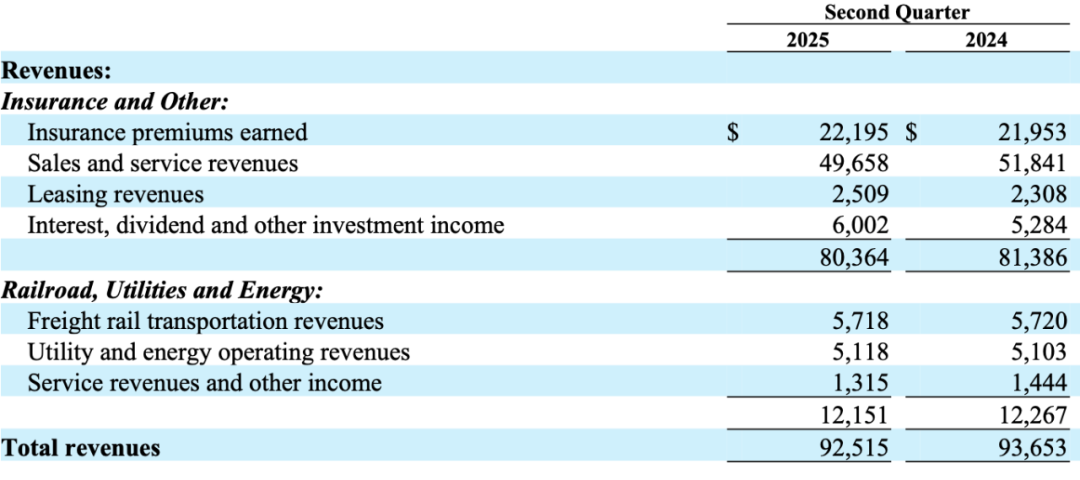
Core Viewpoint - Berkshire Hathaway has disclosed a significant impairment of $3.8 billion on its investment in Kraft Heinz, reducing its book value to $8.4 billion, a substantial drop from over $17 billion at the end of 2017, indicating a rare setback in Warren Buffett's investment career [1][2]. Group 1: Investment Impairment - Berkshire's second-quarter report revealed a $5 billion pre-tax impairment loss on Kraft Heinz, reflecting a non-temporary decline in the investment's book value compared to its fair value [2]. - The impairment was partly due to the ongoing decline in Kraft Heinz's fair value and limited access to timely financial information, as Berkshire's board representative resigned [2][8]. - As of June 30, 2025, the book value of Berkshire's investment in Kraft Heinz fell below the equity share calculated based on its ownership percentage [2]. Group 2: Strategic Changes at Kraft Heinz - Kraft Heinz is considering a major split or sale of its grocery brands, potentially creating a separate publicly traded entity valued at around $20 billion, which could be one of the largest transactions in the consumer goods sector this year [6][7]. - The planned divestiture includes iconic brands such as Oscar Mayer, Velveeta, and Jell-O, while the remaining company will focus on high-growth and premium product lines [7]. - This strategic move aligns with industry trends where traditional giants are narrowing their focus to develop globally appealing, high-margin brands [7]. Group 3: Berkshire's Financial Performance - In the second quarter of 2025, Berkshire reported revenues of $92.515 billion, a slight decrease from $93.653 billion in the same period last year, with net earnings dropping 59% to $12.370 billion [9][11]. - The company's operating profit fell by 4% year-on-year to $11.16 billion, primarily due to a decline in insurance underwriting performance, although profits in other sectors like railroads and energy showed growth [11]. - Berkshire's cash reserves decreased from $347 billion at the end of March to $344.1 billion, marking the first decline in three years [12].
临近退休的巴菲特遭遇“滑铁卢”! 净利润同比暴跌59%,确认38亿美元减值损失,就特朗普关税影响严厉警告
Sou Hu Cai Jing· 2025-08-03 08:12
Core Viewpoint - Berkshire Hathaway, led by Warren Buffett, reported a significant decline in net profit, down 59% year-over-year, raising concerns about the company's performance and Buffett's impending retirement [1][8]. Financial Performance - In Q2 2025, Berkshire achieved revenue of $92.515 billion, slightly down from $93.653 billion in the same period last year [1]. - Net earnings attributable to Berkshire shareholders were $12.370 billion, compared to $30.348 billion in Q2 2024, marking a 59% drop [4]. - Earnings per share were $8,601, exceeding market expectations of $7,443, but down from $21,122 a year earlier [1]. Investment Activities - Berkshire has been a net seller of stocks for 11 consecutive quarters, and despite a more than 10% decline from its historical stock price peak, the company did not repurchase any shares in the first half of 2025 [1]. - The company's top five holdings include American Express, Apple, Bank of America, Coca-Cola, and Chevron [1]. - As of the end of Q2, Berkshire's cash and cash equivalents stood at $344.1 billion, slightly down from $347.0 billion at the end of Q1 [1]. Impairment and Strategic Moves - Berkshire recognized a $3.8 billion impairment loss on its investment in Kraft Heinz, reducing its book value to $8.4 billion [5]. - The investment in Kraft Heinz has seen a 62% decline in stock price since the merger in 2015, significantly underperforming the S&P 500, which has risen over 200% in the same period [5]. - Berkshire has reduced its involvement in Kraft Heinz's board, signaling a potential exit from daily operations [5]. Market Trends and Challenges - Kraft Heinz is reportedly considering a major split of its grocery business, which could be valued at $20 billion, in response to stagnant growth and changing consumer preferences [6][7]. - The company is facing pressure to adapt to consumer trends favoring fresher and healthier food options [7]. Leadership Transition - Warren Buffett announced plans to retire by the end of the year, recommending Greg Abel as his successor [8]. - Since the announcement of Buffett's retirement, Berkshire's Class A shares have dropped over 12%, underperforming the S&P 500 [8]. Economic and Trade Concerns - Berkshire issued warnings regarding the potential impacts of U.S. trade policies and tariffs on its operations and investments, highlighting significant uncertainties in the current economic environment [10].
“股神”巴菲特投错了?伯克希尔减持卡夫亨氏股票,现金储备仍处于高位
Di Yi Cai Jing· 2025-08-03 07:39
Core Viewpoint - Berkshire Hathaway has adopted a conservative investment strategy, continuing to reduce stock holdings and increase cash reserves, following Warren Buffett's announcement of his retirement as CEO, which has led to a 12% decline in A shares while the S&P 500 rose by 10% [1][2] Group 1: Financial Performance - In Q2, Berkshire sold $6.92 billion worth of stocks while purchasing $3.9 billion, marking the 11th consecutive quarter of net stock selling [1] - Cash reserves reached a record high of $344 billion by the end of June, up from $333 billion at the end of March [1] - The company has suspended stock buybacks for the fourth consecutive quarter [1] - Berkshire reported a 3.8% year-over-year decline in operating profit to $11.2 billion, with core insurance profits down 12% [6] Group 2: Investment in Kraft Heinz - Berkshire significantly reduced the book value of its 27.4% stake in Kraft Heinz from $13.5 billion to $8.4 billion, marking the second write-down since the merger in 2015 [2][3] - The investment in Kraft Heinz has been described as one of Buffett's biggest mistakes, with the stock price down 62% since the merger, while the S&P 500 has increased by 202% during the same period [2][3] - Despite the write-down, Berkshire has received approximately $6.3 billion in dividends from its investment in Kraft Heinz, yielding a return close to 60% on its ordinary stock investment [4][5] Group 3: Market Conditions and Strategy - Berkshire's cautious stance is attributed to limited attractive capital allocation opportunities, as Buffett has indicated difficulty in finding appealing investments [6] - The company has not repurchased any shares in the last four quarters, reflecting a continued wait-and-see approach [6] - The consumer goods sector, particularly impacted by U.S. government tariffs, has faced challenges, with companies like Jazwares reporting a 38.5% revenue decline [7] - Berkshire has warned that geopolitical and macroeconomic uncertainties could affect its performance, particularly regarding international trade policies and tariffs [7]
“股神”巴菲特保持谨慎!连续11个季度抛售股票,遭遇“最大投资失败之一”
Sou Hu Cai Jing· 2025-08-03 02:08
Core Viewpoint - Berkshire Hathaway reported a significant decline in net profit and warned about the uncertainties related to tariffs and international trade policies, which could adversely affect its operations and investment performance [1]. Financial Performance - In Q2, Berkshire achieved revenue of $92.515 billion, down from $93.653 billion year-on-year, but above market expectations of $91.963 billion [1]. - Operating profit was $11.16 billion, a 3.8% decrease year-on-year, attributed to lower underwriting profits from its insurance segment, despite growth in profits from railroads, energy, manufacturing, services, and retail [1]. - Net profit plummeted to $12.37 billion, a 59% drop from $30.348 billion in the same quarter last year, exceeding market expectations of $10.703 billion [1]. - Earnings per share were $8,601, surpassing market expectations of $7,443, but down from $21,122 year-on-year [1]. Investment Strategy - Berkshire's cash reserves decreased by 1% to $344 billion, marking the first decline in three years [1]. - The company continued a cautious approach to the stock market, net selling approximately $3 billion in stocks for the 11th consecutive quarter [1]. - The top five holdings accounted for 67% of the fair value, including American Express, Apple, Bank of America, Coca-Cola, and Chevron [1]. - Berkshire reported stock investment gains of $6.4 billion, but experienced a net loss of $710 million in the first half of the year [1]. Impairment and Future Outlook - Berkshire recorded a $3.8 billion impairment on its investment in Kraft Heinz, reducing its book value from over $17 billion at the end of 2017 to $8.4 billion [2]. - Kraft Heinz's stock has declined by 62% since Berkshire's initial investment, while the S&P 500 has risen by 202% during the same period [2]. - Kraft Heinz is considering splitting some of its business units to address inflation impacts and changing consumer preferences [5]. - Analysts suggest that Berkshire may be preparing to exit this investment, with some viewing the impairment as a significant misstep for Buffett [6].
刚刚,巨额减计,巴菲特“最大的投资失败之一”,但股神依旧是股神
Hua Er Jie Jian Wen· 2025-08-03 01:38
Core Insights - Warren Buffett's Berkshire Hathaway has reported a significant write-down of $3.8 billion on its investment in Kraft Heinz, reducing its book value to $8.4 billion from over $17 billion at the end of 2017, confirming perceptions of investment failure [1][2] - Despite the apparent loss, analysis suggests that Buffett's investment strategy and favorable terms have mitigated the impact, allowing him to remain in a relatively advantageous position [3] Investment Performance - The write-down is attributed to the continuous decline in Kraft Heinz's fair value, with the company's stock price dropping 62% since the merger in 2015, while the S&P 500 has increased by 202% during the same period [2] - Berkshire's total investment in Kraft Heinz, including additional investments during the merger, reached $9.8 billion, with the current market value of its 27.4% stake at approximately $8.8 billion [3] - Over the years, Berkshire has received around $6.3 billion in cash dividends from this investment, leading to a total return of nearly 60% when combining market value and dividends [3] Comparison with Other Shareholders - Other shareholders who held Kraft Foods stock since the merger have seen a total return of only 8% over the past decade, highlighting Buffett's superior position [4] - If these shareholders had invested in Unilever instead, their investment could have nearly doubled, emphasizing the relative underperformance of Kraft Heinz [4] Lessons Learned - The merger of two mediocre companies does not necessarily create a strong entity, as Kraft Heinz faces challenges from shifting consumer preferences towards healthier food options, with projected revenue decline of 3% this year [5] - Buffett's ability to negotiate better terms allows him to achieve favorable outcomes even in less successful investments [5]
卡夫亨氏,巴菲特的“最后一课”
Zhong Guo Zheng Quan Bao· 2025-08-02 23:56
Core Insights - Berkshire Hathaway reported a significant decline in net profit for Q2 2025, amounting to $12.37 billion, a 59.24% decrease year-on-year, primarily due to a $5 billion impairment loss on its investment in Kraft Heinz [2][5][8] - The investment in Kraft Heinz has been a notable failure for Berkshire, with the carrying value of the investment dropping to $8.4 billion as of June 30, 2025, reflecting a more than 60% decline from its peak value at the time of the merger in 2015 [8][6] Financial Performance - In Q2 2025, Berkshire's total revenues were $92.515 billion, a slight decrease from $93.653 billion in Q2 2024 [3] - The net earnings attributable to Berkshire shareholders were $12.37 billion, down from $30.348 billion in the same quarter of the previous year [3] Investment Details - Berkshire Hathaway's investment in Kraft Heinz has faced multiple impairments, with a previous $3 billion write-down in 2019 followed by the recent $5 billion impairment [2][4] - The board representative from Berkshire at Kraft Heinz resigned on May 19, 2025, limiting the company's access to timely financial information [5] Strategic Reflections - Warren Buffett has publicly reflected on the mistakes made in the Kraft Heinz investment, acknowledging over-optimism regarding the company's competitive position and challenges in cost control [9][11] - The investment serves as a cautionary tale that even low acquisition prices do not guarantee a good investment if the underlying company is poor [11]
X @Investopedia
Investopedia· 2025-08-02 18:00
Berkshire Hathaway, the conglomerate run by legendary investor and soon-to-be-departing CEO Warren Buffett, on Saturday reported that it had recorded a nearly $5 billion second-quarter write-down of Kraft Heinz shares. https://t.co/hHAEw6Fhnw ...