Lilly(LLY)

Search documents
Jim Cramer Discusses Key Point For Eli Lilly (LLY)’s Drugs
Yahoo Finance· 2025-11-13 16:37
Group 1 - Eli Lilly and Company (NYSE: LLY) is recognized for its weight loss drugs and is frequently discussed by Jim Cramer on his shows [2] - Cramer highlights the potential of a pill form of Eli Lilly's weight loss drug, which could enhance the company's market position [2] - The company has a promising drug in phase two trials that reportedly leads to a weight loss of approximately 20 pounds, with indications that the weight loss is primarily from fat rather than muscle [2] Group 2 - While Eli Lilly shows potential as an investment, there is a belief that certain AI stocks may offer higher returns with lower risk [3] - The article suggests that investors looking for inexpensive AI stocks that benefit from current economic policies should consider alternatives to Eli Lilly [3]

与礼来(LLY.US)、诺和诺德(NVO.US)合作直供GLP-1减重药 Mangoceuticals(MGRX.US)盘前飙升约19%
Zhi Tong Cai Jing· 2025-11-13 14:30
Core Viewpoint - Mangoceuticals (MGRX.US) stock surged approximately 19% pre-market after announcing a collaboration with pharmaceutical giants Eli Lilly (LLY.US) and Novo Nordisk (NVO.US) to provide users with access to their popular GLP-1 weight loss medications [1] Group 1 - The company has launched two platforms, MangoRx Direct and PeachesRx Direct, aimed at self-paying users [1] - The platforms will offer Eli Lilly's Zepbound (tirzepatide) and Novo Nordisk's Wegovy (semaglutide) directly to consumers [1]

美股异动 | 与礼来(LLY.US)、诺和诺德(NVO.US)合作直供GLP-1减重药 Mangoceuticals(MGRX.US)盘前飙升约19%
智通财经网· 2025-11-13 14:30
Core Viewpoint - Mangoceuticals (MGRX.US) stock price surged approximately 19% following the announcement of partnerships with pharmaceutical giants Eli Lilly (LLY.US) and Novo Nordisk (NVO.US) to directly offer their popular GLP-1 weight loss medications [1] Company Summary - Mangoceuticals, based in Dallas, Texas, has launched the MangoRx Direct and PeachesRx Direct platforms aimed at self-paying users [1] - The platforms will sell Eli Lilly's Zepbound (tirzepatide) and Novo Nordisk's Wegovy (semaglutide) directly to consumers [1]
Shine a Light on Healthcare ETFs Amid National Alzheimer's Awareness Month
ZACKS· 2025-11-13 14:11
Core Insights - November is National Alzheimer's Disease Awareness Month in the U.S., highlighting the significance of the disease and the growing relevance of disease-modifying treatments [1] - The healthcare sector, particularly companies focused on Alzheimer's, presents a compelling investment opportunity through Healthcare exchange-traded funds (ETFs) [2] Group 1: Alzheimer's Drug Innovation - Eli Lilly's drug Kisunla (donanemab) received FDA approval in July 2024, showing a 22% slowing of clinical progression in treated patients, equating to a 1.4-month delay in disease progression [5] - Biogen, in collaboration with Eisai, launched Leqembi in 2023, which also gained full FDA approval [5] - Other significant players include Johnson & Johnson, developing two Alzheimer's medicines, and AbbVie, with its investigational drug ALIA-1758 [6] Group 2: Impact on Healthcare ETFs - The success of Alzheimer's therapies is crucial for the revenue and stock performance of companies like Eli Lilly and Biogen, making them key components in many healthcare ETFs [7] - The Dow Jones U.S. Health Care Index has increased by over 9% year to date, reflecting positive momentum from stocks like Eli Lilly and Biogen [8] Group 3: Government Support and Funding - The U.S. Senate Appropriations Committee proposed a $100 million increase for Alzheimer's and dementia research at the NIH for fiscal year 2026, indicating sustained government commitment to the biopharma sector [9] Group 4: Recommended Healthcare ETFs - Vanguard Health Care ETF (VHT) has net assets of $16.2 billion, with top holdings including Eli Lilly (10.33%) and AbbVie (5.76%), and has surged 13.4% year to date [10][11] - First Trust NASDAQ Pharmaceuticals ETF (FTXH) has net assets of $18.9 million, with top holdings including AbbVie (7.14%) and Johnson & Johnson (7.07%), rising 18.2% year to date [12] - Health Care Select Sector SPDR ETF (XLV) has assets worth $38.79 billion, with Eli Lilly (14.36%) and Johnson & Johnson (8.53%) as top holdings, increasing by 12.6% year to date [13] - iShares Neuroscience and Healthcare ETF (IBRN) has net assets of $4.38 million, with Biogen (4.04%) among its top holdings, and has surged 15.1% year to date [14]


Mangoceuticals partners with Lilly, Novo Nordisk to sell weight-loss drugs
Reuters· 2025-11-13 12:15
Core Insights - Telehealth company Mangoceuticals has announced a partnership with Eli Lilly and Novo Nordisk to distribute their weight-loss drugs through its platform [1] Company Summary - Mangoceuticals is expanding its product offerings by collaborating with major pharmaceutical companies Eli Lilly and Novo Nordisk [1] - The partnership aims to leverage Mangoceuticals' telehealth platform to sell blockbuster weight-loss medications [1] Industry Summary - The collaboration highlights the growing trend of telehealth companies partnering with traditional pharmaceutical firms to enhance drug accessibility [1] - Weight-loss drugs are becoming increasingly significant in the healthcare market, driven by rising obesity rates and demand for effective treatments [1]
速递|替尔泊肽,新适应症申报上市!
GLP1减重宝典· 2025-11-13 10:41
Core Viewpoint - The article discusses the recent developments regarding the dual agonist Tirzepatide, highlighting its approval for new indications in China, which expands its market potential in the treatment of type 2 diabetes and obesity [2][4][8]. Group 1: Product Approval and Indications - Tirzepatide, developed by Eli Lilly, is a dual agonist of glucose-dependent insulinotropic polypeptide (GIP) and glucagon-like peptide-1 (GLP-1) [3][5]. - The drug was approved in the U.S. in May 2022 for the treatment of type 2 diabetes and received its first approval in China in May 2024 for adult patients with inadequate blood sugar control on diet and exercise, along with metformin and/or sulfonylureas [4][5]. - In July 2024, Tirzepatide was approved in China for long-term weight management in adults with obesity (BMI ≥ 28 kg/m²) or overweight (BMI ≥ 24 kg/m² with at least one weight-related comorbidity) [4][5]. Group 2: Market Implications - The approval of Tirzepatide strengthens Eli Lilly's position in the metabolic disease treatment landscape in China, where there is a large population of patients with obesity and type 2 diabetes, providing significant market opportunities [8]. - As the first GIP/GLP-1 dual agonist, Tirzepatide offers treatment options in both blood sugar control and weight management, which is expected to have a substantial impact on the market [8]. - The expansion of Tirzepatide's indications is a key strategic move for Eli Lilly, particularly in the obesity and metabolic disease sectors, potentially solidifying its market position in diabetes treatment and increasing its relevance in weight management [8].
2 Quality Healthcare Stocks That Could Build a Strong Foundation for Beginner Investors
The Motley Fool· 2025-11-13 09:40
Core Insights - The healthcare sector is experiencing long-term growth due to an aging global population, leading to increased demand for healthcare services and treatments [1] Company Summaries Eli Lilly - Eli Lilly is positioned as a strong investment option due to its profitable financial growth, leading market position in weight loss and diabetes drugs, and a robust product pipeline [3][4] - The company’s key products, Mounjaro and Zepbound, are driving significant revenue growth, with peak annual sales for tirzepatide expected to exceed $60 billion by 2030 [3][5] - Eli Lilly reported a 54% increase in Q3 2025 revenue and a 475% surge in net income year-over-year, largely attributed to the demand for its incretin drugs [5] - Mounjaro generated $6.5 billion in revenue (up 109%) and Zepbound contributed $3.6 billion (up 185%), capturing approximately two-thirds of new U.S. incretin prescriptions [6] - The company has a history of consistent dividend payments since the late 1800s, appealing to income investors [7] Hims & Hers Health - Hims & Hers Health operates a subscription-based telehealth platform, generating over 90% of its revenue from recurring subscriptions for chronic health conditions [8][12] - The company has expanded its offerings into various specialties, including dermatology and mental health, and added compounded semaglutide to its weight loss program [9][10] - Hims & Hers reported a 90% revenue increase to $1.1 billion in the first half of 2025 compared to the same period in 2024, with net income nearly quadrupling to about $92 million [12] - The company is focusing on personalized GLP-1 formulations and has invested in in-house compounding capabilities to support its wellness offerings [10][11]


1 Incredible Reason to Buy LLY's Stock in November
The Motley Fool· 2025-11-13 09:25
Core Insights - Eli Lilly has secured a deal with the Trump administration that could significantly boost its stock value [1][5] - The company’s drug tirzepatide, marketed as Mounjaro and Zepbound, has become the best-selling drug globally, with year-to-date sales of $24.8 billion [2][10] - The agreement will allow Medicare to cover GLP-1 weight loss drugs at discounted prices, expanding access to millions of recipients [6][10] Company Overview - Eli Lilly's current stock price is $1017.78, with a market capitalization of $962 billion and a gross margin of 83.03% [3] - The company leads the weight-loss drug market with a 57% market share, and the market is projected to exceed $200 billion in annual sales by 2031 [10][11] Market Dynamics - The deal with the Trump administration will lower the cash price of Zepbound from approximately $500 to as low as $150 for eligible Medicare recipients [8] - An estimated 1-in-10 Medicare recipients may qualify for the discounted drugs, which could significantly increase the number of prescriptions [6][9] - The overall number of patients starting GLP-1 treatments for non-diabetic purposes has surged by 700% since 2019, indicating a growing market potential [9] Future Prospects - The agreement is expected to enhance Eli Lilly's position in the expanding weight-loss drug market, with additional eligibility for Medicaid recipients anticipated by 2027 [7][10] - The introduction of a new "TrumpRx" website will facilitate access to these medications at reduced prices [8]

“地球上最畅销的药物”? 花旗:医保纳入改变一切,礼来口服GLP-1明年销售额将比市场预测高两倍
Hua Er Jie Jian Wen· 2025-11-13 08:07
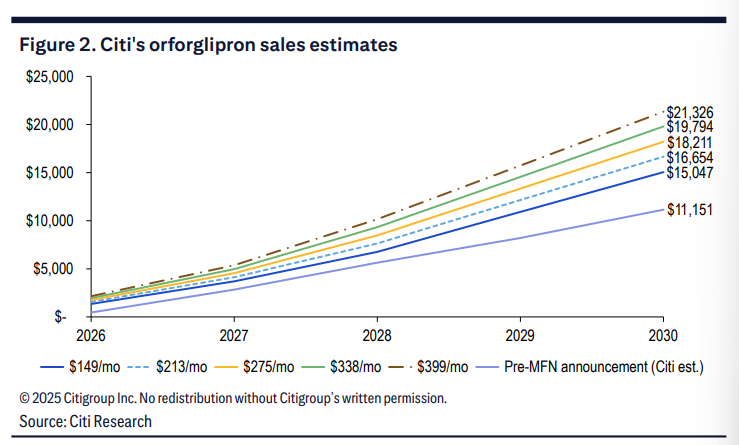
Core Viewpoint - Citigroup has raised the target price for Eli Lilly to $1500, driven by the anticipated rapid market penetration of its oral GLP-1 drug, Orforglipron, following Medicare's expanded coverage for obesity treatment [1][2]. Group 1: Market Dynamics - The change in Medicare's stance to include obesity treatment is seen as a milestone for Orforglipron, potentially leading commercial and private insurers to follow suit, thus opening a significant market opportunity for GLP-1 drugs [2]. - The cost-effectiveness of GLP-1 drugs compared to lifestyle interventions, as highlighted in the ICER report, suggests improved access prospects for these medications [2]. Group 2: Sales Projections - Citigroup has increased its sales forecast for Orforglipron from $500 million to $1.8 billion for 2026, contrasting sharply with the market consensus of approximately $470 million [1]. - Long-term peak sales projections for Orforglipron are estimated to exceed $40 billion [1]. Group 3: Initial Market Launch - The initial market launch of Orforglipron is expected to benefit from a combination of increased patient access due to expanded insurance coverage and lower pricing, which will enhance patient adherence and drive faster sales growth compared to previous GLP-1 drugs [3]. - Citigroup has raised its 2030 sales forecast for Orforglipron from $11.2 billion to $18.2 billion, while the market consensus stands at $12.1 billion [3]. Group 4: Additional Product Benefits - Eli Lilly's injectable products, Zepbound and Mounjaro, are also expected to benefit from the expanded market access, with 2030 sales forecasts adjusted to $26.2 billion and $38.1 billion, respectively [5]. Group 5: Expert Endorsements - Key opinion leaders (KOLs) have shifted their focus from whether Orforglipron can be commercialized to the scale of its commercialization, with positive feedback reinforcing its potential [7]. - Experts from prestigious institutions have praised Orforglipron's efficacy and safety profile, suggesting it could become one of the best-selling drugs globally [8].
礼来(LLY.US)替尔泊肽注射液新适应症在华申报获受理
智通财经网· 2025-11-13 07:05
2024年5月,替尔泊肽首次在我国获批上市,用于在饮食控制和运动基础上,接受二甲双胍和/或磺脲类药物治疗血糖仍控制不佳的成人2型糖尿病(T2DM) 患者。 2024年7月,替尔泊肽又在我国获批一项新适应症:用于在控制饮食和增加运动基础上,体重指数(BMI)符合以下要求的成人的长期体重管理:≥28 kg/m2(肥胖),或≥24 kg/m2(超重)并伴有至少一种体重相关合并症(如:高血压、血脂异常、高血糖、阻塞性睡眠呼吸暂停、心血管疾病等)。 今年6月,替尔泊肽又在华获批第三项适应症:用于治疗成人肥胖患者的中度至重度阻塞性睡眠呼吸暂停(OSA)。 智通财经APP获悉,11月13日,CDE官网显示,礼来(LLY.US)的葡萄糖依赖性促胰岛素多肽(GIP)和胰高血糖素样肽-1(GLP-1)受体双重激动剂替尔泊肽注 射液新适应症上市申请已获得受理。这是该药品在华第三项适应症获批后又一次申报。 | 序号 | 会睡着 | 药品名称 | 药品类型 | 申请类型 | 注册分类 | 企业名称 | 承办日期 | | --- | --- | --- | --- | --- | --- | --- | --- | | 1 | JXHS ...