
Micron Technology(MU)

Search documents
内存告急,云巨头狂锁 2 年产能
半导体行业观察· 2025-11-30 04:53
Core Viewpoint - The explosive demand for artificial intelligence is accelerating a historic shortage of memory chips globally, with major cloud service providers (CSPs) signing long-term agreements to secure supply for 2027 and 2028 [1][3]. Group 1: Server Shortage Driven by AI - The unprecedented shortage of servers is primarily driven by a surge in demand for AI, making servers the largest deployment platform for applications [2][3]. - Major telecom service providers are reserving more servers for 2026-2027, with procurement volumes far exceeding actual demand [3]. - Memory manufacturers' expansion plans for 2026 cannot keep pace with demand, leading to nearly all production capacity being booked for the year [3]. Group 2: Pricing Dynamics - Sellers have gained unprecedented pricing power, ensuring that prices will continue to rise throughout 2026 without any declines in the second half of the year [3]. - Server suppliers are willing to pay premiums to secure capacity, becoming priority customers for suppliers [3]. - Some telecom service providers may offer better terms, such as prepayments or equipment financing, to lock in capacity for 2027-2028 [3]. Group 3: Long-term Agreements and Market Access - Most telecom service providers are actively seeking contracts longer than one year, but only a few are likely to secure long-term agreements [6][7]. - Approximately 30% of telecom service providers have managed to sign long-term agreements, while 90% have not [7]. - Current spot prices are "abnormally high," and while they may decline, contract prices remain significantly lower than spot prices, with expectations of a 50% increase in the next 6-9 months [7]. Group 4: NAND Flash Memory Constraints - The shortage issue is not limited to DRAM; NAND flash prices are also rising rapidly, with some suppliers increasing prices even in the face of shortages [5]. - Server OEMs confirm stable output and yield for AI GPUs, but memory shortages remain a critical bottleneck in the supply chain [5]. Group 5: Manufacturer Focus and Capacity Expansion - SK Hynix plans no expansion of NAND wafer production in 2026, focusing instead on high bandwidth memory (HBM) and DRAM [8]. - New wafer fabs from Samsung and Micron are unlikely to contribute to capacity growth until after the second half of 2027 [8].


Economic Currents: Record Black Friday, AI’s Job Market Impact, Crypto UBI, and Global Tech Investments
Stock Market News· 2025-11-30 01:38
Group 1: E-commerce Trends - U.S. online Black Friday sales reached a record $11.8 billion, marking a 9.1% increase year-over-year, significantly driven by AI-powered shopping tools which saw an 805% increase in traffic to retail sites [2][3][7] - Mobile shopping accounted for over half of all sales, with popular categories including video game consoles, electronics, and home appliances [3][7] - Cyber Monday is projected to continue the trend with anticipated sales of $14.2 billion, making it the largest online shopping day of the year [3] Group 2: Labor Market Dynamics - Entry-level job postings in the U.S. have declined by 16% year-over-year, raising concerns for young workers, particularly recent graduates and those aged 16 to 24, whose unemployment rate reached 10.5% in August [4][5][7] - Platforms like Handshake reported a 15% reduction in job listings compared to the last academic year, while applications per job increased by approximately 30%, indicating a mismatch in the labor market [5] Group 3: Technological Investments - Japan announced an additional budget allocation of approximately ¥252.5 billion (US$1.6 billion) to enhance its AI and semiconductor industries, part of a broader strategy that has committed around ¥5.7 trillion (US$36.5 billion) since 2021 [6][7][8] - The funding will support key projects, including the domestic chip venture Rapidus, which aims to mass-produce 2-nanometer chips by 2027 [7][8] Group 4: Cryptocurrency and Social Aid - A pilot Universal Basic Income program funded by Coinbase is distributing $12,000 in USDC stablecoin to 160 low-income residents in New York, exploring the effectiveness of cryptocurrency in social welfare [9][10] - The total funding for this project is approximately $2.6 million, with participants receiving payments in two stages [10] Group 5: Economic Policy and Market Performance - Treasury Secretary Scott Bessent credited President Trump's economic policies for a recovering bond market, with the U.S. Treasury market achieving a 6% total return year-to-date, its strongest performance since 2020 [11][12] - Plans for regulatory adjustments to enhance market liquidity include a revamped Treasury buyback program, with projections of a tenfold growth in the stablecoin market by the end of the decade [12]


Here's My Top Artificial Intelligence (AI) Stock to Buy in December (Hint: It's Not Broadcom)
Yahoo Finance· 2025-11-29 19:36
Group 1: Broadcom Overview - Broadcom is a key player in the AI chip market, designing custom processors that help hyperscalers reduce data center operating costs [1] - The company has established a solid customer base, including OpenAI, Meta Platforms, and Alphabet, and has experienced healthy growth in AI revenue [2] Group 2: Micron Technology Performance - Micron Technology is set to release its fiscal 2026 first-quarter results, with management guiding for $12.5 billion in revenue, a 45% increase year-over-year, and non-GAAP earnings guidance of $3.75 per share, more than double the previous year's figure [5] - The growth is driven by a favorable demand-supply environment in the memory market, significantly boosted by AI [6] Group 3: Market Trends and Projections - Demand for server memory chips is outpacing supply, leading to a price spike, with DRAM prices increasing by 50% in 2025 and expected to double by the end of 2026 [7] - Counterpoint Research anticipates a 50% increase in overall memory prices by Q2 2026, suggesting strong revenue and earnings growth for Micron in the upcoming year [8]
利好突袭!芯片,重磅消息!
券商中国· 2025-11-29 11:46
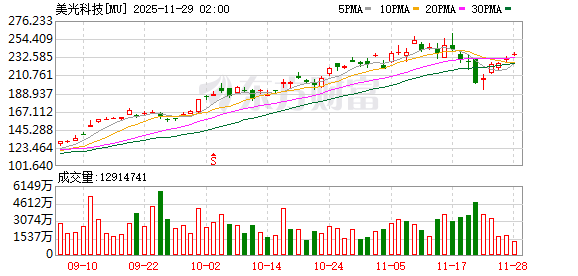
Group 1: Intel Developments - Intel's stock surged by 10% following news that Apple may become a significant customer, potentially starting shipments of M-series chips as early as 2027 [2][3] - The analyst Ming-Chi Kuo indicated that winning Apple's advanced node orders would be more significant than the direct revenue and profit contributions for Intel [2] - Intel's stock has more than doubled this year, with a market capitalization exceeding $190 billion [2] Group 2: Apple and Intel Collaboration - Apple has signed a confidentiality agreement with Intel and is awaiting the release of the PDK 1.0/1.1 tools, which are crucial for the development of M-series chips [3] - The expected shipment volume for Apple's standard M chips in 2026 and 2027 is projected to be between 15 million and 20 million units [3] - Intel's future prospects may improve with additional orders from Apple and other leading clients as it aims to recover under the leadership of its new CEO [3] Group 3: Micron Technology Investments - Micron Technology plans to invest 1.5 trillion yen (approximately $96 billion) to establish a factory in Japan for AI storage chips, with production expected to start around 2028 [5] - The new factory will focus on high-bandwidth memory (HBM) chips, and the Japanese government is expected to provide up to 500 billion yen in subsidies for the project [5] - Micron's stock has increased by 180% this year, reflecting strong performance in the AI sector [5] Group 4: Market Outlook for Micron Technology - Analysts have raised Micron's target price due to increasing demand for DRAM driven by AI applications, with expectations of supply constraints by 2026 [6] - Morgan Stanley and Wells Fargo have both upgraded their target prices for Micron, citing a positive outlook for the memory market and strong demand for DDR5 DRAM [6]


美光将在日本西部投资96亿美元生产AI内存芯片
Di Yi Cai Jing· 2025-11-29 08:00
(文章来源:第一财经) 据报道,美光将在日本西部投资96亿美元,用于生产人工智能内存芯片。 ...
Micron to invest $9.6 billion in Japan to build AI memory chip plant, Nikkei reports
Reuters· 2025-11-29 07:52
Core Viewpoint - U.S. chipmaker Micron Technology plans to invest 1.5 trillion yen ($9.6 billion) in a next-generation memory manufacturing facility in western Japan to enhance support for artificial intelligence computing [1] Investment Details - The investment amount is 1.5 trillion yen, equivalent to $9.6 billion [1] - The facility will focus on next-generation memory technology [1] Strategic Importance - The new manufacturing facility aims to support the growing demand for artificial intelligence computing [1] - This move indicates Micron's commitment to expanding its capabilities in the AI sector [1]
Micron: Possibly The Best Remaining AI Upside Trade
Seeking Alpha· 2025-11-29 07:16
Group 1 - The core viewpoint is that the demand outlook for memory has been structurally transformed due to the intensive data requirements in AI workloads, leading to increased memory and storage content [1] Group 2 - The article discusses the implications of AI on the memory market, highlighting that the growth in AI applications is driving higher demand for memory solutions [1]

Micron Technology (MU) Price Targets Raised by Analysts
Yahoo Finance· 2025-11-29 05:39
Core Insights - Micron Technology, Inc. (NASDAQ:MU) is recognized as one of the 15 best-performing AI stocks heading into 2026, with analysts raising price targets due to strong demand for DRAM and rising prices [1][2][3] Group 1: Analyst Ratings and Price Targets - Morgan Stanley reiterated its Buy rating on Micron Technology and raised the price target from $325 to $338 [1] - Rosenblatt increased its price target from $250 to $300 while maintaining a Buy rating, citing growing demand for DRAM driven by AI applications [1][2] - Wells Fargo raised its price target from $220 to $300 and maintained an Overweight rating after positive meetings with company executives [3][4] Group 2: Market Demand and Supply Dynamics - Demand for DRAM is increasing, particularly due to AI accelerators requiring High Bandwidth Memory (HBM) and the deployment of AI models at the network edge [2] - The supply growth of DRAM is expected to be limited through 2026, which may contribute to rising prices [2] - Prices for DRAM and NAND are rising faster than previously expected, prompting analysts to adjust financial projections for Micron Technology [3] Group 3: Company Overview - Micron Technology is a leading semiconductor technology company known for its innovative memory and storage solutions, including high-performance DRAM, NAND, and NOR products [4] - The company has a strong market position and solid execution, which supports a positive outlook for the memory industry [4]
集体大涨!芯片,重大利好传来!
天天基金网· 2025-11-29 02:26
Core Viewpoint - The article discusses the significant price increase of storage chips, particularly DRAM, driven by surging demand from AI infrastructure and a supply shortage, with expectations of further price hikes in the coming months and years [2][3][5]. Group 1: Market Dynamics - The global DRAM market is experiencing a supply-demand imbalance, leading to rapid price increases, with 512GB storage prices rising nearly 500 yuan compared to the previous month [2][3]. - Major tech companies like Dell and HP have issued warnings about potential storage chip shortages due to increased demand for AI infrastructure, predicting price hikes for their products [3][4]. - Counterpoint Research indicates that memory prices have already risen by 50% this year, with an additional expected increase of 50% by the second quarter of 2026 due to critical chip shortages [5][6]. Group 2: Company Responses - Lenovo's chairman, Yang Yuanqing, anticipates that the shortage and price increases of components, including storage, will persist throughout 2026, driven by the growing demand for AI-related infrastructure [4]. - Xiaomi's president, Lu Weibing, noted that the current rise in memory prices is a long-term trend influenced by AI demand, and the company has secured supply agreements for 2026 to mitigate cost pressures [4]. - Companies are adapting by potentially increasing product prices and seeking alternative suppliers to ensure adequate memory supply [3][4]. Group 3: Future Projections - Counterpoint predicts that major chip manufacturers will increase DRAM production by over 20% by 2026, but the current supply constraints primarily affect traditional products, impacting lower-cost consumer electronics [5][6]. - The shift in demand towards advanced memory types, such as LPDDR, poses significant challenges for the supply chain, as major players like NVIDIA are increasing their consumption, further straining resources [5][6]. - Analysts suggest that the current memory chip price surge may continue for several quarters, driven by strong demand across both advanced and traditional memory sectors [6].
深夜,集体大涨!芯片,重大利好传来!
Zheng Quan Shi Bao Wang· 2025-11-29 00:07
Core Insights - The global DRAM market is experiencing a supply-demand imbalance, leading to rapid price increases for storage chips, particularly driven by the surge in AI infrastructure demand [1][2][3] Group 1: Market Dynamics - The price of 512GB storage has increased by nearly 500 yuan compared to the previous month, indicating significant price inflation in the storage chip market [2] - Counterpoint Research reports that memory prices have risen by 50% this year, with an expected additional 50% increase by Q2 2026 due to critical chip shortages [4][5] - Major PC manufacturers like Dell and HP are issuing warnings about potential price hikes for their products due to rising storage chip costs and supply constraints [2][3] Group 2: Company Responses - Lenovo's chairman predicts that the shortage and price increases of components, including storage, will persist throughout 2026, prompting the company to secure optimal contracts with suppliers [3] - Xiaomi has proactively signed supply agreements for 2026 to mitigate the impact of rising storage costs and may consider price adjustments and product upgrades to alleviate cost pressures [3] - SK Hynix and Micron are adjusting their production strategies in response to the increased demand for advanced memory, with expectations of significant production growth in the coming years [5][6] Group 3: Future Outlook - The semiconductor industry is entering what analysts describe as a "super cycle," with manufacturers aggressively stockpiling memory chips amid soaring demand [6] - The shift in demand from traditional LPDDR4 to advanced memory types like HBM is causing market disruptions, with significant implications for supply chains [4][5] - Analysts predict that the price of DDR5 memory modules could double by the end of 2026 due to the ongoing supply constraints and heightened demand from major players like NVIDIA [5][6]


