
Micron Technology(MU)

Search documents
巨头警告:存储史上最狠涨价要来了!
半导体芯闻· 2025-11-27 10:49
Group 1 - Major tech companies like Dell and HP warn of potential storage chip shortages due to skyrocketing demand for AI infrastructure, which may lead to a 50% increase in storage module prices by Q2 next year [1][3] - Companies such as Xiaomi and Lenovo are preemptively stockpiling storage chips in response to rising costs, with Lenovo's CFO noting a 50% increase in current storage chip inventory compared to usual levels [6][2] - The supply shortage is expected to raise manufacturing costs across various sectors, including smartphones, medical devices, and automobiles, as storage chips are essential in modern electronic devices [1][3] Group 2 - Dell's COO Jeff Clarke highlighted unprecedented cost increases across DRAM, hard drives, and NAND flash, indicating that these costs will inevitably be passed on to consumers [2] - HP's CEO Enrique Lores anticipates significant challenges in the second half of 2026, suggesting potential price hikes for products as a response to supply constraints [2] - The supply chain issues are exacerbated by U.S. sanctions limiting the technological capabilities of emerging Chinese chip companies [2] Group 3 - The valuation of major storage chip manufacturers has surged due to the AI demand, with companies like Samsung, SK Hynix, and Micron Technology seeing significant stock price increases [3] - SK Hynix reported that all storage chip products for 2026 are sold out, indicating a persistent supply tightness [3] - The demand for all storage-related products is extremely strong, while supply lags behind, leading to a continued upward trend in DRAM and NAND flash prices [3] Group 4 - China's top chip manufacturer, SMIC, noted that the storage chip shortage is partly due to manufacturers prioritizing partnerships with leading AI chip supplier Nvidia [4] - Nvidia is focusing on assembling high-value, cutting-edge systems for AI data centers, which may further limit the availability of storage chips for other electronic devices [5] Group 5 - Xiaomi has raised prices for its flagship models and anticipates that the storage chip shortage will lead to increased mobile device prices next year [6] - Asus is also stockpiling inventory, with both Lenovo and Asus planning to maintain stable prices during the holiday season and reassess the market situation next year [6] - Apple remains optimistic, managing costs effectively despite slight upward pressure on storage chip prices [6] Group 6 - SK Group's chairman Chey Tae-won warned of supply bottlenecks, stating that many companies are requesting storage chip supplies, and efforts are underway to meet these demands [7]







Micron Technology Stock: Is MU Outperforming the Technology Sector?
Yahoo Finance· 2025-11-27 06:49
Core Insights - Micron Technology, Inc. is a leading American semiconductor company with a market cap of $252.4 billion, specializing in memory and storage solutions [1][2] - The company has seen significant stock performance, with shares increasing 173.6% year-to-date and 126.2% over the past 52 weeks, outperforming major indices [4] Company Overview - Micron designs, develops, and manufactures DRAM, NAND flash memory, and SSDs for various applications including computing, mobile devices, and data centers [1] - The company operates globally and serves major technology firms and cloud-service providers, playing a critical role in the memory supply chain [2] Stock Performance - Micron's shares have declined 11.6% from their 52-week high of $260.58 but surged 97.7% over the past three months, significantly outperforming the Technology Select Sector SPDR Fund [3] - The stock has been trading above its 50-day and 200-day moving averages since early May, indicating a positive trend [4] Analyst Sentiment - On November 24, Micron's shares rose 7.2% following positive analyst sentiment, with Morgan Stanley raising its price target from $325 to $338 [5] - Other firms, including Citigroup and Wedbush, have also increased their price targets, reflecting optimism about Micron's performance driven by rising memory demand for AI applications [5] Competitive Position - Micron has outperformed its competitor, Analog Devices, Inc., which has returned 21.4% year-to-date and 17.7% over the past 52 weeks [6]
从小米到惠普,多家科技公司警告“内存短缺”,戴尔电话会称“从未见过成本上涨如此之快”
美股IPO· 2025-11-27 03:38
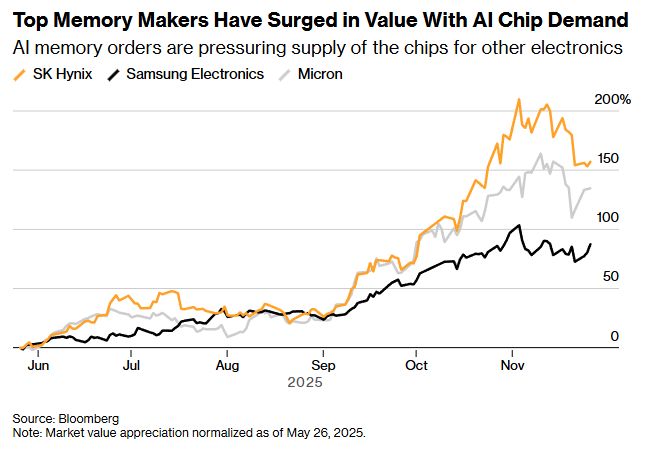
Core Viewpoint - The technology industry is facing a memory chip supply crisis driven by the demand for AI infrastructure, leading to unprecedented cost increases across various electronic products [3][5]. Group 1: Cost Increases and Supply Shortages - Dell and Lenovo have reported unprecedented cost increases, with Dell's COO stating that the company has "never seen costs rise at this pace" [3][6]. - HP's CEO anticipates significant challenges in the second half of 2026, indicating that the company may raise prices as necessary due to rising memory costs, which account for 15% to 18% of a typical PC's cost [3][6]. - Counterpoint Research predicts a 50% increase in memory module prices by the second quarter of next year, with Xiaomi already raising flagship device prices due to the memory chip shortage [4][6]. Group 2: AI's Impact on Memory Chip Production - The shortage is attributed to a reallocation of chip production capacity towards AI systems, with manufacturers prioritizing high-margin products for AI over more common memory types [5][6]. - Major AI chip supplier NVIDIA is influencing manufacturers to focus on advanced systems for AI data centers, which may limit production of automotive and electronic products through 2026 [5][6]. Group 3: Manufacturer Responses to Supply Crisis - Manufacturers like Lenovo and ASUS are increasing their memory inventories by approximately 50% to mitigate supply risks, while Xiaomi has secured supply agreements for 2026 [6][7]. - Xiaomi's management acknowledges potential price increases to offset rising memory costs, emphasizing a focus on product structure optimization rather than just volume growth [6][7]. - Apple remains relatively optimistic, managing costs effectively despite slight upward pressure on memory prices [6][7]. Group 4: Market Valuation and Supplier Dynamics - The supply constraints have led to a surge in valuations for top memory manufacturers, with Samsung, SK Hynix, and Micron experiencing significant stock price increases [7]. - SK Hynix has sold its entire memory chip product line for the upcoming year, while Micron expects supply tightness to persist until 2026 [7]. - The competition for AI infrastructure is driving up costs across the consumer electronics supply chain, impacting energy bills and overall production costs [7].
DRAM价格,暴涨500%
半导体行业观察· 2025-11-27 00:57
Core Viewpoint - The article discusses the significant price increases in memory modules and solid-state drives due to a surge in demand driven by artificial intelligence infrastructure development, with expectations of continued shortages and rising costs into 2026 [1][4][5]. Group 1: Price Increases and Market Impact - CyberPowerPC announced a price increase for memory modules in the US and UK, with memory prices having risen by 500% and solid-state drive prices by 100% since October 2025 [1]. - Micro Center has removed price tags from memory kits, and Framework has stopped selling standalone memory to prevent scalping, with a 64GB DDR5 memory kit now costing as much as a PS5 Pro [2]. - Major manufacturers like Dell and HP are warning of potential memory chip shortages in the coming year, with predictions of a 50% price increase for memory modules by the second quarter of next year [4][6]. Group 2: Supply Chain Challenges - The memory chip shortage is exacerbated by US sanctions limiting the technological capabilities of Chinese entrants, impacting supply chains globally [5]. - Companies like Lenovo and Xiaomi are stockpiling memory chips to mitigate rising costs, while experts predict that the shortage could affect production across various sectors, including automotive and consumer electronics [4][7]. - SK Hynix and Micron have reported that their memory chip orders for next year are already sold out, indicating a tight supply situation that may persist until 2026 [6][8]. Group 3: Strategic Responses from Companies - Companies are adjusting product configurations and considering price increases to cope with rising memory costs, which account for 15% to 18% of a typical PC's cost [6]. - Lenovo has increased its memory inventory by about 50% and plans to maintain stable prices during the holiday season, reassessing the market in the new year [8]. - Apple has reported a slight increase in memory prices but maintains strong cost control due to its position as a major customer in the supply chain [7].


AI热潮引爆内存芯片“超级周期”!供应短缺及涨价或延续至2026年
Zhi Tong Cai Jing· 2025-11-27 00:26
Core Insights - Several technology companies, including Dell Technologies and HP, have warned of a potential shortage of memory chips next year due to a surge in demand driven by AI infrastructure development [1][3] - Market research firm Counterpoint Research predicts that memory module prices could rise by 50% by the second quarter of next year [1] - The shortage of memory chips may increase manufacturing costs across various products, from smartphones to medical devices and automobiles [1] Group 1: Company Responses - Dell Technologies is adjusting its configurations and product mix, considering options such as repricing some devices due to rising costs [2] - HP's CEO indicated that the second half of 2026 will be particularly challenging, and the company may raise prices as necessary [2] - Apple has a more optimistic outlook, with its CFO noting a slight tailwind in memory prices while emphasizing effective cost management [2] Group 2: Market Dynamics - The memory chip industry is entering what analysts refer to as a "super cycle," with manufacturers prioritizing high-bandwidth memory (HBM) production over traditional memory types [3][7] - Major players like Samsung and SK Hynix are shifting their focus to higher-margin, advanced memory products, planning to cease DDR4 production by late 2025 [6] - Morgan Stanley estimates that tech giants will invest $400 billion in AI infrastructure this year, exacerbating the supply constraints for non-HBM memory chips [6] Group 3: Price Trends - The price of RAM has surged significantly, with 4GB DDR4X chips rising from $7 to over $30 per unit, a 3-4 times increase [6] - NAND flash memory prices have also increased, with 64G eMMC chips going from $3.2 to over $8, a nearly 1.5 times rise [6] - The ongoing demand for memory chips is expected to sustain price increases for several quarters [8]
Dell earnings send blunt Micron message
Yahoo Finance· 2025-11-27 00:24
Core Insights - Dell Technologies is experiencing significant growth in AI server demand, with a reported 150% increase in server orders for AI, reaching $30 billion in fiscal 2026 [4] - The company anticipates continued strength in AI server shipments, with projections of a 50% increase to $37 billion in fiscal 2027 [5] - Rising demand for AI servers is expected to create a memory super cycle, impacting memory prices across the industry [5][6] Group 1: Dell's Performance - Dell's third-quarter results highlighted a surge in server demand driven by AI, contributing to higher sales and orders [1] - The momentum in AI server demand has accelerated in the second half of the year, building on a strong first half [2] - Dell's CFO indicated that the company will ship $25 billion in AI servers this fiscal year, with expectations of continued growth [4] Group 2: Industry Implications - The increase in AI server demand is likely to benefit companies like Micron, as they supply high-bandwidth memory needed for these servers [2][4] - Current memory supply chain concerns may lead Micron into another memory super cycle, driven by hyperscaler and enterprise spending [3] - Dell's management acknowledged that rising memory prices will affect all product categories, indicating a broader industry trend [5][6]
美股收盘:三大指数连涨四日,芯片股全线走强
Xin Lang Cai Jing· 2025-11-26 23:30
Market Performance - US stock market opened high and closed higher, with all three major indices rising for four consecutive days [1] - Dow Jones increased by 0.67% to 47,427.12 points, S&P 500 rose by 0.69% to 6,812.61 points, and Nasdaq Composite climbed by 0.82% to 23,214.69 points [1] - Market volatility eased, with the S&P 500 volatility index (VIX) dropping approximately 35% over four days, marking the largest decline since mid-April [1] Technology Sector - Mixed performance among large tech stocks: Nvidia up 1.37%, Apple up 0.21%, Google C down 1.04%, Microsoft up 1.78%, Amazon down 0.22%, Broadcom up 3.26%, Meta down 0.41%, and Tesla up 1.71% [1] - Philadelphia Semiconductor Index rose by 2.76%, with all 30 component stocks closing higher [1] - Notable gains in semiconductor stocks: Teradyne up 6.98%, Marvell Technology up 5.14%, AMD up 3.93%, ASML up 3.76%, and Micron Technology up 2.55% [1] Chinese Stocks - Nasdaq Golden Dragon China Index slightly declined by 0.03% [2] - Most popular Chinese stocks saw gains: Vipshop up 2.54%, Pinduoduo up 1.58%, JD.com up 0.96%, Li Auto up 0.6%, New Oriental up 0.39%, and Alibaba up 0.38% [2] - Declines were noted in some Chinese stocks: Hesai down 7.37%, Tencent Music down 2.33%, Xpeng down 2.22%, Baidu down 1.31%, and NIO down 0.73% [3]


NVIDIA and Micron Stand Out as Likely Profitable AI Winners for 2026
ZACKS· 2025-11-26 21:01
Core Insights - AI stocks have shown exceptional performance in 2023, with expectations for continued momentum into 2024, supported by a projected global AI market growth to US$2,407.02 billion by 2032, reflecting a 30.6% CAGR starting in 2025 [1]. Company Analysis - NVIDIA Corporation (NVDA) and Micron Technology, Inc. (MU) are identified as top profitable AI stocks for 2026 and beyond, attributed to their high net income ratios [3][9]. - NVDA has a 12-month net profit margin of 53%, indicating strong profitability [7][9]. - MU has a 12-month net profit margin of 22.9%, also reflecting solid profitability [8][9]. Profitability Metrics - The net income ratio is a key indicator of a company's profitability, representing the percentage of net income relative to total sales revenues, with a higher ratio indicating better revenue generation and expense management [4]. - Additional screening parameters include Zacks Rank 1 (Strong Buy), trailing 12-month sales and net income growth higher than the industry, and a strong buy percentage rating greater than 70% [5][6]. Screening Results - The screening process narrowed down over 7,685 stocks to 15, highlighting NVDA and MU as qualified candidates based on their strong financial metrics [6][9].

Looking At Micron Technology's Recent Unusual Options Activity - Micron Technology (NASDAQ:MU)
Benzinga· 2025-11-26 16:03
Core Insights - Financial giants are showing a bearish sentiment towards Micron Technology, with 35% of traders indicating bearish tendencies compared to 31% bullish [1] - The trading activity indicates a focus on a price range between $70.0 and $320.0 for Micron Technology over the past three months [2] - Recent options trading data reveals significant interest in both puts and calls, with a total of 99 unusual trades identified [1][3] Options Activity - A total of 43 put options were traded, valued at $5,518,721, while 56 call options were valued at $3,210,749 [1] - Noteworthy options activity includes various trades with different sentiments, such as bullish and bearish, across multiple strike prices [7] Market Standing - Micron Technology is one of the largest semiconductor companies globally, focusing on memory and storage chips, primarily DRAM, with some exposure to NAND flash chips [8] - The company serves a diverse customer base, including data centers, mobile phones, consumer electronics, and industrial applications [8] - Analysts have set an average target price of $300.6 for Micron Technology, with various firms maintaining positive ratings and price targets ranging from $265 to $338 [10][11] Current Performance - The stock price of Micron Technology (MU) is currently at $229.23, reflecting a 2.09% increase with a trading volume of 6,482,028 [13] - Current RSI values suggest that the stock may be approaching overbought conditions [13]

STX vs. MU: Which Storage-Memory Stock Will Win the AI Data Surge?
ZACKS· 2025-11-26 13:16
Core Insights - The AI data storage market is rapidly expanding, with a projected CAGR of 17.2%, reaching $774 billion by 2032 from $255.3 billion in 2025 [2] - Seagate Technology (STX) and Micron Technology (MU) are positioned to benefit from the increasing demand for high-capacity drives and advanced memory for AI infrastructure [3][8] - Both companies are currently rated as Zacks Rank 1 (Strong Buy), but MU appears more attractive from a valuation perspective [24] Seagate Technology (STX) - Seagate's product roadmap focuses on enterprise, exabyte-scale storage solutions, enhancing value for customers and shareholders [4] - The company shipped over 1 million Mozaic drives in the September quarter and is advancing towards 5TB-per-disk technology by early 2028 [5] - Seagate's business transformation and strong product portfolio position it for long-term growth, with expectations of continued demand from global cloud providers [6] - The company has reduced debt by $684 million in fiscal 2025 while maintaining capital returns, reflecting a disciplined approach to capital allocation [7] - Challenges include foreign exchange volatility, intense competition, and elevated debt levels, which may restrict growth [9] Micron Technology (MU) - Micron is benefiting from strong AI-driven memory demand, with its data center business accounting for 56% of total revenue in fiscal 2025 [10][11] - The company expects data center server demand to rise by around 10% in 2025, driven by enterprise workloads and AI [12] - Micron has demonstrated solid cash-flow generation, reducing total debt by $900 million in the last reported quarter [13] - However, the company faces competition in the memory market, which could pressure pricing and profitability [15] Price Performance and Valuation - Over the past six months, MU has gained 133%, outperforming STX and the Zacks Computer-Integrated Systems industry's growth of 123.8% and 59.9% respectively [16] - MU's shares trade at a price/earnings ratio of 13.16X forward earnings, lower than STX's 21.79X [17] - The Zacks Consensus Estimate for MU's earnings for fiscal 2026 has been revised up by 5.9% to $17.17, while STX's estimate has increased by 7.9% to $11.26 [18][22]

