
Nestle(NSRGY)

Search documents
双11咖啡暴涨800%和雀巢宣布全球裁员1.6万人,市场两重天?
Sou Hu Cai Jing· 2025-10-17 05:45
Group 1 - The first wave of sales for Double 11 in the domestic market has shown significant growth, with Taobao flash sales seeing multiple categories increase by over 200% year-on-year, and coffee orders growing by 800% [2] - Nestlé announced a global layoff of 16,000 employees, which represents about 6% of its total workforce of 277,000, indicating the company is facing multiple challenges despite the rising market demand [2][4] - The paradox of increasing market demand alongside Nestlé's layoffs highlights a shift in consumer preferences and operational strategies, particularly influenced by emerging consumption trends [2][4] Group 2 - The surge in coffee orders is attributed to a new consumption concept driven by daily coffee shop and tea house experiences, as well as promotional subsidies from delivery platforms [3] - Emotional tags related to coffee consumption, such as "healing afternoon" and "office companion," have gained popularity, surpassing traditional keywords, which explains the 800% growth in coffee orders [3] - Technological advancements in coffee production, such as freeze-dried coffee, have improved taste and accessibility, allowing consumers to stock up during sales events like Double 11 [4] Group 3 - Coffee has evolved beyond a beverage to become an essential part of daily life, with portable coffee products seeing increased demand in outdoor activities [5] - The rise in sales of home coffee kits and related products indicates the growing trend of creating "home coffee corners," reflecting a shift in consumer behavior towards coffee as a necessity rather than a luxury [5] - Nestlé's CEO has stated that the company will prioritize growth driven by sales volume and increase investments to achieve this goal, while also facing challenges related to global tariffs and cost pressures [5]



杰富瑞上调雀巢目标价至81瑞士法郎
Ge Long Hui· 2025-10-17 04:39
Group 1 - Jefferies raised Nestlé's target price from 77 Swiss francs to 81 Swiss francs [1]
新老总刚上台,雀巢就宣布裁员1.6万人,股东很高兴:股价应声大涨
Mei Ri Jing Ji Xin Wen· 2025-10-17 02:55
Core Viewpoint - Nestlé plans to cut approximately 16,000 jobs, representing 6% of its total workforce, despite exceeding sales expectations in Q3 [1][3] Group 1: Job Cuts and Leadership Changes - The job cuts will affect 12,000 white-collar positions and 4,000 roles in manufacturing and supply chain [1] - New CEO Philippe Naefratil emphasizes the need for faster transformation within the company, stating, "The world is changing, and Nestlé must change faster" [1][3] - Naefratil was appointed following the dismissal of former CEO Laurent Freyks due to personal misconduct [3] Group 2: Financial Performance - Nestlé's total sales for the first nine months of the year reached 65.9 billion Swiss francs, a year-on-year decline of 1.9% [5] - The organic growth rate was 3.3%, with all regions and global direct operations showing positive growth [5] - In Q3, the organic growth rate improved to 4.3%, up from 2.9% in the first half of the year [5] Group 3: Regional Performance - The Greater China region has been a drag on performance, with a Q3 organic growth rate of -10.4% [8] - Excluding Greater China, the organic growth rate for Asia, Oceania, and Africa was 5.3% [8] - Nestlé is focusing on reducing excess inventory in Greater China and shifting its organizational focus towards demand creation [8] Group 4: Cost-Saving Initiatives - Nestlé has raised its cost-saving target to 3 billion Swiss francs (approximately 3.77 billion USD) by the end of 2027, up from the previous target of 2.5 billion Swiss francs (approximately 3.14 billion USD) [3] - The company aims to implement necessary but difficult decisions to achieve these savings [3] Group 5: Market Reaction - Following the announcement of job cuts and better-than-expected financial results, Nestlé's ADR rose over 9% [11]

刚刚!雀巢计划裁员16000人、公布前9个月财报,称投资成果初现
Sou Hu Cai Jing· 2025-10-17 02:27
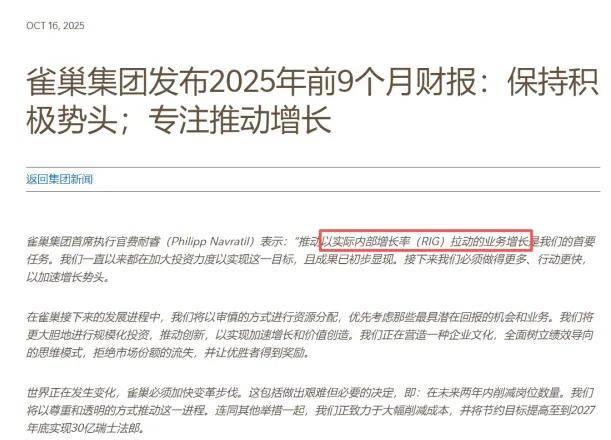
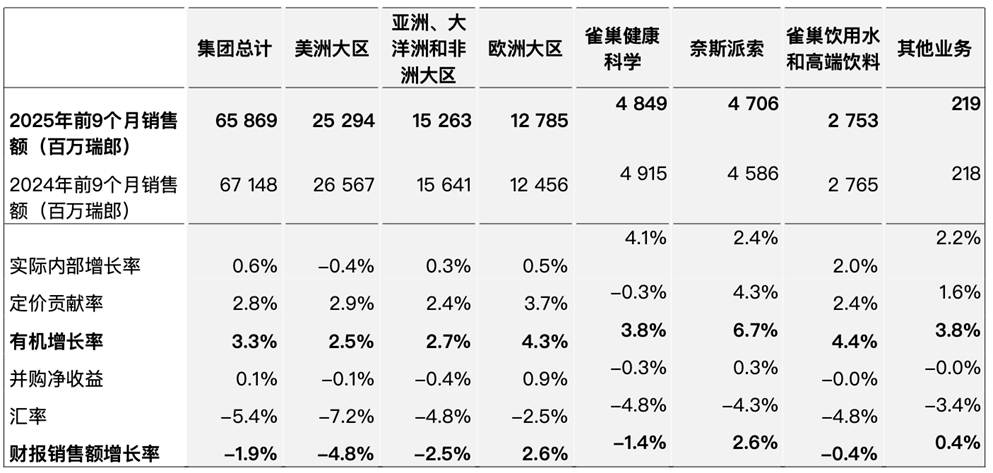
Core Insights - Nestlé reported a total sales of 65.9 billion Swiss francs for the first nine months of 2025, a decline of 1.9% year-on-year, with an organic growth rate of 3.3% and an internal growth rate of 0.6% [2][6] - The company announced a global workforce reduction of approximately 16,000 positions, representing about 6% of its total workforce of 277,000, to enhance operational efficiency and support cost-cutting initiatives [4][5] - The new CEO, Philipp Navratil, emphasized the importance of driving business growth through actual internal growth rates and increasing investments to achieve this goal [2][6] Group 1: Workforce and Cost Management - The workforce reduction includes around 12,000 white-collar jobs and 4,000 positions in manufacturing and supply chain, with the restructuring expected to save 1 billion Swiss francs annually by 2027 [4][5] - The total cost-saving target for the "growth-supporting" initiative has been raised from 2.5 billion to 3 billion Swiss francs [4][5] - The company is focusing on improving operational efficiency through shared services and process automation [4][5] Group 2: Growth Strategy and Financial Performance - Nestlé's organic growth rate improved from 2.0% in the same period last year to 3.3%, with a notable increase in the third quarter reaching 4.3% [6] - The company aims to achieve over 8 billion Swiss francs in free cash flow by 2025, with a commitment to maintaining its long-standing dividend policy [7] - The management team is addressing performance issues in the Greater China region, which negatively impacted overall growth rates [6][7]
雀巢做起“加减法”:拟优化1.6万人,每年省10亿瑞郎投入高增长领域
3 6 Ke· 2025-10-17 00:48
Core Insights - Nestlé's transformation strategy is showing early signs of success, with a focus on internal growth rates driving performance [1][2] - The company reported total sales of 65.9 billion Swiss francs for the first nine months of 2025, a slight decline of 1.9% year-on-year, but an organic growth rate of 3.3%, up from 2.0% in the same period of 2024 [1][2] - The third quarter saw an organic growth rate rise to 4.3%, indicating strong internal growth resilience despite currency fluctuations impacting sales [1][2] Financial Performance - The organic growth of 3.3% in the first three quarters included a 100 basis point contribution from high-growth investments and efficiency improvements [2] - Breakdown of the organic growth rate shows a pricing contribution of 2.8% and an internal growth rate of 0.6%, reflecting a trend in the global consumer goods industry where price increases are the main driver, but sales volumes are beginning to recover [2][4] - The third quarter's performance was particularly strong, with organic growth rising from 2.9% in the first half to 4.3%, and the internal growth rate rebounding to 1.5% [3][4] Regional Performance - All regions contributed positively to organic growth, with Europe showing the strongest performance at a sales growth of 2.6% and an organic growth rate of 4.3% [8][9] - Emerging markets outperformed developed markets, with an organic growth rate of 5.2%, driven primarily by pricing strategies [8][9] Strategic Initiatives - Nestlé has increased its cost-saving target from 2.5 billion to 3 billion Swiss francs, aiming to achieve this by the end of 2027 through optimizing 16,000 positions [7] - The company is focusing on high-potential areas and has launched six major innovation projects in functional foods and smart packaging [7][10] - E-commerce channels showed a robust organic growth rate of 13.2%, indicating successful digital transformation efforts [6][10] Market Outlook - Nestlé maintains its outlook for 2025, expecting organic sales growth to improve compared to 2024, with a basic trading operating profit margin reaching or exceeding 16% [9][10] - The company aims for a free cash flow target exceeding 8 billion Swiss francs by 2025, with growth rates expected to surpass dividend growth from 2026 onwards [10] Stock Market Reaction - Following better-than-expected performance and confidence in the new CEO's organizational changes, Nestlé's stock price surged by 8.2% on October 16, marking the largest single-day increase since 2008 [11]
雀巢计划全球裁员1.6 万人;小米入局短剧丨消费早参
Mei Ri Jing Ji Xin Wen· 2025-10-16 23:32
Group 1: Xiaomi's Short Drama App Launch - Xiaomi has launched an independent short drama app called "Weiguan Short Drama," which offers "ad-free, massive short dramas for free," quickly attracting attention with over 20,000 downloads within two days [2] - The app is developed by Chengdu Share Information Technology Co., Ltd., which is fully owned by Beijing Juai Liao Network Technology Co., Ltd., a subsidiary of Xiaomi Group [2] - Currently, the app is only available for Xiaomi smartphone users and has not been launched on iOS or other brands [2] Group 2: China's Ice and Snow Industry Growth - According to the "China Ice and Snow Industry Development Research Report (2025)," the scale of China's ice and snow industry is expected to exceed 1 trillion yuan, reaching 1,005.3 billion yuan by 2025 [3] - The industry is anticipated to enter a phase of sustained high growth due to the upcoming large-scale ice and snow events, such as the 15th National Winter Games [3] - The report indicates that the industry will benefit from policy support and event-related incentives, although companies need to be cautious about seasonal customer flow and rapid supply expansion [3] Group 3: Growth in Service Consumption During National Day Holiday - During the National Day holiday, the average daily sales revenue of service consumption-related industries in China increased by 7.6% year-on-year, with notable growth in county and rural tourism [4] - The Ministry of Commerce plans to focus on cultivating new growth points in service consumption, innovating diverse consumption scenarios, and continuously optimizing service supply [4] - The positive performance in service consumption is expected to benefit sectors such as hotels, restaurants, online travel agencies (OTAs), and sports operations, with a potential recovery in revenue for the fourth quarter [4] Group 4: Nestlé's Workforce Reduction Plan - Nestlé reported a sales revenue of 65.87 billion Swiss francs for the first nine months of 2025, with an internal growth rate of 0.6% [5] - The company announced a plan to cut approximately 16,000 jobs, equivalent to 6% of its total workforce, as part of its transformation strategy [5] - The market responded positively to Nestlé's latest financial results and restructuring plan, indicating an increased expectation for profit recovery, particularly in high-end, pet care, and coffee businesses [5]
雀巢新老总刚上台,就宣布裁员1.6万人!股东很高兴:股价大涨
Mei Ri Jing Ji Xin Wen· 2025-10-16 22:34
Core Insights - Nestlé plans to cut approximately 16,000 jobs, representing 6% of its total workforce, despite exceeding sales expectations in Q3 [1][3] - The new CEO, Philippe Navratil, aims to accelerate the company's transformation, indicating that difficult decisions, including layoffs, are necessary for adaptation to changing market conditions [1][3] Financial Performance - For the first nine months of the year, Nestlé reported total sales of CHF 65.9 billion, a year-on-year decline of 1.9%, with an organic growth rate of 3.3% [5] - In Q3, the organic growth rate improved to 4.3%, up from 2.9% in the first half of the year, with all major product categories showing improvement [5] - The pricing contribution remained stable at 2.8%, reflecting price increases in the candy and coffee segments [5] Regional Performance - The Greater China region has been a drag on Nestlé's performance, with a Q3 organic growth rate of -10.4% and a nine-month rate of -6.1% [8] - Excluding Greater China, the organic growth rate for the Asia, Oceania, and Africa region was 5.3%, indicating stronger performance in other markets [8] Cost-Saving Initiatives - Nestlé has raised its cost-saving target to CHF 3 billion (approximately USD 3.77 billion) by the end of 2027, up from the previous target of CHF 2.5 billion (USD 3.14 billion) [3] - The company is focusing on reducing excess inventory in the Greater China region and shifting its organizational focus towards demand creation [8] Market Reaction - Following the announcement of the financial results and job cuts, Nestlé's ADR saw an increase of over 9% [9]

Nestle will cut 16,000 jobs to reverse slowed growth as it faces U.S. tariffs
NBC News· 2025-10-16 19:24
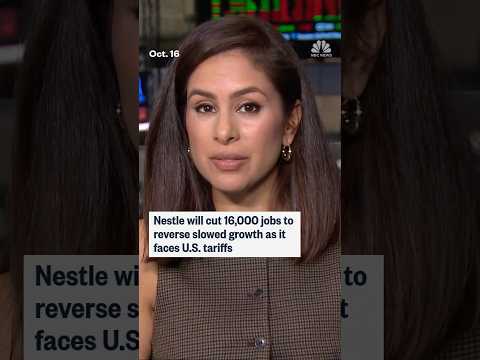
Let's start with Nestle. It's cutting 16,000 jobs or roughly 6% of its workforce. The world's largest package food maker says the move will help it cut costs and win back investor confidence.The Swiss maker of KitKats, Nespresso, Perier is trying to reverse stalling sales growth as it faces US import tariffs. ...
新老总刚上台 就宣布裁员1.6万人 其中包括1.2万个白领!公司股东很高兴:股价应声大涨
Mei Ri Jing Ji Xin Wen· 2025-10-16 16:48
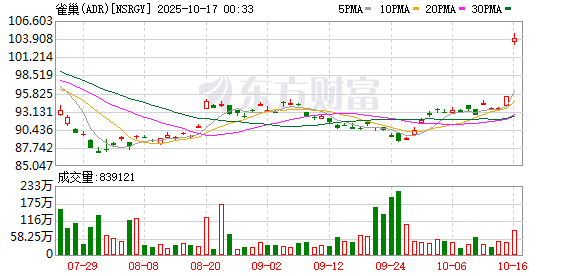
Core Viewpoint - Nestlé plans to cut approximately 16,000 jobs, equivalent to 6% of its total workforce, as part of a strategy to accelerate corporate transformation amid growth pressures, despite exceeding sales expectations in Q3 [2][3][4]. Group 1: Job Cuts and Leadership Changes - The job cuts will affect 12,000 white-collar positions and 4,000 roles in manufacturing and supply chain [3]. - The new CEO, Philippe Naefratil, emphasizes the need for faster changes within the company, stating that difficult but necessary decisions must be made [3]. - Naefratil replaced Laurent Freixe, who was dismissed after a year due to allegations of concealing a relationship with a subordinate [3]. Group 2: Financial Performance - Nestlé's total sales for the first nine months were 65.9 billion Swiss francs, a year-on-year decline of 1.9%, with an organic growth rate of 3.3% [4]. - In Q3, the organic growth rate improved to 4.3%, up from 2.9% in the first half of the year, with all major product categories showing improvement [4]. - The pricing contribution rate remained stable at 2.8%, reflecting price increases in the candy and coffee segments [4]. Group 3: Regional Performance - The Greater China region has been a significant drag on Nestlé's performance, with an organic growth rate of -10.4% in Q3, continuing a downward trend [6]. - Excluding Greater China, the organic growth rate for the Asia, Oceania, and Africa region was 5.3%, indicating stronger performance in other markets [6]. - Nestlé is working to reduce excess inventory in Greater China and refocus its organizational efforts on demand creation [7]. Group 4: Market Reaction - Following the announcement of the better-than-expected financial results and job cuts, Nestlé's ADR rose by over 9% [9].
新老总刚上台,就宣布裁员1.6万人,其中包括1.2万个白领!公司股东很高兴:股价应声大涨
Mei Ri Jing Ji Xin Wen· 2025-10-16 16:40
Core Viewpoint - Nestlé plans to cut approximately 16,000 jobs, representing 6% of its total workforce, as part of a strategy to accelerate corporate transformation amid growth pressures, despite exceeding sales expectations in Q3 [1][2][4]. Group 1: Job Cuts and Corporate Strategy - The job cuts will affect 12,000 white-collar positions and 4,000 roles in manufacturing and supply chain [2]. - New CEO Philippe Naefratil emphasizes the need for Nestlé to adapt more quickly to changing market conditions, stating that difficult but necessary decisions must be made [2][4]. - Nestlé has raised its cost-saving target to 3 billion Swiss francs (approximately 3.77 billion USD) by the end of 2027, up from the previous target of 2.5 billion Swiss francs (approximately 3.14 billion USD) [4]. Group 2: Financial Performance - For the first nine months of the year, Nestlé reported total sales of 65.9 billion Swiss francs, a year-on-year decline of 1.9%, with an organic growth rate of 3.3% [6]. - In Q3, the organic growth rate improved to 4.3%, up from 2.9% in the first half of the year, with all major product categories showing improvement [6]. - The coffee and confectionery segments were the main contributors to organic growth, driven primarily by pricing strategies [6]. Group 3: Regional Performance - The Greater China region has been a drag on Nestlé's performance, with an organic growth rate of -10.4% in Q3, continuing a downward trend [9]. - Excluding Greater China, the organic growth rate for the Asia, Oceania, and Africa region was 5.3%, indicating stronger performance in other markets [9]. - Nestlé is working to reduce excess inventory in Greater China and refocus its organizational efforts on demand creation [9]. Group 4: Market Reaction - Following the announcement of the job cuts and better-than-expected financial results, Nestlé's ADR saw an increase of over 9% [12].