Oracle(ORCL)

Search documents
Oracle (ORCL): HSBC Reaffirms Buy, Sets $382 PT Amid Strong Backlog and Data Center Strategy
Yahoo Finance· 2025-12-03 09:47
Core Viewpoint - Oracle Corporation is recognized as a prominent AI stock on Wall Street, with HSBC maintaining a Buy rating and a price target of $382.00, reflecting confidence in Oracle's execution and backlog visibility while noting challenges in large-scale data center buildouts [1] Group 1: Funding and Infrastructure - Oracle has not yet disclosed its specific funding strategy for upcoming infrastructure projects, despite having significant needs on the horizon [2] - The company is exploring capital-intensive project funding methods such as special purpose vehicles or joint ventures to manage balance sheet risks and leverage debt markets [2] - An example of alternative funding structures is Meta's recent joint venture with Blue Owl Capital, which will issue debt to bond investors [3] Group 2: Competitive Positioning - Oracle has secured over USD 500 billion in Remaining Performance Obligations (RPO), demonstrating strong revenue visibility and commitment to meeting its obligations [3] - The company has been refining its data center model for over a decade to compete effectively against established players like AWS and Azure, showing impressive execution and market share gains [4] - Oracle is dedicated to maintaining its investment grade rating and is open to various funding options to mitigate risks [4]

市场过虑了!法国巴黎银行力挺甲骨文(ORCL.US):AI基建无需增发千亿美元债务
Zhi Tong Cai Jing· 2025-12-03 07:25
Core Viewpoint - The market is concerned about Oracle's potential issuance of up to $100 billion in debt to fund its AI ambitions, but analysts believe the actual amount will be significantly lower, estimated between $25 billion and $35 billion [1][2]. Debt Issuance and Financial Health - Oracle's recent bond issuance of $18 billion is part of its strategy to finance AI infrastructure, with additional debt issuance of $38 billion planned for data centers [3]. - The company's capital expenditure for the current fiscal year is projected at $35 billion, primarily for its cloud business, leading to a negative free cash flow forecast of $9.7 billion [3][4]. - Standard & Poor's has revised Oracle's outlook to "negative" due to anticipated capital expenditures and debt issuance straining its credit status [4]. Market Sentiment and AI Investment - Analysts note that approximately 84% of Oracle's market value is supported by its non-AI business, indicating a limited current valuation for its AI partnerships [2]. - The overall trend in the tech sector shows a record debt issuance of $108 billion among the top five AI spending companies, which is more than three times the average over the past nine years [3]. Investor Concerns and Future Projections - There is growing concern among investors regarding the sustainability of high capital expenditures without corresponding cash flow, particularly as Oracle's cash reserves may be depleted by November 2026 [4][6]. - The anticipated increase in AI capital expenditures to $600 billion by 2027 raises questions about the ability of the bond market to absorb this surge in supply [6][7].

12月全球富豪榜大洗牌:第二名易主,AI 股神佩奇登顶!
Sou Hu Cai Jing· 2025-12-03 05:11
Core Insights - The global billionaire rankings have shifted significantly due to the surge in Alphabet's stock price and the decline in Oracle's stock price [1] Group 1: Wealth Changes Among Billionaires - Larry Page's net worth increased by $30 billion to $262 billion, driven by a 14% rise in Alphabet's stock following the release of the Gemini 3 model [25][26] - Larry Ellison's net worth decreased by $67 billion to $195 billion due to a 23% drop in Oracle's stock, causing him to fall from second to fourth place on the billionaire list [25][26] - Sergey Brin's wealth rose by $27 billion to $242 billion, allowing him to move up to fifth place [29] Group 2: Market Dynamics - The performance of tech giants is a key driver of the billionaire rankings, with confidence in AI's commercial potential boosting the tech sector [28][26] - Oracle faces intense competition in the cloud services sector, and recent disappointing earnings reports have led to investor sell-offs [31][26] - The resilience of the semiconductor industry is highlighted by Jensen Huang's net worth, which remains strong despite a slight decline [33]


Oracle Stock: Ignoring The Market Noise And Buy The Dip Going Into Earnings (NYSE:ORCL)
Seeking Alpha· 2025-12-03 04:48
Oracle Corporation ( ORCL )( ORAC:CA ) has been making headlines in recent weeks for all the wrong reasons. With a mounting debt load to be used to finance major data center developments, investors have begun to question theMonte Independent Investment Research: Michael Del Monte is a buy-side equity analyst with expertise in the technology, energy, industrials, and materials sectors. Prior to working in the investment management industry, Michael spent over a decade in professional services working across ...

Oracle: Ignore The Market Noise And Buy The Dip Going Into Earnings
Seeking Alpha· 2025-12-03 04:48
Core Viewpoint - Oracle Corporation is facing scrutiny from investors due to its increasing debt levels associated with financing significant data center developments [1] Group 1: Company Overview - Oracle Corporation (ORCL) has been in the news recently for negative reasons, primarily related to its financial strategies [1] Group 2: Financial Concerns - The company is accumulating a substantial debt load to support its major data center projects, raising concerns among investors about its financial health [1]

AI泡沫担忧加剧,甲骨文债务恐慌指标创2009年以来新高
Hua Er Jie Jian Wen· 2025-12-03 01:45
Core Viewpoint - Concerns about an AI bubble are escalating in the credit market, highlighted by Oracle's credit default swap (CDS) costs reaching their highest level since the 2009 financial crisis, indicating investor anxiety over the imbalance between massive AI investments and expected returns [1][3]. Group 1: Credit Market Indicators - Oracle's CDS prices rose to approximately 1.28% at the close in New York, marking the highest level since March 2009, and have more than doubled from a low of 0.36% in June [1][3]. - The surge in CDS prices reflects market worries about the vast capital expenditures in the AI sector, with Oracle having issued hundreds of billions in bonds recently, making its CDS a key tool for investors hedging against potential AI downturns [3][4]. Group 2: Debt Levels and Market Sentiment - Oracle is the lowest-rated among major cloud service providers, with a total debt of approximately $105 billion as of the end of August, including $95 billion in dollar bonds that are part of the Bloomberg U.S. Corporate Bond Index [4]. - The trading volume of Oracle's CDS has surged to about $5 billion over seven weeks, compared to just over $200 million in the same period last year, indicating heightened investor interest in hedging against its debt [4]. Group 3: Historical Context and Future Projections - The rising cost of default protection signals investor anxiety about the timing gap between massive AI investments and productivity gains or profit growth [5]. - Predictions suggest that the spending spree on AI infrastructure and power capacity will continue into next year, with U.S. investment-grade bond issuance expected to reach a record $2.1 trillion by 2026, having already surpassed $1.57 trillion this year [6]. Group 4: Supply and Demand Dynamics in Credit Markets - A new wave of large-scale bond issuance may overwhelm buyers, leading companies to offer higher yields to attract investors, with spreads expected to reach 100 to 110 basis points above benchmark rates next year [7]. - Historical precedents exist where industries have leveraged significantly without disastrous outcomes, but concerns remain about the credit quality of debt investments as companies continue to invest heavily in AI [7].
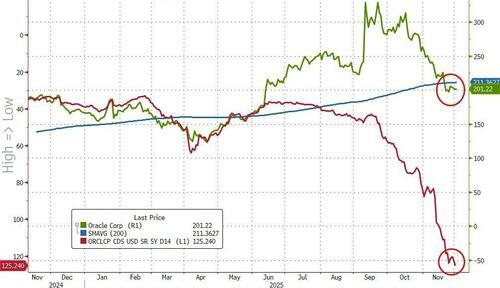
AI泡沫担忧持续 甲骨文信用风险指标创2009年以来新高
Jin Rong Jie· 2025-12-03 00:07
Core Viewpoint - The rising debt default risk indicators for Oracle Corporation reflect investor concerns about an artificial intelligence bubble, exacerbated by significant bond issuance by tech giants [1] Group 1: Debt Default Risk Indicators - The five-year credit default swap (CDS) for Oracle has risen to approximately 128.1 basis points, the highest level since March 2009 [1] - The CDS increased nearly 3 basis points in a single day and has more than doubled from a low of 36 basis points in June of this year [1] Group 2: Market Concerns - Oracle has issued hundreds of billions of dollars in debt in recent months, both in its own name and for supported projects [1] - The surge in CDS costs indicates deep market concerns about the disconnect between massive capital investments in AI and the actual returns [1] Group 3: Analyst Warnings - Analysts, such as Hans Mikkelsen from TD Securities, warn that the current market exuberance resembles previous market frenzies, which often lead to unsustainable asset price increases followed by declines [1] - Mikkelsen notes that while he cannot definitively prove the current situation is identical to the internet bubble, the similarities are striking [1]
甲骨文五年期信用违约掉期创2009年以来收盘新高
Mei Ri Jing Ji Xin Wen· 2025-12-02 22:41
每经AI快讯,12月3日,甲骨文五年期信用违约掉期创2009年以来收盘新高。 ...
美股三大指数集体收涨,大型科技股多数上涨,英特尔涨超8%
Mei Ri Jing Ji Xin Wen· 2025-12-02 21:14
Core Viewpoint - The U.S. stock market experienced a collective rise on December 3, with major indices showing positive performance, indicating a favorable market sentiment [1] Group 1: Market Performance - The Dow Jones Industrial Average increased by 0.39% [1] - The Nasdaq Composite rose by 0.59% [1] - The S&P 500 index saw a gain of 0.25% [1] Group 2: Technology Sector - Most large-cap technology stocks experienced gains, with Intel rising over 8% [1] - Apple, Meta, and Qualcomm each increased by more than 1% [1] - Amazon, NVIDIA, Microsoft, and Netflix saw slight increases [1] - AMD declined by over 2% [1] - Broadcom fell by more than 1% [1] - Tesla and Oracle experienced minor declines [1]


November Selling Sets Floor for Stronger December, Japan's Bond Opportunity
Youtube· 2025-12-02 17:01
Core Insights - The current landscape of fixed income, particularly U.S. Treasury yields, is influenced by global dynamics, especially Japan's bond market, which has seen rising yields that could divert investor demand from U.S. Treasuries [2][4][6] - The expectation is that the U.S. 10-year Treasury yield will remain around 4% in the near term, even as the Federal Reserve is anticipated to cut rates over the next year [3][6] - The upcoming FOMC meeting is expected to result in a 25 basis point rate cut, which could set a favorable environment for a year-end stock market rally [7][15] Fixed Income Market - Japan has increased its Treasury purchases but has not kept pace with the rising supply of U.S. Treasuries, leading to a declining influence on the broader market [5][6] - The 2-year and 10-year Japanese Government Bonds (JGBs) are at 17-year highs, indicating a significant shift in the bond market landscape [6] Stock Market Outlook - November and December are typically bullish months for stocks, and a recent 7% pullback in the NASDAQ may set the stage for a positive December [7][8] - Technical indicators show that major indices are above their 50-day moving averages, suggesting a bullish trend [10] Cryptocurrency Insights - Bitcoin's recent rebound is seen as a positive sign, with a need to maintain levels above $80,000 for stability [9] Economic Indicators - The Atlanta Fed's GDP estimate is at 3.9%, indicating healthy economic growth, while consumer behavior during Black Friday and Cyber Monday sales appears robust despite poor consumer sentiment [13] Federal Reserve Dynamics - The Fed is expected to cut rates next week, aligning with market expectations, but future policy paths remain uncertain due to diverging views among Fed officials [15][16] - Potential changes in Fed leadership could lead to increased volatility and more dissenting opinions within the committee [17][18]