甲骨文云基础设施

Search documents
500亿美元,甲骨文再加码AI
3 6 Ke· 2026-02-03 02:37
Core Viewpoint - Oracle plans to raise $45 billion to $50 billion by 2026 through bond and stock issuance to expand its cloud infrastructure capacity, driven by demand from major clients like AMD, Meta, NVIDIA, OpenAI, TikTok, and xAI [1] Group 1: Funding Plans - Oracle aims to raise approximately half of the funds through equity-linked securities and common stock, including mandatory convertible preferred stock, and a stock issuance plan of up to $20 billion [1] - The remaining funds will be raised through a bond issuance planned for early 2026, following a significant $18 billion debt issuance in 2025 [1] - The transactions have been approved by Oracle's board, with Goldman Sachs leading the senior unsecured bond issuance and Citigroup managing the stock and preferred securities issuance [1] Group 2: Investor Concerns - Investors are increasingly worried about the return on investment from Oracle's large-scale AI-related expenditures, particularly due to OpenAI's commitment to spend approximately $300 billion on server rentals without current profitability [2] - Oracle's stock price has dropped over 50% since its record high on September 10, resulting in a market capitalization loss of over $460 billion [3] - Concerns have been raised about Oracle's ability to finance its expansion plans, with TD Cowen estimating a capital expenditure burden of $156 billion from the OpenAI deal, leading to an increase in expected capital expenditures for 2026 to $50 billion [3][4] Group 3: Financing Challenges - TD Cowen noted that several U.S. banks have ceased lending to Oracle's data center projects, indicating a tightening of financing options for the company [4]

三大股指期货跌幅显著收窄,特朗普豪掷120亿美元启动“金库计划”
Zhi Tong Cai Jing· 2026-02-02 13:29
Market Overview - US stock index futures showed a significant narrowing of declines, with Dow futures down 0.09%, S&P 500 futures down 0.38%, and Nasdaq futures down 0.66% as of the report [1] - European indices performed positively, with Germany's DAX up 0.91%, UK's FTSE 100 up 0.64%, France's CAC40 up 0.60%, and the Euro Stoxx 50 up 0.47% [2][3] - WTI crude oil fell by 4.75% to $62.11 per barrel, while Brent crude oil dropped by 4.52% to $66.19 per barrel [3][4] Key Corporate Developments - Disney reported Q1 revenue and profit exceeding expectations, driven by strong performance in its theme park business, achieving $26 billion in revenue, a 5% year-over-year increase, and a pre-tax profit of $3.7 billion [10] - Tyson Foods also exceeded revenue expectations in Q1, reporting $14.31 billion, a 5.1% year-over-year increase, with adjusted EPS of $0.97, surpassing analyst expectations [10] - Tesla announced the upcoming launch of its third-generation humanoid robot, aiming for an annual production capacity of 1 million units by the end of 2026, although its stock was down 1.64% in pre-market trading [11] - Oracle plans to raise $45 to $50 billion to expand its cloud infrastructure, indicating strong demand from major clients like AMD and Meta [11] - Apple faces supply chain challenges as AI companies aggressively purchase key components, impacting its profit margins and leading to increased costs for chips and storage [12] - Boeing is under scrutiny from the FAA, which stated that the company must take further actions to regain its certification rights, despite having made significant progress [13] Upcoming Economic Data and Events - Key economic data releases include the final January SPGI Manufacturing PMI at 22:45 Beijing time and the January ISM Manufacturing PMI at 23:00 [14][15] - Notable earnings reports are expected from Palantir, NXP, and Teradyne on Tuesday morning, with PepsiCo and Pfizer reporting before the market opens [17]


美股前瞻 | 三大股指期货跌幅显著收窄,特朗普豪掷120亿美元启动“金库计划”
Zhi Tong Cai Jing· 2026-02-02 13:26
Market Overview - US stock index futures showed a significant narrowing of declines, with Dow futures down 0.09%, S&P 500 futures down 0.38%, and Nasdaq futures down 0.66% as of the report [1] - European indices performed positively, with Germany's DAX up 0.91%, UK's FTSE 100 up 0.64%, France's CAC 40 up 0.60%, and the Euro Stoxx 50 up 0.47% [2] - WTI crude oil fell by 4.75% to $62.11 per barrel, while Brent crude oil dropped by 4.52% to $66.19 per barrel [3] Strategic Developments - The US government is launching a strategic critical mineral reserve initiative, with President Trump allocating $12 billion to the "Treasury Project" aimed at reducing dependence on Chinese rare earths and other metals. This plan combines $1.67 billion in private capital with $10 billion in loans from the Export-Import Bank of the United States [4] Economic Focus - The upcoming week will focus on the US non-farm payroll report, with additional attention on manufacturing and service sector data, as well as the University of Michigan's consumer sentiment index. Major tech companies, including Google and Amazon, are set to report earnings [5] Commodity Volatility - Gold prices have experienced unprecedented volatility, surpassing that of Bitcoin, with Wall Street maintaining a bullish long-term outlook for gold, predicting prices could reach $6,000 by the end of 2026 [6] Currency Movements - Following the nomination of Kevin Walsh as the next Federal Reserve Chair, the dollar saw its largest increase since May, despite asset managers increasing their bearish positions on the dollar [7] Market Sentiment - Wedbush warns that under Walsh's leadership, liquidity benefits may end, leading to potential turbulence in the US stock market in the coming months [8] Company Earnings - Disney reported Q1 revenue of $26 billion, exceeding analyst expectations, driven by strong performance in its theme park business [9] - Tyson Foods posted Q1 revenue of $14.31 billion, surpassing Wall Street's forecast, aided by robust chicken demand [9] - Tesla announced the upcoming launch of its third-generation humanoid robot, aiming for a production capacity of 1 million units annually by the end of 2026 [10] - Oracle plans to raise $45 to $50 billion to expand its cloud infrastructure, targeting major clients like AMD and Meta [10] - Apple faces challenges as AI companies increasingly dominate the supply chain for critical components, impacting its profit margins [11] - Boeing is under scrutiny from the FAA, which states that the company must take further actions to regain its certification rights [12] Upcoming Economic Data - Key economic data releases include the final manufacturing PMI for January and the ISM manufacturing PMI, along with speeches from Federal Reserve officials [13][14]


云业务投资不能停!甲骨文今年将融资500亿美元
硬AI· 2026-02-02 11:24
Core Viewpoint - Oracle plans to raise up to $50 billion by 2026 through bond and equity financing to expand its cloud infrastructure to meet the demands of major clients like AMD, Meta, NVIDIA, OpenAI, TikTok, and xAI [1][2][6]. Financing Plan Details - The financing will involve raising approximately $22.5 billion to $25 billion through equity-related instruments and common stock issuance, including mandatory convertible preferred securities and a market equity program with a maximum size of $20 billion [5]. - The remaining funds will be raised through the bond market, with a planned single bond issuance of about $22.5 billion to $25 billion in early 2026 [5]. Debt Concerns - Oracle currently has approximately $95 billion in outstanding debt, making it one of the largest corporate bond issuers outside the financial sector [2][8]. - The company's aggressive investment strategy to transition from a traditional database software provider to a cloud infrastructure provider has led to significant debt accumulation [8]. Market Position and Criticism - Michael Burry, a well-known short seller, has criticized Oracle for its "unnecessary heavy asset expansion" and fragile financial structure, labeling it as a "pure AI bubble vehicle" [3][10]. - Burry's concerns highlight that Oracle's stock price is heavily reliant on the narrative of surging AI cloud service demand, which poses a risk if such demand does not materialize [11].

云业务投资不能停!甲骨文今年将融资500亿美元
Hua Er Jie Jian Wen· 2026-02-02 01:12
Core Viewpoint - Oracle plans to raise up to $50 billion by 2026 through bond and equity financing to expand its cloud infrastructure to meet the demands of major clients, amidst concerns regarding its debt burden and heavy asset transformation strategy [1][4]. Group 1: Financing Plan Details - Oracle intends to raise approximately $22.5 billion to $25 billion through equity-related instruments and common stock issuance, including mandatory convertible preferred securities and a market equity program of up to $20 billion [2]. - The remaining funds will be sourced from the bond market, with a planned single bond issuance in early 2026, estimated at $22.5 billion to $25 billion [2]. Group 2: Client Contracts and Market Position - The funds will specifically be used to expand cloud infrastructure capacity to fulfill contracts with major clients, including key players in the AI industry such as AMD, Nvidia, OpenAI, TikTok, and Meta [3]. Group 3: Debt Concerns and Market Criticism - Oracle currently has approximately $95 billion in outstanding debt, making it one of the largest corporate bond issuers outside the financial sector, raising concerns about its financial sustainability [4]. - Critics, including notable short-seller Michael Burry, have expressed concerns over Oracle's aggressive asset expansion and fragile financial structure, labeling it as a "pure AI bubble vehicle" [4][5]. - Burry argues that Oracle's high-risk transformation under heavy debt could lead to significant vulnerabilities if AI demand does not meet expectations, contrasting it with tech giants like Microsoft and Google that have stronger financial cushions [5][6].
甲骨文今年将筹集至多500亿美元用于云投资
Xin Lang Cai Jing· 2026-02-01 23:26
Core Viewpoint - Oracle plans to raise between $45 billion to $50 billion by 2026 through a combination of bond and stock issuance to expand its cloud infrastructure capacity [1] Funding Strategy - The company aims to raise half of the funds through equity-linked securities, common stock (including mandatory convertible preferred stock), and a market-based stock issuance plan of up to $20 billion [1] - The remaining funds will be raised through a one-time bond issuance planned for early 2026 [1] Client Demand - The fundraising is intended to meet the contractual needs of Oracle's core cloud infrastructure clients, which include AMD, Meta, NVIDIA, OpenAI, TikTok, and xAI [1]
华尔街分析师看涨甲骨文
Guo Ji Jin Rong Bao· 2026-01-21 12:30
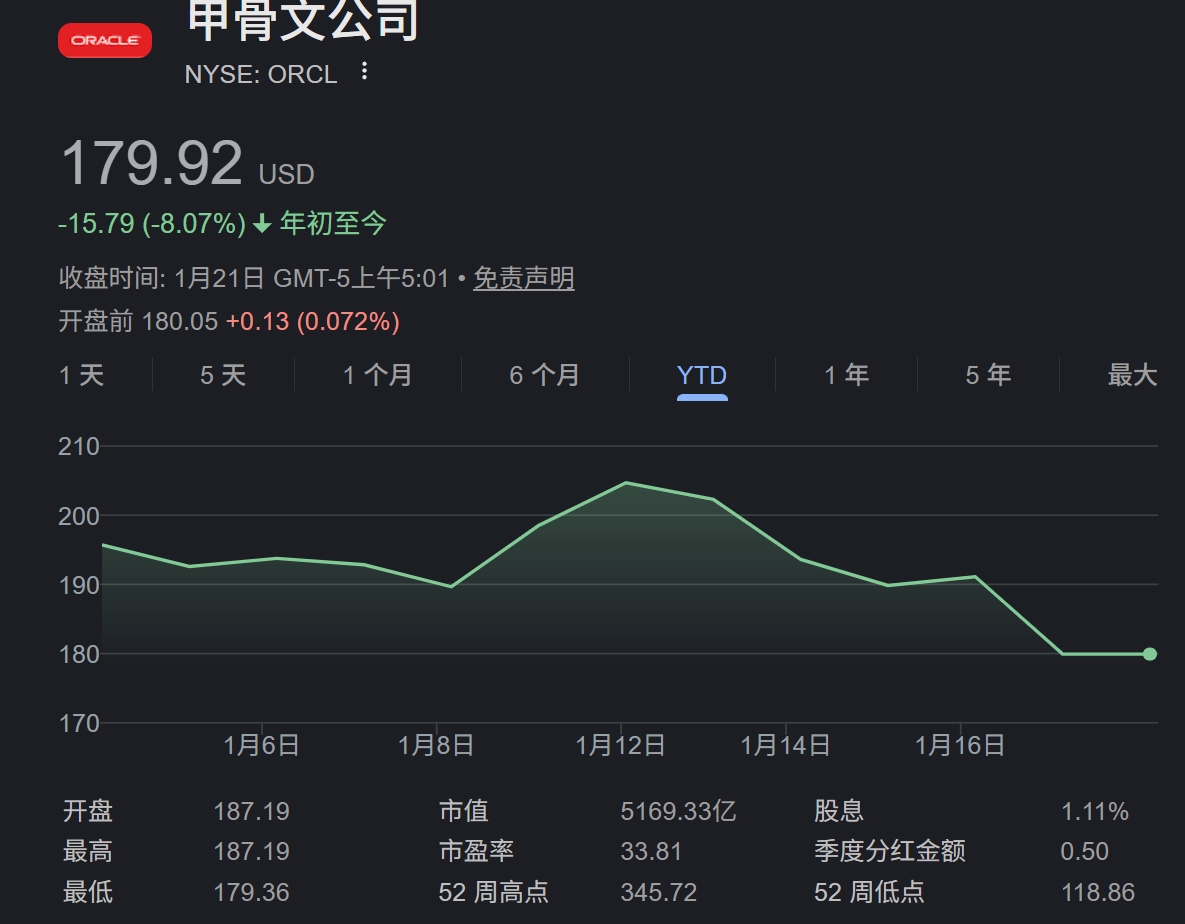
Core Viewpoint - Oracle's stock has experienced a significant decline, dropping approximately 6% to $183.10, with a total market value decrease of nearly $400 billion over the past four months, raising concerns about its debt capacity and credit rating expectations [1][3] Group 1: Stock Performance and Market Sentiment - Oracle's stock price fell to $183.10, continuing a downward trend with a market value decline of nearly $400 billion [1] - Investors are currently cautious about Oracle's stock due to concerns regarding its debt repayment ability and poor credit rating outlook [1] Group 2: Analyst Recommendations - Guggenheim Securities has listed Oracle as a "top pick" for 2026, maintaining a "buy" rating with a target price of $400, which is more than double the current stock price [3] - Analysts believe that concerns over Oracle's debt repayment capacity and reliance on OpenAI are exaggerated, potentially overshadowing its long-term growth potential [3] Group 3: Financial Projections and Revenue Growth - Guggenheim analyst John DiFucci predicts Oracle's revenue will grow from $67 billion in 2026 to $228 billion by fiscal year 2030, representing nearly a fourfold increase [3] - DiFucci emphasizes that Oracle is a rare "ten-year hold" stock for long-term investors, currently in its early growth phase [3][6] Group 4: AI Infrastructure and Investment Needs - Oracle is becoming a leading supplier of AI infrastructure, with profits expected to grow at an "ultra-fast rate" and generate strong free cash flow [4] - To achieve its revenue targets, Oracle may need to invest $292 billion in AI infrastructure, raising concerns about its asset condition; however, DiFucci suggests that actual cash investment may be limited to $100 billion due to its "self-owned chip" model [4] Group 5: Profit Margins and Cost Savings - The "self-owned chip" collaboration model is expected to enhance gross margins by 15% to 25%, reaching approximately 50% to 60%, with cost savings projected to increase earnings per share by $0.5 to $0.8 [4] - DiFucci addresses concerns regarding Oracle's revenue concentration from OpenAI, asserting that this validates Oracle's technical strength and solidifies its position as a core infrastructure provider in the AI economy [4] Group 6: Payment Methods and Future Outlook - OpenAI may utilize various methods to fulfill its payment obligations to Oracle, including large-scale financing, potential IPOs, or partnerships with firms like SoftBank to cover chip costs [5] - DiFucci concludes that this presents a good opportunity for long-term investors, maintaining Oracle as a "ten-year target" with financial data expected to be validated within a reasonable timeframe [6]
甲骨文的“逆袭剧本”:AI巨头的下一个十年,股价翻倍不是梦?
Jin Shi Shu Ju· 2026-01-21 05:44
Core Viewpoint - Investors have been cautious about Oracle Corporation (ORCL.O) stock due to concerns over potential rapid capital expenditure growth and the risk of losing investment-grade credit rating, leading to a nearly 50% drop since September peak. However, Guggenheim Securities analyst John DiFucci views Oracle as a rare "ten-year stock" with significant long-term return potential, projecting strong growth in AI infrastructure and free cash flow [1][2]. Group 1 - DiFucci has listed Oracle as his "best investment pick" for 2026, reiterating a "buy" rating with a target price of $400, more than double the current price of $179.92 [1]. - Oracle's revenue is expected to nearly quadruple over the next five years, from an estimated $67 billion in fiscal 2026 to $228 billion in fiscal 2030 [1]. - To achieve this revenue target, Oracle needs to invest $292 billion in AI infrastructure, raising concerns about potential loss of investment-grade rating [2]. Group 2 - DiFucci believes that due to Oracle's "bring your own chip" model, actual cash expenditure may be limited to $100 billion, significantly reducing costs [2]. - The arrangement could increase gross margins by 15 to 25 percentage points, reaching approximately 50% to 60%, potentially adding $0.50 to $0.80 to earnings per share [2]. - Concerns regarding Oracle's relationship with OpenAI are addressed, with estimates suggesting OpenAI accounts for 60% of Oracle's remaining performance obligations, equating to $315 billion in future business [2][3]. Group 3 - Despite high revenue concentration from OpenAI, DiFucci believes this validates Oracle's technological strength and solidifies its position as a core infrastructure provider in the AI economy [3]. - Revenue related to OpenAI is expected to grow rapidly, from an estimated $3.6 billion in fiscal 2026 to $62.4 billion in fiscal 2030 [3]. - DiFucci suggests that OpenAI has various ways to fulfill its financial commitments to Oracle, including large-scale financing or potential IPOs [3].
甲骨文百亿项目融资突然「告吹」,美国AI泡沫恐慌来袭?
Xin Lang Ke Ji· 2025-12-19 01:29
Core Viewpoint - Oracle's $10 billion data center project in Michigan has lost funding support from Blue Owl Capital, raising concerns about the AI bubble and leading to a nearly 45% drop in Oracle's stock price since its peak in early September [1][2]. Group 1: Project Financing and Market Reaction - The withdrawal of Blue Owl Capital is seen as a significant setback for Oracle, with the news amplifying market fears regarding the sustainability of AI investments [2][15]. - Oracle's stock price surged from approximately $122 on April 21 to over $320 in early September, but has since retraced all gains as investors shift focus from growth narratives to the costs of realizing those promises [8][9]. - Concerns have emerged regarding the reliability of OpenAI's commitments to Oracle, with analysts questioning whether OpenAI will fulfill its $300 billion power purchase agreement [17][18]. Group 2: Financial Performance and Analyst Concerns - Jim Chanos, a prominent short-seller, criticized Oracle's rapid asset expansion, indicating that the company's return on new capital investments is only about 8.5%, compared to Microsoft's nearly 40% [11]. - Analysts have pressed Oracle's management for clarity on AI investment costs, but the company has not provided definitive answers, leading to further skepticism [12]. - The market is reevaluating which companies can sustain prolonged delays in returns, especially as Oracle's traditional cash flow model is disrupted by heavy AI investments [22]. Group 3: Competitive Landscape and Strategic Positioning - OpenAI's partnerships with Microsoft and Amazon indicate a diversification of its computing resources, potentially diminishing Oracle's role in OpenAI's ecosystem [19]. - The competitive landscape is shifting, with Google and other well-capitalized firms accelerating their AI initiatives, raising questions about OpenAI's ability to maintain its lead [20]. - Oracle's heavy investment in AI infrastructure contrasts with its previous reliance on predictable cash flows from traditional software, making it more vulnerable to market fluctuations [22].
财报前夕甲骨文CDS创历史新高,3000亿美元豪赌OpenAI引发债市恐慌
Hua Er Jie Jian Wen· 2025-12-10 06:34
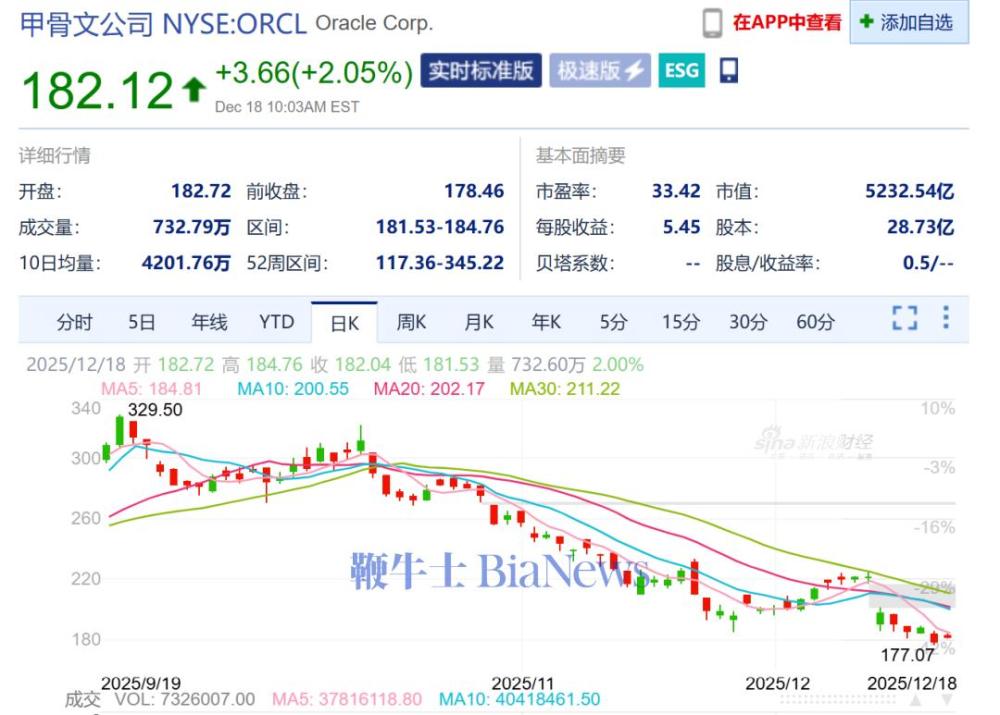
Core Viewpoint - Oracle is set to release its Q2 financial report, with market focus on its debt-driven AI infrastructure expansion and heavy reliance on OpenAI, amid rising concerns over the AI bubble [1] Group 1: Financial Performance and Market Reaction - Oracle's stock price surged 36% after announcing a backlog of contracts with OpenAI but has since retraced all gains and is testing the 200-day moving average, with a 23% decline in October marking its worst monthly performance since 2001 [1] - Despite a year-to-date increase of over 30%, the company's five-year credit default swap (CDS) prices have soared to historical highs, indicating heightened investor concern over AI-related credit risks [1] Group 2: Debt and Financing Challenges - Oracle has become the largest investment-grade bond issuer among non-financial companies, raising $18 billion in September alone, with analysts estimating a need to raise $20-30 billion in debt annually over the next three years [3] - The company's total debt has increased from $84.5 billion a year ago to $111.6 billion, while cash and equivalents have slightly decreased from $10.6 billion to $10.45 billion [4] - Various financing options are being considered by Oracle, including off-balance-sheet financing, bond issuance, equity financing, and potential involvement from sovereign wealth funds [4] Group 3: Dependency on OpenAI and Associated Risks - A significant portion of Oracle's capital expenditures is tied to data centers related to OpenAI, raising concerns about the sustainability of revenue from a single client [5] - Analysts highlight that the $300 billion contract with OpenAI exposes Oracle to unprecedented revenue risk from a single customer, with potential implications if OpenAI fails to meet its financial commitments [5] Group 4: Growth Expectations and Market Sentiment - Analysts maintain an optimistic outlook for Oracle's performance, with expectations of a 15.3% revenue growth in Q2, reaching $16.21 billion, marking the fastest growth in over two years [3] - Oracle's cloud infrastructure revenue is projected to surge by 71.3% during the September-November period, surpassing the previous quarter's growth rate of 55% [6] - The remaining performance obligations are expected to exceed $500 billion, reflecting a 359% year-over-year increase, although the stock has since retraced its gains [6]