Oracle(ORCL)

Search documents
Rosen Law Firm Urges Oracle Corporation (NYSE: ORCL) Investors to Contact the Firm for Information About Their Rights
Businesswire· 2026-01-21 22:17
Core Viewpoint - Rosen Law Firm has initiated a class action lawsuit against Oracle Corporation, alleging that the company misled investors regarding its business operations and financial needs related to AI infrastructure [1][2]. Group 1: Allegations - The lawsuit claims that the Offering Documents contained false or misleading statements and failed to disclose that Oracle would need significant additional debt to develop its AI infrastructure [3]. - It is alleged that Oracle was already organizing to raise this additional debt, which could jeopardize the creditworthiness of the bonds issued [3]. Group 2: Legal Representation - Investors may be eligible to participate in the class action against Oracle Corporation, with representation provided on a contingency fee basis, meaning shareholders incur no fees or expenses [4]. Group 3: About Rosen Law Firm - Rosen Law Firm is recognized for its commitment to shareholder rights litigation, having recovered over $1 billion for shareholders since its inception [5].

My AI Is Smarter Than Your AI
Etftrends· 2026-01-21 18:42
Group 1: AI Impact on Economy and Capital Markets - Artificial Intelligence (AI) presents both significant opportunities and threats to the economy and capital markets, with the potential to enhance productivity and create new industries while also posing risks of labor displacement [2][6][8] - In 2025, AI-related companies like NVIDIA, Palantir, and Alphabet saw substantial stock gains, indicating strong market interest and investment in AI technologies [4][12] - AI's ability to automate tasks and improve efficiency could lead to a productivity boost, which is crucial for economic growth, especially in aging economies [6][7] Group 2: Market Valuations and Concentration - The S&P 500 Index shows a high concentration, with the top ten companies accounting for nearly 40% of the index, raising concerns about overvaluation and lack of diversification for investors [11][12][13] - The average price-to-earnings (P/E) ratio for the top ten S&P 500 companies is significantly higher than historical averages, suggesting that these stocks may be overvalued [12][15] - Elevated valuations could lead to lower future returns, as higher purchase prices for earnings result in diminished return on investment [15] Group 3: Financing and Investment Risks - AI companies are engaging in vendor financing arrangements, creating a feedback loop where investments are made based on projected growth, which raises concerns about sustainability and profitability [16][17] - The reliance on private credit markets for financing AI initiatives has increased, with many companies borrowing significant amounts, which could lead to risks if these companies fail to generate expected revenues [18][19] - The mismatch between the rapid evolution of technology and the long-term nature of private credit loans poses additional risks, as companies may struggle to keep up with advancements while repaying older debts [20][21] Group 4: Global Investment Opportunities - Despite concerns in the US market, there are attractive investment opportunities in undervalued assets globally, particularly in emerging markets and specific sectors like technology and healthcare [24][25] - Emerging markets are benefiting from positive demographics and structural growth, making them compelling investment options compared to developed markets [25] - The potential for a weaker dollar could further enhance the attractiveness of non-US investments, providing a hedge against domestic economic challenges [24]






Is Oracle's Multicloud AI Strategy Powering Sustainable Growth?
ZACKS· 2026-01-21 18:06
Core Insights - Oracle's multicloud AI strategy is fostering sustainable growth by enhancing AI adoption beyond its cloud ecosystem and integrating more deeply into enterprise AI workflows [1] Multicloud Strategy - Oracle is establishing itself as a cloud-neutral AI and data layer, allowing customers to operate Oracle databases and AI workloads across AWS, Azure, and Google Cloud, which is expected to support multicloud momentum and reduce single-vendor dependency [2] - In the second quarter of fiscal 2026, multicloud database consumption increased by 817% year over year, indicating a significant rise in enterprise adoption [2] New Initiatives - Oracle launched two key multicloud initiatives in the fiscal second quarter: Multicloud Universal Credits for consistent pricing across any cloud and a reseller program for purchasing through preferred partners, which simplifies deployment and enhances customer retention [3] Revenue Visibility - The sustainability of Oracle's multicloud approach is bolstered by increasing long-term contract commitments, providing clearer visibility into future demand and reinforcing confidence in ongoing cloud expansion [4] - Cloud revenues account for approximately 50% of total revenues, with rising Remaining Performance Obligations (RPOs) indicating improved multi-year revenue visibility [4] Revenue Growth Projections - The Zacks Consensus Estimate anticipates total revenues to grow by 16.7% in fiscal 2026 and 27.5% in fiscal 2027, reflecting the positive impact of Oracle's multicloud AI strategy on top-line growth [5] Competitive Landscape - Amazon (AMZN) maintains a significant advantage over Oracle in cloud strategy, with AWS experiencing around 20% growth and a $132 billion run rate, supported by a $200 billion backlog [6] - Microsoft (MSFT) is a strong competitor, with Azure achieving about 40% growth and Microsoft Cloud revenues increasing by 26%, benefiting from a rich data ecosystem and partnerships [7] Stock Performance and Valuation - Oracle's shares have declined by 34% over the past three months, underperforming the Zacks Computer and Technology sector's growth of 4.2% and the Zacks Computer - Software industry's decline of 14.1% [8] - Currently, Oracle's stock trades at a forward Price/Earnings ratio of 22.81x, lower than the industry average of 26.77x, indicating potential valuation opportunities [12] - The Zacks Consensus Estimate for Oracle's fiscal 2026 earnings is projected at $7.42 per share, reflecting a 23.05% growth compared to fiscal 2025 [15]

甲骨文公司股价跌至逾七个月以来的低点,最新下跌2.2%
Mei Ri Jing Ji Xin Wen· 2026-01-21 14:59
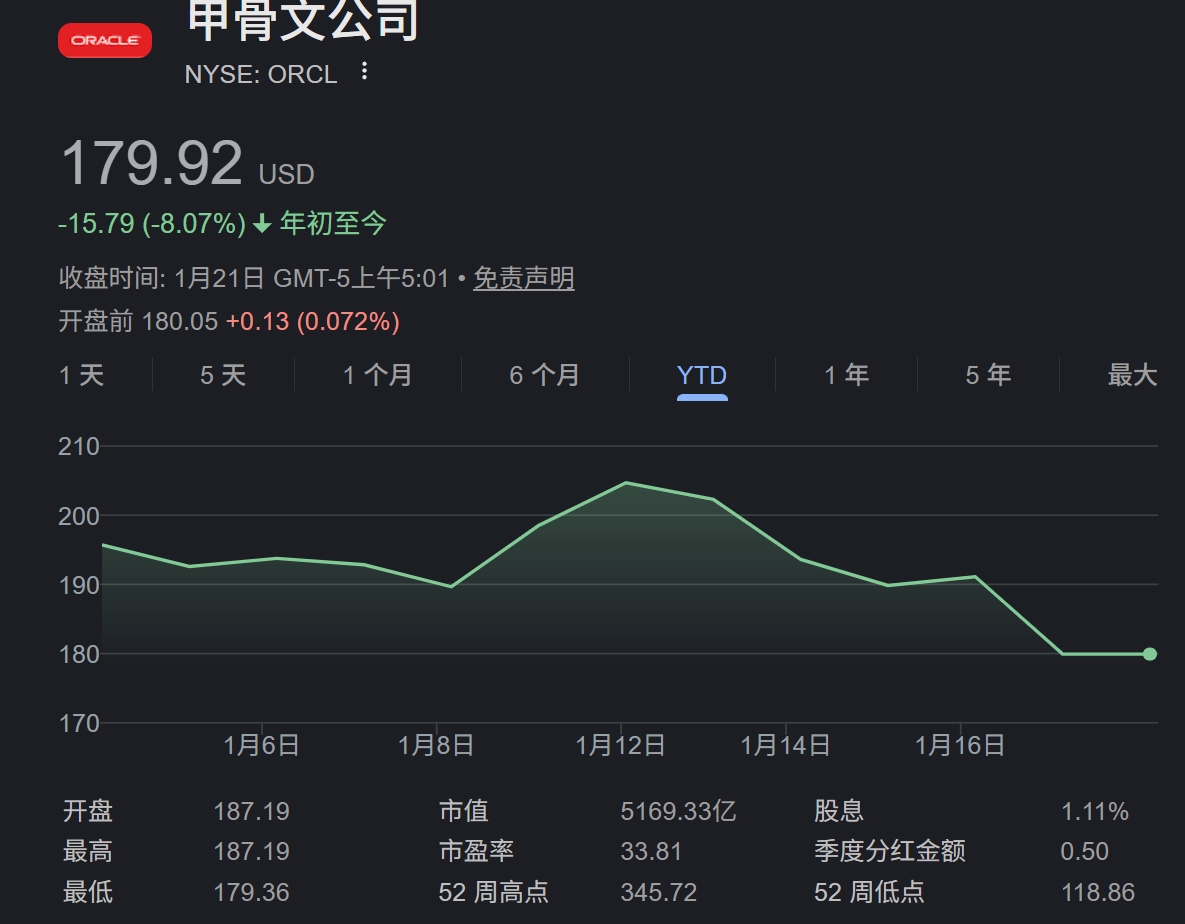
每经AI快讯,1月21日,甲骨文公司股价跌至逾七个月以来的低点,最新下跌2.2%。 ...
华尔街分析师看涨甲骨文
Guo Ji Jin Rong Bao· 2026-01-21 12:30
迪富奇指出,对于愿意放眼长期,而非仅关注未来几个季度的投资者而言,甲骨文是一只罕见的"值得持有十年的股票",目前仅处于起步阶段,未来十 年有望为投资者带来巨大收益。 对于债务偿还问题,他认为,甲骨文正逐步成为AI(人工智能)基础设施的领先供应商,公司利润将以"超高速率"增长,并产生"瀑布般"强劲的自由现 金流。 1月20日,伴随着科技股主导的广泛抛售,甲骨文公司股价下跌约6%至183.10美元。21日,该股开盘后继续下跌。在过去4个月中,甲骨文市值下跌近 4000亿美元,接近自去年6月初以来的最低水平。由于市场担心其负债能力以及信用评级预期不佳,投资者目前对甲骨文股票持谨慎态度。 即便如此,仍有分析师看好该股。著名证券公司古根海姆(Guggenheim Securities)近日将甲骨文列为2026年"首选推荐",重申"买入"评级及400美元目 标价,较当前股价高出两倍以上。 根据1月20日的公开报告,古根海姆认为,当前市场对甲骨文的债务偿还能力以及其对OpenAI过度依赖的担忧被夸大,这些担忧反而使得投资者忽视了 其长期上涨的巨大潜力。 据悉,OpenAI占甲骨文未来履约合同收入的60%,双方合作收入预计在 ...
Oracle Stock To $126?
Forbes· 2026-01-21 12:00
Core Viewpoint - Oracle's stock has experienced significant volatility, dropping 50% from its peak due to concerns over its debt and geopolitical tensions, despite a strong cloud contract backlog of $523 billion [3][13]. Financial Performance - Oracle is a $515 billion company generating $61 billion in revenue with an 11% growth rate and a solid 32% operating margin [9]. - The company's debt-to-equity ratio stands at 0.24, and its cash-to-assets ratio is only 0.1, indicating potential financial strain [9]. Market Reaction - The stock fell by 6% recently due to geopolitical concerns and a lawsuit from bondholders regarding losses from its debt-driven AI infrastructure expansion [2]. - Despite a strong backlog, Oracle's stock has dropped 26% over the past six months, reflecting market skepticism about its balance sheet stability [3]. Historical Context - During the 2008 financial crisis, Oracle's stock decreased by 41%, but it recovered fully in 16 months [5]. - In the 2020 COVID crash, Oracle's stock fell by 29%, rebounding in under four months [6]. - However, in 2022, Oracle's stock dropped by 41% compared to a 25% decline in the S&P 500, indicating vulnerability during inflationary periods [7]. Future Outlook - Analysts suggest a fair valuation of $295 for Oracle, indicating over 60% potential upside from current prices [13]. - The critical question remains whether Oracle can effectively monetize its $523 billion backlog while managing its debt without compromising profitability [10]. Investment Considerations - Investors who purchased Oracle at $180 may face concerns about further declines, with historical trends suggesting potential recovery if conditions mirror past crises [11]. - The prevailing pessimism around Oracle may be excessive, as the market has been penalizing the company for its debt concerns for months [13].
3 of the Hottest Artificial Intelligence (AI) Stocks Can Skyrocket Up to 109% in 2026, According to Select Wall Street Analysts
The Motley Fool· 2026-01-21 09:06
Core Insights - Analysts predict significant growth for select AI stocks, with potential increases ranging from 89% to 109% in 2026, marking a new technological revolution akin to the internet boom [1][2][3] Company Summaries Nvidia - Nvidia is seen as a leader in the AI revolution, with 64 analysts rating it as a strong buy, and a price target of $352 suggesting an 89% upside, potentially raising its market cap to nearly $8.6 trillion [4][5] - The company is leveraging advancements in parallel processing and its CUDA software platform to enhance its GPUs, which are critical for AI applications [6][7] - Despite its strong position, Nvidia faces challenges related to historical technology bubbles and a high price-to-sales ratio exceeding 30 [8] Oracle - Oracle is projected to have a 109% upside, with a target price of $400, as analysts believe concerns over its hyperscaler concentration are overstated [9][10] - The company has a robust remaining performance obligation (RPO) of $523 billion, indicating substantial future revenue beyond its contract with OpenAI [10] - Oracle's shares have declined by 42% since mid-September, leading to a forward P/E ratio of 24, which is attractive given expected sales growth [12] Super Micro Computer - Super Micro Computer is expected to see a 93% upside, with a target price of $63, driven by its integration with Nvidia's GPUs [14][15] - The company benefits from a growing demand backlog due to Nvidia's innovation cycles and is supported by Taiwan Semiconductor Manufacturing's expansion of GPU supply [16] - Super Micro's shares are trading at less than 11 times forward-year earnings, with projected sales growth of 64% for fiscal 2026, making it an appealing investment despite concerns over margin deflation [17][18]


The Ithaka Group Q4 2025 Commentary
Seeking Alpha· 2026-01-21 03:20
Market Overview - U.S. equity markets ended the fourth quarter positively, with the S&P 500 and Nasdaq 100 rising 2.4% and 2.6% respectively, while the Dow Jones Industrial Average led with a 3.6% return [2] - The Russell 1000 Growth Index lagged, increasing only 1.1% as investors shifted from high-growth technology stocks to more defensive sectors [2] - The quarter was marked by significant volatility, influenced by a 43-day government shutdown that affected market transparency and risk appetite [2] Economic and Monetary Policy - Approximately 83% of S&P 500 companies reported positive earnings surprises, indicating a broadening economic recovery beyond the "Magnificent Seven" [4] - The Federal Reserve implemented two 25-basis point cuts, bringing the federal funds rate to a range of 3.50% to 3.75% by year-end, and concluded its quantitative tightening program [4] - The Fed's balance sheet expanded by approximately $100 billion to $6.6 trillion, reflecting a shift from "abundant" to "ample" bank reserves [4] Sector Performance - Ithaka's portfolio underperformed the Russell 1000 Growth Index by 700 basis points, with stock selection detracting 740 basis points from relative performance [6] - Positive relative returns were generated in the Materials and Processing sector, while Technology and Consumer Discretionary sectors were significant sources of underperformance [7] - Weakness in Technology was attributed to fears of AI disintermediating software stocks, while Consumer Discretionary faced pressures from consumer spending concerns [7] Top Contributors and Detractors - Top contributors included Intuitive Surgical (26.6% return), Advanced Micro Devices (32.4%), and Alphabet (28.9%), driven by strong earnings and positive investor sentiment [9][10][12] - Major detractors were ServiceNow (-16.8%), Netflix (-21.8%), and Veeva Systems (-25.1%), with concerns over AI impacts and unexpected financial disclosures affecting stock performance [9][15][16] Investment Strategy and Outlook - Ithaka initiated three new positions and eliminated four during the quarter, with a trailing 12-month turnover of 22.1% [17] - The investment approach focuses on long-term wealth creation through concentrated positions in high-quality companies with strong management and favorable market conditions [4][19] - The narrative around AI is shifting towards tangible productivity gains, suggesting that the economic opportunities from AI will continue to expand [18]



全球软件 2026 年初步展望及重点标的-Global Software Initial thoughts for 2026 and our software names
2026-01-21 02:58
Summary of Global Software Conference Call Industry Overview - The software industry is experiencing a significant shift in focus from macroeconomic concerns to the disruptive rise of AI, with investor discussions centered around whether an AI bubble exists and the potential impact of AI on enterprise software [1][11][15]. Key Themes for 2026 - **Valuation Reset**: Software valuations have halved over the past year, creating opportunities for investors to acquire high-quality stocks at discounted prices [14][31]. - **IT Spending Outlook**: Recent CIO surveys indicate one of the strongest IT spending outlooks since 2018, with expectations for a stable macro environment and lower interest rates supporting demand, particularly among small and medium-sized businesses (SMBs) [3][13][23]. - **Generative AI Impact**: While Generative AI is a major topic, its actual revenue impact on software companies is still limited. Most companies are not yet seeing significant revenue from AI, and the focus is shifting towards company-specific opportunities [6][15][19]. Company Recommendations - **Buy Recommendations**: - **Oracle (ORCL)**: Strong core business with significant cloud transition and market share gains in IaaS/PaaS, driven by unique offerings [4][27]. - **Microsoft (MSFT)**: Durable business with multiple growth levers and a reset valuation, positioned well for AI monetization [4][27]. - **SAP (SAP)**: Consistent double-digit revenue growth and margin improvement, despite AI cycle noise [4][27]. - **HubSpot (HUBS)**: Attractive entry point with strong SMB market positioning and potential benefits from AI adoption [4][27]. - **Cautionary Recommendations**: - **Salesforce (CRM)**: Concerns over underperformance and potential reliance on acquisitions to drive growth [4][29]. - **Snowflake (SNOW)**: Long-term growth concerns due to market saturation and competitive pressures [4][30]. - **Workday (WDAY)**: Growth deceleration and investor skepticism regarding AI's impact on its business model [4][28]. Financial Metrics - **Valuation Comparisons**: - Adobe (ADBE): Adjusted P/E ratios have decreased significantly, with a current valuation of 12.0x for 2026E [5][32]. - Microsoft (MSFT): Current P/E at 27.5x for 2026E, reflecting a reset from previous highs [5][32]. - Oracle (ORCL): Trading at a 0.9x PEG ratio, down from 1.4x a year ago, indicating a significant valuation adjustment [32]. Macro Considerations - **Economic Environment**: The macroeconomic landscape is expected to stabilize, with potential benefits from deregulation and tax cuts in the U.S. impacting SMB spending positively [6][23]. - **AI Adoption Timeline**: Enterprise adoption of AI is anticipated to take longer than expected, with significant visibility likely not occurring until 2027 or 2028 [22][23]. Conclusion - The software sector is at a pivotal moment, with significant valuation resets providing investment opportunities. However, the actual impact of AI on revenue generation remains uncertain, necessitating a cautious approach to investment in this space. The focus should be on companies with strong fundamentals and clear growth trajectories amidst the evolving landscape of AI and macroeconomic conditions [1][14][19].



美股大跌,科技股全线下挫,热门中概股普跌
Di Yi Cai Jing Zi Xun· 2026-01-20 23:31
Group 1 - The global market risk appetite has significantly decreased following President Trump's renewed tariff threats towards Europe, leading to a sell-off in major stock indices [2][3] - The Dow Jones Industrial Average fell by 870.74 points, a decline of 1.76%, closing at 48,488.59 points; the S&P 500 dropped by 143.15 points, down 2.06%, at 6,796.86 points; and the Nasdaq Composite decreased by 561.07 points, a 2.39% drop, ending at 22,954.32 points, marking the worst single-day performance since October 10 of the previous year [2] - Major tech stocks experienced declines, with Nvidia down 4.32%, Apple down 3.45%, and Microsoft down 1.16%, among others [2] Group 2 - The CBOE Volatility Index (VIX), often referred to as the "fear index," rose to a two-month high, reflecting increased market anxiety [3] - Trading volume on U.S. stock markets reached approximately 20.6 billion shares, significantly above the 20-day average of 17.01 billion shares, indicating concentrated selling pressure [3] - Analysts suggest that the current geopolitical tensions regarding tariffs are more of an emotional shock rather than a fundamental change that would trigger a deep market correction [3] Group 3 - The global bond market is also experiencing spillover effects, with upward pressure on some European government bonds due to potential increases in defense spending [4] - The yield on the U.S. 10-year Treasury note reached a high of 4.313%, the highest since late August, closing at 4.287% after a rise of 5.6 basis points [5] - Market expectations for interest rate cuts by the Federal Reserve have been adjusted downward, with projections for a reduction of approximately 47 basis points in 2026, down from 53 basis points at the end of the previous year [5] Group 4 - Netflix reported fourth-quarter revenue of $12.1 billion, exceeding market expectations of $11.97 billion, with adjusted earnings per share of $0.56, also slightly above forecasts [6] - The company anticipates full-year revenue for 2026 to reach between $50.7 billion and $51.7 billion, with expectations for advertising revenue to potentially double in the future [6] - Following the announcement, Netflix's stock price fell by 4.9% in after-hours trading, influenced by merger financing and market sentiment [7] Group 5 - Gold prices surged significantly, with spot gold rising approximately 2% to $4,757.33 per ounce, reaching a historical high of $4,756.93 during the session [7] - Silver prices experienced a slight decline of 0.3%, settling at $94.38 per ounce, after hitting a record high of $95.87 [7] - Oil prices showed volatility, with light crude oil futures for February delivery rising by $0.90 to $60.34 per barrel, a 1.51% increase [8]