Panasonic(PCRFY)

Search documents
快来钱塘赶一场热闹的新春年货大集
Mei Ri Shang Bao· 2026-01-29 22:17
Core Insights - The 2026 Qiantang Consumer Expo has officially launched the Qiantang Spring Consumption Season, featuring a variety of quality products including tech items, local specialties, and cross-border goods [1][2] - The event showcases well-known local brands such as Geely, Ford, Panasonic, and others, highlighting a complete industrial chain in Qiantang [1] - The expo aims to stimulate consumer spending through dual subsidies on home appliances and 3C products, enhancing the shopping experience for attendees [1] Group 1 - The Qiantang New Year Goods Expo runs until February 8, providing an engaging experience for citizens with opportunities to shop, play, and enjoy local delicacies [1] - The event includes a dedicated "BRICS Goods" consumption channel, featuring products from BRICS countries like Russian vodka and Ethiopian coffee beans, catering to diverse consumer needs [2] - Traditional cultural activities such as writing Spring Festival couplets and family photo sessions are integrated into the shopping experience, adding a unique touch to the event [2] Group 2 - In 2025, Qiantang aims to boost consumption through various initiatives, achieving a retail sales total of 50.5 billion yuan, a year-on-year increase of 13.1%, leading the province in growth [2] - The Qiantang District Commerce Bureau plans to implement a "three-year action plan" to stimulate consumption, focusing on issuing vouchers, hosting themed events, and supporting new consumption formats [2] - The goal is to ignite consumer enthusiasm and provide strong momentum for the local market, enhancing the overall economic environment [2]




Panasonic Avionics Corporation replaces legacy systems with AI-powered ServiceNow CRM to support 300+ airlines
Businesswire· 2026-01-28 21:10
SANTA CLARA, Calif.--(BUSINESS WIRE)--ServiceNow (NYSE: NOW), the AI control tower for business reinvention, today announced an expanded relationship with Panasonic Avionics Corporation, a global leader for in-flight engagement. Panasonic Avionics will replace siloed legacy systems with ServiceNow CRM and Now Assist, integrated with Aria Billing Cloud and Tenon Marketing Automation, to modernize and unify sales, service, marketing, and billing formore than 300 airlines worldwide with real-time customer insi ...



行业报告 | 全球与中国LCP-FCCL市场现状及未来发展趋势
QYResearch· 2026-01-26 05:59
Core Viewpoint - The LCP-FCCL industry is transitioning from "usable" to "stable mass production," with a focus on addressing production pain points such as film thickness consistency, dielectric stability, and moisture absorption control [2][4]. Industry Development Status - The core of LCP-FCCL lies in the matching of LCP film, adhesive systems, and copper foil processes, with current challenges in achieving consistent production quality and performance [2]. - The demand for LCP-FCCL is driven by high-frequency, low-loss, and moisture-resistant characteristics, particularly in applications like 5G antennas and RF modules [3]. - Key bottlenecks include lamination, drilling, and reliability validation, with the industry facing challenges in achieving stable and cost-effective production [4]. Market Dynamics - The high-end market is primarily driven by leading companies, with domestic alternatives accelerating but showing clear segmentation [5]. - The industry is shifting from a "performance-first" approach to a "comprehensive cost-first" strategy, as LCP-FCCL prices remain higher than mainstream PI systems [6]. Development Trends - The demand for high-frequency applications continues to grow, with LCP-FCCL expected to penetrate more into high-frequency interconnects and antenna arrays due to its advantageous properties [7]. - The trend towards ultra-thin and lightweight designs is evolving, with a focus on reducing copper and film thickness while maintaining signal integrity [8]. - Material system iterations are underway to enhance low-loss bonding and surface treatment, improving thermal reliability and chemical resistance [10]. Domestic Market Insights - The domestic market for LCP-FCCL is rapidly evolving, with significant growth expected in China, which is projected to account for 54.03% of the global market by 2031 [14]. - The electronic communication sector is the largest consumer of LCP-FCCL, with a market share of approximately 69.06% in 2024 [15]. Competitive Landscape - Major global players in the LCP-FCCL market include Kurary, Panasonic, and Murata, with the first tier holding about 49% of the market share [17]. - The industry is witnessing increased competition as more companies enter the field, driven by the growing demand for high-frequency communication materials [17]. Industry Opportunities - The upgrade in high-frequency communication technologies such as 5G and satellite communication is creating a strong demand for LCP-FCCL materials [18]. - The automotive sector is also experiencing rapid growth in LCP-FCCL applications due to the increasing need for high-speed data links and radar systems [18]. - The trend towards terminal miniaturization and high integration is pushing the adoption of LCP-FCCL in various devices [19]. Supply Chain and Cost Considerations - The maturation of the supply chain and expected cost reductions are anticipated to enhance market stability and expand opportunities for LCP-FCCL [21].

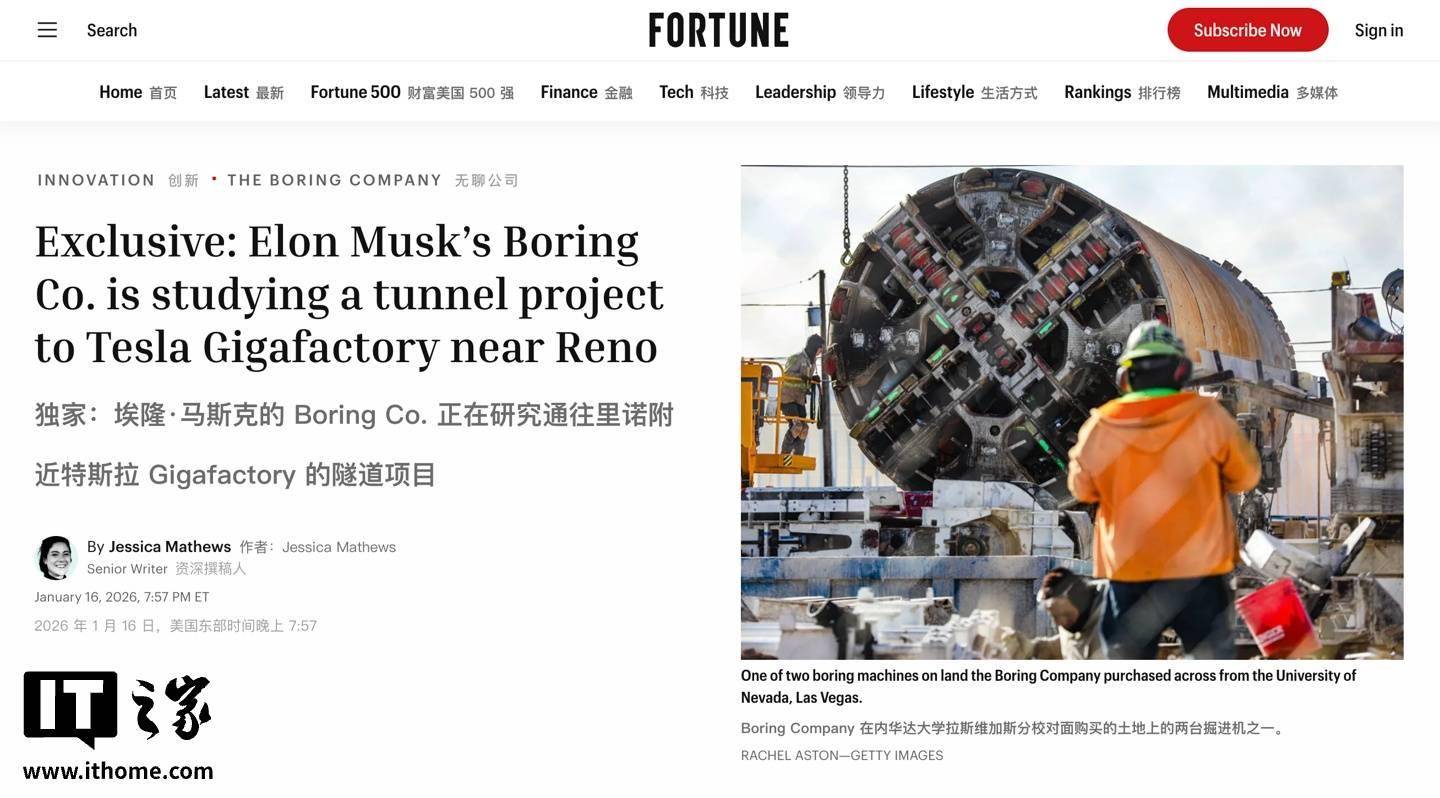
马斯克“无聊公司”被曝将新建地下隧道,缓解通勤压力
Sou Hu Cai Jing· 2026-01-17 03:49
Group 1 - The core focus of the article is on the collaboration between Elon Musk's Boring Company and the Nevada government to explore a potential underground tunnel project extending from Reno to the Tesla Gigafactory, with a length of approximately 14.5 km [1] - The study is funded by the Western Nevada Economic Development Authority, which has allocated $50,000 (approximately 349,000 RMB) to the Boring Company for conceptual design and feasibility research, aimed at finding new transportation alternatives for the Tahoe-Reno Industrial Center [1] - The Tahoe-Reno Industrial Center spans about 433 square kilometers, and traffic volume and accident rates along Interstate 80 have significantly increased due to the ongoing influx of data centers and large enterprises [3] Group 2 - Tesla and Panasonic, the largest companies within the industrial center, have been in discussions with the Nevada Governor's office regarding transportation issues since at least last spring, evaluating various solutions [3] - Currently, the commuter rail option remains a primary focus, with Tesla and Panasonic collaborating with local transportation agencies to fund a study utilizing existing freight rail for commuter services [3] - The tunnel project is still in a highly conceptual phase, with key details such as length, construction costs, and the potential inclusion of autonomous vehicles not disclosed [3]

松下控股取得光频梳装置及计测装置专利
Jin Rong Jie· 2026-01-16 04:58
Core Viewpoint - Panasonic Holdings Corporation has obtained a patent for a device named "Optical Frequency Comb Device and Measurement Device," with the authorization announcement number CN115769447B and an application date of November 2021 [1] Group 1 - The patent signifies Panasonic's ongoing innovation in optical technology [1] - The application date indicates a strategic focus on developing advanced measurement devices [1]
松下集团携全系列创新成果亮相CES 2026 聚焦AI与绿色转型
Zhong Guo Jing Ji Wang· 2026-01-09 04:43
Group 1: Core Themes - Panasonic showcased its innovative solutions at CES 2026, focusing on AI infrastructure, AI-driven B2B solutions, and green transformation [1][3] - The exhibition area covered 1412 square meters, highlighting the company's commitment to sustainable and efficient technologies [1] Group 2: AI Infrastructure Solutions - Panasonic introduced a distributed power system designed for installation within server racks, addressing the energy demands of high-power data centers [1] - The company presented high-performance cooling water circulation pumps, achieving a 75% increase in flow rate while enhancing cooling performance and energy efficiency [2] Group 3: B2B Solutions - The new warehouse automation solution from Blue Yonder integrates camera vision, robotics, RFID, and sensors for comprehensive logistics optimization [2] - Hussmann unveiled two new embedded display cabinets using natural refrigerant R-290, featuring AI IoT capabilities for real-time management and predictive maintenance [2] Group 4: Health Solutions - Panasonic launched a brain health assessment solution based on facial expression analysis, providing a quick evaluation of the BHQ index without MRI [3] - The smart aging care solution utilizes AI to analyze individual risk data and generate intervention plans [3] Group 5: Green Transformation Solutions - The perovskite solar cells introduced by Panasonic feature a glass-integrated structure, offering flexibility and durability for urban renewable energy applications [3] - An automated home appliance disassembly system aims for commercialization by 2028, focusing on efficient reuse of components and high-purity material separation [3]
日本制造撤离中国?真相远比想象复杂
Xin Lang Cai Jing· 2026-01-04 11:30
Core Insights - The closure of the Canon factory in Zhongshan marks the end of an era, with the factory once considered a "golden rice bowl" employing over 10,000 people and generating an industrial output of nearly 3.2 billion yuan in 2022 [1][11] - This closure is part of a broader trend of Japanese companies retreating from the Chinese market, with significant examples including Nissan's Wuhan factory acquisition by Lantu Automotive for 732 million yuan, Mitsubishi's exit from Chinese automotive manufacturing, and Sony's withdrawal from the smartphone market in China [3][13] - Japanese companies are experiencing a "comprehensive collapse" in various sectors, with market shares plummeting, such as Japanese cars in China dropping from 25% to 11.2% [5][15] Industry Trends - The market share of domestic smart toilets has surpassed 60%, while Japanese companies like Sharp and Yakult have struggled to adapt to local consumer preferences, leading to significant losses [5][15] - Trust issues have arisen due to scandals involving Japanese companies, which have eroded consumer confidence and contributed to their decline in market share [5][15] - Japanese firms are now adopting a "K-shaped differentiation" strategy, withdrawing from low-end production while heavily investing in high-end sectors, such as Toyota's $2 billion investment in a wholly-owned electric vehicle company in Shanghai [7][17] Strategic Shifts - Japanese companies are transitioning from being seen as low-cost manufacturers to becoming sources of technological innovation and large-scale markets in China [7][17] - The appointment of local executives, such as Li Hui as the first Chinese general manager of Toyota China, signifies a shift towards localized decision-making [7][17] - Investments in high-tech sectors, including semiconductor packaging and medical aesthetics, indicate a strategic pivot to enhance competitiveness against domestic players [7][17]



母婴卧室静音除甲醛?2025空气净化器十大品牌权威实测解析
Xin Lang Cai Jing· 2025-12-22 11:24
Core Insights - The air purifier market in China is transitioning from a niche product to a health necessity, with retail sales expected to grow nearly 20% year-on-year in the first half of 2025, driven by demand from newly renovated homes, families with infants, and pet owners [1] - A report indicates significant disparities in formaldehyde removal efficiency among different brands, with some showing over 20 times the difference [1] - Only 28.6% of tested air purifiers achieved a formaldehyde CADR value exceeding 400 m³/h, and only 54.3% met the F4 level for formaldehyde CCM [1] Market Trends - The demand for air purifiers is increasing, particularly in family scenarios such as new renovations and households with infants and pets [1] - The market is seeing a shift towards more stringent performance standards and consumer awareness regarding air quality [1] Product Performance - The annual testing results reveal that nearly one-third of the air purifiers tested did not meet the required formaldehyde purification efficiency, indicating a gap between advertised and actual performance [1] - The report highlights the importance of certifications and performance metrics in guiding consumer choices [33] Consumer Guidance - A comprehensive evaluation of air purifiers includes factors such as CADR, CCM, energy efficiency, and noise levels, which are critical for consumer decision-making [33] - The report provides a selection of top-performing brands based on rigorous testing and consumer feedback, emphasizing the need for reliable and effective air purification solutions [33]




日本科技-硬件电子专家-行业将受益于下一代变压器、电池管理系统、高温超导电缆-Japan Technology_ Hardware - Industrial Electronics_ Expert call (AI power)_ Sector to benefit from next-gen transformers-BBUs-HTS cables
2025-12-18 02:35
Summary of Key Points from the Expert Call on Japan Technology: Hardware - Industrial Electronics Industry Overview - The focus is on the industrial electronics sector, particularly in relation to power supply systems for generative AI data centers, highlighting the involvement of Japanese heavy electrical equipment manufacturers like Hitachi and Mitsubishi Electric [2][3] Core Insights - **Power Consumption Trends**: Generative AI data centers are experiencing increased power consumption, leading to a shift towards higher voltages to minimize power loss. This trend benefits companies like Hitachi and Mitsubishi Electric, which are expanding their business into data centers [2] - **Next-Generation Transformers**: Hitachi and Mitsubishi Electric are participating in Nvidia's 800V architecture ecosystem and are expected to supply next-generation transformers, including solid-state transformers (SSTs) [2][12] - **Battery Backup Units (BBUs)**: Companies like Panasonic are developing advanced products such as Capacitor Backup Units (CBUs) to manage power consumption fluctuations in generative AI applications [2] - **High-Temperature Superconducting (HTS) Cables**: The use of HTS cables is being explored for efficient DC power transmission, with companies like Fujikura and Furukawa Electric leading in this area [3][15] Technical Developments - **Power Supply Evolution**: The evolution of power supply systems for data centers includes moving from supplying 100 VAC to 415 VAC, and now to integrating power supply units within racks to provide 48 VDC [4][9] - **Power Stabilization Methods**: New configurations involve using battery energy storage systems (BESS) and supercapacitors to stabilize power supply, particularly in high-demand scenarios [10][11] - **Voltage Supply Changes**: The power supply configuration is evolving to provide +/-400 VDC and 800 VDC, with future plans for 1,500 VDC power supply [9] Market Dynamics - **Power Supply Issues**: Generative AI data centers are emerging with large power capacities (up to 5 GW), leading to local production for local consumption strategies, including building small nuclear plants or gas turbine power plants near data centers [17] - **Networking Evolution**: The approach to data center networking is shifting from scale-up to scale-out, and now to a scale-across concept, connecting multiple data center campuses [19] Component Demand - **Increased Demand for Components**: The need for stable power supply in GPU servers is driving demand for multi-layer ceramic capacitors (MLCCs) from companies like Murata Manufacturing and Taiyo Yuden [21] - **Google's TPU Development**: Google’s 7th generation TPU is becoming competitive with NVIDIA's GPUs, emphasizing the importance of in-house hardware and software development [22] Company-Specific Insights - **Hitachi**: Target price set at ¥5,900 with risks including project delays and forex swings [23] - **Mitsubishi Electric**: Target price set at ¥5,200 with risks related to industrial automation and competition [24] - **Panasonic Holdings**: Target price set at ¥2,100 with risks including demand fluctuations and competition in the battery market [28] - **Fujikura**: Target price set at ¥22,700 with risks in telecommunications and electronics sectors [29] - **Furukawa Electric**: Target price set at ¥10,000 with risks in energy infrastructure and electronics [30] Additional Considerations - **Investment Risks**: The report highlights potential conflicts of interest due to Goldman Sachs' business relationships with the companies discussed, advising investors to consider this when making decisions [5][39] This summary encapsulates the key points from the expert call, focusing on the industrial electronics sector's developments, market dynamics, and company-specific insights.

全球固定式紫外线空气净化器行业发展现状调研及未来竞争策略分析报告2026年版
Sou Hu Cai Jing· 2025-12-10 16:24
Core Insights - The report provides a comprehensive analysis of the global fixed ultraviolet air purifier industry, focusing on market size, growth trends, and competitive strategies up to 2031 [1][3]. Group 1: Industry Overview - The fixed ultraviolet air purifier industry is categorized by product type and application, with significant market size projections for 2020, 2024, and 2031 [3][4]. - Key characteristics of the industry include technological advancements and increasing consumer awareness regarding air quality [4][5]. - Factors influencing industry development include favorable conditions such as rising health concerns and adverse factors like regulatory challenges [4][5]. Group 2: Market Share and Rankings - The report outlines the market share and rankings of major companies in the fixed ultraviolet air purifier sector over the past three years, highlighting sales volume and revenue [4][5]. - It includes detailed statistics on the top companies' market positions in both global and Chinese markets, with projections for 2024 [4][5]. Group 3: Supply and Demand Analysis - A thorough analysis of the supply and demand dynamics for fixed ultraviolet air purifiers is provided, including production capacity, output, and utilization rates from 2020 to 2031 [5][6]. - The report forecasts market trends in various regions, emphasizing the growth potential in key markets [5][6]. Group 4: Competitive Landscape - The competitive landscape is analyzed, detailing the market concentration and competitive intensity among leading manufacturers [5][6]. - The report identifies major players in the industry, their product specifications, market applications, and financial performance metrics from 2020 to 2025 [6][7]. Group 5: Product and Application Analysis - The report categorizes fixed ultraviolet air purifiers by product type and application, providing sales and revenue forecasts for different segments [10][11]. - It highlights the expected growth in various applications, including residential, industrial, and commercial uses [10][11]. Group 6: Industry Trends and Drivers - The report discusses the overall trends in the fixed ultraviolet air purifier industry, including technological innovations and shifts in consumer preferences [17]. - Key drivers of industry growth are identified, such as increasing health awareness and regulatory support for air quality improvement [17].