
Pfizer(PFE)

Search documents
最高250%关税!多只医药股大涨!
证券时报· 2025-08-06 00:14
Core Viewpoint - The article discusses the performance of the U.S. stock market on August 5, highlighting a decline in major indices while the pharmaceutical sector saw significant gains due to proposed tariffs on imported drugs by President Trump [2][3][6]. Market Performance - On August 5, all three major U.S. stock indices closed lower: the Dow Jones Industrial Average fell by 0.14% to 44,111.74 points, the S&P 500 dropped by 0.49% to 6,299.19 points, and the Nasdaq Composite decreased by 0.65% to 20,916.55 points [3]. - The ISM reported that the U.S. services PMI for July was 50.1, below the expected 51.5 and the previous month's 50.8, indicating near stagnation in service sector growth [3]. Sector Performance - The pharmaceutical sector saw notable gains, with Pfizer rising over 5% and UnitedHealth Group increasing by over 4% following Trump's announcement of potential tariffs on imported drugs [6][7]. - Major technology stocks mostly declined, with Meta and Microsoft both dropping over 1%, while Amazon's stock rose nearly 1% [3]. - Airline stocks collectively increased, with American Airlines up over 3% and Delta Airlines rising by 0.69% [4]. - Semiconductor stocks generally fell, with the Philadelphia Semiconductor Index down 1.12% and notable declines in companies like GlobalFoundries, TSMC, and ARM [4]. Trade Relations - The European Union announced a suspension of planned retaliatory tariffs against the U.S., which were set to take effect on August 7, as both parties work on a trade agreement [9][10].



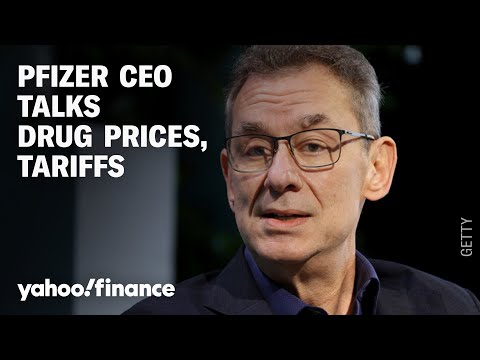
Pfizer CEO talks lowering drug prices, tariffs, and earnings
Yahoo Finance· 2025-08-05 20:48
Financial Performance & Cost Reduction - Pfizer reported exceeding its initial cost reduction program for the year and announced an additional 17 billion USD cost reduction plan, with 12 billion USD impacting administrative, marketing, and selling expenses by 2027, and 500 million USD reinvested in R&D [3] - Pfizer experienced 10% revenue growth this quarter, but revenue growth has been volatile due to the fluctuating impact of COVID-19 [3][4] - New products and recently acquired products contributed 47 billion USD in the first half of the year, growing at 15% [5] Operational Strategy - Pfizer is focusing on productivity enhancement and margin expansion through focus on key priorities and leveraging technology, particularly AI, to simplify business processes and reduce waste [1][2] - Pfizer aims to streamline operations by eliminating less important activities and concentrating on core strengths [2] Regulatory & Political Landscape - The CEO of Pfizer has a special relationship with the US President, particularly stemming from collaboration during the COVID-19 crisis, and has discussed the impact of middlemen on drug prices [8][9] - The US President aims to secure better deals on drug pricing, expressing concern that other countries pay less [10] - The US President is considering tariffs, potentially reaching 250%, on imports, but may phase them in and allow a grace period due to the long lead times required for pharmaceutical manufacturing site completion (over 4 years) [11][12][13] - The pharmaceutical industry is engaging in discussions with the US President regarding the "most favored nations" pricing clause and potential mitigation plans [17] - Generics account for over 90% of prescriptions in the US and are the cheapest globally, but patients may still pay more due to the insurance system [19][20] - Pfizer has a significant manufacturing presence in the US, with 13 sites, including 11 manufacturing plants [20] - The impact of tariffs depends on the product and how customs authorities define the country of origin, considering both API origin and final product location [19][21]
美股三大股指齐跌 Coinbase跌超6%
Di Yi Cai Jing· 2025-08-05 20:20
Market Performance - The Dow Jones Industrial Average closed down by 0.1% [1] - The S&P 500 index fell by 0.49% [1] - The Nasdaq Composite dropped by 0.65% [1] Company Highlights - Pfizer (PFE.N) saw an increase of 5% [1] - Coinbase (COIN.O) experienced a decline of 6.3% [1] - Microsoft (MSFT.O) and Meta Platforms (META.O) both fell by over 1% [1] Chinese Stocks - The Nasdaq Golden Dragon China Index decreased by 0.56% [1] - Yum China (YUMC.N) dropped by 6% [1] - NIO Inc. (NIO.N) fell by 2% [1]




Pfizer Q2 Earnings Review: Upside At Last As CEO Prepares For Trump Policy Battle
Seeking Alpha· 2025-08-05 19:41
Group 1 - Pfizer Inc. is a major player in the pharmaceutical industry, with its share price reaching $60 during the pandemic due to the success of its COVID vaccine Comirnaty [1] - The company is part of a broader investment group focused on biotech, pharma, and healthcare, providing insights on market trends and catalysts that influence stock valuations [1] - The investment group offers detailed financial analyses, including product sales forecasts and discounted cash flow analysis for major pharmaceutical companies [1] Group 2 - The article emphasizes the importance of staying updated on stocks within the biotech and healthcare sectors for both novice and experienced investors [1] - The author, Edmund Ingham, has extensive experience in the biotech field, having covered over 1,000 companies and providing detailed reports [1]
BMO Capital Markets' Evan Seigerman: I'm encouraged by Pfizer raising 2025 profit outlook
CNBC Television· 2025-08-05 18:40
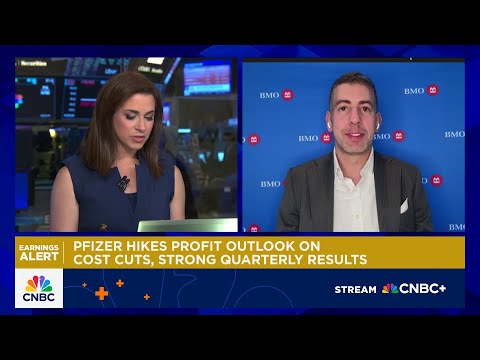
Fizer shares are gaining this morning, up nearly 5% after beating earnings estimates on the top and bottom line. The company raising its fullear earnings guidance. Joining us now is managing director and head of healthcare research Evan David Seagerman.Thank you for being here, David. Um, so they hiked their forecast despite President Trump's calls to lower drug prices as well as uh tariffs on pharmaceuticals imported into the country, potential uh potentially more tariffs to come. Uh, do you think these po ...
Pfizer Q2 Earnings Beat Estimates, Oncology Drives Top-Line Growth
ZACKS· 2025-08-05 16:50
Core Insights - Pfizer (PFE) reported strong second-quarter 2025 results with adjusted earnings per share of 78 cents, exceeding the Zacks Consensus Estimate of 58 cents, and reflecting a 30% year-over-year increase [1] - Total revenues reached $14.65 billion, a 10% increase from the previous year, significantly surpassing the Zacks Consensus Estimate of $13.78 billion [1] Revenue Breakdown - Revenues from key products such as Vyndaqel, Padcev, Lorbrena, Paxlovid, and the BioNTech-partnered Comirnaty vaccine increased during the quarter, while U.S. revenues were impacted by higher manufacturer discounts due to the Inflation Reduction Act [2] - International revenues rose 6% operationally to $5.76 billion, while U.S. revenues increased 13% to $8.9 billion [2] Expense Management - Adjusted selling, informational, and administrative (SI&A) expenses decreased 8% operationally to $3.4 billion, and adjusted R&D expenses fell 9% to $2.44 billion [3] Segment Performance - Primary Care segment sales declined 12% operationally to $5.54 billion, while Specialty Care sales increased 7% to $4.38 billion, and Oncology sales rose 11% to $4.39 billion [4] - Eliquis sales rose 6% to $2.0 billion, Prevnar family revenues increased 2% to $1.38 billion, and Comirnaty sales surged 95% year over year to $381 million [5][6][7] Guidance and Future Outlook - Pfizer raised its 2025 adjusted EPS guidance to a range of $2.90 to $3.10, while maintaining total revenue guidance of $61 billion to $64 billion [11][17] - The company expects R&D expenses to be between $10.4 billion and $11.4 billion, and SI&A spending to range from $13.1 billion to $14.1 billion [20] Challenges and Strategic Initiatives - Pfizer faces challenges including declining sales of COVID-19 products, U.S. Medicare Part D headwinds, and potential patent expirations for key products between 2026 and 2030 [24] - The company anticipates cost cuts and internal restructuring to yield savings of $7.2 billion by the end of 2027, aiming to drive profit growth despite expected revenue volatility [26]

刚刚 美股突变!特朗普:可能很快宣布美联储新任主席
Zheng Quan Shi Bao Wang· 2025-08-05 15:46
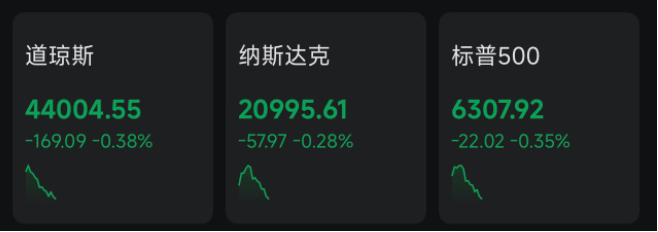
Market Overview - US stock indices opened mixed on August 5, later experiencing a collective drop, with all major indices turning negative by the time of reporting [1] - The Dow Jones Industrial Average closed at 44,004.55, down 169.09 points (-0.38%); the Nasdaq Composite at 20,995.61, down 57.97 points (-0.28%); and the S&P 500 at 6,307.92, down 22.02 points (-0.35%) [2] Chinese Stocks Performance - The Nasdaq China Golden Dragon Index saw a slight increase, with notable gains from several companies: Ascentage Pharma rose nearly 10%, Sohu increased over 6%, and Zhihu and Zai Ding Pharma both rose over 3% [3][4] Corporate Earnings and Stock Movements - Pfizer's stock rose over 5% after reporting Q2 revenue of $14.65 billion, a 10% year-over-year increase, driven by core drug sales growth [6][8] - Palantir Technologies experienced a significant increase of nearly 10%, with a market capitalization exceeding $400 billion, reporting Q2 revenue of $1.004 billion, a 48% year-over-year growth [9][10] - Arteris saw a surge of over 40% in its stock price, attributed to AMD's adoption of its new FlexGen interconnect technology for AI chip design [11][12]


辉瑞(PFE.US)涨逾4% Q2营收和盈利超预期
Zhi Tong Cai Jing· 2025-08-05 15:26
Core Viewpoint - Pfizer's Q2 earnings exceeded expectations, driven by strong demand for heart disease drug Vyndaqel and anticoagulant Eliquis, leading to a stock price increase of over 4% [1] Financial Performance - Q2 revenue reached $14.7 billion, surpassing the expected $13.47 billion [1] - Earnings per share (EPS) were $0.78, exceeding the forecast of $0.57 [1] Future Guidance - Pfizer raised its adjusted EPS forecast for 2025 to a range of $2.90 to $3.10, up from the previous estimate of $2.80 to $3.00 [1] - The midpoint of the adjusted EPS outlook was increased by $0.10, above the market consensus of $3.01 [1] - The full-year revenue guidance remains unchanged at $61 billion to $64 billion [1]
美股异动 | 辉瑞(PFE.US)涨逾4% Q2营收和盈利超预期
智通财经网· 2025-08-05 15:13
Core Viewpoint - Pfizer's strong Q2 performance driven by robust demand for heart disease drug Vyndaqel and anticoagulant Eliquis, leading to revenue and profit exceeding expectations [1] Financial Performance - Q2 revenue reached $14.7 billion, surpassing the expected $13.47 billion [1] - Earnings per share (EPS) were $0.78, exceeding the forecast of $0.57 [1] Future Guidance - Pfizer projects adjusted EPS for 2025 to be between $2.90 and $3.10, up from the previous estimate of $2.80 to $3.00 [1] - The midpoint of the adjusted EPS outlook is raised by $0.10, above the market consensus of $3.01 [1] - Full-year revenue guidance remains unchanged at $61 billion to $64 billion [1]
辉瑞上涨5.04%,报24.715美元/股,总市值1405.17亿美元
Jin Rong Jie· 2025-08-05 15:03
Core Viewpoint - Pfizer's stock experienced a 5.04% increase on August 5, reaching $24.715 per share, with a total market capitalization of $140.517 billion [1]. Financial Performance - As of March 30, 2025, Pfizer reported total revenue of $13.715 billion, a year-over-year decrease of 7.82% [1]. - The company's net profit attributable to shareholders was $2.967 billion, reflecting a year-over-year decline of 4.75% [1]. Company Overview - Pfizer is committed to improving health at every stage of life through scientific innovation and global resources [2]. - The company offers a diverse range of healthcare products, including biologics, small molecule drugs, and vaccines, and collaborates with healthcare professionals, governments, and communities worldwide [2]. - With over 160 years of history, Pfizer aims to provide better and higher-quality healthcare services [2].