Palantir Technologies(PLTR)

Search documents
2 Popular AI Stocks to Sell Before They Drop 47% and 60%, According to Wall Street Analysts
The Motley Fool· 2025-11-10 09:12
Group 1: Palantir Technologies - Palantir Technologies has seen a remarkable stock return of 1,960% since the launch of ChatGPT in November 2022, but analysts believe the stock is overvalued [1][3] - The company reported a 63% increase in revenue to $1.1 billion for the third quarter, marking the ninth consecutive quarter of revenue acceleration, with non-GAAP earnings more than doubling to $0.21 per diluted share [4] - Despite strong fundamentals, Palantir's stock trades at a valuation of 108 times sales, significantly higher than the next closest competitor at 38 times sales, indicating a potential 60% downside from its current price of $178 [5][7] Group 2: Nvidia - Nvidia holds over 90% market share in data center GPUs and is recognized for its leadership in generative AI networking equipment, but analysts have set a target price of $100 per share, implying a 46% downside from its current price of $188 [8][7] - Concerns have arisen regarding Nvidia's market position due to competition from Chinese AI labs and U.S. export restrictions, which have significantly impacted its ability to operate in China, reducing its market share from 95% to near zero [9][11] - Despite these challenges, Nvidia's stock trades at 54 times earnings, which is considered reasonable given the forecasted earnings growth of 36% annually over the next three years, suggesting it remains a worthwhile investment in the AI sector [12]


"Big Short" Investor Michael Burry Just Placed a Big Wager Against Artificial Intelligence (AI) Giants Nvidia and Palantir -- and History Is on His Side
The Motley Fool· 2025-11-10 08:06
Core Viewpoint - Michael Burry, known for his contrarian investment strategies, has made significant bets against Nvidia and Palantir, indicating a belief that the AI sector may be overvalued and poised for a downturn [5][12]. Company Summaries Nvidia - Nvidia has a current market capitalization of $4,572 billion and recently traded at $188.13, with a price-to-sales (P/S) ratio exceeding 30 [14][20]. - The company is recognized as the leader in AI graphics processing units (GPUs) and has enjoyed substantial competitive advantages [15]. - Despite its growth, Nvidia's high P/S ratio raises concerns about sustainability, reminiscent of past market bubbles [20]. Palantir Technologies - Palantir has a market capitalization of $424 billion and is currently priced at $177.93, with a staggering P/S ratio of 152 [18][20]. - The company's Gotham software-as-a-service platform is noted for having no direct replacement, contributing to its competitive edge [15]. - Similar to Nvidia, Palantir's elevated valuation metrics suggest potential risks associated with its stock price [20]. Investment Insights - Burry's recent 13F filing reveals a notional value put option position of $912.1 million in Palantir and approximately $186.6 million in Nvidia, indicating a strong bearish stance [12][13]. - Historical trends suggest that high P/S ratios, such as those currently seen in Nvidia and Palantir, often precede market corrections, as seen during the dot-com bubble [20]. - The rapid growth rates of both companies may temporarily support their stock prices, but historical patterns indicate a high likelihood of Burry's bearish bets being profitable in the long run [20].
The 5 Most Interesting Analyst Questions From Palantir Technologies’s Q3 Earnings Call
Yahoo Finance· 2025-11-10 05:32
Core Insights - Palantir Technologies exceeded Wall Street expectations for revenue, non-GAAP profit, and operating income in Q3, yet the market reacted negatively with a notable decline in shares post-earnings [1] - The strong quarterly results were attributed to rapid expansion in the U.S. commercial segment, particularly due to increased adoption of the AIP (Artificial Intelligence Platform) by enterprise clients [1] - Management highlighted a significant rise in large, organization-wide deals, indicating a shift among customers towards broader AI deployments [1] Financial Performance - Revenue reached $1.18 billion, surpassing analyst estimates of $1.09 billion, reflecting a year-on-year growth of 62.8% and an 8% beat [6] - Adjusted EPS was reported at $0.21, exceeding analyst expectations of $0.17, marking a 25.5% beat [6] - Adjusted Operating Income stood at $600.5 million, with a margin of 50.8%, beating analyst estimates of $501.9 million by 19.7% [6] - Revenue guidance for Q4 CY2025 is set at $1.33 billion at the midpoint, above analyst estimates of $1.20 billion [6] - Operating Margin improved to 33.3%, up from 15.6% in the same quarter last year [6] - Billings totaled $1.12 billion at quarter end, representing a year-on-year increase of 65.8% [6] - Market Capitalization is currently at $424.1 billion [6] Analyst Insights - Analysts noted an acceleration in sales cycles, with customers moving from initial contact to large-scale deals more rapidly [6] - Management indicated that clients are increasingly motivated by tangible results seen in peer organizations, leading to a focus on product fit and rapid delivery [6] - Future government opportunities were discussed, with ongoing large-scale initiatives in defense and infrastructure projects highlighted, although specifics could not be disclosed [6]
?利空突袭,全线大跌!5.7万亿,发生了什么?
Zheng Quan Shi Bao Wang· 2025-11-10 03:46
Core Points - The technology sector in the U.S. experienced significant volatility, with the Nasdaq index dropping over 3% in a week, marking its worst performance since April [1][2] - Eight major AI-related companies saw a combined market value loss of over $800 billion in a week, contributing to a total market loss of nearly $1 trillion for AI-related U.S. companies [1][2] - Concerns over high valuations in the AI sector were triggered by Palantir's recent earnings report, leading to a sell-off that affected other companies in the industry [1][3] Group 1: Market Performance - The Nasdaq index fell by over 3% this week, while the S&P 500 index decreased by 1.6%, ending a three-week streak of gains [2] - Nvidia's stock dropped more than 7%, resulting in a market value loss of approximately $348.5 billion, while Microsoft and Oracle also experienced significant declines [2][3] Group 2: AI Sector Concerns - Analysts are increasingly questioning the sustainability of high valuations in the AI sector, with significant capital expenditures and reliance on debt financing raising red flags [3][4] - The total capital expenditure of major tech companies like Alphabet, Amazon, Meta, and Microsoft reached $112 billion in Q3, indicating substantial investment in AI expansion [3] Group 3: Meta's Advertising Issues - Internal documents revealed that Meta is projected to earn about $16 billion in 2024 from fraudulent and prohibited advertisements, highlighting regulatory gaps in its advertising business [5][6] - Meta's platforms have been linked to a significant portion of successful scams in the U.S., with estimates suggesting that one-third of such cases are associated with the company [6]



突然出手,华尔街“大空头”押上八成资产做空AI,再次“狙击”英伟达,他曾精准预测2008年次贷危机,但做空特斯拉失败
3 6 Ke· 2025-11-10 03:37
Group 1 - Michael Burry's hedge fund, Scion Asset Management, disclosed a third-quarter position holding over $1 billion in put options, primarily betting against Nvidia and Palantir, which constitutes 80% of its total assets [1][3] - Following the disclosure, Nvidia's stock fell by 3.96%, while Palantir experienced a more significant drop of 7.95%, with Nvidia's market value decreasing by approximately $455.1 billion over four trading days [1][3] - The fund's total holdings amount to approximately $1.38 billion, with a significant portion concentrated in put options for Nvidia and Palantir, valued at about $187 million and $912 million respectively [3][4] Group 2 - Burry's actions represent the second time this year he has targeted Nvidia, having previously established a short position worth over $97 million in the first quarter, which was later liquidated [4][5] - The market's interest in shorting Nvidia is reportedly declining, with short positions decreasing from approximately 315 million shares to about 211 million shares between June 2024 and October 2025 [18][20] - Analysts express skepticism regarding Burry's timing, suggesting that his put options may already be at a loss unless Nvidia and Palantir experience further significant declines [20][21] Group 3 - Palantir's CEO criticized Burry's shorting strategy, asserting that the company is genuinely profitable in the AI sector, and emphasized their commitment to delivering strong performance despite external pressures [15] - Palantir reported a 63% year-over-year revenue increase in its latest quarterly earnings, with revenues surpassing analyst expectations for 21 consecutive quarters [15] - Despite strong performance, Palantir's stock has seen an 11.24% decline recently, raising concerns about its high valuation relative to its earnings guidance [15][21] Group 4 - Major investment banks are adopting a dual strategy of lending while simultaneously shorting stocks in the tech and AI sectors, reflecting a cautious approach to the perceived overvaluation in these markets [21][23] - Deutsche Bank has provided significant loans to data center operators, while also exploring hedging strategies to mitigate risks associated with their AI investments [23][25] - The financial sector is increasingly aware of the potential for a market correction in the tech space, with analysts noting that the risks currently outweigh potential rewards [22][25]

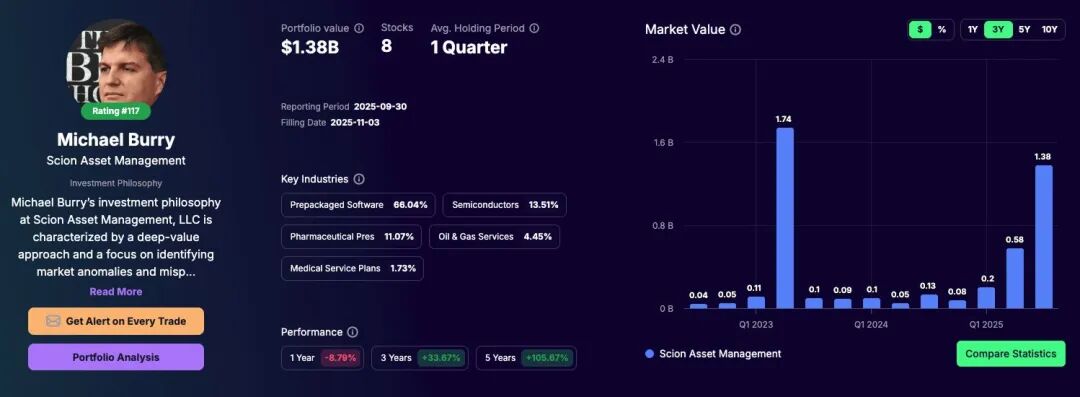
Michael Burry’s Scion Asset Management Q3 2025 Portfolio Analysis
Acquirersmultiple· 2025-11-10 01:17
Core Insights - Michael Burry's Scion Asset Management reported a portfolio valued at $1.38 billion, with Palantir Technologies and NVIDIA making up nearly 80% of total assets [1][2][14] - The portfolio reflects a concentrated and aggressive long bias, particularly in AI and energy sectors, marking a shift from Burry's historically defensive stance [2][14][15] Holdings Summary - **Palantir Technologies Inc. (PLTR)**: Represents 66.04% of total assets, with 5,000,000 shares valued at $912.1 million, indicating strong conviction in its role in AI and defense technology [3][4] - **NVIDIA Corp. (NVDA)**: Accounts for 13.51% of total assets, with 1,000,000 shares worth $186.6 million, highlighting a recognition of its importance in AI infrastructure [5][14] - **Pfizer Inc. (PFE)**: Holds call options valued at $152.9 million (11.07%), reflecting a contrarian bet on the normalization of pharmaceuticals post-pandemic [6] - **Halliburton Co. (HAL)**: Call options valued at $61.5 million (4.45%), providing exposure to potential rebounds in oilfield activity [7] - **Molina Healthcare Inc. (MOH)**: Represents 1.73% of the portfolio with 125,000 shares worth $23.9 million, offering stable cash flow exposure [8] - **Lululemon Athletica Inc. (LULU)**: Re-entered with 100,000 shares valued at $17.8 million (1.29%), indicating a valuation reset opportunity [9] - **SLM Corp. (SLM)**: Added 480,054 shares valued at $13.3 million (0.96%), reflecting an opportunistic play on the student-loan cycle [10] - **Bruker Corp. (BRKRP)**: Holds 48,334 preferred convertible shares valued at $13.1 million (0.95%), aligning with an asymmetric risk-reward strategy [11] Exits Summary - Scion fully exited several prior holdings, including UnitedHealth Group, Regeneron, Meta Platforms, Estée Lauder, JD.com, and Alibaba, indicating a pivot away from mega-cap and China exposure towards AI, energy, and U.S. value names [12]


截至今年9月浙江人工智能核心产业营业收入4944亿元,同比增长22%;莱维特:人工智能的关键在人类要提出正确的问题丨AIGC日报
创业邦· 2025-11-10 00:08
Group 1 - Meta's internal documents reveal that approximately 10% of its revenue, around $16 billion, in 2024 will come from fraudulent and prohibited advertisements, highlighting regulatory gaps in its advertising business [2] - The number of fraudulent ads pushed to users daily on Meta's platforms is estimated to be around 15 billion, exposing billions of users to investment scams, online gambling, and prohibited medical products [2] - The market capitalization of eight major AI-related companies, including Nvidia, Meta, Palantir, and Oracle, has dropped by over $800 billion in a single week, raising concerns about the sustainability of current high valuations [2] Group 2 - Michael Levitt, a Nobel Prize winner, emphasizes that the key to artificial intelligence lies in humans asking the right questions, suggesting that AI can assist in various fields if properly utilized [2] - As of September this year, the core AI industry in Zhejiang reported revenues of 494.4 billion yuan, a year-on-year increase of 22%, with R&D expenses reaching 39 billion yuan, up 14% [2]

Has Contrarian Michael Burry Found His Next Big Short? The Famed Investor Is Betting the Farm Against an Artificial Intelligence Stock That Is Up 1,290% Over the Past 5 Years
The Motley Fool· 2025-11-09 19:11
Core Viewpoint - Michael Burry, known for predicting the housing market crash, is currently bearish on the U.S. stock market and has made significant short bets against AI stocks, particularly Palantir and Nvidia [2][3][4]. Company Analysis - Scion Asset Management, led by Burry, purchased 5 million put options on Palantir with a notional value of over $912 million and 1 million puts on Nvidia in the third quarter [4]. - Palantir's stock has increased by 156% this year and trades at approximately 300 times forward earnings, raising concerns about its valuation [8][10]. - Despite Palantir's strong third-quarter earnings, which exceeded analysts' expectations, CEO Alex Karp criticized short sellers like Burry, asserting that the companies he is shorting are profitable [11]. Industry Insights - Burry's recent tweets indicate a belief that the market is in a bubble, supported by charts showing slowed cloud growth and high technology capital expenditure growth reminiscent of the dot-com bubble [5][6]. - The AI sector, particularly companies like Palantir and Nvidia, has attracted significant investor enthusiasm, but the high valuations pose risks for potential investors [10][11].
Wall Street Brunch: Here Come The 13Fs
Seeking Alpha· 2025-11-09 18:31
Group 1: Hedge Fund Activity - Hedge funds will disclose positions ahead of the 13F deadline, providing insights into their strategies during recent market highs [2][3] - Michael Burry's Scion Capital has disclosed bets against Nvidia and Palantir, indicating a cautious stance on AI stocks [4] - The upcoming filings will reveal whether funds increased their positions during the third quarter or remained cautious due to high valuations, particularly in tech and AI sectors [5] Group 2: Earnings Reports - 90% of S&P 500 companies have reported Q3 earnings, with 82% exceeding profit estimates and 77% surpassing revenue expectations [9] - Walt Disney is expected to report EPS of $1.02 on revenue of $22.78 billion for fiscal Q4, with a focus on guidance and debt reduction [10] - Other companies reporting include CoreWeave, Occidental, Cisco, and Applied Materials, among others [10][12][13] Group 3: Market and Political Developments - The government shutdown is projected to last at least 50 days, impacting market sentiment and economic data availability [15] - President Trump has proposed reallocating federal healthcare funds away from insurance companies to direct payments to the public, suggesting a $2,000 dividend for most Americans [16][17]


Does Michael Burry of "The Big Short" Fame Know Something Wall Street Doesn't? He Just Made a Billion-Dollar Bet Against 2 Companies Driving the AI Boom.
The Motley Fool· 2025-11-09 18:15
Core Viewpoint - Michael Burry, known for identifying market bubbles, has made significant bets against AI companies Nvidia and Palantir, raising questions about the sustainability of the AI market's growth [1][3][7]. Company Analysis - Burry's Scion Asset Management purchased $186 million in put options on Nvidia and $912 million in put options on Palantir, totaling over $1 billion in bets against these companies [4]. - Nvidia and Palantir have shown remarkable earnings growth due to the demand for their AI products, with Nvidia being a leader in AI chip sales and Palantir providing software solutions for AI applications [5]. - Despite strong earnings reports, Burry's actions suggest he anticipates a decline in stock prices for both companies, indicating a potential bubble in the AI sector [7]. Industry Insights - The AI market is projected to grow from billions to over $2 trillion by the end of the decade, highlighting its rapid expansion [3]. - Recent discussions among investors have centered around the possibility of an AI bubble, although current earnings and growth forecasts remain strong [8]. - Burry's moves have sparked debate on whether to hold or sell AI stocks, emphasizing the importance of maintaining positions in quality companies for long-term growth [10].