
Ferrari(RACE)

Search documents
From Tesla to Porsche: The winners and losers of 2025 in cars
The Economic Times· 2025-12-15 06:37
Core Insights - The automotive industry in 2025 is characterized as the "Year of the Supercar," with luxury brands like Bugatti, Pagani, Koenigsegg, Lamborghini, and Ferrari experiencing unprecedented demand and profitability [1][16] - The average price of new luxury cars in the US has surpassed $50,000, reflecting a growing appetite for high-end vehicles among consumers [1][16] - Electric vehicle (EV) sales have increased globally, but growth has not met expectations in many markets, leading to challenges for several automakers [2][16] Luxury Car Market - Luxury brands are reporting strong profits and have order books filled until 2027, contrasting with legacy automakers facing financial difficulties [16] - Porsche has faced significant challenges, including a 33% drop in shares over the past year and a €3.1 billion ($3.6 billion) loss reported in October [8][16] - Ferrari, on the other hand, has maintained high profit margins and a strong order book, with less than 10% of its sales coming from the Chinese market, which has insulated it from some market volatility [6][7][16] Electric Vehicle Challenges - Tesla has experienced a decline in sales and profits, facing lawsuits and public backlash against CEO Elon Musk, which has affected its market share in the US [2][16] - Lucid Group has also struggled with supply chain issues, leading to financial losses [4][16] - The overall EV market has been impacted by competition from affordable Chinese EVs and the end of government subsidies, which has slowed growth [2][16] Future Outlook - Audi and Cadillac are set to join Formula One in 2026, which is expected to enhance their brand visibility and market positioning [10][11][16] - The average audience for Formula One races has reached 1.3 million viewers in the US, indicating growing interest in the sport [11][17] - Audi is generating excitement with new car concepts, while Cadillac aims to shed its outdated image and compete with established luxury brands [12][17]



What Has Ferrari (RACE) Stock Done For Investors?
The Motley Fool· 2025-12-12 12:40
Core Insights - Ferrari has a strong history in the automotive industry, known for its technical expertise and racing legacy, which contributes to its success as a luxury car manufacturer [1] - The stock has generated total returns of (14%), 82%, and 93% over the past one, three, and five years, respectively, with only the three-year gain slightly outperforming the S&P 500 [3] - The stock experienced a significant 15% drop after disappointing long-term financial targets were revealed, forecasting a 5% revenue growth and 6% operating income growth from 2025 to 2030 [4] Financial Performance - Ferrari's stock has produced a total return of 673% since its IPO in October 2015, significantly outperforming the S&P 500's 306% return [6] - The company pays a dividend of nearly three euros per share, contributing to total returns [3] - Revenue and net income are projected to increase by 12% and 17%, respectively, from 2019 to 2024, indicating strong financial growth despite conservative management outlooks [8] Market Position - Ferrari's brand is its most valuable asset, emphasizing its status as a luxury goods manufacturer rather than a typical car maker [7] - The company maintains exclusivity by controlling production volumes, with only 799 units of the F80 model being produced, all of which are pre-ordered at a starting price of $3.7 million [7][8] - Currently, Ferrari's shares are trading 25% below their peak, suggesting potential investment opportunities for long-term investors [9]

如何看待高成长与经典价值?柏基“传奇基金经理”2019年深度撰文 | 思考汇
高毅资产管理· 2025-12-12 07:03
Core Viewpoint - The article discusses the evolving landscape of investment strategies, particularly the tension between growth and value investing, emphasizing the need for a nuanced understanding of these concepts in the context of modern economic changes [6][8][9]. Group 1: Growth vs. Value Investing - James Anderson acknowledges a widening divide between growth and value investing, suggesting that traditional value metrics may not suffice in a changing economic landscape dominated by tech giants like Microsoft and Google [8]. - The article highlights that while growth and value investing appear divergent, they share fundamental principles, such as the importance of honest long-term cash flow estimation and risk awareness [9]. - Anderson emphasizes the need for a longer time perspective and serious company research, valuing patience and governance sensitivity inherent in value investing [9][10]. Group 2: Historical Context and Literature - The article notes a lack of literature supporting growth investing compared to the extensive documentation of value investing, which has a rich tradition and numerous classic texts [11][13]. - It references Benjamin Graham's views on growth stocks, indicating that while he recognized their potential, he also warned of their speculative nature and preferred investing in larger, less popular companies [13][14]. - The article argues that the realities of the past decade have diverged from Graham's observations, with growth stocks outperforming traditional value stocks [15]. Group 3: Future Investment Landscape - The article posits that future returns are highly uncertain, urging a reevaluation of investment beliefs and strategies in light of complex market dynamics [18][30]. - It suggests that understanding structural changes in the global economy is crucial for predicting long-term investment outcomes, rather than focusing solely on short-term financial metrics [33][34]. - The piece warns against relying on historical volatility to forecast future performance, advocating for a mindset open to exploring various possibilities [38][39]. Group 4: Case Studies - The article compares Coca-Cola and Facebook, illustrating how traditional value metrics may misrepresent the potential of high-growth companies [64][69]. - It highlights that Coca-Cola's growth has stagnated, while Facebook has shown significant growth potential, challenging the notion of which company represents true value [66][70]. - The automotive industry is used as a case study, showcasing how different companies within the sector exhibit varying growth and value characteristics, with General Motors and Ferrari serving as contrasting examples [82][88].




Ferrari faces valuation pressure as Jefferies trims estimates on slower shipment outlook
Proactiveinvestors NA· 2025-12-10 19:45
Company Overview - Proactive is a financial news publisher that provides fast, accessible, informative, and actionable business and finance news content to a global investment audience [2] - The news team operates from key finance and investing hubs, including London, New York, Toronto, Vancouver, Sydney, and Perth [2] Expertise and Focus Areas - The company specializes in medium and small-cap markets while also covering blue-chip companies, commodities, and broader investment stories [3] - Proactive delivers news and insights across various sectors, including biotech and pharma, mining and natural resources, battery metals, oil and gas, crypto, and emerging digital and EV technologies [3] Technology Adoption - Proactive is recognized for its forward-looking approach and enthusiastic adoption of technology to enhance workflows [4] - The company utilizes automation and software tools, including generative AI, while ensuring that all content is edited and authored by humans [5]

美股异动 | 法拉利盘前续跌2% 开盘或刷新年内新低 大摩下调其评级及目标价
Ge Long Hui· 2025-12-10 09:33
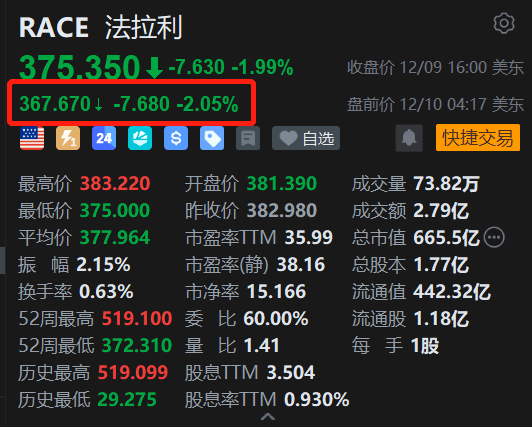
Group 1 - Ferrari's stock (RACE.US) has experienced a decline of 2% in pre-market trading, marking a four-day losing streak and potentially reaching a new annual low [1] - Morgan Stanley has downgraded Ferrari's rating from "overweight" to "hold" and reduced the target price from $520 to $425 [1] - Bernstein analysts indicated that Ferrari's long-term financial guidance is significantly below market expectations, with a compound annual revenue growth target of only 5% from 2024 to 2030, compared to the market's average expectation of around 7% [1] Group 2 - As of the last trading session, Ferrari's closing price was $375.35, down 1.99%, with a pre-market price of $367.67, reflecting a 2.05% decrease [2] - The stock's 52-week high was $519.10, while the 52-week low was $372.31, indicating significant volatility [2] - Ferrari's total market capitalization stands at $66.55 billion, with a total share count of 177 million [2]
Why RICH People HATE Ferrari 😳
Mark Tilbury· 2025-12-09 13:04
This is why rich people hate Ferrari. When you finally make real money, you expect one thing, being able to buy whatever you want. Every luxury car brand allows you to do that, but not Ferrari.You can walk in with the money ready, point at the car you want, and Ferrari will look you dead in the eye, and say no, because they're not selling cars. They're running a private club and they decide who gets in. ...

大摩:将法拉利评级下调至“持股观望”
Ge Long Hui· 2025-12-08 10:17
Core Viewpoint - Morgan Stanley downgraded Ferrari's rating from "Overweight" to "Equal-weight" and reduced the target price from $520 to $425 [1] Company Summary - The downgrade reflects a shift in investment sentiment towards Ferrari, indicating a more cautious outlook on the company's future performance [1] - The new target price of $425 suggests a significant reduction in expected growth or profitability compared to previous estimates [1]
Ferrari N.V. (NYSE:RACE) Price Target and Investor Moves
Financial Modeling Prep· 2025-12-08 08:05
Core Insights - Ferrari N.V. is a luxury sports car manufacturer with a current trading price of $393.21 and a market capitalization of approximately $70.21 billion, indicating its significant presence in the luxury automotive market [1][5] - Morgan Stanley has set a price target of $425 for Ferrari, suggesting an 8.08% potential increase from the current price [1][6] - Recent investor activity shows mixed sentiment, with some investors reducing their stakes while others are acquiring new positions [2][3][6] Investor Activity - Dnca Finance reduced its stake in Ferrari by 1.3%, selling 1,672 shares, leaving them with 130,435 shares valued at approximately $63.7 million [2] - Jump Financial LLC acquired a new stake in Ferrari valued at around $19.6 million, while Capula Management Ltd took a new position worth approximately $397,000 [3] - Cresset Asset Management LLC increased its holdings in Ferrari by 2.0%, indicating varied investor sentiment [3][6] Stock Performance - Ferrari's stock is currently priced at $393.21, experiencing a slight decrease of 0.51% today, with a trading range of $392.17 to $399.05 [4] - Over the past year, the stock has shown volatility, reaching a high of $519.10 and a low of $372.31 [4]
如何看待高成长与经典价值?柏基“传奇基金经理”詹姆斯·安德森2019年深度撰文︱重阳荐文
重阳投资· 2025-12-08 07:33
Core Viewpoint - The article discusses the evolving perspectives on growth and value investing, highlighting the need to reassess traditional investment principles in light of modern economic realities and the success of high-growth companies [5][6][7]. Group 1: Growth vs. Value - There is an acknowledged and widening divergence between growth and value investing, with traditional value principles struggling to account for the sustained high growth of companies like Microsoft, Google, and Amazon [7][8]. - The underlying economic structure has shifted, suggesting that reliance on historical value metrics may no longer be sufficient for investment success [7][8]. - Despite the differences, there are fundamental commonalities between growth and value investing, particularly in the importance of honest long-term cash flow estimation and risk management [8][9]. Group 2: Historical Context and Evolution - Historically, there has been a lack of literature supporting growth investing compared to the extensive documentation of value investing, which has created a bias in the investment community [13][14]. - The belief that "value will ultimately prevail" remains entrenched, despite evidence that growth strategies have outperformed passive indices over the long term [14][15]. - The past decade has seen a significant deviation from Graham's observations, with high-growth stocks yielding substantial returns, contrary to his predictions [18][19]. Group 3: Case Studies - Microsoft serves as a prime example of a company that has achieved remarkable long-term growth, with revenue increasing from $60 billion in 2008 to $110 billion in 2018, showcasing a compound annual growth rate of 24% [20]. - Google also exemplifies this trend, with its revenue growing from $21.8 billion in 2008 to $136.8 billion in 2018, reflecting the potential of high-growth companies to deliver exceptional returns [21]. - The article contrasts Coca-Cola's stagnation in stock value over the past 20 years with Facebook's growth trajectory, suggesting that the latter may align more closely with modern investment principles [70][75]. Group 4: Future Investment Landscape - The future of investing will likely be shaped by structural changes in the global economy, necessitating a shift in focus from short-term financial metrics to long-term transformative trends [40][41]. - The concept of "creative destruction" is becoming increasingly relevant, indicating that traditional investment strategies may need to adapt to a rapidly changing economic environment [41][42]. - Companies that can leverage network effects and platform positions may exhibit "super-linear growth," challenging traditional value investment assumptions [61][62].



Why I Bought the Dip in Ferrari Stock
Yahoo Finance· 2025-12-06 12:05
Core Viewpoint - Ferrari's stock experienced a significant decline following the October Capital Markets Day, dropping from above $500 to below $400, primarily due to new 2030 targets indicating slower growth than expected [1]. Group 1: Financial Guidance - Ferrari raised its 2025 guidance to at least 7.1 billion euros, with a long-term target of approximately 9 billion euros in net revenue by 2030, reflecting about 5% annualized revenue growth [4]. - The company expects earnings before interest (EBIT) to reach at least 2.75 billion euros by 2030, implying around 6% annual growth and an EBIT margin of at least 30% [4]. - Management plans to generate at least 3.6 billion euros of EBITDA and about 8 billion euros of industrial free cash flow from 2026 to 2030, with a commitment to return roughly 7 billion euros to shareholders through dividends and buybacks [5]. Group 2: Market Reaction and Performance - The stock's double-digit drop was triggered by investors' focus on slower growth targets, despite the company maintaining some of the best margins in the auto industry, with high-30s adjusted EBITDA margins and high-20s adjusted operating margins [2][6]. - The introduction of the new F80 supercar is expected to provide significant earnings support in the upcoming year [6]. Group 3: Management Strategy - Ferrari's conservative long-term targets may be viewed as a cautious approach, as the company has a history of outperforming its targets, being on track to exceed many of its 2026 profitability goals a year early [7].