
Takeda(TAK)

Search documents
With Emma Walmsley exiting GSK, who will be pharma’s top women CEOs?
Yahoo Finance· 2025-10-03 08:00
Core Insights - GSK's CEO Emma Walmsley is stepping down, with Luke Miels set to take over by the end of the year, marking a significant leadership change in a pivotal year for the company [1][2] - Walmsley, who became the first female CEO in Big Pharma in 2017, has been credited with major transformations at GSK, including the spinoff of its consumer health business and advancements in specialty medicine [1] - Despite successes, Walmsley faced criticism from activist investors regarding her biopharma R&D experience and GSK's recent struggles in the vaccine market and share price growth [2] Company Leadership Changes - Julie Kim will become the president and CEO of Takeda Pharmaceuticals in June 2026, succeeding Christophe Weber [4] - Kim joined Takeda through its $62 billion acquisition of Shire in 2019 and has held significant roles, including president of the U.S. business unit [5] - Takeda is currently reexamining its portfolio and has announced a halt to its cell therapy R&D as part of this strategic process [6] Gender Representation in Pharma - Walmsley's departure highlights ongoing challenges in women's leadership within the pharmaceutical industry, despite evidence that female executives contribute to higher profitability and innovation [3] - The leadership gap between men and women in pharma remains incremental, with few notable exceptions of female CEOs in major companies [3]


Takeda Pharmaceutical to exit cell therapy research
Reuters· 2025-10-01 13:41
Core Viewpoint - Takeda Pharmaceutical will discontinue its cell therapy research and seek a partner to advance its candidates under development [1] Company Summary - Takeda Pharmaceutical is shifting its strategy by halting its internal cell therapy research efforts [1] - The company is actively looking for a partner to help progress its cell therapy candidates that are currently in development [1] Industry Summary - The decision reflects a broader trend in the pharmaceutical industry where companies are reassessing their research and development strategies, particularly in complex fields like cell therapy [1]


晋城监管分局同意泰康人寿山西晋城阳城支公司变更营业场所
Jin Tou Wang· 2025-09-30 03:27
Core Points - The National Financial Supervision Administration of Jincheng approved the request from Taikang Life Insurance Co., Ltd. regarding the change of business location for its Yangcheng branch [1] Group 1 - Taikang Life Insurance Co., Ltd. Yangcheng branch will change its business location to the 10th floor (rooms 102, 103, 104) and the 12th floor (rooms 1201, 1202, 1204) of Yintong Building, Fengcheng Town, Yangcheng County, Jincheng City, Shanxi Province [1] - The company is required to handle the change and license renewal in accordance with relevant regulations [1]
旅居养老火了!险企纷纷布局
券商中国· 2025-09-28 12:32
Core Viewpoint - The trend of travel-based elderly care is gaining popularity among active seniors, with a significant market potential as the elderly population in China is expected to exceed 300 million by the end of the 14th Five-Year Plan [4][7]. Group 1: Market Potential - The travel-based elderly care market is anticipated to transition from a niche to a mainstream market, driven by an increase in the elderly population and higher penetration rates [4]. - By 2035, the travel and health integration industry for the elderly is projected to reach a scale of 5 trillion yuan, accounting for 16.7% of the total output value of the silver economy [8]. Group 2: Industry Participation - Major insurance companies, including China Pacific Insurance, China Taiping, and others, are increasingly entering the travel-based elderly care market, with various operational models being adopted [5]. - The operational models include leveraging existing nationwide elderly care communities, establishing travel projects in key cities, and collaborating with tourism and health service providers [5]. Group 3: Characteristics of Elderly Travelers - The typical characteristics of "traveling elderly" include being relatively younger, preferring to experience different locations rather than staying in one place year-round, desiring a home-like environment instead of hotels, requiring medical and health support, and having social interaction needs [4]. Group 4: Policy Environment - Recent government policies have emphasized the development of the travel-based elderly care market, including the establishment of a national cooperation platform and the promotion of travel-based elderly care destinations [8]. - Local governments, such as Beijing and Hainan, are also implementing specific guidelines and standards to enhance the travel-based elderly care services [8]. Group 5: Challenges and Considerations - Despite the promising outlook, the travel-based elderly care sector is still in its early stages, facing challenges such as resource integration, quality service provider selection, and the need for standardized services tailored to elderly tourists [9]. - Balancing service quality and cost-effectiveness is crucial, as travel projects may experience fluctuating occupancy rates [9].

Takeda: Excellent Pipeline Kaizen - 6 Drugs, $20 Billion Annually
Seeking Alpha· 2025-09-24 21:40
Group 1 - Takeda is currently facing significant valuation issues, particularly after the costly acquisition of Shire [1] - The company has implemented effective kaizen practices to improve its pipeline [1] - Takeda presents a unique biopharma case that may lead to investment opportunities despite its challenges [1]

医保目录和商保目录“双报”观察:今年79款药品“双报”,背后是必进的决心?
Di Yi Cai Jing· 2025-09-24 02:29
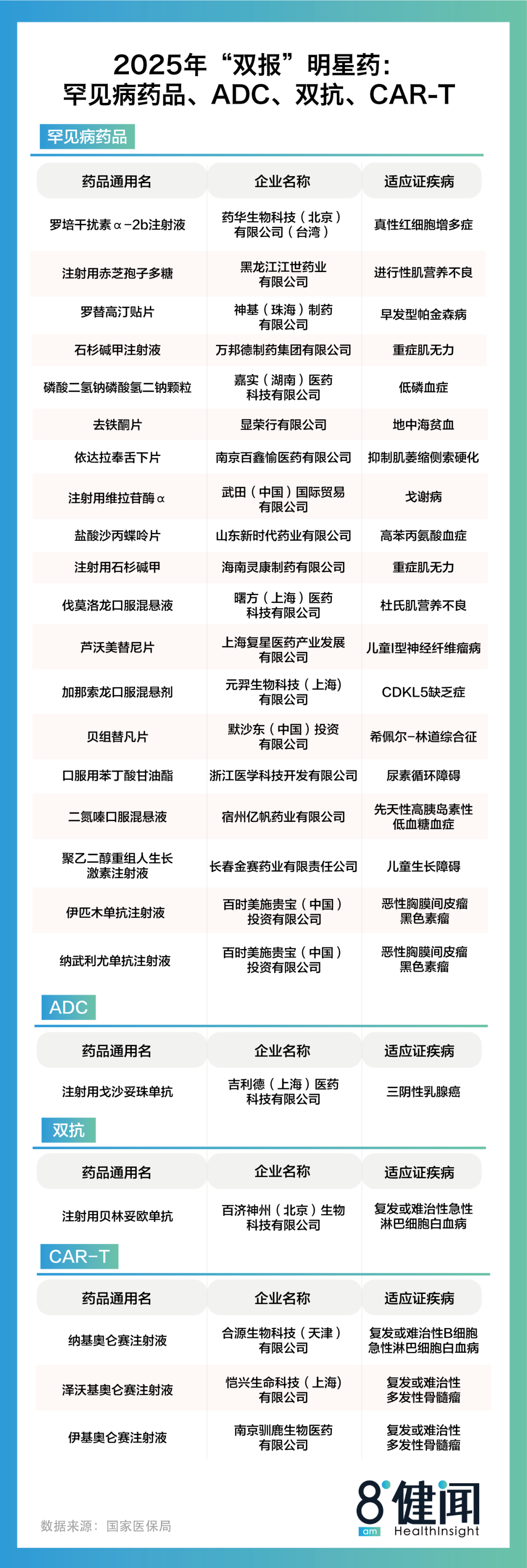
Core Insights - The National Healthcare Security Administration (NHSA) announced the review results for the 2025 National Basic Medical Insurance (BMI) catalog and the first version of the commercial health insurance innovative drug catalog, marking a critical phase in the "dual catalog" adjustment process [1] - In the first year of the "dual catalog" discussions, 534 products passed the initial review for the BMI catalog, while 121 drugs were included in the commercial insurance innovative drug catalog, with over 60% of the 121 drugs being "double reported" [1][2] - The "double reported" drugs reflect the pharmaceutical companies' uncertain mindset regarding drug pricing negotiations in the BMI process, with high-priced drugs often targeting commercial insurance while others focus on BMI [2][3] Group 1: Drug and Company Analysis - A total of 79 drugs from 74 companies were "double reported," with 4 companies reporting two or more drugs, indicating a competitive landscape among pharmaceutical firms [1][3] - The "double reported" drugs include various categories, such as 19 rare disease drugs and 3 CAR-T therapies, showcasing a diverse range of therapeutic areas [1][5] - The highest annual treatment cost among the "double reported" drugs is approximately 1.5 to 2 million yuan for a rare disease drug from Takeda, highlighting the financial implications for both companies and patients [8][9] Group 2: Market Dynamics and Strategies - The "double reporting" strategy is seen as a low-cost strategic exploration for companies, allowing them to gauge market responses without significant investment [3][4] - Companies are motivated to participate in both catalogs to avoid being at a disadvantage if competitors succeed in securing listings in one while they do not [3][4] - The overall pass rate for the commercial insurance innovative drug catalog is estimated to be below 30%, indicating a challenging environment for companies seeking approval [4][9] Group 3: Insights on Rare Diseases and CAR-T Therapies - Rare disease drugs face significant hurdles in entering the BMI catalog, with only 13 out of 48 rare disease drugs passing the initial review in 2024, suggesting a low success rate [9][10] - CAR-T therapies are viewed as having a better chance of entering the commercial insurance catalog, with companies adjusting their strategies based on past experiences in BMI negotiations [10][11] - The pricing strategies for CAR-T drugs reflect a calculated approach, with companies aware of the need to control costs to meet BMI requirements while also targeting commercial insurance [10][11] Group 4: Cross-National Company Participation - Among the "double reported" drugs, 14 are from 10 multinational companies, indicating a strong interest from global players in the Chinese market [20][21] - The competitive landscape includes multiple drugs targeting similar conditions, leading to a scenario where companies are closely monitoring each other's submissions [22][23] - The performance of these drugs in commercial health insurance products, particularly in the context of "惠民保" (Hui Min Bao), has been promising, providing a potential pathway for future approvals [26][28]


20,000 + Takeda Employees Voted to Select Four New Global Corporate Social Responsibility Collaborations to Advance Climate-Resilient Health Systems in 94 Countries
Businesswire· 2025-09-23 22:04
OSAKA, Japan & CAMBRIDGE, Mass.--(BUSINESS WIRE)--Takeda (TOKYO:4502/NYSE: TAK) today committed JPY 4.6 billion (approx. USD 32.1 million) to four new Global Corporate Social Responsibility (CSR) partners as part of the company's ongoing commitment to building climate-resilient health systems in low- and middle-income countries around the world. Amid rising temperatures and extreme weather events, Takeda recognizes an urgent need to ensure that healthcare remains resilient and accessible, parti. ...

(投资中国)跨国药企高层:中国可为全球研发带来“加速度”
Zhong Guo Xin Wen Wang· 2025-09-18 05:53
Core Viewpoint - China's rapid development in the life sciences sector is attributed to decades of accumulation, supported by government policies, expert capabilities, and entrepreneurial spirit [1][2] Group 1: Innovation Ecosystem - The innovation ecosystem in China is driven by the collaboration of regulatory support from drug authorities, acceleration from policies, and the expertise of researchers [1] - The combination of strong research capabilities, government support, and entrepreneurial efforts is crucial for transforming scientific achievements into marketable products [1] Group 2: Research and Development Contributions - China has produced numerous best-in-class and first-in-class innovations in recent years, with potential groundbreaking targets identified in collaboration with renowned hospitals in Shanghai [1] - The involvement of China in global research, such as the TAK-861 drug for treating type 1 narcolepsy, highlights the country's significant patient base and strong clinical research capabilities [2] Group 3: Future Directions - The increasing strength of China in technology fields like AI is expected to accelerate global research and development efforts [2] - There is a desire to deepen R&D strategies in China to leverage its growing capabilities [2]
跨国药企高层:中国可为全球研发带来“加速度” 会成全球研发典范
Zhong Guo Xin Wen Wang· 2025-09-17 13:57
Core Viewpoint - China is poised to become a global benchmark for research and development in the life sciences sector within the next five years, driven by its exceptional talent, infrastructure, and supportive policies [1][2]. Group 1: China's R&D Capabilities - China has rapidly developed in the life sciences field over the past decades, with a strong emphasis on innovation and research capabilities [1]. - The collaboration between government support, expert research capabilities, and entrepreneurial spirit creates a unique innovation ecosystem in China that is unmatched by many other countries [1]. - The past decade has seen an explosive growth in innovation in China, particularly in the last two to three years, leading to a surge in new research outcomes [1][2]. Group 2: Innovation and Drug Development - The development of new drugs in the biopharmaceutical industry is inherently challenging, with significant difficulties in moving from initial concepts to successful products [2]. - China has already produced numerous best-in-class and first-in-class innovations in recent years, indicating a strong potential for original innovations [2]. - The example of TAK-861, a drug for treating type 1 narcolepsy, highlights China's involvement in both Phase I and Phase III studies, showcasing the capabilities of Chinese researchers and clinical centers [3]. Group 3: Future Prospects - There is confidence that within the next three to five years, more original innovations will emerge from China, benefiting both local and global patients [2]. - The integration of advanced technologies, such as AI, is expected to further enhance China's innovation capabilities and facilitate the global reach of its research [3]. - The company aims to deepen its R&D strategy in China, leveraging the country's innovation ecosystem to create mutually beneficial partnerships [3].
RMX VAST™ Video Now Natively Supported in U.S. Government's TAK Platform
Prnewswire· 2025-09-10 12:05
Core Insights - RMX Industries, Inc. presented its VAST™ video platform at the TAK Offsite 2025, showcasing its capabilities in enhancing tactical data solutions for government agencies [1][2][5] Company Overview - RMX Industries specializes in advanced data compression and video optimization, aiming to transform how organizations capture, transmit, store, and share visual data [7] - The company’s technology has demonstrated up to 50% reduction in video bandwidth, storage needs, and power consumption without compromising quality [7] Product Highlights - The VAST™ platform allows for multiple simultaneous HD streams over MANET and real-time video streaming over constrained RF networks, enhancing the capabilities of the Tactical Assault Kit (TAK) [3][4] - The integration of VAST™ with the TAK 5.5 Feature Release simplifies deployment, enabling operators to stream and view VAST™ enabled video without additional software [4] Industry Context - The TAK Offsite event gathered government agencies, federal contractors, and technology providers to discuss advancements within the TAK ecosystem, which has over 500,000 active users globally [2][6] - RMX's role in the defense, public safety, and emergency response sectors is growing, positioning the company as a standardized solution for efficient video transmission [5]