
Takeda(TAK)

Search documents
Takeda Pharmaceutical Q3 Earnings Call Highlights
Yahoo Finance· 2026-01-29 13:37
Core Insights - Takeda Pharmaceutical revised its full-year revenue guidance downward to JPY 4.53 trillion, reflecting a low single-digit decline at constant exchange rates due to stronger-than-anticipated erosion of Vyvanse generics in the U.S. [1][7] - The company maintained its full-year guidance for core operating profit at JPY 1.15 trillion and core EPS at JPY 486, supported by disciplined cost management [1][7] - Takeda reported adjusted free cash flow of JPY 625.9 billion for the period, indicating strong cash generation despite a $1.2 billion upfront payment to Innovent Biologics [2][7] Financial Performance - For the nine-month period, Takeda's revenue was just over JPY 3.4 trillion, down 3.3% year over year (down 2.8% at constant exchange rates) [3] - Core operating profit decreased by 3.4% year over year to JPY 971.6 billion, while reported operating profit rose by 1.2% to JPY 422.4 billion [3] - Core EPS was reported at JPY 428, with reported EPS at JPY 137 [3] Growth Drivers - Growth-and-launch products accounted for over 50% of total revenue, growing 6.7% year to date, driven by Entyvio and vaccines [5][8] - Entyvio experienced a growth of 7.4% at constant exchange rates, attributed to strong third-quarter performance and formulary wins [9] - Qdenga vaccine growth accelerated to 22.1%, primarily driven by demand in Brazil [10] Pipeline Developments - Takeda is preparing for several late-stage product launches, with three key pipeline assets—oveporexton, rusfertide, and zasocitinib—expected to shape future growth [4][11] - Positive phase III readouts for oveporexton and rusfertide have led to NDA filings, with launches planned within the current calendar year [6][11] - Zasocitinib showed significant efficacy in psoriasis treatment, with a summer submission target and a potential launch in 2027 [14] Leadership Transition - CEO Christophe Weber announced his transition from the main presenter role, with Julie Kim set to take over leadership in June [17]

Takeda(TAK) - 2026 Q3 - Earnings Call Transcript
2026-01-29 11:32
Takeda Pharmaceutical Company (NYSE:TAK) Q3 2026 Earnings call January 29, 2026 05:30 AM ET Company ParticipantsAndrew Plump - President of Research & DevelopmentChristophe Weber - CEOChristopher O'Reilly - Head of Investor RelationsJulie Kim - CEO-electMilano Furuta - CFOConference Call ParticipantsHidemaru Yamaguchi - AnalystHiroyuki Matsubara - AnalystMike Nedelcovych - AnalystSeiji Wakao - AnalystShinichiro Muraoka - AnalystSteve Barker - AnalystTony Ren - AnalystChristopher O'ReillyThank you for taking ...
Takeda(TAK) - 2026 Q3 - Earnings Call Transcript
2026-01-29 11:32
Takeda Pharmaceutical Company (NYSE:TAK) Q3 2026 Earnings call January 29, 2026 05:30 AM ET Company ParticipantsAndrew Plump - President of Research & DevelopmentChristophe Weber - CEOChristopher O'Reilly - Head of Investor RelationsJulie Kim - CEO-electMilano Furuta - CFONone - Company RepresentativeConference Call ParticipantsHidemaru Yamaguchi - AnalystHiroyuki Matsubara - AnalystMike Nedelcovych - AnalystSeiji Wakao - AnalystShinichiro Muraoka - AnalystSteve Barker - AnalystTony Ren - AnalystChristopher ...
Takeda(TAK) - 2026 Q3 - Earnings Call Transcript
2026-01-29 11:30
Financial Data and Key Metrics Changes - Revenue for the nine-month period was just over JPY 3.4 trillion, a decrease of 3.3% or -2.8% at constant exchange rate [10] - Core Operating Profit was JPY 971.6 billion, a year-on-year decrease of 3.4% at both actual effects and constant exchange rate [10] - Reported operating profit was JPY 422.4 billion, an increase of 1.2% [11] - Core EPS was JPY 428, and reported EPS was JPY 137 [11] - Adjusted free cash flow was JPY 625.9 billion, even after a $1.2 billion upfront payment to Innovent Biologics [11] Business Line Data and Key Metrics Changes - Growth and launch products represented over 50% of total revenue and grew 6.7% at constant exchange rate [11] - In GI, Entyvio grew 7.4% at constant exchange rate, with strong growth in Q3 due to a one-time gross-to-net drop [12] - Rare diseases product Takhzyro slowed to 2.4% growth at constant exchange rate, impacted by new competing products in the US [12] - Immunoglobulin growth was 4.3% year to date, driven by subcutaneous IG products [13] - Qdenga growth accelerated to 22.1%, primarily driven by Brazil [13] Market Data and Key Metrics Changes - Entyvio Pen is now on formulary with all three large pharmacy benefit managers, achieving commercial coverage of more than 80% [12] - Takhzyro's growth is being offset by new competitors and the impact of Medicare Part D redesign in the U.S. [13] - Albumin has returned to growth of 1.3%, but slower than expected due to softening demand in China [13] Company Strategy and Development Direction - The company is preparing for significant new product launches, focusing on Oveporexin, rusfertide, and zasocitinib, expected to launch over the next 18 months [5][6] - The late-stage pipeline includes eight programs with potential to transform the standard of care [8] - The company is committed to maintaining operational efficiency while investing in R&D for future growth [15] Management's Comments on Operating Environment and Future Outlook - Management revised revenue guidance to low single-digit decline at constant exchange rate due to stronger than anticipated Vyvanse generic erosion [16] - The company maintains full-year guidance for core operating profit and core EPS [16] - Management emphasized the importance of cost discipline while preparing for new product launches [15] Other Important Information - The transition of leadership to Julie Kim, CEO-elect, is underway, with operational responsibilities being handed over [28][30] - The company is focusing on simplifying processes and adopting advanced technologies [31] Q&A Session Summary Question: Thoughts on next fiscal year and dividend policy - Management indicated it is too early to provide guidance for the next fiscal year, with the budget being finalized [39] - Emphasis on maintaining a progressive dividend policy, with decisions based on core EPS and cash flow [43] Question: Zasocitinib phase 2 outcomes and safety data - Data from UC and Crohn's disease phase 2 studies expected this year, with ongoing studies on dosing [45] - Safety profile consistent with previous studies, with more data to be presented at an upcoming medical conference [46] Question: Impact of MFN on U.S. policy - Management does not support MFN, emphasizing that price controls could impact future innovation [52] - Organizational changes aim to enhance competitiveness and speed in U.S. marketing [54] Question: Entyvio sales performance and IRA impact - Q3 sales were robust, with improved coverage in the U.S. [59] - Anticipation of price negotiations under IRA, with uncertainty on the extent of potential price cuts [61] Question: Takhzyro growth trends and competitive impact - Takhzyro remains the gold standard, but growth is impacted by new competitors and Medicare Part D redesign [66] - Long-term efficacy data supports Takhzyro's position in the market [66] Question: PDT clinical progress and outlook - Demand slowdown noted, particularly in albumin due to regulatory changes in China [81] - Overall outlook for PDT remains mid-single-digit growth for the year [81] Question: Zasocitinib phase III data presentation - Presentation at AAD is a possibility, with focus on fast onset of action and clear skin [87] - Competitive advantages include ease of administration and strong safety profile [88]
Takeda(TAK) - 2026 Q3 - Earnings Call Presentation
2026-01-29 10:30
TSE: 4502 Committed to Growth & Shareholder Returns FY2025 Q3 Earnings Announcement The companies in which Takeda directly and indirectly owns investments are separate entities. In this presentation, "Takeda" is sometimes used for convenience where references are made to Takeda and its subsidiaries in general. Likewise, the words "we", "us" and "our" are also used to refer to subsidiaries in general or to those who work for them. These expressions are also used where no useful purpose is served by identifyi ...
Takeda Reports Third-Quarter FY2025 Results: Updates Full Year Outlook to Reflect VYVANSE® Generics Impact, OPEX Discipline and FX Tailwind; Progressing Toward Three Transformative Launches Ahead
Businesswire· 2026-01-29 06:37
Core Viewpoint - Takeda announced improved earnings results for Q3 FY2025, highlighting a narrowing gap between incremental Growth & Launch Products revenue and VYVANSE erosion, alongside operational efficiencies leading to reduced operating expenses [1] Financial Performance - The company reported year-on-year reductions in operating expenses, including R&D, indicating effective cost management strategies [1] - Takeda raised its full-year forecasts, attributing this to cost discipline and favorable foreign exchange (FX) conditions [1] Revenue Management - The narrowing gap between Growth & Launch Products revenue and VYVANSE erosion suggests a positive trend in product performance and revenue management [1]


医药生物行业周报:医药生物行业双周报2026年第2期总第151期2026年JPM大会圆满落幕
Great Wall Glory Securities· 2026-01-26 06:24
Investment Rating - The investment rating for the pharmaceutical and biotechnology industry is "Positive" and the rating has been maintained [2] Core Insights - The pharmaceutical and biotechnology industry index experienced a decline of 1.07%, ranking 26th among 31 primary industries, outperforming the CSI 300 index which fell by 1.19% [4][15] - The valuation of the pharmaceutical and biotechnology industry as of January 23, 2026, is a PE (TTM overall method, excluding negative values) of 30.31x, down from 30.56x in the previous period, indicating a downward trend below the average [4][19] - The top three sub-industries by PE are vaccines (47.34x), hospitals (44.94x), and other medical services (40.38x), while the lowest valuation is in pharmaceutical circulation (15.31x) [4][19] - During the reporting period, 34 listed companies in the pharmaceutical and biotechnology sector saw a net reduction of 2.125 billion yuan in shareholder holdings, with 2 companies increasing holdings by 63 million yuan and 32 companies reducing holdings by 2.189 billion yuan [4] Industry Review - The report highlights significant developments in the pharmaceutical retail sector, emphasizing the need for transformation from traditional drug sales to comprehensive health services [24][25] - The Ministry of Commerce and other departments issued opinions to promote high-quality development in the pharmaceutical retail industry, projecting a market size increase from 2.41 trillion yuan in 2020 to 2.95 trillion yuan by 2024, a growth of 22.4% [24][25] - The report also discusses the approval of new drugs and treatments, including the PD-1/VEGF bispecific antibody RC148 by Rongchang Biopharmaceuticals, which has a potential total payment of up to 4.95 billion USD [7][50] Investment Recommendations - The report suggests focusing on innovative pharmaceutical companies with differentiated pipelines that have received validation from high-quality collaborations with multinational pharmaceutical companies, particularly in key areas such as ADC, bispecific antibodies, and siRNA therapies [7]


ADC药物优赫得在华获批二线治疗胃癌
Jing Ji Guan Cha Wang· 2026-01-24 10:27
Core Viewpoint - Daiichi Sankyo announced that Enhertu (injectable trastuzumab deruxtecan) has officially received approval from the National Medical Products Administration (NMPA) in China for second-line treatment of HER2-positive adult patients with gastric or gastroesophageal junction adenocarcinoma [1] Group 1: Approval and Indications - The new indication marks the sixth approval for trastuzumab deruxtecan in China and the second indication related to HER2-positive gastric cancer [1] - This approval signifies that trastuzumab deruxtecan is the first and only approved antibody-drug conjugate (ADC) for second-line treatment in this patient population in China [1] Group 2: Development and Clinical Trials - Trastuzumab deruxtecan is designed to target HER2 and is a DXd antibody-drug conjugate developed and commercialized by Daiichi Sankyo in collaboration with AstraZeneca [1] - The approval for the new gastric cancer indication is based on results from the international multicenter, randomized, open-label Phase III study DESTINY-Gastric04, which demonstrated statistically significant and clinically meaningful improvements in overall survival (OS), progression-free survival (PFS), and objective response rate (ORR) [1]

武田(TAK.US)1类新药奥博雷通片拟纳入优先审评 适用于1型发作性睡病患者
Zhi Tong Cai Jing· 2026-01-23 06:53
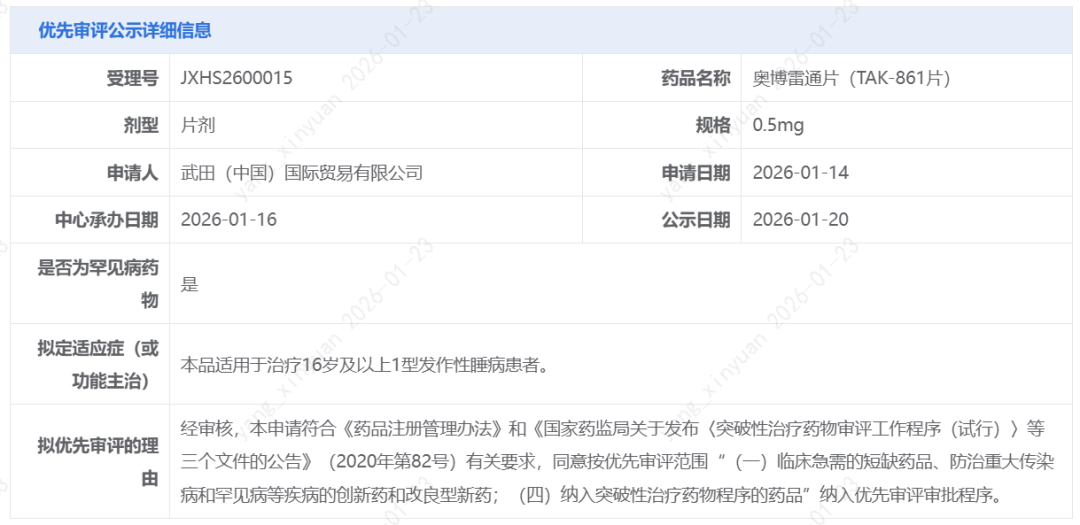
发作性睡病I型(NT1)是一种罕见的慢性中枢神经系统疾病,由于患者的食欲素神经元大量缺失,导致大脑和脑脊液中食欲素神经肽水平低下。NT1患者常 常有日间过度思睡(EDS)、猝倒(即肌肉张力突然丧失)、夜间睡眠紊乱、入睡前和清醒前幻觉以及睡眠瘫痪等临床症状。 奥博雷通片是一种在研选择性OX2R激动剂,可选择性地刺激OX2R以恢复其信号传导,并改善因食欲素缺乏而导致的NT1。2025年7月,武田宣布奥博雷 通片的两项针对NT1的3期研究达到所有主要和次要终点。 中国国家药监局药品审评中心官网近日公示显示,武田(TAK.US)申报的1类新药奥博雷通片(oveporexton,TAK-861片)的上市申请拟纳入优先审评,适用 于治疗16岁及以上1型发作性睡病(NT1)患者。公开资料显示,这是武田研发的一款口服选择性食欲素2型受体(OX2R)激动剂。该产品针对NT1适应症的两 项3期关键性研究已经达到所有主要和次要终点。 | 优先审评公示详细信息 | | | | | --- | --- | --- | --- | | 광택음 | JXHS2600015 奥博雷通片 (TAK-861片) | 药品名称 | | | 机号 ...
第一三共ADC药物R-DXd获国家药监局突破性疗法认定
Mei Ri Jing Ji Xin Wen· 2026-01-22 05:57
Core Viewpoint - Raludotatug Deruxtecan (R-DXd, DS-6000a) has received Breakthrough Therapy Designation (BTD) from the China National Medical Products Administration (NMPA) for the treatment of adult patients with platinum-resistant epithelial ovarian cancer, primary peritoneal cancer, or fallopian tube cancer who have previously been treated with Bevacizumab and express CDH6 [1] Group 1 - Raludotatug Deruxtecan is developed by Daiichi Sankyo and co-developed with Merck [1] - The drug is a CDH6-targeted antibody-drug conjugate (ADC) [1]
