TI(TXN)

Search documents
汽车芯片巨头,全力反击
3 6 Ke· 2026-01-09 03:48
Core Insights - The automotive chip discussion is shifting towards centralized and domain-controlled architectures as software-defined vehicles (SDVs) enter the engineering phase [1] - Traditional MCU manufacturers are adapting by introducing advanced processes and higher system integration to compete in the core architecture of software-defined vehicles [1][7] - The competition is intensifying as established chipmakers like NXP, Renesas, and TI aim to reclaim control over vehicle core functions against high-performance computing firms like Qualcomm and NVIDIA [8][19] Industry Transition - The traditional automotive electronic architecture was highly distributed, with vehicles using numerous ECUs for specific functions, which worked well in a mechanical-dominated industry [2] - The automotive MCU market was valued at $6 billion in 2020, accounting for 40% of the global MCU market, dominated by traditional automotive electronics manufacturers [3] - The rise of intelligent vehicles has disrupted this balance, with companies like Qualcomm and NVIDIA entering the market with superior computing power and software ecosystems [3][4] Competitive Landscape - Qualcomm has established a stronghold in the cockpit chip market, with a 67% share in the Chinese passenger vehicle cockpit chip market as of 2024 [4] - NVIDIA has dominated the autonomous driving sector, with its Orin chip achieving 254 TOPS of computing power and the upcoming Thor chip expected to reach 2000 TFLOPS [5] - Traditional MCU manufacturers face challenges as they adapt to the new architecture, with their products still important but no longer sufficient [6] Strategic Responses - As SDVs become the industry consensus, traditional MCU giants are launching new products to regain control over vehicle core functions [7][19] - NXP's S32N7 processor focuses on vehicle core functions, while Renesas' R-Car Gen 5 X5H is the first multi-domain automotive SoC built on a 3nm process [9][13] - TI's TDA5 series emphasizes energy efficiency with a maximum of 1200 TOPS computing power while maintaining a competitive power consumption ratio [16][18] Future Outlook - The collective efforts of MCU giants signify a redefinition of the automotive value chain, transitioning from background roles to central players in vehicle core functions [19] - The competition will evolve to encompass full-stack capabilities, from cloud to edge, and from perception to execution, with MCU manufacturers leveraging their expertise in real-time performance and reliability [21]


汽车芯片巨头,全力反击!
半导体行业观察· 2026-01-09 01:53
Core Viewpoint - The automotive chip discussion is shifting towards software-defined vehicles (SDV), with a focus on centralized and domain-controlled architectures, leading traditional chip manufacturers to adapt their strategies and technologies to remain competitive in the evolving market [1][9]. Group 1: Traditional Automotive Electronics - The traditional automotive electronic architecture is highly distributed, with high-end models using dozens to hundreds of ECUs, each serving specific functions like engine control and safety systems [3][4]. - Major players like TI, NXP, and Infineon have dominated the MCU market, which reached $6 billion in 2020, accounting for 40% of the global MCU market share [4][3]. - The rise of intelligent vehicles has disrupted this balance, as companies like Qualcomm and NVIDIA have entered the market with high-performance computing solutions, challenging traditional chip manufacturers [4][5]. Group 2: Emergence of High-Performance Computing - Qualcomm has established a strong presence in the cockpit chip market, with a 67% share in the Chinese passenger vehicle cockpit chip market as of 2024, driven by its advanced Snapdragon series [5][6]. - NVIDIA has dominated the autonomous driving sector, with its Orin chip achieving 508 TOPS of computing power, and its latest Thor chip reaching 2000 TFLOPS [6][7]. - The complexity of software and the need for high computing power in both cockpit and autonomous driving systems have made traditional MCUs less competitive [6][7]. Group 3: Strategic Response from Traditional MCU Manufacturers - Traditional MCU manufacturers are launching new products to regain control in the SDV landscape, focusing on high integration, advanced processes, and software architecture [9][10]. - NXP's S32N7 processor, based on 5nm technology, aims to be a system-level coordinator for core vehicle functions, emphasizing hardware isolation and software-defined partitioning [12][11]. - Renesas introduced the R-Car Gen 5 X5H, the first multi-domain automotive SoC built on 3nm technology, supporting ADAS and infotainment systems [15][16]. Group 4: Competitive Landscape and Value Reassessment - The shift from distributed to centralized architectures is redefining the roles of MCU manufacturers, transforming them from background players to key players in vehicle core functions [21][20]. - The strategic significance of this transition includes differentiated competition focusing on real-time reliability and safety, leveraging decades of experience and established relationships in the automotive industry [21][22]. - Cost control through high integration and efficiency is a common goal among MCU giants, with estimates suggesting potential cost reductions of up to 20% for NXP's S32N7 [22][21].


7份料单更新!出售安世、TI、美光等芯片
芯世相· 2026-01-08 04:23
Core Insights - The article discusses the challenges of managing excess inventory in the semiconductor industry, highlighting the financial burden of storage and capital costs associated with unsold materials [1] - It promotes a service called "Chip Superman," which has served 22,000 users and offers rapid inventory clearance solutions [9] Group 1: Inventory Management - Excess inventory of 100,000 units incurs monthly storage and capital costs of at least 5,000, leading to a potential loss of 30,000 over six months [1] - The article emphasizes the difficulty in promoting and selling excess materials, suggesting that companies can seek assistance from Chip Superman for better pricing and faster transactions [1][9] Group 2: Inventory Offerings - A list of available excess materials is provided, including various brands and models, with quantities ranging from 1600 to 240,000 units [4][5] - Notable items include NEXPERIA's BZT52H-C6V8 with 240,000 units and TI's TPS7B8250QDRVRQ1 with 78,000 units, indicating a diverse inventory across multiple brands [4][5] Group 3: Purchase Requests - The article also includes a section for requested materials, indicating demand for specific components such as Diodes' D5V0L1B2T-7 with a request for 150,000 units [6] Group 4: Warehouse and Quality Control - Chip Superman operates a 1,600 square meter smart warehouse with over 1,000 models and a total inventory of 50 million chips, valued at over 100 million [7] - Each component undergoes quality control checks in an independent laboratory located in Shenzhen [8]


半导体 - CES 2026 要点:AI 势头延续;模拟芯片数据边际向好_ Semiconductors_ CES 2026 Takeaways_ AI strength continues; incrementally positive analog datapoints
2026-01-08 02:43
Summary of Key Points from Conference Call Transcripts Industry Overview: Semiconductors Core Insights - **Strong Demand for AI Infrastructure**: Companies like Nvidia, AMD, and Marvell reported ongoing strong demand for AI infrastructure, driven by both physical and agentic AI in the medium term [2][6]. - **Incremental Drivers**: Nvidia introduced a new context memory storage platform aimed at enhancing AI model performance, while AMD is set to launch its MI400 series GPUs in 2026 and MI500 series in 2027 [2][9]. - **Market Dynamics**: Micron noted a robust DRAM supply/demand environment with strong pricing, consistent with previous earnings calls, and similar strength in the NAND market due to AI datacenter demand [2][19]. Company-Specific Highlights - **Nvidia (NVDA)**: - Anticipates a strong volume ramp for its Rubin platform in 2H26, with no major supply constraints reported [6][8]. - Launched an AI-native storage infrastructure platform to support larger context memory for GPUs, enhancing model performance [8]. - Price target set at $250 based on a 30X P/E multiple [7]. - **AMD (AMD)**: - Introduced the MI440X GPU for enterprise AI and plans to launch the Helios rack in 2026 [9][12]. - Price target set at $210 based on a 30X P/E multiple [10]. - **Analog Devices (ADI)**: - Experiencing a cyclical recovery with demand led by Industrial and Communications markets, though customer restocking is minimal [11][13]. - Price target set at $300 based on a 30X P/E multiple [14]. - **Marvell Technology (MRVL)**: - Announced acquisition of XConn Technologies to enhance networking capabilities, with strong order momentum [15][16]. - Price target set at $90 based on a 27X P/E multiple [18]. - **Micron Technology (MU)**: - Strong DRAM market conditions with expectations of ~20% growth in industry bit supply for CY2026 [20]. - Price target set at $235 based on a 15X P/E multiple [20]. - **ON Semiconductor (ON)**: - Stable demand trends with no notable customer restocking activity [22]. - Price target set at $60 based on a 17X P/E multiple [23]. - **Skyworks Solutions (SWKS)**: - Solid unit traction at major customers, though potential demand destruction in the smartphone market is a concern [25][29]. - Not rated currently [26]. - **Texas Instruments (TXN)**: - Highlighted refreshed product lines across various applications, but revenue conversion may take time [27]. - Price target set at $156 based on a 25X P/E multiple [28]. - **Synopsys (SNPS)**: - Emphasized synergies between chip design and physical simulation, with a new product expected in 1H26 [30]. - Price target set at $600 based on a 40X P/E multiple [31]. Additional Considerations - **Market Risks**: Key risks across companies include potential slowdowns in AI infrastructure spending, increased competition, and supply constraints [7][10][18]. - **Inventory Levels**: Many companies report lean inventories, with expectations of future restocking as demand stabilizes [11][13][22]. This summary encapsulates the critical insights and projections from the conference call transcripts, highlighting the semiconductor industry's current landscape and individual company trajectories.


Why Texas Instruments (TXN) Dipped More Than Broader Market Today
ZACKS· 2026-01-08 00:00
Company Performance - Texas Instruments (TXN) closed at $185.71, reflecting a -3.33% change from the previous day, underperforming the S&P 500's loss of 0.34% [1] - The stock has increased by 7.01% over the past month, outperforming the Computer and Technology sector's loss of 1% and the S&P 500's gain of 1.19% [1] Upcoming Earnings - Texas Instruments is set to release its earnings on January 27, 2026, with an expected EPS of $1.28, indicating a 1.54% decline compared to the same quarter last year [2] - Revenue is anticipated to reach $4.42 billion, representing a 10.38% increase from the year-ago quarter [2] Full Year Estimates - Analysts project earnings of $5.46 per share and revenue of $17.69 billion for the full year, reflecting changes of +5% and 0% respectively from the previous year [3] Analyst Forecast Revisions - Recent revisions to analyst forecasts for Texas Instruments are crucial as they often indicate short-term business trends and can influence stock performance [4] - Upbeat changes in estimates suggest a favorable outlook on the company's health and profitability [4] Zacks Rank and Performance - The Zacks Rank system, which incorporates estimate changes, currently rates Texas Instruments as 2 (Buy), with a 0.67% upward shift in the consensus EPS estimate over the past month [6] - Historically, 1 ranked stocks have returned an average of +25% annually since 1988 [6] Valuation Metrics - Texas Instruments has a Forward P/E ratio of 31.97, which is a premium compared to the industry average of 31.88 [7] - The company also has a PEG ratio of 3.1, compared to the Semiconductor - General industry's average PEG ratio of 3.39 [7] Industry Context - The Semiconductor - General industry, part of the Computer and Technology sector, holds a Zacks Industry Rank of 20, placing it in the top 9% of over 250 industries [8] - Research indicates that the top 50% rated industries outperform the bottom half by a factor of 2 to 1 [8]
今年CES,芯片厂商又开始“神仙打架”
3 6 Ke· 2026-01-07 00:42
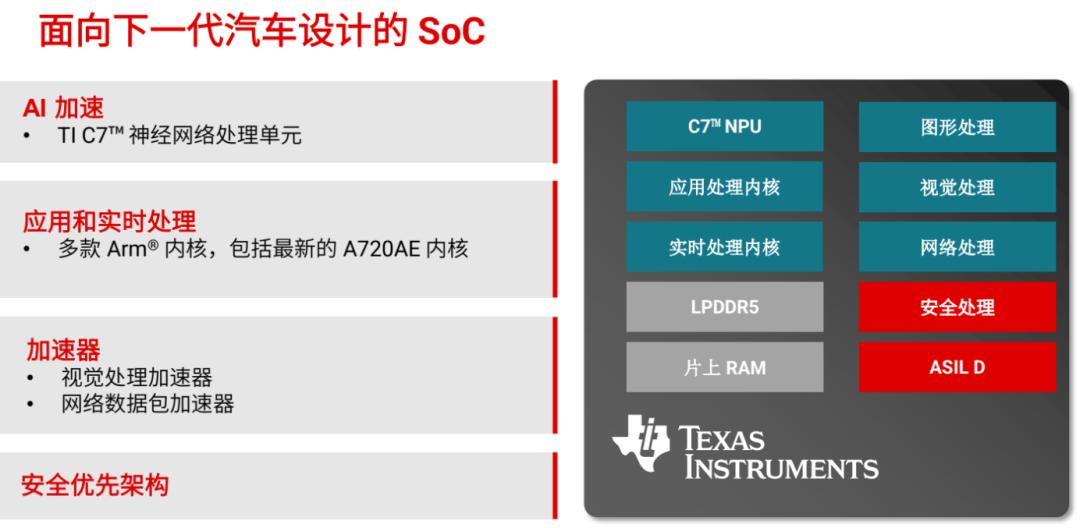
Group 1: TI's Automotive Innovations - TI launched three powerful automotive products at CES: the TDA5 series SoC, AWR2188 radar transmitter, and DP83TD555J-Q1 Ethernet PHY [1][4][7] - The TDA5 SoC features a maximum performance of 1200 TOPS and an energy efficiency of over 24 TOPS/W, with a 12-fold increase in AI computing power compared to previous generations [1] - AWR2188 is the industry's first single-chip 8x8 radar solution, enhancing performance by 30% and achieving high-precision detection for targets over 350m [4] - The DP83TD555J-Q1 Ethernet PHY supports nanosecond-level time synchronization and can transmit power and data over the same line, reducing cable design complexity and costs [7] Group 2: ADI's Diverse Solutions - ADI showcased various solutions in automotive, consumer, and robotics sectors, highlighting the A²B 2.0 solution with four times the bandwidth of its predecessor [10] - The automotive solutions include advanced lighting control and ADAS systems utilizing machine vision inputs [10][11] Group 3: NXP's High-Integration Processor - NXP introduced the S32N7 processor series, which integrates multiple vehicle functions on a single chip, potentially reducing total cost of ownership (TCO) by up to 20% [12][15] Group 4: Microchip's Demonstrations - Microchip presented demos including the ASA Motion Link for Qualcomm's Ride platform and a software-free intelligent headlight system using 10BASE-T1S technology [17][18] Group 5: Silicon Labs' New SDK - Silicon Labs launched a new Simplicity SDK for Zephyr, enhancing support for embedded systems and showcasing advancements in Bluetooth wireless technology [19] Group 6: Infineon's Development Kit - Infineon and Flex unveiled a modular development kit for regional control units, aimed at accelerating the development of software-defined vehicle architectures [20] Group 7: ST's Automotive Gateway - ST displayed the Osdyne Automotive Gateway, which enhances vehicle communication and security while reducing wiring complexity [22] Group 8: Ambarella's AI Vision Chip - Ambarella released the CV7 AI vision SoC, built on a 4nm process, achieving over 20% power reduction and more than 2.5 times the AI performance of its predecessor [25] Group 9: NVIDIA's Revolutionary Products - NVIDIA introduced the Rubin platform with six new chips and launched the Alpamayo series for AI-assisted driving development [26][28] Group 10: AMD's AI Innovations - AMD announced several new products, including the MI455X GPU and Ryzen AI 400 series processors, emphasizing its comprehensive AI capabilities [29][30] Group 11: Arm's Technology Trends - Arm focused on five key technology trends at CES, including advancements in autonomous driving, robotics, and smart home devices [31][32] Group 12: Industry Trends - The CES highlighted three major trends: the penetration of AI across all technology layers, the shift towards centralized and software-defined automotive electronics, and the importance of ecosystem collaboration over isolated technology competition [33]


昨夜,全线收涨!涉及美联储降息!
Xin Lang Cai Jing· 2026-01-07 00:29
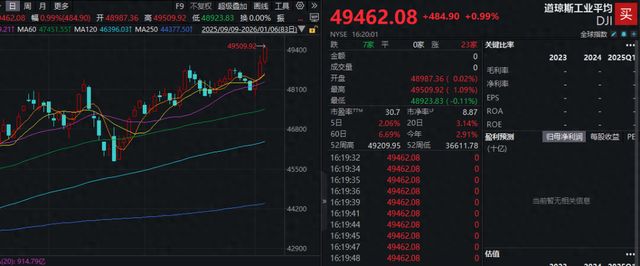
Group 1: Market Performance - The U.S. stock market saw all three major indices rise, with the Dow Jones Industrial Average reaching a new historical high, approaching the 50,000 mark, closing at 49,462.08 points, up 0.99% [3] - The Philadelphia Semiconductor Index increased by 2.75%, setting a new historical high, with notable gains in chip stocks such as Microchip Technology up over 11%, Micron Technology up over 10%, and NXP Semiconductors up over 9% [5][6] Group 2: Federal Reserve Insights - Federal Reserve Governor Milan stated that the Fed should lower interest rates by more than 100 basis points this year, as economic data trends may support further rate cuts [5] - Milan noted that core inflation has returned to around the Fed's 2% target, and he expects strong economic growth in the U.S. this year [5] Group 3: Commodity Prices - Silver prices surged again, with COMEX silver futures breaking the $80 per ounce mark, reflecting a rise of approximately 6% [8] - Gold prices also saw a slight increase, with COMEX gold futures surpassing $4,500 per ounce, up over 1% [8]


Texas Instruments to webcast Q4 2025 and 2025 earnings conference call
Prnewswire· 2026-01-06 16:57
Core Viewpoint - Texas Instruments Incorporated (TI) will host a webcast for its fourth quarter and year-end 2025 earnings conference call on January 27, 2026, at 3:30 p.m. Central time, featuring key executives discussing financial results and addressing investor questions [1]. Company Overview - Texas Instruments is a global semiconductor company that designs, manufactures, and sells analog and embedded processing chips for various markets, including industrial, automotive, personal electronics, enterprise systems, and communications equipment [3]. - The company aims to make electronics more affordable through its semiconductor innovations, focusing on reliability, affordability, and lower power consumption [3].

Texas Instruments Ahead Of Earnings: I See Stability, Not Urgency
Seeking Alpha· 2026-01-06 15:28
Core Insights - The focus is on producing objective, data-driven research primarily about small- to mid-cap companies, which are often overlooked by many investors [1] Group 1 - The analysis occasionally includes large-cap companies to provide a broader perspective on the equity markets [1]
【太平洋科技-每日观点&资讯】(2026-01-07)
远峰电子· 2026-01-06 11:58
Market Overview - Major indices showed positive performance with the STAR Market 50 up by 1.84%, the Northern Exchange 50 up by 1.82%, the Shanghai Composite Index up by 1.50%, the Shenzhen Component Index up by 1.40%, and the ChiNext Index up by 0.75% [1] - The TMT sector led the gains, with the SW Panel sector increasing by 5.21%, SW Semiconductor Materials by 4.41%, and SW Vertical Application Software by 3.86% [1] - Conversely, the TMT sector also saw declines, with SW Communication Network Equipment and Devices down by 1.70%, SW Communication Cables and Supporting down by 0.68%, and SW Printed Circuit Boards down by 0.60% [1] Domestic News - Luxshare Precision is set to add a new VR glasses production line with an annual capacity of 9 million units, alongside an increase in the production capacity of VR glasses charging cases by 4.5 million units [2] - A semiconductor equipment R&D and production base project in Suzhou has been signed with a total investment of 1.05 billion yuan, expected to achieve an annual output value of over 1 billion yuan upon full production [2] - Deep Tianma has signed a long-term OLED materials supply and licensing agreement with UDC to support its OLED display production [2] - The new factory of Jinglong Technology for high-end semiconductor testing has been put into operation with a total investment of 4 billion yuan, covering AI, automotive-grade, and industrial-grade chip testing [2] Overseas News - Appfigures data indicates that the Manus mobile app is projected to reach approximately 4.5 million downloads by 2025, primarily from emerging markets like Brazil, Egypt, and India, with an estimated in-app revenue of 13 million USD for the year [3] - AMD has launched the Helios platform, boasting an AI computing capability of 2.9 exaflops and equipped with 31TB of HBM4 memory [3] - Texas Instruments has introduced the TDA5 chip for autonomous vehicles, utilizing a 5nm process and enhancing computation speed from 100 trillion operations per second to up to 1.2 quadrillion [3] - METI plans to increase its overall budget by approximately 50% to around 3.07 trillion yen, with significant funding directed towards the semiconductor and AI sectors [3] AI News - NVIDIA has officially launched the "Vera Rubin" platform, featuring the Vera CPU with 88 customized Olympus cores and the Rubin GPU capable of 50 quintillion floating-point operations per second [4] - WeChat has initiated the "AI Mini Program Growth Plan," committing resources to support developers and aiming for a significant increase in AI applications by 2026 [4] - The National Radio and Television Administration announced a month-long special governance initiative starting January 1, 2026, targeting the misuse of AI tools in altering classic content [4] Industry Tracking - Brain-computer interface startup Strong Brain Technology has completed approximately 2 billion yuan in financing, producing products that assist disabled individuals in controlling prosthetic limbs [5] - New Times has released the first "industrial-grade" embodied intelligent robot, SYNDA R1, designed for various operational tasks [5] - Dongfang Boiler has successfully completed a key phase of a national key R&D project related to stable and clean combustion technology [5] - Beijing has announced an action plan for building an AI innovation hub, aiming to achieve a core industry scale exceeding 1 trillion yuan within two years [5]