GitHub

Search documents
X @Avi Chawla
Avi Chawla· 2026-03-01 06:30
Cognee GitHub:(don't forget to star 🌟)https://t.co/Ken9bmXWY9 ...
AI领域趋势深度洞察报告-从蛮力到智能:2025年人工智能发展的三大核心
Sou Hu Cai Jing· 2026-02-27 22:52
今天分享的是:AI领域趋势深度洞察报告-从蛮力到智能:2025年人工智能发展的三大核心趋势 报告共计:36页 文档包含2025年AI领域三大核心趋势与中国罕见病行业发展两大核心内容。AI领域方面,算法创新与开源浪潮推动行业从"拼算力"转向"拼技巧",MoE架构 降低训练成本,DeepSeek、Llama 4等开源模型崛起,AI使用门槛降低;AI从对话工具升级为生产力工具,企业AI支出爆发式增长,AI Agent、人形机器人 量产落地,广泛渗透多行业;全球AI监管框架逐步建立,中国、欧盟、韩国等出台相关政策,中国明确"三步走"战略,平衡创新与规范。罕见病领域方面, 我国已知罕见病逾4000种,患者约2000万,两批目录覆盖207种疾病,2025年获批药品48款,医保与商保"双目录"形成互补保障;诊疗体系不断完善,诊疗 协作网、MDT模式及AI辅助诊断提升确诊效率,但药物可及性、特医食品供应等仍存挑战,未来将聚焦政策完善、研发创新、多层次保障等方向推进。 以下为报告节选内容 01 02 03 从拼蛮力到拼技巧 从对话工具到工作伙伴 从野蛮生长到规则重 AI变得更聪明, 也更便宜了 AI正在成为实打实的生产力工具 ...


Claude Code“隐形技术栈”被扒出来了,2430次测试揭秘工具偏好清单
3 6 Ke· 2026-02-27 09:27
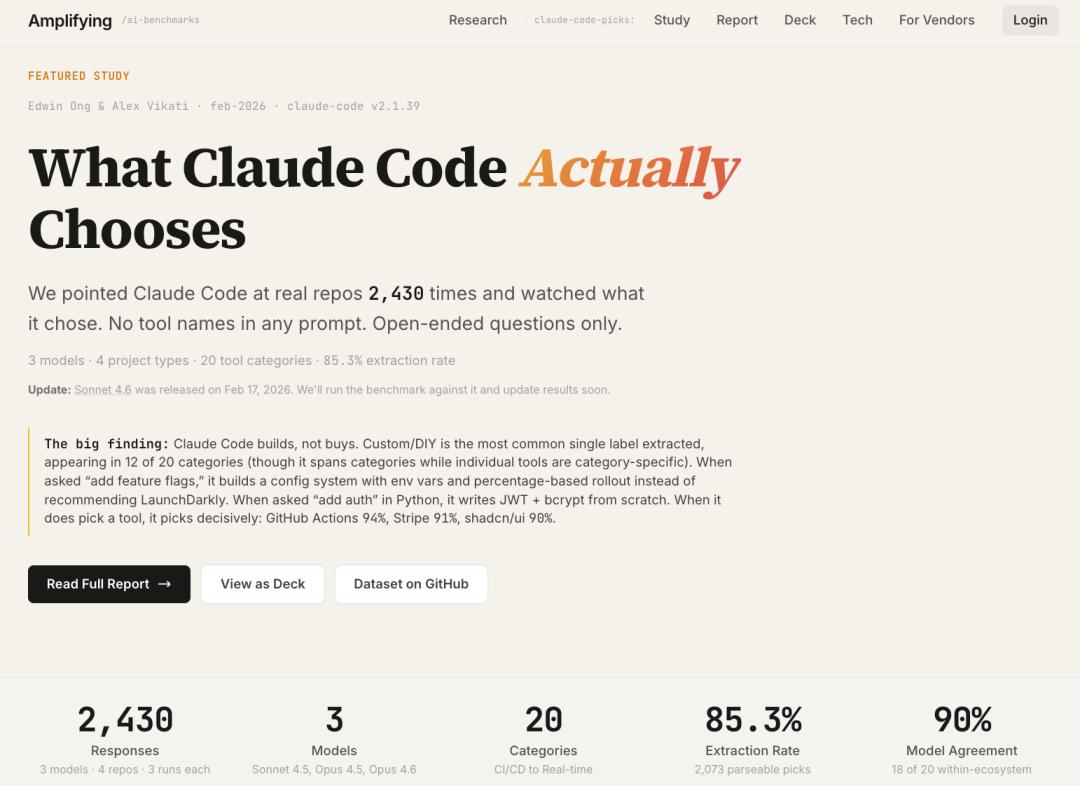
向Claude Code提开发需求,却刻意不在prompt中提及任何具体工具,它会更倾向于选择用什么工具?又会展现出哪些偏好特征? 最近,专注于量化AI主观决策的基准测试工作室Amplifying.ai,针对Claude Code的工具选择倾向开展了一项系统性研究。 研究覆盖3款模型、4种项目类型及20个工具类别,累计分析了2430次工具选择行为。 1、倾向"自建"而非选用第三方工具: Claude Code更倾向于自己编写自定义解决方案,而不是直接推荐现成的第三方工具。自定义/DIY实现占所有主要选择的12%(2073次中的252次),成了 最常见的选择。 2、默认技术栈已然形成: Claude Code选择第三方工具时,会集中选:Vercel、PostgreSQL、Stripe、Tailwind CSS、shadcn/ui、pnpm、GitHub Actions、Sentry、Resend、Zustand。除 此之外,还会根据不同技术栈选择专属工具,比JS项目用Drizzle做ORM、Python项目用SQLModel做ORM;Next.js项目用NextAuth.js做认证;JS项目用 Vitest做测 ...
GitHub前CEO推出面向智能体编程时代的开发者平台
Sou Hu Cai Jing· 2026-02-25 10:18
当GitHub CEO托马斯·多姆克在2025年8月离开这家微软旗下公司时,他表示这是为了回归创业初心。经 过几个月的开发,他现在推出了Entire,这是一个全新的开源开发者平台,重新构想了如果从零开始构 建,开发者与智能体之间的协作会是什么样子。 Entire获得了6000万美元的种子轮融资,这是开发者工具领域历史上最大的种子轮。本轮融资由Felicis 领投,Madrona、Basis Set和微软旗下风险投资部门M12参投。 同样值得注意的是,虽然这是一个平台策略,但Entire不一定最终会与GitHub竞争。多姆克说,想法是 在堆栈中构建更高层次的层,开发者可以在其中管理智能体的推理过程并与它们协作。代码仓库仍将是 其中的核心。 Entire正在构建的是一个三层平台,以从零开始构建的新Git兼容数据库作为基础,中间是语义推理层, 顶部是用户界面。 这在任何标准下都是一笔超大规模的融资,但多姆克的声誉无疑起到了帮助作用,他曾领导GitHub从代 码仓库发展为围绕Copilot构建的以AI为中心的平台。此外,考虑到软件开发的快速发展步伐,需要大 量投资来跟上市场不断变化的需求。 在接受采访时,多姆克解释了 ...

DAU已死,TPD永生
3 6 Ke· 2026-02-23 02:37
Core Insights - OpenAI is reportedly shifting focus from the traditional DAU (Daily Active Users) metric to a new metric called TPD (Tokens Per Day), which measures the value generated by users through AI interactions rather than just user engagement [2][3][25][60]. Group 1: Shift in Metrics - DAU has been a key performance indicator in the internet industry for the past 20 years, primarily measuring user attention [4][5]. - The traditional logic of DAU is based on capturing user time to drive advertising and sales, but this is being challenged by AI agents that can perform tasks without direct user interaction [6][7][62]. - OpenAI's product lead emphasized that DAU does not reflect the value created by users, leading to the adoption of TPD as a more relevant metric [3][25]. Group 2: The Role of AI Agents - AI agents can automate tasks that previously required significant user attention, fundamentally changing how productivity is measured [8][10][22]. - Users can now delegate complex tasks to AI agents, resulting in high token consumption without the need for constant app interaction, thus diminishing the relevance of DAU [12][24][63]. - The emergence of AI agents suggests that many traditional applications may become obsolete, as users will rely on agents to perform tasks rather than manually interacting with multiple apps [17][20][24]. Group 3: TPD as a New Metric - TPD measures the computational resources a user drives through AI, indicating a shift from time-based productivity to value-driven productivity [25][27]. - Companies like Midjourney and Cursor exemplify high TPD, achieving significant outputs with minimal personnel, showcasing the efficiency of AI in driving productivity [30][32][43]. - The value of a user is now determined by their ability to leverage AI agents effectively, rather than the time they spend on applications [38][39]. Group 4: Implications for Business Models - The transition to TPD will alter business models, moving from user-based revenue to consumption-based revenue, where companies charge based on token usage rather than user counts [46][47]. - OpenAI's projected annual recurring revenue (ARR) for 2025 is expected to exceed $20 billion, largely driven by token consumption from enterprise clients [47]. - Future SaaS models will likely charge based on the computational power required, rather than per user, reflecting the shift in how value is generated [48][49]. Group 5: Future of Software and User Engagement - The rapid adoption of AI agents is expected to lead to a decline in traditional software applications, as users will prefer to interact with agents that can complete tasks efficiently [54][66]. - The competitive landscape will shift from user acquisition to enhancing the efficiency of user-driven AI interactions, fundamentally changing how platforms are valued [45][62]. - While DAU remains relevant for content and social products, its importance is diminishing in productivity tools and enterprise services, where TPD is becoming the primary measure of success [61][63].

Figma(FIG) - 2025 Q4 - Earnings Call Transcript
2026-02-18 23:02
Financial Data and Key Metrics Changes - The company reported Q4 2025 revenue of $304 million, representing a year-over-year growth rate of 40% [5][25] - For the full year 2025, total revenue reached $1.056 billion, up 41% year-over-year [25][29] - The non-GAAP operating margin for Q4 was 14%, with adjusted free cash flow margin at 13% [5][32] - The company ended the year with $1.7 billion in cash, cash equivalents, and marketable securities [5][32] Business Line Data and Key Metrics Changes - The net dollar retention rate for customers with more than $10,000 in ARR increased to 136%, up five percentage points quarter-over-quarter [5][26] - Weekly active users of Figma Make grew over 70% quarter-over-quarter, with over 50% of paid customers spending more than $100,000 in ARR using it weekly [12][25] - The company added 951 net customers spending more than $10,000 in ARR in Q4, and 143 net customers spending more than $100,000 in ARR, a 46% year-over-year growth [26][27] Market Data and Key Metrics Changes - International revenue grew 45% year-over-year, with international users representing approximately 85% of monthly active users and accounting for 54% of revenue in Q4 [28][29] - The company launched in India in November 2025, indicating ongoing international expansion efforts [29] Company Strategy and Development Direction - The company plans to continue investing in AI-native workflows and enhancing product capabilities to support customer adaptation to new working methods [33][34] - Figma aims to unify its product surfaces, particularly between Figma Make and Figma Design, to enhance user experience and drive adoption [62] Management's Comments on Operating Environment and Future Outlook - Management expressed confidence in the long-term cash-generating profile of the business despite a decline in adjusted free cash flow due to investments in infrastructure and AI [32][34] - The company anticipates revenue for Q1 2026 to be in the range of $315 million to $317 million, implying 38% growth at the midpoint [34] Other Important Information - The company acquired Weavy, enhancing its AI image, video, animation, and motion generation capabilities [20][24] - Stock-based compensation was elevated in 2025 due to various factors, but the company expects improvement as revenue scales [33] Q&A Session Summary Question: Insights on UI and UX with Emerging Agentic Layers - Management believes that while agents will take on more tasks, the need for human-readable visual interfaces will remain crucial, emphasizing the importance of design [39][40] Question: 2026 Guidance and Credit Consumption Monetization - Management indicated that guidance is based on observed seat adoption behavior and usage trends, with expectations for refinement as new features are introduced [42][43] Question: User Types and Figma Make Adoption - The company is seeing new user types, including product managers, engaging with Figma Make, which could lead to seat expansion [48][49] Question: Pricing and Revenue Impact - Management explained that the pricing changes implemented last year will continue to contribute to revenue growth, with a bell curve effect expected [54][57] Question: Competition in Prototyping Space - Management noted that over 80% of full seat users of Figma Make also use Figma Design, indicating a strong integration and potential for unifying product surfaces [61][62]

Figma(FIG) - 2025 Q4 - Earnings Call Transcript
2026-02-18 23:02
Financial Data and Key Metrics Changes - Figma reported Q4 2025 revenue of $304 million, representing a 40% year-over-year growth rate, and full-year revenue of $1.056 billion, up 41% year-over-year [5][25] - The net dollar retention rate for customers with more than $10,000 in ARR increased by five percentage points quarter-over-quarter to 136%, marking the highest rate in the last 10 quarters [5][26] - The company ended the year with $1.7 billion in cash, cash equivalents, and marketable securities [5][32] Business Line Data and Key Metrics Changes - Figma expanded from four to eight products in 2025 and launched over 200 features, including new AI-native functionalities [5][6] - Weekly active users of Figma Make grew over 70% quarter-over-quarter, with over 50% of paid customers spending more than $100,000 in ARR using Figma Make weekly [12][25] Market Data and Key Metrics Changes - International revenue grew 45% year-over-year, with international users representing approximately 85% of monthly active users and accounting for 54% of revenue in Q4 [28][29] - The company is seeing strong expansion dynamics as customers broaden their use of the platform, with 67 paid customers spending more than $1 million in ARR, growing 68% year-over-year [27] Company Strategy and Development Direction - Figma is focused on defining new AI-native workflows and supporting customers as they adapt to new ways of working, while maintaining a disciplined approach to scaling the business [33][34] - The company aims to enhance integration between Figma Make and Figma Design, emphasizing the importance of round-tripping between code and design [61][62] Management's Comments on Operating Environment and Future Outlook - Management expressed confidence in the long-term cash-generating profile of the business, despite a sequential decline in adjusted free cash flow due to investments in infrastructure and AI [32][33] - For Q1 2026, Figma expects revenue in the range of $315 million to $317 million, implying 38% growth at the midpoint, and for the full year, revenue is anticipated to be between $1.366 billion and $1.374 billion, implying 30% growth at the midpoint [34] Other Important Information - Stock-based compensation was elevated in 2025 due to IPO-related expenses and is expected to improve as a percentage of revenue as the company scales [33] - The company is excited about the potential of AI to enhance creative processes and is pushing the boundaries of what can be created on the Figma platform [20][23] Q&A Session Summary Question: Insights on the impact of agentic layer offerings on UI/UX - Management believes that while agents will take on more work, humans will still need visual interfaces for understanding and auditing, which will keep design as a critical differentiator [38][39] Question: Guidance on credit consumption monetization - Management expects to refine guidance based on observed seat adoption behavior and usage trends, with 75% of paid customers consuming AI credits weekly [41][42] Question: User types and budget implications from Figma Make - Management noted an increase in non-designer roles engaging with design tasks, indicating a shift towards more generalist responsibilities within teams [65][66] Question: Concerns about AI partnerships and product development - Management emphasized the importance of maintaining control over design tasks while leveraging AI advancements, focusing on integrating AI capabilities into the product roadmap [54][71] Question: Pricing and packaging impact on revenue - Management indicated that the pricing changes implemented last year will continue to benefit revenue, with a growing impact expected as customers renew [56][57]
Figma(FIG) - 2025 Q4 - Earnings Call Transcript
2026-02-18 23:00
Financial Data and Key Metrics Changes - Figma reported Q4 2025 revenue of $304 million, representing a 40% year-over-year growth rate, and full-year revenue of $1.056 billion, up 41% year-over-year [4][22] - The net dollar retention rate for customers with more than $10,000 in ARR increased by five percentage points quarter-over-quarter to 136%, marking the highest rate in the last 10 quarters [4][23] - The company ended the year with $1.7 billion in cash, cash equivalents, and marketable securities [4][28] Business Line Data and Key Metrics Changes - Figma expanded from four to eight products in 2025 and launched over 200 features, including new AI-native functionality [4] - Weekly active users of Figma Make grew over 70% quarter-over-quarter, with over 50% of paid customers spending more than $100,000 in ARR using Figma Make weekly [11][22] Market Data and Key Metrics Changes - International revenue grew 45% year-over-year, with international users representing approximately 85% of monthly active users and accounting for 54% of revenue in Q4 [25][26] - The company added 951 net customers spending more than $10,000 in ARR and 143 net customers spending more than $100,000 in ARR, with the latter growing by 46% year-over-year [23] Company Strategy and Development Direction - Figma is focused on defining new AI-native workflows and supporting customers adapting to new ways of working, while maintaining a disciplined approach to scaling the business [30][31] - The company aims to enhance integration between Figma Make and Figma Design, emphasizing the importance of round-tripping between code and design [59] Management's Comments on Operating Environment and Future Outlook - Management expressed confidence in the long-term cash-generating profile of the business, despite a decline in adjusted free cash flow in Q4 due to investments in infrastructure and AI [28][29] - For Q1 2026, Figma expects revenue in the range of $315 million to $317 million, implying 38% growth at the midpoint, and for the full year, revenue is anticipated to be between $1.366 billion and $1.374 billion, implying 30% growth at the midpoint [31] Other Important Information - The company is seeing a shift in user types, with product managers and other non-designers increasingly engaging with Figma Make, indicating potential for seat expansion [45][62] - Figma's AI image editing capabilities were significantly enhanced, with over 10 million uses in just a few weeks after updates [18] Q&A Session Summary Question: Insights on the impact of agentic layer offerings on UI/UX - Management believes that while agents will take on more work, humans will still need to understand and trust the processes, necessitating visual interfaces [36][38] Question: Guidance on 2026 revenue and credit consumption monetization - Management expects to refine guidance based on observed seat adoption behavior and usage trends, with 75% of paid customers consuming AI credits weekly [40][41] Question: Competition in the prototyping space and budget implications - Management noted that over 80% of Figma Make users also use Figma Design, indicating a strong integration opportunity and potential for budget consolidation [58][59] Question: Future partnerships with AI companies - Management is focused on ensuring that as AI models improve, Figma also enhances its offerings, while exploring deeper partnerships with AI providers [68][69]
10 Middle Class Careers That Won’t Survive AI — And the Wealth Strategy That Will
New Trader U· 2026-02-18 09:31
Core Insights - The rise of AI technology is dismantling traditional middle-class careers, particularly in white-collar sectors, rather than blue-collar jobs [1][2] Group 1: Vulnerable Careers - Data entry and processing clerks are facing a projected 35% decline by 2032, equating to approximately 53,000 jobs lost in the US [4] - Paralegals and legal assistants are being replaced by AI tools that can conduct legal research and draft documents significantly faster, with a reported 60% reduction in case preparation time [6] - Insurance underwriters are seeing a shift as AI systems evaluate risk profiles and make coverage decisions more efficiently, with McKinsey estimating 25% of tasks in the insurance industry to be fully automated by 2030 [8] - Bookkeepers and accounting clerks are increasingly being replaced by AI platforms that automate transaction categorization and financial reporting [10] - Customer service representatives are being replaced by AI chatbots, with companies like Klarna saving $40 million annually by replacing 700 agents [12] - Loan officers and mortgage processors are becoming obsolete as AI-driven platforms can assess creditworthiness and approve loans faster than traditional methods [15] - Medical coders and billing specialists are facing job losses as AI systems automate coding and claims processing with high accuracy [17] - Junior and mid-level financial analysts are at risk as AI tools can generate reports and identify market trends, potentially replacing significant portions of the workforce [19] - Technical writers are seeing a decline in demand as AI can generate documentation with minimal human input [21] - Administrative and executive assistants are being replaced by AI tools that manage scheduling and communication tasks [23] Group 2: Wealth Strategy - The article suggests that the conventional career path is breaking down, and the future lies in leveraging AI tools to create one-person businesses [24] - By utilizing AI, individuals can offer services that were previously managed by teams, thus transforming the traditional employment model [26] - The shift towards AI-powered businesses allows individuals to scale their output and create value without competing for traditional salaried positions [27]


开发者福音!GitHub AI代理终结3小时杂务,效率狂升10倍
Tai Mei Ti A P P· 2026-02-16 05:49
Core Insights - GitHub introduces Agentic Workflows, an AI-driven feature aimed at alleviating the "invisible burden" of repository management tasks for developers, which includes dependency updates, issue categorization, and simple code error fixes [2][5] - The feature is designed to enhance developer productivity by automating mundane tasks while maintaining strict control over repository operations through a robust safety mechanism [3][5] Developer Pain Points - Approximately 68% of developers spend over 3 hours weekly on repository management tasks, with nearly 30% of open-source projects having known security vulnerabilities due to untimely dependency updates [2] - The introduction of Agentic Workflows aims to free developers from these repetitive tasks, allowing them to focus on core activities like code innovation and feature development [5] Agentic Workflows Features - The AI agent is built on GitHub Copilot's large language model, capable of understanding repository structure, contribution rules, and historical data to execute various tasks within predefined limits [2][3] - The safety mechanism allows maintainers to define AI operation permissions, ensuring that high-risk changes require manual approval, thus preventing unauthorized modifications [3][4] Implementation and Efficiency - The AI agent analyzes repository documentation and historical commits to establish a clear understanding of the repository's rules and coding style, creating a closed-loop process of "cognition-execution-review" [3][4] - A case study showed that a project maintainer using the feature was able to review and merge updates in just 5 minutes, achieving nearly a 10-fold increase in efficiency compared to traditional manual processes [4] Industry Impact - The launch of Agentic Workflows marks a significant shift for GitHub from a code storage tool to an intelligent collaboration platform, setting a new standard for AI application safety in the industry [5] - Competitors are responding rapidly, with OpenAI releasing an upgraded version of Copilot featuring AI-driven code security scanning, and GitLab launching AI-powered merge request automation [5][6] - Bitbucket is collaborating with Anthropic to introduce an automation tool focused on fixing security vulnerabilities in open-source projects, indicating a competitive race in AI-driven developer collaboration tools [6]