
中国南方电网有限责任公司

Search documents
电力中长期交易:直接参与市场用户不再执行分时电价!利好新型储能等灵活调节资源
中关村储能产业技术联盟· 2025-12-19 06:19
Core Viewpoint - The document outlines the guidelines for signing and fulfilling long-term electricity contracts for 2026, emphasizing the importance of high-quality contracts to ensure stable electricity supply and pricing in the market [6][7][8]. Group 1: Contract Signing Requirements - The document stresses the need for a high proportion of long-term electricity contracts, with coal-fired power plants required to sign contracts for at least 70% of the previous year's actual grid-connected electricity [7]. - For regions with tight electricity supply, local authorities may adjust the signing ratio upwards during peak seasons [8]. - The document mandates that electricity users should also ensure that their annual contract signing volume meets at least 80% of the expected electricity consumption [8]. Group 2: Improving Contract Quality - It is essential to enhance the quality of long-term contracts by implementing time-segmented and curve-based signing mechanisms, allowing for more precise reflection of price signals [9][10]. - The document encourages the adoption of flexible pricing mechanisms that reflect real-time supply and demand, rather than enforcing fixed prices [10]. - Regions are required to optimize the price formation mechanism, ensuring that market participants are not bound by government-mandated time-of-use pricing [10]. Group 3: Cross-Province and Cross-Region Agreements - The document requires that parties involved in cross-province and cross-region electricity transactions must fully sign annual long-term contracts and clarify monthly plans and delivery curves [3][8]. - It emphasizes the need for coordination between sending and receiving parties to establish stable inter-provincial electricity flows [3][8]. Group 4: Timeframe and Implementation - Local governments and the National Energy Administration are tasked with implementing these guidelines and must report their arrangements for the 2026 annual trading by December 10, 2025 [14]. - The Beijing and Guangzhou electricity trading centers are specifically mentioned to complete the signing of national long-term contracts by December 25, 2025 [3][14].


南方电网 电力建设先行 服务封关运作
Ren Min Ri Bao· 2025-12-18 01:03
Core Viewpoint - The construction and digital upgrade of Hainan's power infrastructure are crucial for supporting the operation of the Hainan Free Trade Port, enhancing energy supply security, and promoting green development [1][2][3]. Group 1: Infrastructure Development - The Hainan 500 kV main grid project, completed on December 15, marks the first provincial digital power grid in China, designed to withstand severe weather and enhance the power supply capacity by over four times, equivalent to adding four efficient power highways [1]. - The project involved an investment of 5.7 billion yuan and the construction of 838 kilometers of new transmission lines, significantly improving the power transmission capability to support future development [1]. Group 2: Digital and Green Transformation - The upgraded digital grid can accurately capture data related to equipment, environment, and weather, addressing the increased electricity demand and complex scenarios post-closure [2]. - Hainan's energy transition aligns with its goal of becoming a clean energy island, with initiatives like the Boao zero-carbon demonstration area and a comprehensive smart grid established by the end of 2021 [2]. Group 3: Renewable Energy Integration - The Hainan power grid company has introduced a "one-stop" grid connection service, reducing connection times by nearly 30%, with renewable energy installations exceeding 12 million kW, making it the largest power source in the province [3]. - The new digital grid significantly enhances the capacity for clean energy, which is vital for attracting high-end industries to the region [3]. Group 4: Service Improvement and Strategic Planning - The company has established mechanisms to improve electricity service for 1,005 major projects, transitioning from reactive to proactive service delivery [4]. - Efforts to streamline high-voltage electricity application processes and achieve over 99% online application rates have resulted in significant cost savings for customers [4]. - The company aims to build a world-class modern power grid in Hainan, focusing on intelligent, green, and high-quality electricity services to support the development of the free trade port [4].
两部委:2026年起组织开展全国统一电力市场评价
Xin Lang Cai Jing· 2025-12-17 14:19
风电头条获悉,12月17日,国家发展改革委办公厅、国家能源局综合司发布关于建立全国统一电力市场评价制度的通知。 文件指出,全国统一电力市场评价工作应结合市场建设情况开展多维度综合评价,重点围绕电力市场运营效果、市场作用发挥、经营主体可持续 性发展、市场竞争充分度四个方面开展评价。 登录新浪财经APP 搜索【信披】查看更多考评等级 (来源:风电头条) 文件还指出,市场为储能、虚拟电厂等新业态提供发展空间,推动民营企业参与,带动相关产业链成长,促进就业和能源新质生产力提升。 市场竞争充分度评价方面,要求电力市场实现统一开放,经营主体有序竞争,对不当市场竞争、报价异常及市场力滥用行为能够有效约束,电力 市场信用机制健全,能够对市场失信行为进行惩戒。 此外,自2026年起组织开展全国统一电力市场评价,制定市场评价标准。鼓励各地因地制宜按需开展电力市场评价工作。鼓励市场运营机构充分 发挥自身优势,开展市场量化评价,及时发现并反馈电力市场建设运营相关问题。 公告如下: 以习近平新时代中国特色社会主义思想为指导,全面贯彻党的二十大和二十届历次全会精神,按照完善全国统一电力市场体系要求,围绕加快构 建新型电力系统的总体目标, ...
两部委:为储能、虚拟电厂等提供发展空间
Xin Lang Cai Jing· 2025-12-17 14:19
Core Viewpoint - The National Development and Reform Commission and the National Energy Administration have announced the establishment of a national unified electricity market evaluation system, set to begin in 2026, aimed at enhancing market efficiency and promoting the participation of private enterprises in the energy sector [1][19]. Group 1: Overall Requirements - The evaluation system is guided by Xi Jinping's thoughts and aims to create a scientific, systematic, and dynamic evaluation framework that balances safety, green transition, and economic efficiency [22]. - The evaluation will provide a decision-making basis for market construction and regulation, enhancing the optimization of electricity resource allocation [22]. Group 2: Evaluation Content - The evaluation will focus on four key areas: market operation effectiveness, market role performance, sustainable development of operating entities, and market competition adequacy [22]. Group 3: Market Operation Effectiveness Evaluation - A complete unified electricity market rule system will be established, ensuring coverage of various market types including long-term, spot, and ancillary services [23]. - A comprehensive technical standard system will be developed to meet current market needs and reflect advanced technologies [23]. - The evaluation will assess the efficiency of market operations, including member management, information disclosure, and transaction organization [23][25]. Group 4: Market Role Performance Evaluation - The evaluation will promote efficient circulation of electricity resources across regions, enhancing overall grid efficiency [26]. - Safety benefits will be ensured through coordinated operations of energy markets and capacity compensation mechanisms [26]. - Environmental benefits will be measured by the promotion of high-quality development and consumption of renewable energy [26]. - Economic benefits will be assessed through dynamic pricing mechanisms that optimize resource allocation and maintain reasonable electricity price fluctuations [26]. Group 5: Sustainable Development of Operating Entities Evaluation - The market mechanism will guide reasonable investment layouts, ensuring cost recovery and stable operations for electricity enterprises [27]. - The market will provide development space for new business models like energy storage and virtual power plants, fostering private sector participation and job creation [28]. - Market satisfaction among operating entities will be evaluated, focusing on their engagement and recognition of the market environment [29]. Group 6: Market Competition Adequacy Evaluation - The evaluation will ensure orderly competition among market participants and effective constraints on unfair practices [30]. - The market concentration index will be monitored to maintain a balance between supply-demand risks and price volatility [31]. Group 7: Evaluation Methods - A comprehensive evaluation indicator system will be established, reflecting practical market operations and allowing for dynamic adjustments [31]. - The evaluation will combine qualitative and quantitative analyses, as well as horizontal and vertical comparisons [31][32]. - Digital technologies will be leveraged to enhance the evaluation process and improve regulatory efficiency [33]. Group 8: Implementation and Application - The evaluation results will be compiled into reports for reference by government departments and market operators, facilitating analysis and improvement [34]. - The evaluation work will be organized by the National Development and Reform Commission and the National Energy Administration, with collaboration from various stakeholders [35].

为储能等新业态提供发展空间!国家发展改革委、国家能源局建立全国统一电力市场评价制度
中关村储能产业技术联盟· 2025-12-17 11:47
Core Viewpoint - The establishment of a national unified electricity market evaluation system aims to enhance the efficiency and effectiveness of the electricity market, ensuring sustainable development and promoting competition among market participants [1][5][6]. Group 1: Overall Requirements - The evaluation system is guided by Xi Jinping's thoughts and aims to align with the goals of building a new power system, focusing on safety, green transformation, and economic efficiency [6]. - The evaluation will provide a scientific and systematic framework to assess the performance of the electricity market, supporting decision-making for market construction and regulation [6]. Group 2: Evaluation Content - The evaluation will focus on four main aspects: market operation effectiveness, market role performance, sustainable development of operating entities, and market competition adequacy [7]. Market Operation Effectiveness - The evaluation will assess the progress of market construction, including the establishment of a complete set of unified market rules and the coverage of various market types [8]. - It will also evaluate the technical standards and the operational foundation of the electricity market, ensuring efficient management and accurate information disclosure [9][10]. Market Role Performance - The evaluation will measure the efficiency of electricity factor circulation, the safety benefits of power supply, environmental benefits related to renewable energy, and the overall economic benefits of the electricity market [11][12]. Sustainable Development of Operating Entities - The evaluation will focus on the operational status of market entities, the cultivation of new business models like energy storage and virtual power plants, and the overall satisfaction of market participants [13][14]. Market Competition Adequacy - The evaluation will analyze the behavior of market participants, ensuring fair competition and monitoring market concentration levels to manage risks effectively [15][16]. Group 3: Evaluation Methods - A comprehensive evaluation indicator system will be established, combining qualitative and quantitative analysis methods to reflect the multi-dimensional aspects of the market [17][18]. - The evaluation will utilize digital technologies for real-time monitoring and enhance the predictive capabilities of market assessments [20][21]. Group 4: Implementation and Organization - The evaluation work will be organized by the National Development and Reform Commission and the National Energy Administration, with collaboration from various stakeholders [24]. - Local departments are expected to take responsibility for the evaluation, ensuring that the process is independent, professional, and comprehensive [24].

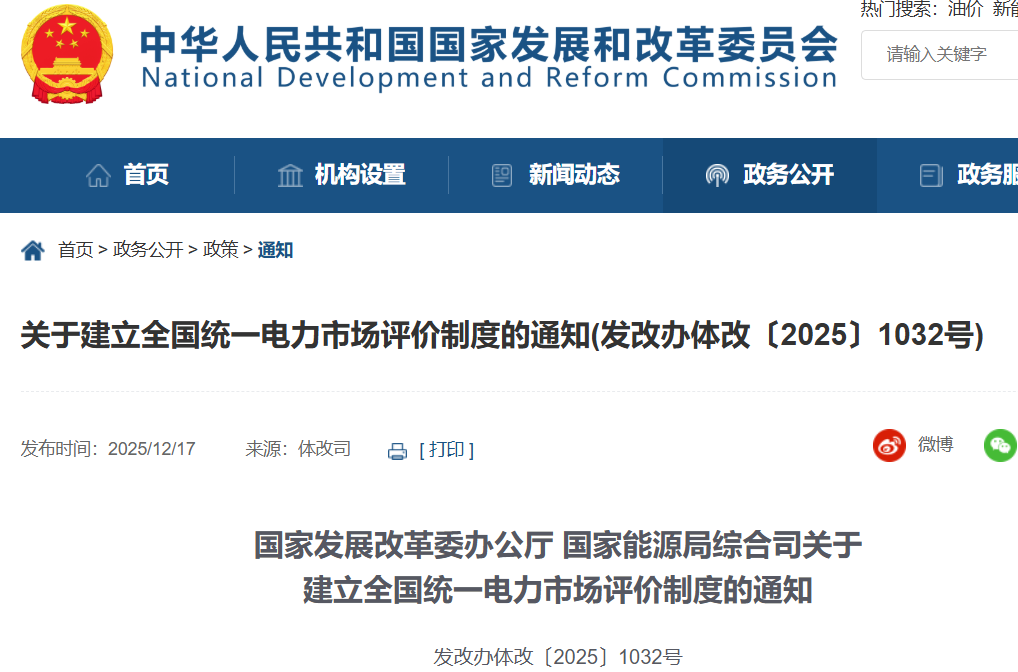
国家发展改革委办公厅 国家能源局综合司关于建立全国统一电力市场评价制度的通知
国家能源局· 2025-12-17 09:57
Core Viewpoint - The article outlines the establishment of a national unified electricity market evaluation system to enhance the efficiency and regulation of the electricity market in China, aligning with the country's broader economic and energy reform goals [3][4]. Group 1: Overall Requirements - The evaluation system aims to create a scientific, systematic, and dynamic framework that balances safety, green transformation, and economic efficiency, providing a basis for decision-making in market construction and regulation [4]. Group 2: Evaluation Content - The evaluation will focus on four key areas: market operation effectiveness, market role performance, sustainable development of operating entities, and the degree of market competition [5]. Group 3: Market Operation Effectiveness Evaluation - The evaluation will assess the progress of market construction, including the establishment of a complete rule system and the implementation of local regulations [6]. - It will also evaluate the technical standards and the operational foundation of the electricity market, ensuring timely and accurate information disclosure and transaction organization [6]. - The effectiveness of the regulatory framework and the role of the market management committee in maintaining fairness and order in the market will be assessed [7]. Group 4: Market Role Performance Evaluation - The evaluation will measure the efficiency of electricity factor circulation across regions, the safety benefits of market mechanisms, and the environmental benefits related to renewable energy development [8]. - Economic benefits will be analyzed through the overall economic impact of the electricity market, focusing on dynamic pricing and resource optimization [8]. Group 5: Sustainable Development of Operating Entities Evaluation - The evaluation will consider the operational status of electricity enterprises and their ability to recover costs and maintain stable operations [9]. - It will also assess the market's support for new business models and the participation of private enterprises, contributing to job creation and industry growth [9][10]. Group 6: Market Competition Adequacy Evaluation - The evaluation will analyze the competitive behavior of market participants and the effectiveness of mechanisms to prevent market manipulation [11]. - It will also monitor market concentration levels and the effectiveness of risk prevention mechanisms [11]. Group 7: Evaluation Methods - A comprehensive evaluation index system will be established, focusing on practicality, accessibility, and representativeness [12]. - The evaluation will combine qualitative and quantitative analyses, as well as horizontal and vertical comparisons [13]. Group 8: Digital Technology Support - The use of digital technology will enhance the evaluation process, allowing for real-time monitoring of market conditions and improving the timeliness and responsiveness of evaluations [15]. Group 9: Implementation and Organization - The evaluation work will be organized by the National Development and Reform Commission and the National Energy Administration, with collaboration from various stakeholders [18].

国家发改委、国家能源局重要通知
中国能源报· 2025-12-17 07:53
Core Viewpoint - The article discusses the establishment of a national unified electricity market evaluation system aimed at enhancing the efficiency and regulation of the electricity market in China, aligning with the country's broader economic and energy reform goals [1][2]. Group 1: Overall Requirements - The evaluation system is guided by Xi Jinping's thoughts and aims to create a scientific, systematic, and dynamic evaluation framework that balances safety, green transition, and economic efficiency [2][3]. Group 2: Evaluation Content - The evaluation will focus on four key areas: market operation effectiveness, market role performance, sustainable development of operating entities, and market competition adequacy [4]. Market Operation Effectiveness Evaluation - Progress in market construction includes establishing a complete set of unified market rules and ensuring coverage of various market types [5]. - A comprehensive technical standard system for the electricity market is necessary to meet current needs and industry development [5]. - The operational foundation of the electricity market should ensure efficient management, timely information disclosure, and effective market intervention mechanisms [5]. - The market management committee must effectively coordinate market rules and ensure fair and orderly market operations [5]. - A unified regulatory system with standardized methods is essential for enhancing regulatory effectiveness [5]. Market Role Performance Evaluation - The evaluation will assess the efficiency of electricity factor circulation and the growth of cross-regional electricity trading [6]. - Safety benefits will be evaluated based on the collaborative operation of energy markets and capacity compensation mechanisms [6]. - Environmental benefits will focus on promoting high-quality development and consumption of renewable energy, supporting carbon reduction goals [7]. - Economic benefits will be measured by the overall economic impact of the electricity market and its ability to maintain reasonable price fluctuations [7]. Sustainable Development of Operating Entities Evaluation - The evaluation will consider the operational status of electricity enterprises and their ability to recover costs and maintain stable operations [8]. - The market will provide development opportunities for new business models, fostering private sector participation and job creation [8]. - Market satisfaction among operating entities will be assessed to gauge their perception of the market environment [8]. Market Competition Adequacy Evaluation - The evaluation will analyze competitive behaviors within the market and the effectiveness of mechanisms to prevent unfair competition [9]. - The concentration index of the electricity market will be monitored to ensure it remains within a reasonable range [9]. Group 3: Evaluation Methods - A comprehensive evaluation indicator system will be established to reflect the multi-dimensional aspects of market evaluation [10]. - The evaluation will combine qualitative and quantitative analyses, as well as horizontal and vertical comparisons [12]. - Digital technology will play a crucial role in supporting real-time monitoring and enhancing the evaluation's responsiveness [13]. Group 4: Implementation and Application - The evaluation will commence in 2026, with local adaptations encouraged to suit regional needs [14]. - Evaluation results will be compiled into reports for reference by government departments and market operators [15]. - The evaluation work will be organized by the National Development and Reform Commission and the National Energy Administration, with collaboration from various stakeholders [16].

中国西电电气股份有限公司 产品中标公告
Zhong Guo Zheng Quan Bao - Zhong Zheng Wang· 2025-12-17 05:05
Group 1 - The core announcement is about China XD Electric Co., Ltd. winning a bid for the ±800 kV UHVDC transmission project from the Southeast Tibet to the Guangdong-Hong Kong-Macao Greater Bay Area, with a total bid amount of 1.00505 billion yuan [1] - Four subsidiaries of the company, including Xi'an XD Power System Co., Ltd., Xi'an XD Transformer Co., Ltd., Xi'an XD High Voltage Insulator Co., Ltd., and Xi'an XD Power Capacitor Co., Ltd., are the successful bidders for various products such as converter valves, transformers, insulators, and capacitors [1] - The company's projected revenue for 2024 is 22.17478 billion yuan, indicating that the bid amount represents approximately 4.54% of the expected annual revenue [1] Group 2 - The successful bid is expected to have a positive impact on the company's future operational development, although it does not affect the independence of the company's business [1]

中国西电子公司中标约10.05亿元采购项目
Zhi Tong Cai Jing· 2025-12-16 08:49
中国西电(601179)(601179.SH)发布公告,2025年12月15日,中国南方电网有限责任公司发布了藏东 南至粤港澳大湾区±800千伏特高压直流输电工程受端换流站直流主设备和材料专项招标项目中标结果 公告。公司下属4家子公司为相关中标人,总中标金额为10.0505亿元。相关项目签约后,其合同的履行 将对公司未来经营发展产生积极的影响。 ...
中国西电(601179.SH):中标10.05亿元换流阀、变压器、套管、电容器等产品
Ge Long Hui A P P· 2025-12-16 07:52
Core Viewpoint - China XD Electric (601179.SH) announced that its subsidiaries won bids for the ±800 kV UHVDC transmission project from Southeast Tibet to the Guangdong-Hong Kong-Macao Greater Bay Area, with a total bid amount of 1.00505 billion yuan [1] Group 1: Company Overview - The company has four subsidiaries involved in the project: Xi'an XD Power System Co., Ltd., Xi'an XD Transformer Co., Ltd., Xi'an XD High Voltage Insulator Co., Ltd., and Xi'an XD Power Capacitor Co., Ltd. [1] - The total bid amount won by the subsidiaries is 1.00505 billion yuan [1] Group 2: Financial Impact - The company's projected revenue for the year 2024 is 22.17478 billion yuan [1]