能源绿色转型

Search documents
国家能源局召开2026年电力调度交易与市场秩序厂网联席会议
国家能源局· 2026-03-03 09:09
Core Viewpoint - The National Energy Administration (NEA) is advancing the construction and regulation of the national unified electricity market in 2026, emphasizing energy security, green transformation, and fair competition in the market [4]. Group 1 - The NEA held a meeting on March 2, 2026, to discuss electricity dispatch trading and market order, with a focus on enhancing communication between power plants and networks [2]. - The meeting highlighted the importance of implementing the decisions made by the Central Committee and the State Council regarding the unified electricity market and the regulation of natural monopoly sectors [4]. - The NEA aims to strengthen regulatory work in key areas such as energy security and the promotion of green energy policies, while ensuring a fair competitive market environment [4]. Group 2 - The meeting included reports on the current status of electricity market construction and regulation, with contributions from electricity trading centers in Beijing and Guangzhou [4]. - Fourteen electricity companies shared insights on supply-demand dynamics, operational conditions, market construction, trading order, and clean energy consumption, along with suggestions for 2026 priorities [4].

紧盯产业堵点 精准建言资政
Xin Lang Cai Jing· 2026-02-24 20:22
Core Viewpoint - The key focus is on the high-quality development of the new energy sector and the implementation of the "dual carbon" strategy, emphasizing the importance of effective proposals and research in addressing industry challenges [1][2]. Group 1: Proposals and Research - Zhang Liwen has submitted multiple proposals over the years, including those on establishing a residual life assessment system for photovoltaic (PV) components and accelerating the establishment of a dual control mechanism for carbon emissions in the industrial sector, all of which have been officially recognized [1]. - The proposal on the assessment of PV component lifespan has been particularly impactful, leading to a series of proposals that create a comprehensive framework for recycling in the new energy sector, addressing the questions of whether to recycle, how to classify recycling, and how to conduct scientific recycling [1][3]. Group 2: Engagement and Activities - Zhang Liwen actively participates in various discussions and research activities, including attending the National Committee of the Chinese People's Political Consultative Conference (CPPCC) meetings and conducting field research in regions like Inner Mongolia and Xinjiang to promote high-quality development in the new energy sector [2]. - The commitment to continuous learning and responsibility is evident in her approach, as she plans to propose initiatives focused on building a new power system to support the construction of an energy powerhouse [2][3].
打造绿色发展高地 为全球绿色低碳转型贡献智慧与方案
Xin Lang Cai Jing· 2026-02-21 20:16
Core Viewpoint - The establishment of the China-Shanghai Cooperation Organization Green Industry Cooperation Platform marks a significant extension of regional cooperation within the SCO from traditional security and economic fields to green sustainable development [1] Group 1: Green Technology Innovation Center - The platform aims to integrate green innovation resources and focus on key core technology breakthroughs, establishing a "source of innovation" for green technology [2] - It will facilitate the transformation and application of green innovation results by creating a comprehensive innovation ecosystem that spans research, transformation, and industrialization [2] - The initiative includes promoting the exchange and training of green technology talents, attracting top scientists and engineers globally to participate in platform projects [2] Group 2: Green Industry Upgrade Demonstration Zone - The platform will support the green transformation of traditional industries and the cultivation of new green industries, forming a new engine for green development [3] - It aims to create cross-border green industry cooperation demonstration parks and specialized industrial bases in sectors like new energy and low-carbon agriculture [3] - The establishment of a cross-border green industry cooperation mechanism and standard system will enhance the efficiency of green trade and investment [3] Group 3: Green Smart Development Pilot Zone - The initiative focuses on integrating smart technologies to create a green smart development ecosystem, emphasizing the interconnectivity of smart infrastructure [4] - It will develop a collaborative management cloud platform to monitor and analyze data related to environmental and energy consumption [4] - The project will promote typical application scenarios for green smart living, such as integrated microgrid systems and intelligent waste recycling [4] Group 4: Energy Green Transition Leading Zone - The platform will promote the green upgrade of traditional energy and the large-scale application of new energy, enhancing China's influence in global energy transitions [5][6] - It aims to reduce fossil energy consumption and accelerate the development of clean energy through collaborative projects [6] - Establishing a cross-border energy security and governance cooperation mechanism will ensure regional energy safety and green development [6] Group 5: Green Financial Innovation Cluster - The platform will link global financial innovation resources to support green technology research and cross-border cooperation projects [7] - It will create a digital green financial service platform that integrates project matching, financing, risk assessment, and policy consulting [7] - The initiative includes establishing a risk-sharing mechanism for green finance, encouraging the development of specialized insurance products for green projects [7]
能源开新局丨国家能源局法改司司长宋雯:深化改革加快构建适应新型能源体系的体制机制
国家能源局· 2026-02-14 10:41
Core Viewpoint - The article emphasizes the need for deepening reforms in the energy sector to adapt to a new energy system, focusing on high-quality development and addressing challenges such as energy security, low-carbon transition, and economic efficiency [3][9]. Group 1: Achievements in Energy Reform during the 14th Five-Year Plan - The energy market structure has been further improved, with nearly 80% of electricity prices determined by market competition and over 970,000 registered electricity market entities [5]. - A national unified energy market system is being established, with significant progress in electricity, oil, and gas markets, promoting efficient resource allocation [6]. - The market-oriented energy pricing mechanism is being refined, with competitive pricing for coal and renewable energy, and a shift in the pricing model for natural monopoly sectors [7]. Group 2: Challenges for the 15th Five-Year Plan - The energy supply-side needs to accelerate the establishment of mechanisms for green transformation, targeting a renewable energy capacity of 3.6 billion kilowatts by 2035, with an annual growth of 200 million kilowatts [10]. - The energy consumption side requires enhanced mechanisms to stimulate flexibility and innovation, as new business models and green energy consumption patterns emerge [11]. - The resilience and safety of the energy system must be improved, transitioning from a traditional centralized balance to a more flexible and collaborative approach [12]. Group 3: Strategic Measures for Energy Reform - A resilient energy supply mechanism should be constructed, integrating renewable and fossil energy sources while enhancing the capacity for resource optimization [15]. - A green consumption guidance mechanism is essential, promoting policies that encourage green energy consumption and developing a robust carbon market [16]. - The establishment of market and pricing mechanisms that reflect true supply-demand relationships is crucial for optimizing resource allocation and fostering new business models [17]. - A modern energy governance system must be developed, focusing on legal frameworks and regulatory mechanisms to prevent monopolistic practices and enhance international cooperation [18].

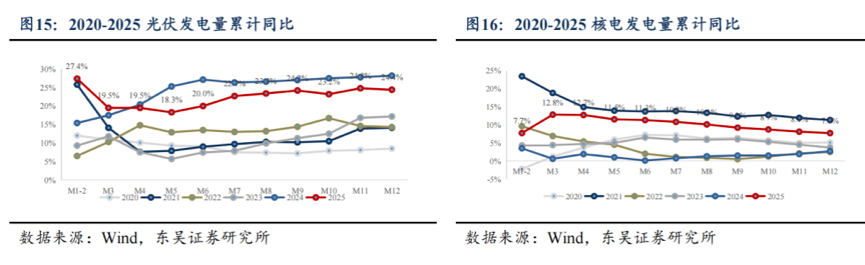
2025年全国风光发电量同比增长25%,风光装机增速分化
Huan Qiu Wang· 2026-02-14 01:04
Core Insights - The National Energy Administration projects that by 2025, the national wind and solar power generation will increase by 25% year-on-year, accounting for 22% of total power generation, significantly boosting the share of renewable energy to nearly 40% [1] - New installed capacity for renewable energy in China is expected to reach 452 million kilowatts by 2025, representing a year-on-year growth of 21% [1] Group 1: Wind and Solar Power Growth - By 2025, new installed capacity for wind power and solar energy is forecasted to be 119.33 GW and 315.07 GW respectively, with year-on-year growth rates of 50.4% and 13.7% [1] - The disparity in growth rates between wind and solar installations is attributed to the pressure on electricity prices and demand caused by the full market entry of new energy sources, with wind power being less affected due to its dispersed output [1] Group 2: Investment and Infrastructure - During the 14th Five-Year Plan period, the State Grid's fixed asset investment is expected to reach 4 trillion yuan, a 40% increase compared to the previous period, focusing on green transformation [1] - The State Grid aims to support an annual increase of approximately 20 million kilowatts in wind and solar energy installations, targeting a non-fossil energy consumption share of 25% and an electricity share in terminal energy consumption of 35% [1] Group 3: Market Mechanisms and Development - The National Development and Reform Commission and the National Energy Administration have introduced a new pricing mechanism for power generation, which includes independent new-type energy storage in the compensation framework [2] - East Wu Securities notes that the three main constraints on the full market entry of new energy—consumption, pricing, and subsidies—are gradually easing, paving the way for high-quality development of renewable energy [2]
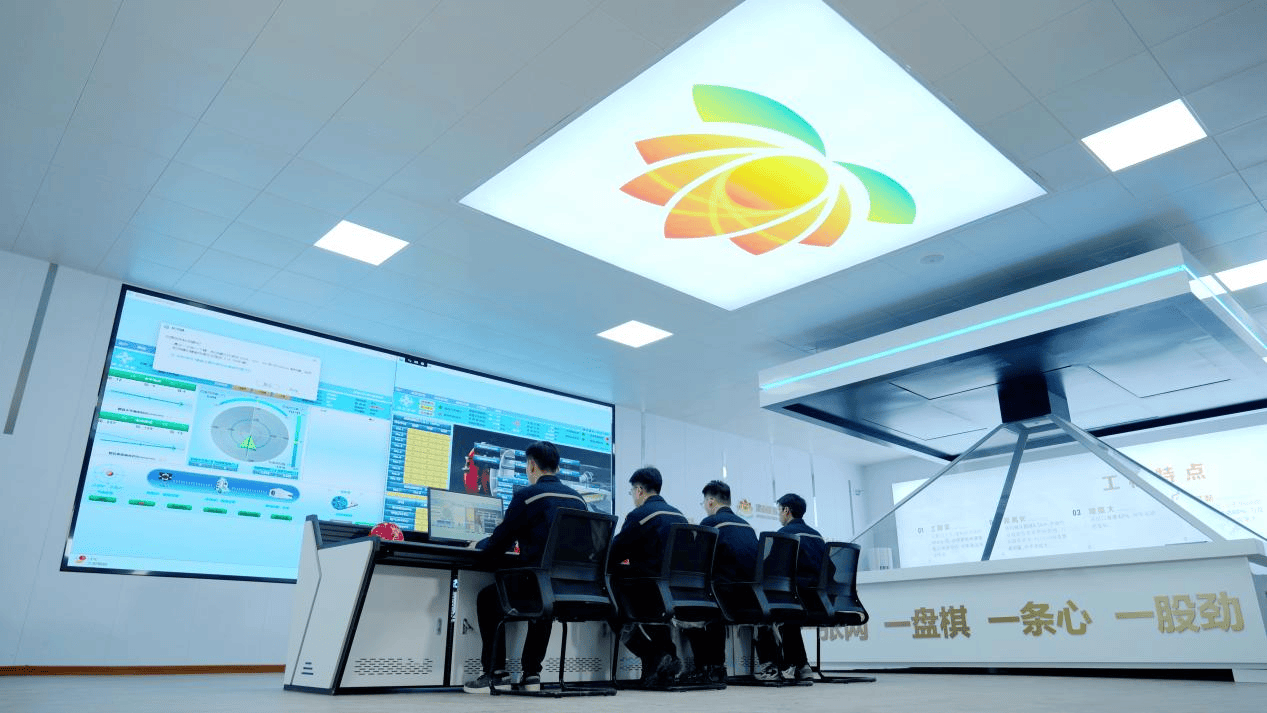
济南能源集团加速构建新型能源体系
Sou Hu Cai Jing· 2026-02-13 10:41
Group 1 - The core mission of Jinan Energy Group is to accelerate the construction of a new energy system, focusing on high-quality development and contributing to the green transformation of the economy and society [1][10] - The "Liao Heat into Jinan" project is a key initiative for optimizing the energy structure, utilizing industrial waste heat from Liaocheng to provide a stable and clean urban heating source for Jinan [2][4] - The project exemplifies the "waste to resource" concept and sets a benchmark for cross-regional energy collaboration, facilitating the large-scale replacement of traditional energy sources with clean energy [4] Group 2 - Jinan Energy Group aims to build a comprehensive and efficient heating network, ensuring stable and equitable access to clean heating for residents [5][7] - The company operates a heating network exceeding 11,000 kilometers, covering Jinan's main urban area and enhancing the overall resilience and reliability of the heating system [7] - By 2026, the company plans to upgrade heating facilities in 60 residential communities, benefiting approximately 43,000 households [7] Group 3 - The smart upgrade of the heating network is crucial for improving operational efficiency, with the implementation of a nationwide first ERP system for comprehensive management of the heating supply chain [9] - The company integrates green low-carbon technologies throughout the energy production and utilization chain, achieving over 50% improvement in pipeline delivery capacity through advanced techniques [12] - Jinan Energy Group is committed to regional energy collaboration, optimizing resource allocation and enhancing energy security through integrated development with surrounding cities [12] Group 4 - The company emphasizes innovation and collaboration as core drivers for sustainable energy development, focusing on long-term planning and institutional support for the new energy system [10][13] - Jinan Energy Group is dedicated to serving the community and enhancing the quality of life for residents by promoting a cleaner, more efficient energy structure [13]
我国首个交直流混联跨江工程建成投产,这是世界首个多源换相直流输电工程
Yang Zi Wan Bao Wang· 2026-02-13 07:21
Core Insights - The Jiangsu Yangzhou-Zhenjiang ±200 kV DC transmission project has been completed and is the world's first multi-source commutation DC transmission project, enhancing the existing cross-river transmission capacity by three times, contributing to global energy transition efforts [1] Group 1: Project Overview - The Yang-Zhen DC Phase II project spans approximately 228 kilometers with a transmission capacity of 1.2 million kilowatts, passing through seven counties in Jiangsu province [1] - The project includes 47 kilometers of new DC transmission lines co-located with 500 kV AC lines and two new converter stations, significantly increasing the cross-river transmission capacity without adding new crossings [1] - The project is expected to deliver over 6 billion kilowatt-hours of electricity annually to the Yangtze River Delta, equivalent to the annual electricity consumption of about 2 million households, with over 30% of this being renewable energy [1] Group 2: Technological Innovations - The project features the world's first converter station utilizing multi-source commutation technology (SLCC), which allows for power sharing between two 220 kV AC grids, enhancing the efficiency of power dispatch [1][3] - The integration of traditional DC transmission technology with static reactive power compensation and filtering devices creates a new type of converter unit that supports the stable integration of variable renewable energy sources [3] Group 3: Regional Energy Transition - Jiangsu's energy transition is accelerating, with over 95% of the new power generation capacity expected to come from renewable sources by 2025 [2] - The region has established a mixed AC-DC grid to improve the efficiency of clean power transmission by approximately 20%, addressing the spatial and temporal imbalance between renewable energy generation and consumption [2] - The completion of the Yang-Zhen DC Phase II project contributes to a provincial mixed AC-DC grid structure, enhancing the "north-to-south" transmission capacity to approximately 25 million kilowatts [2]
光伏行业周报(20260126-20260130):本周光伏设备(申万)指数表现
Guoxin Securities Co., Ltd· 2026-02-04 13:25
Investment Rating - The report suggests focusing on companies benefiting from supply-side reforms, technological iterations, and marginal changes in demand expectations, with a long-term view on efficient technologies and leading companies in the industry [4] Core Insights - The photovoltaic equipment industry index decreased by 6.19% during the week of January 26 to January 30, 2026, underperforming the broader market index by 5.18 percentage points [12][14] - Key companies in the photovoltaic equipment sector showed varied performance, with notable gains from Yamaton, Jincheng Co., and others, while significant losses were observed in Mingguan New Materials and others [17] - The report highlights the stability in prices of key materials such as silicon, wafers, and batteries, with slight increases in component prices [19] Summary by Sections Market Performance - The Shanghai Composite Index increased by 0.08%, while the photovoltaic equipment industry index fell by 6.19%, indicating a challenging week for the sector [12][14] Industry Chain Price Trends - As of January 21, 2026, the prices for key materials were as follows: silicon at 59 CNY/kg, wafers at 1.50 CNY/piece, batteries at 0.42 CNY/W, and components at 0.81 CNY/W, with a slight increase in component prices [19] Industry News - Guangdong province is advancing offshore photovoltaic construction as part of its action plan for high-quality marine economic development, promoting the integration of offshore wind and photovoltaic projects [26] - The National Energy Administration announced that by 2025, the country expects to add over 430 million kW of wind and solar capacity, with significant investments in renewable energy projects [27][28]




中电联发布电力供需形势分析预测报告 今年全国全社会用电量将增5%~6%
Zhong Guo Dian Li Bao· 2026-02-04 01:35
Core Viewpoint - The China Electricity Council (CEC) forecasts that by 2025, China's total electricity consumption will exceed 10 trillion kilowatt-hours, marking a historic milestone, with a projected growth of 5% to 6% in 2026, driven by the expansion of renewable energy capacity and a balanced supply-demand situation [1][2][7]. Group 1: Electricity Consumption Growth - In 2025, China's total electricity consumption is expected to reach 10.37 trillion kilowatt-hours, maintaining its position as the world's largest electricity consumer [2]. - The second industry will account for 6.64 trillion kilowatt-hours, representing 64% of total consumption, contributing 47.5% to the growth [2][3]. - The third industry will see a growth of 8.2%, with a contribution rate of 30.7%, driven by sectors like charging services and internet-related services [3][10]. Group 2: Renewable Energy Expansion - By the end of 2025, China's total installed power generation capacity is projected to reach 3.89 billion kilowatts, with non-fossil energy sources accounting for 61.7% of this capacity [4][5]. - Wind and solar power will constitute over 80% of the newly added generation capacity, with a total of 4.47 trillion kilowatt-hours of non-fossil energy generation expected, representing 42.9% of total generation [5][6]. - In 2026, solar power generation capacity is anticipated to surpass coal power for the first time, with non-fossil energy sources expected to account for 63% of total installed capacity [7][8]. Group 3: Infrastructure and Investment - Investment in power grid construction is projected to reach 639.5 billion yuan in 2025, with significant growth in both direct current and alternating current projects [5][6]. - Cross-regional and cross-provincial electricity transmission is expected to grow, with cross-regional transmission reaching 998.4 billion kilowatt-hours, a 7.9% increase [6]. - The "14th Five-Year Plan" emphasizes the construction of a modern energy system, with a focus on enhancing electricity supply security and grid intelligence [6][10].
能源早新闻丨十种有色金属产量,首次突破8000万吨大关
中国能源报· 2026-02-03 22:32
Industry Updates - In January and February 2025, a total of 6,233 new registered renewable energy generation projects were added nationwide, including 36 wind power projects and 6,190 solar power projects, with 48 centralized solar projects and 6,142 distributed commercial and industrial solar projects [2] - The domestic prices of gasoline and diesel have increased by 205 yuan and 195 yuan per ton, respectively, due to recent fluctuations in international oil prices [3] - The production of ten non-ferrous metals in China has surpassed 8 million tons for the first time, reaching 8,175 million tons, which is a 3.9% increase compared to the previous year [3] - Ningxia has become the first province in China to achieve "green electricity self-sufficiency," with a 70% increase in renewable energy investment and a 38% increase in installed capacity expected by 2025 [4] - The first gas ignition test at the Leitan-1 well in Sichuan Province marks a significant milestone in the province's oil and gas exploration efforts [5] - A total of 30 low-efficiency coal-fired units have been shut down and converted in Shandong Province, with a combined installed capacity of 490,500 kilowatts [5] International News - Mexico will stop supplying oil to Cuba, as stated by U.S. President Trump, indicating a shift in energy supply dynamics in the region [6] - Hungary has filed a lawsuit against the EU regarding the ban on importing Russian energy, challenging the "REPowerEU" energy plan [7] Corporate News - The National Pipeline Group has achieved a historic milestone with both incoming and outgoing natural gas volumes exceeding 30 billion cubic meters in a single month, reflecting a year-on-year increase of over 14% [8]