中国科学技术大学

Search documents
“Q世纪:量子物理百年科普展”在中国科大展出
Huan Qiu Wang Zi Xun· 2025-05-09 13:19
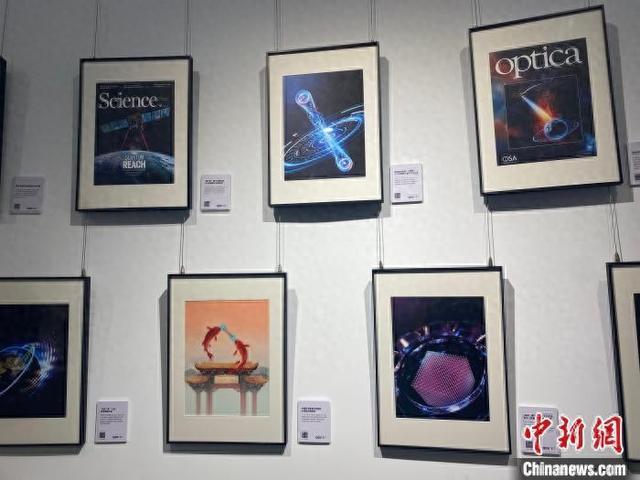
Core Viewpoint - The "Q Century: Quantum Physics Centenary Science Exhibition" opened at the University of Science and Technology of China, marking a significant event in the celebration of the centenary of quantum mechanics [1][3]. Group 1: Exhibition Overview - The exhibition is part of a series of activities celebrating the 100th anniversary of modern quantum mechanics, which will be in 2025, and is recognized as the "International Year of Quantum Science and Technology" by UNESCO [3]. - The exhibition features three main sections: "Our Superconducting Quantum Computer," "The Century Leap of Quantum Physics," and "The Magical Quantum World," showcasing key quantum concepts such as Schrödinger's cat and quantum entanglement [3]. Group 2: Innovative Presentation - The curatorial team has transformed abstract theories into perceivable artistic forms, including a "Quantum Music Laboratory" where real sounds from quantum labs are artistically restructured into quantum dance music [3]. - A "Universal Map" presents a historical map of technology using traditional artistic techniques, offering a unique perspective on the relationship between art and technological development [3]. - The "Quantum Journal Cover Wall" artistically presents rich scientific theories, providing a new perspective on the evolution of quantum technology [3]. Group 3: Public Engagement - The exhibition features a 1:1 model of the "Zuchongzhi No. 2" superconducting quantum computer, allowing the public to explore the mysteries of quantum computing [5]. - Visitors can observe the core structure of superconducting quantum chips through microscopes and experience an immersive view of "Zuchongzhi No. 3" using a naked-eye 3D grating screen, highlighting recent breakthroughs by Chinese quantum scientists [5]. - Chinese scientists, represented by the University of Science and Technology of China, have made significant contributions to the development of quantum mechanics, opening up infinite possibilities for its future [5].

科好玩|从“小来”到“小临”,一起了解“机器化学家”的故事
Xin Hua She· 2025-05-05 05:09
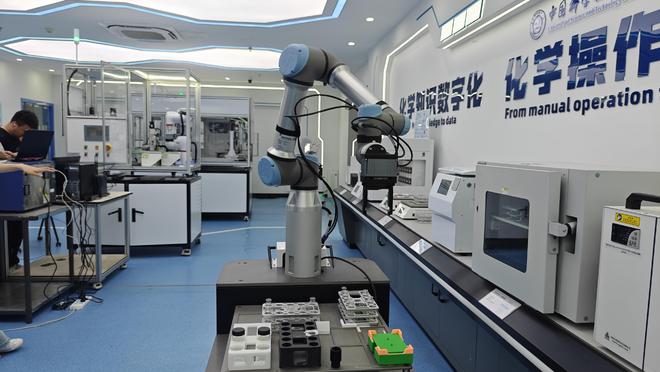
Core Insights - The article highlights the emergence and capabilities of "machine chemists," which utilize artificial intelligence to revolutionize chemical research and enhance efficiency in scientific experiments [2][3][7]. Group 1: Development of "Machine Chemists" - The traditional chemical research paradigm relies heavily on trial and error, leading to long cycles and high costs for new material creation [3]. - In 2013, a team at the University of Science and Technology of China (USTC) began exploring the use of big data technology to innovate chemical research, addressing issues of low efficiency and data dispersion [3][6]. - After three years of data collection, the "machine chemist" named "Xiao Lai" was developed, integrating mobile robots and intelligent chemical workstations, capable of performing 2,000 precise operations daily, equivalent to the work of five to six researchers [6][8]. Group 2: Achievements of "Xiao Lai" - "Xiao Lai" demonstrated remarkable capabilities in researching Martian oxygen catalysts, identifying optimal solutions in just six weeks, a task that would take human researchers 2,000 years [7]. - The research findings were published in the prestigious journal "Nature Synthesis," showcasing the potential for in-situ chemical production in extraterrestrial environments [7]. Group 3: Advancements with "Xiao Lin" - The second-generation "machine chemist," "Xiao Lin," was introduced, featuring enhanced efficiency and the ability to autonomously design and optimize experiments using generative models [8][11]. - "Xiao Lin" successfully reduced the material screening time for energy-absorbing materials from ten years to seven months, showcasing its advanced analytical capabilities [11]. Group 4: Future Plans and Vision - The research team plans to construct a "machine chemist building" to accommodate hundreds of robots and thousands of intelligent workstations, aiming for a daily experimental capacity of one million operations [12]. - Future iterations of "machine chemists" will include advanced sensory capabilities, allowing them to analyze molecular structures and chemical differences, further enhancing their research capabilities [12].
同兴科技:与中国科大共建的联合实验室终止合作
news flash· 2025-04-24 14:03
同兴科技(003027)公告,公司与中国科大签署了《合同终止协议书》,自本协议签署之日起,双方签 署的《中国科学技术大学同兴环保科技股份有限公司共建"中国科大-同兴环保储能电池材料及器件联合 实验室"合作协议》等均根据本协议内容同步终止。原合作协议签署后,公司向联合实验室支付1500万 元研发经费。 ...

预算1.41亿元!中国科学技术大学近期大批仪器采购意向
仪器信息网· 2025-04-09 11:00
采购详情点击文末"阅读原文" 导读: 近日,中国科学技术大学发布多批政府采购意向,仪器信息网特对其中的仪器设备品目进行梳理,统计出30项仪器设备采购意 向,预算总额达1.41亿元。 特别提示 微信公众号机制调整,请点击顶部"仪器信息网" → 右上方"…" → 设为 ★ 星标,否则很可能无法看到我们的推送。 近日,中国科学技术大学发布3 0项仪器设备采购意向,预算总额达1 . 4 1亿元,涉及高内涵细胞成像与分析系统、飞秒 激光负压环、自动化高通量萃取剂筛选平台、高通量智能电池测试系统等,预计采购时间为2 0 2 5年3~9月。 中国科学技术大学2 0 2 5年3 ~ 9月仪器设备采购意向汇总表 | 采购项目 | 需求概况 | 预算 | 采购 | | --- | --- | --- | --- | | | | 万元 | 时间 | | 数字化医 | 主要是用于:1.满足中国科学技术大学新生入学体检 | | | | 用X射线 | 中胸部DR项目的检查;2.满足日常我院临床医生、学 | 156 | 2025年 | | | | | 6月 | | 摄影系统 | 校教职工及学生的诊疗需求。 | | | | 飞秒激光 | | ...
中科大ICLR2025:特定领域仅用5%训练数据,知识准确率提升14%
量子位· 2025-04-07 04:19
KG-SFT团队 投稿 量子位 | 公众号 QbitAI 让大语言模型更懂特定领域知识,有新招了! 来自中国科学技术大学MIRA实验室的王杰教授团队提出了提出了一个创新的框架—— 知识图谱驱动的监督微调(KG-SFT) ,该框架通过 引入知识图谱(KG)来提升大语言模型(LLMs)在特定领域的知识理解和处理能力。 实验结果表明,其在多个领域和多种语言的数据集上取得了显著的效果, 成功入选ICLR 2025 。 截至目前,LLMs在常识问答方面表现越来越出色,但它们对领域知识的理解和推理能力仍然有限。 由于难以深入理解专业领域问答背后所蕴含的复杂知识和逻辑关系,因此在面对这类问题时,往往无法准确地给出正确的答案和详细的推理过 程,这极大地限制了其在专业领域的应用价值。 尤其是在数据稀少和知识密集型的场景中, 如何让LLMs更好地理解和操纵知识,成为了研究的关键 。 而中科大MIRA实验室的这项工作即围绕此展开。 KG-SFT是如何工作的 KG-SFT针对LLMs难以理解领域问答背后的知识和逻辑,导致 推理能力弱 的问题,提出 基于知识图谱增强的大语言模型监督微调 技术。 KG-SFT首先通过解析领域知识图谱中的 ...

中科大提出动作价值表征学习新方法,率先填补长期决策信息的缺失
量子位· 2025-03-31 04:35
Core Viewpoint - The article discusses the introduction of a novel robust action value representation learning method called ROUSER, which addresses the lack of long-term information in visual reinforcement learning by utilizing the Information Bottleneck framework [2][9]. Group 1: ROUSER Methodology - ROUSER maximizes the mutual information between the representation and action value to retain long-term information while minimizing the mutual information between the representation and state-action pairs to filter out irrelevant features [4][10]. - The method decomposes the robust representation of state-action pairs into representations that include single-step rewards and the robust representation of the next state-action pair, allowing for effective learning despite unknown action values [5][10]. Group 2: Experimental Results - In experiments involving 12 tasks with background and color interference, ROUSER outperformed various advanced methods in 11 of the tasks, demonstrating its effectiveness in enhancing generalization capabilities [6][18]. - ROUSER is compatible with both continuous and discrete control tasks, as evidenced by experiments conducted in the Procgen environment, which showed improved generalization performance when combined with value-based VRL methods [21][22]. Group 3: Theoretical Foundations - The theoretical proof indicates that ROUSER can accurately estimate action values using the learned vectorized representations, thereby improving the robustness of various visual reinforcement learning algorithms [3][17].

本科扩招、文科缩减,顶尖大学的真相是什么?
21世纪经济报道· 2025-03-13 14:03
Core Viewpoint - The article discusses the expansion of high-quality undergraduate programs in China, highlighting the increase in enrollment numbers at top universities while also addressing the reduction of liberal arts programs, suggesting a shift towards interdisciplinary studies and the integration of liberal arts with science and technology [1][2][3]. Group 1: Expansion of Undergraduate Programs - The Chinese government aims to increase the enrollment of "double first-class" universities, with an additional 20,000 students planned for 2025, following a previous increase of 16,000 students [1]. - Tsinghua University and Peking University have announced plans to expand their undergraduate admissions by 150 students each, focusing on fields such as artificial intelligence and clinical medicine [5][6]. - Other 985 universities, including Shanghai Jiao Tong University and Xi'an Jiaotong University, are also expanding their enrollment, with a focus on emerging fields like AI, integrated circuits, and biomedical sciences [5][7]. Group 2: Reduction of Liberal Arts Programs - The trend of reducing liberal arts programs has sparked discussions, with Fudan University's president stating that the proportion of liberal arts admissions will decrease from 30-40% to 20% [2][9]. - Despite the reduction, data from the C9 university alliance indicates that liberal arts programs will not disappear, but rather undergo adjustments to better align with societal needs [9][11]. - The article emphasizes that while liberal arts may face cuts, they still hold significant importance in comprehensive universities, with a substantial number of students and faculty dedicated to these fields [11][13]. Group 3: Interdisciplinary Focus - The article suggests that the future of liberal arts lies in interdisciplinary integration, with universities developing programs that combine liberal arts with science and technology [3][15]. - Examples include Tsinghua University offering cross-disciplinary programs in political economy and creative design, and Fudan University launching new programs like neurolinguistics and data intelligence [18][19]. - The shift towards interdisciplinary studies is seen as a response to the evolving job market and societal demands, indicating a need for graduates who possess a blend of skills from both liberal arts and sciences [16][17].

中国科学家再破世界纪录!
券商中国· 2025-03-04 14:24
Core Viewpoint - The recent development of the 105-qubit superconducting quantum computing prototype "Zuchongzhi No. 3" by the team from the University of Science and Technology of China demonstrates a significant leap in quantum computing capabilities, achieving a speed that surpasses the fastest supercomputers by a factor of one trillion [1][2]. Group 1 - The "Zuchongzhi No. 3" prototype can process quantum random circuit sampling problems at a speed one trillion times faster than the current fastest supercomputer, setting a new world record for superconducting quantum computing superiority [1][2]. - The prototype includes 105 readable qubits and 182 coupled qubits, with multiple key performance indicators significantly improved compared to its predecessor, "Zuchongzhi No. 2," which had 66 qubits and was already a major advancement in 2021 [2]. - The international academic community recognizes that the development of quantum computing will follow a three-step process: achieving quantum computing superiority, developing quantum simulators with hundreds of qubits, and significantly enhancing qubit manipulation precision and fault tolerance to create programmable universal quantum computers [2]. Group 2 - The research team behind "Zuchongzhi No. 3" is actively exploring various aspects of quantum technology, including quantum error correction, quantum entanglement, quantum simulation, and quantum chemistry [3]. - The team is currently conducting research on surface code error correction with a code distance of 7, with plans to expand to distances of 9 and 11, which will facilitate the integration and manipulation of large-scale qubits [4].