
上海银行

Search documents
银行发射卫星不是噱头!产融双向赋能逐渐落地!科技赋能银行产业或重启业绩增长周期
Mei Ri Jing Ji Xin Wen· 2026-02-10 06:17
Core Viewpoint - The banking sector is experiencing a transformation driven by the adoption of satellite remote sensing technology, which is enhancing risk control in credit operations and potentially leading to a new growth cycle for bank stocks in 2026 [1]. Group 1: Market Performance - As of February 10, 2026, the China Securities Bank Index (399986) increased by 0.23%, with Shanghai Bank rising by 2.03%. The bank ETF Huaxia (515020) also saw a rise of 0.18%, with the latest price at 1.69 yuan [1]. Group 2: Technological Advancements - On January 16, 2026, China Merchants Bank's "Zhaoyin Jinkui" and Shanghai Pudong Development Bank's "Puyin Shuzhi" satellites were successfully launched, marking a significant step in banks collaborating with commercial satellite companies for smart risk control [1]. - Other banks, such as Internet banks and Industrial Bank, have already begun utilizing satellite remote sensing technology in their credit business, even before launching their own satellites [1]. Group 3: Industry Outlook - The maturity of satellite remote sensing technology, combined with advancements in artificial intelligence and the Internet of Things, is leading to a quiet revolution in the traditional risk control logic of the banking industry [1]. - The traditional reliance on real estate as collateral is being challenged, as agricultural assets and commercial inventories, which are often difficult to manage, can benefit from satellite technology to improve risk management and reduce costs [1]. - According to Zheshang Securities, the banking sector is expected to restart its earnings growth cycle in 2026, with a positive outlook on absolute returns for bank stocks [1].


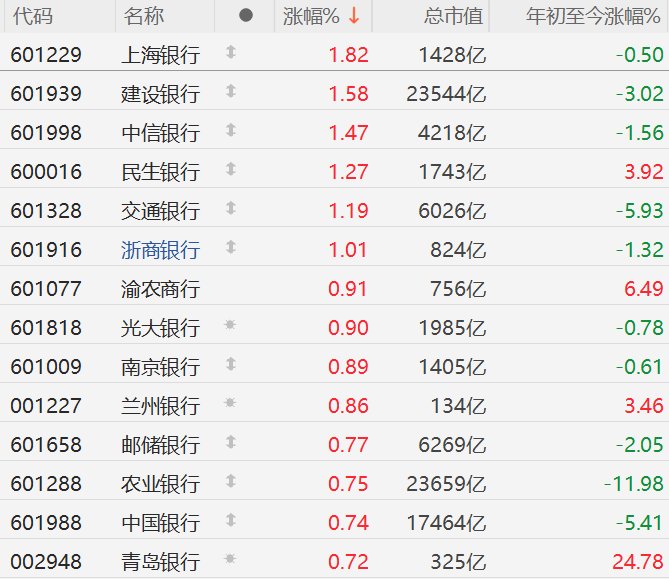
A股银行股普涨,建设银行、交通银行续涨超1%
Ge Long Hui A P P· 2026-02-10 05:25
Core Viewpoint - The A-share market saw a broad increase in bank stocks, with Shanghai Bank, Construction Bank, CITIC Bank, Minsheng Bank, Bank of Communications, and Zheshang Bank all rising over 1% [1] Group 1: Stock Performance - Shanghai Bank (601229) increased by 1.82%, with a total market capitalization of 142.8 billion and a year-to-date decline of 0.50% [2] - Construction Bank (601939) rose by 1.58%, holding a market cap of 2,354.4 billion, and has a year-to-date decline of 3.02% [2] - CITIC Bank (601998) saw a rise of 1.47%, with a market cap of 421.8 billion and a year-to-date decline of 1.56% [2] - Minsheng Bank (600016) increased by 1.27%, with a market cap of 174.3 billion and a year-to-date increase of 3.92% [2] - Bank of Communications (601328) rose by 1.19%, with a market cap of 602.6 billion and a year-to-date decline of 5.93% [2] - Zheshang Bank (601916) increased by 1.01%, with a market cap of 82.4 billion and a year-to-date decline of 1.32% [2] Group 2: Additional Bank Performance - Chongqing Rural Commercial Bank (601077) rose by 0.91%, with a market cap of 75.6 billion and a year-to-date increase of 6.49% [2] - Everbright Bank (601818) increased by 0.90%, with a market cap of 198.5 billion and a year-to-date decline of 0.78% [2] - Nanjing Bank (6000009) rose by 0.89%, with a market cap of 140.5 billion and a year-to-date decline of 0.61% [2] - Lanzhou Bank (001227) increased by 0.86%, with a market cap of 13.4 billion and a year-to-date increase of 3.46% [2] - Postal Savings Bank (601658) rose by 0.77%, with a market cap of 626.9 billion and a year-to-date decline of 2.05% [2] - Agricultural Bank (601288) increased by 0.75%, with a market cap of 2,365.9 billion and a year-to-date decline of 11.98% [2] - Bank of China (601988) rose by 0.74%, with a market cap of 1,746.4 billion and a year-to-date decline of 5.41% [2] - Qingdao Bank (002948) increased by 0.72%, with a market cap of 32.5 billion and a year-to-date increase of 24.78% [2]





红利低波ETF华泰柏瑞(512890)近20个交易日吸金31.5亿 机构:高股息策略或仍受青睐!
Xin Lang Cai Jing· 2026-02-10 04:20
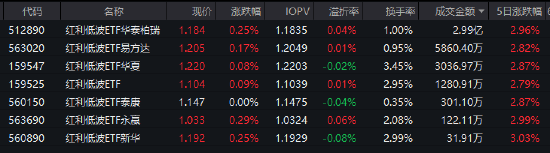
Market Overview - On February 10, the A-share market showed a narrow fluctuation pattern with the three major indices slightly declining, where the Shanghai Composite Index fell by 0.02% and the North Exchange 50 Index experienced a drop of over 1% [1][7] - In this context, the Huatai-PB Low Volatility ETF (512890) rose by 0.25%, closing at 1.184 yuan, with a turnover rate of 1% and a half-day trading volume of 299 million yuan, ranking first among similar ETFs [1][7] ETF Performance - The Huatai-PB Low Volatility ETF (512890) had a net inflow of 440 million yuan over the past five trading days, 3.15 billion yuan over the past 20 days, and 4.57 billion yuan over the past 60 days, with a circulating scale of 29.987 billion yuan as of February 9, 2026 [3][9] - The top ten holdings of the ETF showed mixed performance, with Shanghai Bank up by 1.32%, Nanjing Bank up by 0.18%, and Ping An Bank down by 0.18% [2][8] Institutional Insights - Everbright Securities believes that the current spring market is still promising, with positive signals expected from both policy and fundamentals in the coming months, suggesting a potential rebound in trading activity after the Spring Festival [5][11] - China Galaxy Securities noted a typical "pre-holiday risk aversion" in the market, with a shift of funds from high-valuation technology and cyclical sectors to value and consumer sectors, indicating strong performance in defensive sectors like banks and food and beverage [6][11] - The Huatai-PB Low Volatility ETF, established on December 19, 2018, has outperformed its benchmark with a return of 39.62% over the past three years, ranking 392nd among 1,634 funds [11]
南京银行20260205
2026-02-10 03:24
2026 年银行板块的投资机会如何? 南京银行 20260205 摘要 预计 2026 年上市银行营收和利润增速将分别达到 2.8%和 2.7%,较 2025 年前三季度有所提升,主要受益于息差拖累的同比改善,预示着 银行板块盈利能力的复苏。 当前 10 年期国债收益率约为 1.8%,而银行股的股息率约为 4.5%,显 示出银行股较高的股息配置价值,尤其是在市场风格再平衡的背景下, 大金融板块的投资机会值得关注。 推荐具有新动能组合的大行(交行、工行、建行、中行、农行及港股六 大行)和中小行(南京银行、浦发银行、上海银行、玉农商行),以及 关注北京银行和华夏银行等困境反转标的。 南京银行被确定为 2026 年度金股,其投资逻辑包括业绩增速维持上市 城商行前列、ROE 有望步入上升通道,以及营收和利润增速呈现真 U 型 改善趋势。 南京银行贷款预计维持双位数增长,得益于江苏区域强劲信贷需求、转 债完成转股后的规模增长空间以及自身资产获取能力强劲。 Q&A 南京银未来催化因素及盈利展望如何? 我们持续看好 2026 年的银行板块,认为其有整体绝对收益的行情。随着市场 风格平衡后,银行板块可能进入配置区间。从基本面 ...

天津银行“回A”心病
Xin Lang Cai Jing· 2026-02-09 18:14
Core Viewpoint - Tianjin Bank is facing significant challenges as it approaches its 30th anniversary, particularly regarding its long-delayed A-share listing and the need for performance recovery and digital transformation [1][2][3] A-share Listing Challenges - Tianjin Bank has been attempting to return to the A-share market since 2015 but has faced continuous delays due to the lack of necessary external approvals, making it the only city commercial bank in four direct-controlled municipalities yet to achieve this [2][3] - The bank's A-share listing journey has been complicated by a tightening IPO environment in the A-share market, which has seen no new bank listings since January 2022 [2][4] Financial Performance and Growth - The bank's net profit has fluctuated significantly over the past decade, peaking at 49.16 billion yuan in 2015 before entering a period of decline, with a low of 31.96 billion yuan in 2021, reflecting a 25.8% year-on-year drop [5][6] - As of the end of 2024, Tianjin Bank's net profit rebounded to 38.02 billion yuan, with a 5.47% year-on-year increase in the first three quarters of 2025 [6][7] Asset Scale and Market Position - By the end of Q3 2025, Tianjin Bank's total assets reached 968.9 billion yuan, marking a 4.63% increase from the beginning of the year, but still lagging behind other city commercial banks in direct-controlled municipalities [7][8] Shift in Lending Strategy - The bank has shifted its focus from aggressive personal loan growth to increasing corporate loans, with personal loans dropping to 18.4% of total loans by mid-2025, while corporate loans rose to 75.3% [10][11] - This strategic pivot was a response to rising risks in personal lending, particularly in the consumer loan segment, which saw a significant increase in non-performing loans [10][12] Future Growth and Strategic Initiatives - As it approaches its 30th anniversary, Tianjin Bank is exploring new growth avenues, including entering the consumer finance sector through a partnership with JD.com [13][14] - The bank is also enhancing its governance and digital capabilities to improve operational efficiency and risk management, aiming to better serve the local economy [14][15]

交投回落,战略加配优质金融
HTSC· 2026-02-09 02:45
证券研究报告 金融 交投回落,战略加配优质金融 华泰研究 2026 年 2 月 08 日│中国内地 行业周报(第六周) 投资机会方面证券>保险>银行。市场波动加大,上周 A 股日均成交额 2.4 万亿元,周环比-21%;融资余额连续 6 个交易日下滑。央行等八部门发布 《关于进一步防范和处置虚拟货币等相关风险的通知》,禁止在境内开展现 实世界资产代币化活动,并严格监管境内主体赴境外开展相关业务活动。年 初至今保险板块中的弹性组合表现优于稳健组合,显示市场在交易保险股的 β属性。央行信贷市场工作会议提出要落实好结构性货币政策工具增量政 策,加强与财政政策协同。齐鲁银行披露业绩快报,营收增速较前三季度提 升,利润保持同比高增,资产质量持续优化。 子行业观点 1)证券:上周 A 股日均成交额 2.4 万亿元,周环比-21%;融资余额连续 6 个交易日下滑。前期涨幅较高的资产明显回落,市场风格切换,看好券商板 块高性价比机会。2)保险:在市场波动率加大的背景下,投资者可能需要 降低风险偏好,关注稳健标的。3)银行:央行信贷市场工作会议提出要落 实好结构性货币政策工具增量政策,加强与财政政策协同。齐鲁银行披露业 绩快报 ...
震荡市显韧性,黄金增强策略理财产品近3月收益仍领先
2 1 Shi Ji Jing Ji Bao Dao· 2026-02-09 01:15
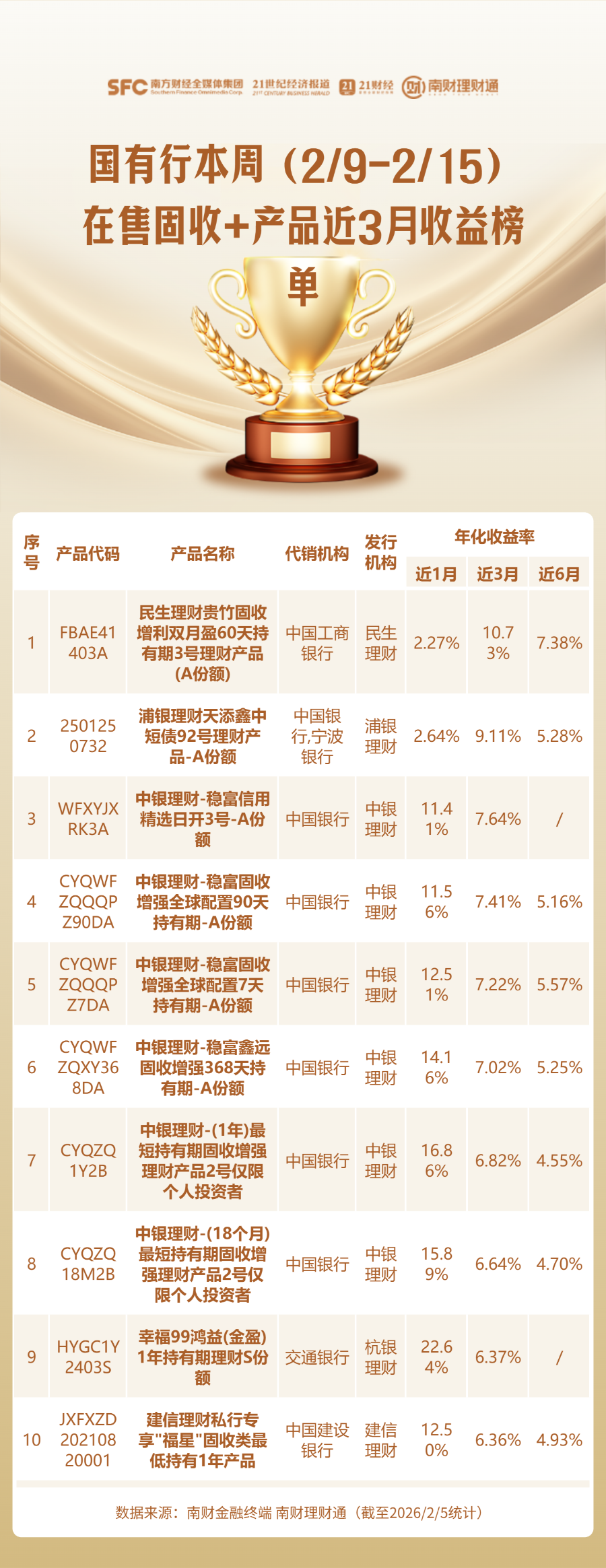
Core Insights - The report focuses on fixed income + products issued by wealth management companies, highlighting superior performing products available for investors through distribution channels [1] - A ranking of products is provided based on their annualized performance over the last month, three months, and six months, with a particular emphasis on the three-month annualized yield to reflect their performance amid recent market fluctuations [1] Distribution Channels - The report includes a list of 28 distribution institutions, which consist of major banks such as Industrial and Commercial Bank of China, Bank of China, Agricultural Bank of China, and others [1] Product Performance - The ranking showcases various products with their respective annualized yields, indicating the performance metrics over different time frames, such as 2.64% for one month and 9.11% for three months for a specific product [5] - The data is sourced from the South Finance Financial Terminal, with statistics as of February 5, 2026, providing a snapshot of the current market offerings [5][10]





收益率碾压现金产品!这份“闲钱理财”榜单透露了哪些机会?
2 1 Shi Ji Jing Ji Bao Dao· 2026-02-09 01:15
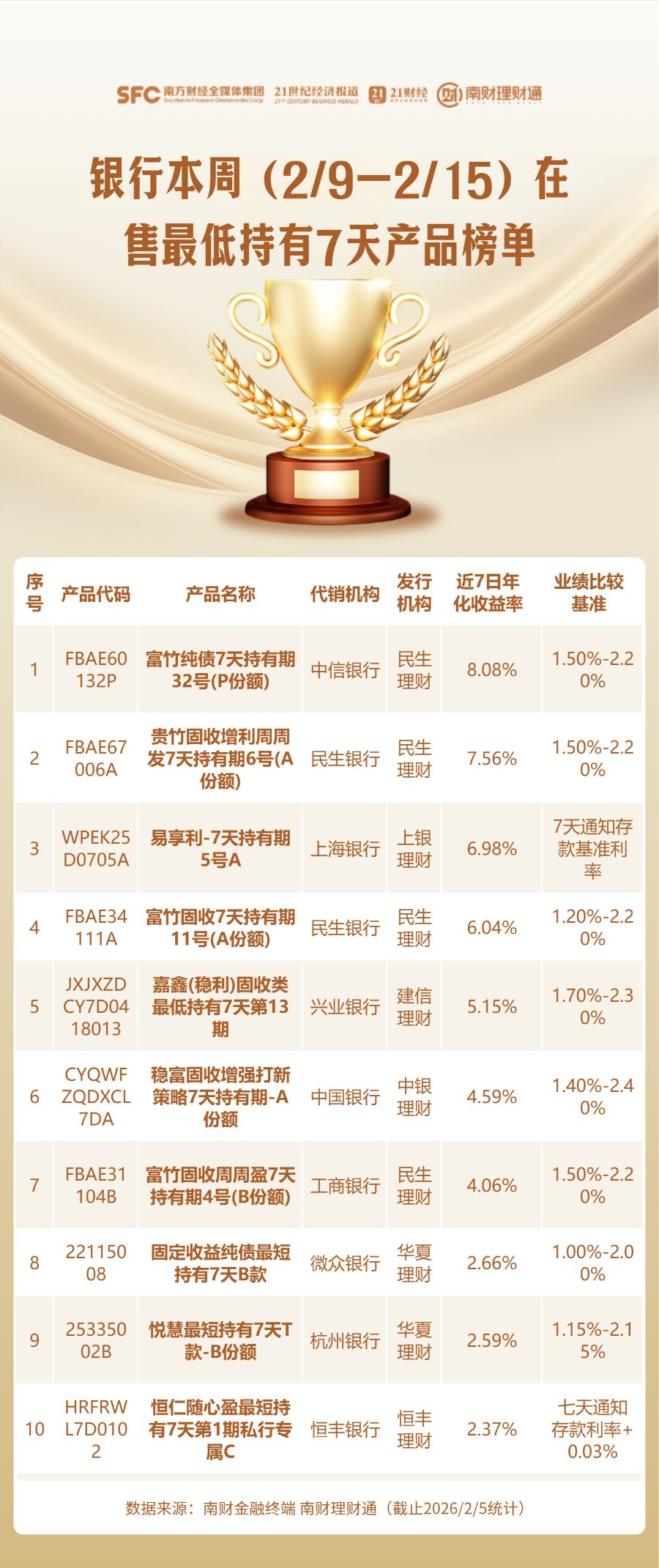
Core Insights - The article focuses on the performance of minimum holding period RMB public offering products, ranking them based on annualized returns for holding periods of 7, 14, 30, and 60 days [1] Group 1: 7-Day Holding Period Products - The top-performing product is from Minsheng Bank with an annualized return of 7.56% [5] - Other notable products include a 6.98% return from Shanghai Bank and a 6.04% return from Minsheng Bank [5] Group 2: 14-Day Holding Period Products - The leading product is from Minsheng Bank with a return of 7.39% [8] - China Bank follows with a return of 4.44% [8] Group 3: 30-Day Holding Period Products - The highest return is 18.14% from Hangzhou Bank [12] - Other significant returns include 12.34% from Minsheng Bank and 9.72% from Minsheng Bank [12][13] Group 4: 60-Day Holding Period Products - The top product is from China Bank with a return of 9.33% [15] - Other products include 5.95% from Shanghai Bank and 5.54% from Huaxia Bank [15][16]
银行股迎结构性行情:大行回调、小行领跑
第一财经· 2026-02-08 14:41
Core Viewpoint - The A-share banking sector has shown resilience and strength since early February 2026, driven by both fundamental improvements and capital inflows, with expectations for revenue and profit growth to gradually recover throughout the year [3][7]. Group 1: Market Performance - The banking sector has outperformed the broader market, with 42 A-share bank stocks rising collectively on February 5, 2026, particularly small and medium-sized banks like Xiamen Bank, which hit the daily limit, and Chongqing Bank, which rose over 5% [3][4]. - Over the past year, regional banks represented by city commercial banks have outperformed the industry average, with Xiamen Bank's stock rising 40.36%, Qingdao Bank 35.29%, and Ningbo Bank 32.91%, significantly surpassing the 22.36% increase of the CSI 300 index [6][4]. - In contrast, large state-owned banks have faced downward pressure, with notable declines such as Shanghai Pudong Development Bank down 18.65% and Agricultural Bank of China down 13.15% [6][4]. Group 2: Fundamental and Capital Factors - The core factors supporting the rise in bank stocks are improvements in fundamentals, with 11 A-share banks reporting stable revenue and profit recovery for 2025, particularly city commercial banks like Qingdao Bank and Qilu Bank, which saw net profit growth exceeding 10% [7][8]. - Xiamen Bank reported a revenue of 5.856 billion yuan, a year-on-year increase of 1.69%, and a net profit of 2.75 billion yuan, up 1.64%, with a loan growth of 18.39% [8][9]. - The banking sector has seen a net inflow of approximately 2.249 billion yuan in the past week, with a low average price-to-earnings ratio of 6.1 times and a price-to-book ratio of about 0.52 times, making it attractive to long-term investors [10][9]. Group 3: Future Outlook - The current market dynamics suggest a shift in the logic behind bank stock investments, moving from defensive assets to actively managed positions, particularly for city commercial banks with strong regional advantages [12][11]. - Analysts believe that the banking sector is entering a new growth cycle in 2026, with expectations for net interest income to turn positive and continued inflows from long-term funds due to high dividend yields [13][12]. - However, not all banks are expected to benefit equally, as differences in regional economic foundations, asset structures, and management capabilities are becoming more pronounced in market valuations [13][12].

银行股迎结构性行情:大行回调、小行领跑
Di Yi Cai Jing· 2026-02-08 12:07
Group 1 - The core viewpoint of the articles indicates that the recent strength in A-share bank stocks is driven by a combination of fundamental improvements and capital inflows, with a notable performance from regional banks [1][4][9] - The banking sector has shown resilience with expectations of revenue and net profit growth gradually recovering in 2026, supported by a stable net interest margin and improved asset quality [1][4][9] - The performance of city commercial banks has outpaced that of larger banks, with significant stock price increases observed in banks like Xiamen Bank and Qingdao Bank, which have shown year-on-year gains of 40.36% and 35.29% respectively [2][3][4] Group 2 - The recent data shows that the banking sector has attracted approximately 22.49 billion yuan in net capital inflows, particularly into smaller banks, indicating a shift in investor preference towards stable cash flows and lower valuations [7][9] - The average price-to-earnings ratio for the banking sector is currently at 6.1 times, with a price-to-book ratio of about 0.52 times, suggesting that valuations are at historical lows and making the sector attractive for long-term investors [7][9] - Analysts believe that the banking sector is entering a new growth cycle in 2026, with expectations of a recovery in earnings and a potential increase in loan growth, which could further enhance the attractiveness of bank stocks [8][9]