EssilorLuxottica

Search documents
张一鸣和奥特曼都得学小扎
36氪· 2025-09-29 10:23
Core Viewpoint - The article discusses the emerging trend of AI hardware development by leading tech companies like OpenAI and ByteDance, highlighting their strategies and potential market impacts. Group 1: OpenAI's Hardware Strategy - OpenAI is shifting focus towards hardware development, integrating design expertise from Jony Ive's team and collaborating with manufacturers like Luxshare Precision and GoerTek for AI product components [5][11][12] - The first product from OpenAI is expected to be a "screenless smart speaker" with potential future products including glasses and wearable devices, aiming for a release by late 2026 or early 2027 [6][12] - OpenAI's hardware team is led by former Apple executives, indicating a strong background in hardware design and manufacturing [11][12] Group 2: ByteDance's AI Hardware Plans - ByteDance is also venturing into AI hardware, planning to launch self-developed AI smart glasses and expanding its robotics efforts, having already produced over 1,000 logistics robots [6][16] - The company has previously launched AI headphones, but the market response was lukewarm, indicating challenges in establishing a strong hardware presence [16][18] - ByteDance's AI glasses are expected to focus on voice interaction and photography, similar to Meta's Ray-Ban products, but with a different approach to display technology [19][20] Group 3: Meta's Market Position - Meta has successfully established itself in the AI glasses market with the Ray-Ban series, achieving over 2 million units sold and aiming for an annual production of 10 million by 2026 [7][25] - The collaboration with EssilorLuxottica has allowed Meta to leverage existing retail networks for product trials and sales, enhancing consumer acceptance [20][22] - Meta's strategy emphasizes integrating AI into familiar product designs rather than creating entirely new categories, which has contributed to its market leadership [22][26] Group 4: Industry Challenges and Comparisons - Both OpenAI and ByteDance face significant challenges in hardware development, particularly in establishing effective distribution channels and consumer engagement [20][27] - The article suggests that learning from Meta's approach could be beneficial for both companies, as they navigate the complexities of the hardware market [28]



Omdia:2026年AI眼镜市场规模将达到1000万台
Huan Qiu Wang Zi Xun· 2025-09-29 05:20
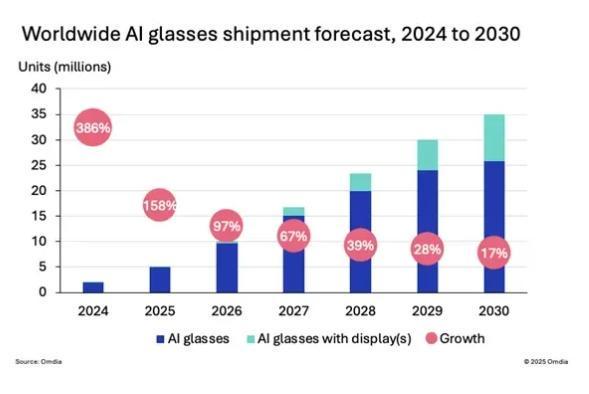
Core Insights - The AI glasses market is experiencing strong growth, with global shipments expected to surge by 158% to reach 5.1 million units by 2025, and projected to exceed 10 million units by 2026, ultimately reaching 35 million units by 2030, with a CAGR of 47% from 2025 to 2030 [1][3] Group 1 - Major consumer technology companies like Google and Xiaomi are accelerating their entry into the AI glasses market, driving its growth [1] - Meta has emerged as a pioneer in the AI glasses sector, with its collaboration with EssilorLuxottica and Ray-Ban being crucial in transforming the technology from a niche concept to a mainstream product [3] - The combination of EssilorLuxottica's distribution strength and Ray-Ban's cultural influence has helped overcome the challenges faced by earlier AI glasses like Google Glass [3] Group 2 - China is expected to become the second-largest AI glasses market globally, with shipments projected to reach 1.2 million units by 2026, accounting for 12% of the global market share [3] - The unique ecosystem in China, built by internet giants, smart device manufacturers, and emerging companies, provides a solid foundation for the development of AI glasses [3] - Current trends show that AI glasses manufacturers are increasingly focusing on locking users into their own ecosystems and AI platforms, which may limit the overall utility of the devices [3] Group 3 - Achieving platform-agnostic AI technology is essential for transforming AI glasses into everyday necessities, posing significant commercial and technical challenges for manufacturers [3]
半导体材料:亚洲投资者调研反馈-Semiconductor_Tech Materials_ Feedback from investor visits in Asia
2025-09-25 05:58
Summary of Key Points from J.P. Morgan's Semiconductor/Tech Materials Conference Call Industry Overview - **Industry Focus**: Semiconductor and Tech Materials - **Investor Interest**: Strong interest in Advantest (6857, OW) and Nittobo (3110, N) observed during investor visits in Asia [1][4] Core Themes Discussed 1. **Advanced Packaging**: - Companies benefiting from advanced packaging were a key topic, especially in light of SEMICON Taiwan [1] - Disco (6146, N) is highlighted as a key stock related to advanced packaging opportunities [5] 2. **WFE Investment Outlook**: - Potential increase in Wafer Fabrication Equipment (WFE) investment due to rising NAND and DRAM prices [1][6] - Memory makers are investing heavily in High Bandwidth Memory (HBM) driven by generative AI demand [6] - DRAM prices are rising due to strong demand and supply shortages, while NAND contract prices are also increasing [6] 3. **NVIDIA's Investment in Intel**: - NVIDIA announced a $5 billion investment in Intel, which is expected to impact the semiconductor market positively [1][6] - Key stocks affected include Lasertec (6920, N) and Nikon (7731, UW) [6] 4. **EssilorLuxottica's Stake in Nikon**: - EssilorLuxottica raised its stake in Nikon from 8.45% to 9.47%, which may influence Nikon's market position [1] Company-Specific Insights - **Advantest (6857, OW)**: - Investors are keen on the medium-term business plan update and operating profit projections for FY2026, estimated at ¥411.8 billion [4] - Potential for operating profit to reach ¥460–470 billion based on a more optimistic consensus [4] - **Nittobo (3110, N)**: - Plans to double T-glass production capacity by FY2026 and potentially triple T-glass cloth capacity by early 2027 [4] - Investors expect a price revision of around 30%, while current estimates factor in a 15% YoY increase [4] - **Disco (6146, N)**: - Anticipated increase in opportunities for grinders and dicers in PLP due to advancements in packaging technology [5] Additional Important Insights - **Market Dynamics**: - The competitive environment is expected to remain stable for Nittobo despite new entrants due to overall market growth [4] - NAND companies are focusing on developing nearline SSD products to reduce the price gap with HDDs [6] - **Investment Sentiment**: - Investors are optimistic about memory investment trends, although rapid increases in NAND investment are not expected in the near term [6] - **Price Performance**: - Various companies in the semiconductor sector are experiencing different levels of market performance, with Advantest showing strong growth potential [8][12] This summary encapsulates the key points discussed in the conference call, highlighting the semiconductor industry's current trends, company-specific insights, and overall market sentiment.
CAC 40 Drifts Lower On Valuation Concerns, Rate Uncertainty
RTTNews· 2025-09-24 11:01
Market Overview - French stocks are experiencing weakness due to concerns about the Federal Reserve's rate cuts and high equity valuations as noted by Fed Chair Jerome Powell [1] - The benchmark CAC 40 index is down 20.34 points or 0.26% at 7,851.68 [2] Company Performance - Stellantis is the biggest loser in the CAC 40 index, down 3.4% [2] - Hermes International has decreased nearly 2%, while Renault, EssilorLuxottica, Capgemini, L'Oreal, Euronext, Publicis Groupe, and Saint Gobain are down between 1% to 1.7% [2] - LVMH and Pernod Ricard are both down nearly 1% [3] - Atos SE shares have increased by 4.7% after securing a major cybersecurity contract from the European Commission [3] - Carrefour is gaining approximately 2.3%, while Thales, Bouygues, Kering, and Legrand are up between 1.3% to 1.6% [3]


花旗:2026年—智能眼镜的“普及转折点”?
美股IPO· 2025-09-24 07:19
Core Viewpoint - Citi believes that Meta's long-term layout in the smart glasses sector is entering a critical harvest period, predicting that smart glasses may become mainstream within the next 12-24 months and could reach a key inflection point by 2026 [1][2]. Market Potential and Growth - The report indicates that Meta's smart glasses are moving towards a critical commercialization phase driven by AI features, with expectations for a mainstream market breakthrough in 2026 [2]. - Meta's Ray-Ban smart glasses saw a threefold increase in sales in the first half of 2025, with plans to achieve an annual production capacity of 10 million units by the end of 2026 [1][2]. - The potential adoption curve for smart glasses is compared to the explosive growth of smartwatches and wireless earbuds, suggesting a similar trajectory in the coming years [2][7]. Consumer Sentiment and Demand - A consumer survey revealed that approximately 12% of respondents plan to purchase Ray-Ban Meta smart glasses, while only about 5% currently own the product [9]. - Analysts predict that by 2030, smart glasses could contribute around €3.7 billion to EssilorLuxottica's revenue, accounting for about 10% of total sales, with expected revenue of less than €300 million in 2024 [9]. Development Phases of Smart Glasses - The adoption of smart glasses is expected to occur in three core phases: 1. "Hands-free moments" where voice commands are used for photography and video [5]. 2. "AI-powered experiences," which is the core of making glasses "smart" [5]. 3. "Digital overlay," which is just beginning, with the potential for AI interaction experiences [5]. Challenges and Competitive Landscape - Key hardware challenges affecting widespread adoption include appearance, battery life, and weight, with 50 grams being the maximum tolerable weight for users [10]. - The second-generation Ray-Ban Meta glasses have doubled battery life to approximately 6-8 hours, but a full AR experience may require all-day battery life [10]. - Meta is considered to be years ahead of competitors in defining the smart glasses category, although competition is intensifying from companies like Google, Snap, and Apple [11][12][13][14].

2026年—智能眼镜的“普及转折点”?
Hua Er Jie Jian Wen· 2025-09-24 03:58
Core Insights - Smart glasses are evolving from a tech concept to a consumer electronics category with significant commercial potential, driven by AI functionalities [1] - Meta Platforms is positioned to capitalize on this emerging market, with expectations for mainstream adoption by 2026 [1][5] - The market sentiment towards Meta's AI glasses is increasingly optimistic, supported by production capacity expansion plans from its partner EssilorLuxottica [1][5] Market Trends - The report compares the potential adoption curve of smart glasses to that of smartwatches and wireless earbuds, suggesting a similar trajectory of explosive growth [1] - Sales of Ray-Ban Meta smart glasses tripled in the first half of 2025, indicating strong market demand [1] - A consumer survey revealed that approximately 12% of respondents plan to purchase Ray-Ban Meta smart glasses, while current ownership stands at about 5% [5] Development Phases - The adoption of smart glasses is expected to progress through three core phases: hands-free moments, AI-powered experiences, and digital overlay [3] - The current market is in the second phase, focusing on integrating AI capabilities into the glasses [3] - The launch of Meta Ray-Ban Display glasses marks the beginning of the third phase, which will involve more advanced AI interactions [3] Pricing and Revenue Projections - The report indicates that smart glasses may achieve mainstream adoption in 12 to 24 months, with pricing being a critical factor [5] - By 2030, smart glasses are projected to contribute approximately €3.7 billion in revenue to EssilorLuxottica, representing about 10% of total sales [5] Hardware Challenges - Key hardware limitations affecting the widespread adoption of smart glasses include appearance, battery life, and weight [6] - The second-generation Ray-Ban Meta glasses have improved battery life to 6-8 hours, but full AR experiences may require all-day battery performance [6] - Meta is currently leading the competition in the smart glasses market, although competition is intensifying [6] Competitive Landscape - Other companies like Google, Snap, and Apple are also exploring the smart glasses market, with various product launches planned [7] - Google is expected to release Android XR glasses in collaboration with Gentle Monster and Warby Parker, while Snap aims to launch lighter, more immersive glasses by 2026 [7]
Truist Financial Sets High Price Target for Meta Platforms (NASDAQ:META)
Financial Modeling Prep· 2025-09-18 18:11
Group 1 - Truist Financial has set a price target of $880 for Meta Platforms (NASDAQ:META), indicating a potential increase of about 13.89% from the current stock price of $772.66 [1][6] - Meta Platforms is expanding into wearable technology with the launch of $799 Ray-Ban smart glasses, aiming to replace traditional smartphones [2][6] - The new AI-powered Meta Ray-Ban Display glasses feature a built-in screen for displaying text messages, video calls, and more, showcasing Meta's push into innovative consumer technology [3][6] Group 2 - Following the announcement of the smart glasses, META's stock saw a rise in premarket trading, positively impacting EssilorLuxottica's shares, which increased by approximately 1.6% [4] - Currently, META's stock price on NASDAQ is around $786.21, reflecting an increase of about 1.35% or $10.50, with a market capitalization of approximately $1.98 trillion [5]
Meta Wants Its Glasses—Not Phones—to Be Your Tool for Using AI Technology
Investopedia· 2025-09-18 17:16
Core Insights - Meta Platforms has introduced new smart glasses, the "Meta Ray-Ban Display," which feature a built-in screen and are aimed at competing with smartphones for AI access [2][6] - The glasses are controlled by a wristband called the Neural Band and allow users to send messages and respond to platforms like WhatsApp without using a phone [5][6] - Analysts view these glasses as a strategic move for Meta, potentially positioning the company as a leader in a new category of AI devices [2][7] Product Details - The smart glasses will retail for $799 and will be available for purchase starting September 30 [5][6] - The glasses are designed to integrate AI capabilities, allowing for real-time interaction and information generation [3][5] - Meta has collaborated with EssilorLuxottica for the development of these glasses, which have seen significant revenue growth in previous iterations [4][7] Market Context - Other tech giants, including Apple, Samsung, and Amazon, are also planning to enter the smart glasses market by 2027, indicating a competitive landscape [8] - Analysts from Citi and JPMorgan highlight the potential for continued engagement and monetization from Meta's AI investments, suggesting a positive outlook for the company's product roadmap [7]

CAC 40 Rises 1.1% As Stocks Rally On Fed Interest Rate Cut
RTTNews· 2025-09-18 10:47
Group 1: Market Overview - French stocks are in positive territory, boosted by the Federal Reserve's 25-basis point interest rate cut and indications of further easing this year [1] - The benchmark CAC 40 index increased by 87.75 points or 1.13%, reaching 7,874.73 [1] Group 2: Company Performance - STMicroElectronics shares rose by 4.3%, Legrand by 3.7%, and Capgemini by 3.2% [2] - Schneider Electric's stock advanced nearly 3%, while other companies like ArcelorMittal, Dassault Systemes, and LVMH saw gains between 1.3% and 2.7% [2] - Michelin's stock decreased by approximately 1.2%, with Eurofins Scientific, Pernod Ricard, and Danone down by 0.4% to 0.7% [2] Group 3: Economic Indicators - The euro area current account surplus fell to EUR 27.7 billion in July from EUR 35.8 billion in June, and down from EUR 31.6 billion in the same period last year [3] - The surplus on goods trade increased to EUR 25 billion from EUR 23 billion, while the surplus on services decreased to EUR 12 billion from EUR 16 billion [3] - Primary income halved to EUR 7 billion from EUR 14 billion, and the shortfall in secondary income narrowed to EUR 16 billion from EUR 17 billion [4] - Over the twelve months to July, the current account surplus was EUR 315 billion or 2% of GDP, down from EUR 394 billion or 2.6% of GDP in the same period last year [4]
Meta Shares Rise In Premarket After It Unveils New $799 AI Smart Glasses
Forbes· 2025-09-18 09:40
Core Insights - Meta introduced AI-powered smart glasses, the Meta Ray-Ban Display, at the Meta Connect keynote, with CEO Mark Zuckerberg highlighting their potential as a platform for "personal superintelligence" [1][5] - Following the announcement, Meta's share price increased by over 1% in premarket trading, reaching $783 [1] Product Details - The Meta Ray-Ban Display will be available for purchase on September 30 at a price of $799, featuring a high-resolution see-through display on the right lens for reading messages, video calls, and navigation [2] - The glasses include a 12-megapixel camera for taking photos and recording videos [2] Control and Compatibility - The device can be controlled via a wristband, described by Zuckerberg as the "world's first mainstream neural interface" capable of detecting gestures and hand movements [3] - At launch, the glasses will support Meta's apps like WhatsApp and Facebook Messenger, as well as third-party apps including Spotify and a limited Instagram app [3] Market Impact - Shares of EssilorLuxottica, the parent company of Ray-Ban, rose approximately 1.6% to $324.73 following the announcement [4] - The smart glasses will be sold in EssilorLuxottica's stores, Best Buy, and select Verizon outlets [4] Vision for the Future - Zuckerberg expressed that smart glasses could eventually surpass smartphones as the primary personal computing device, emphasizing their ability to enhance communication, memory, and sensory experiences [5]