平安银行

Search documents
长江出版传媒股份有限公司关于为子公司提供担保的进展公告
Shang Hai Zheng Quan Bao· 2025-11-06 18:59
Group 1 - The company has signed guarantee contracts with China Everbright Bank and Hubei Bank to support its wholly-owned subsidiaries' financing needs, with a total guarantee amount not exceeding RMB 1.05 billion [1][4][5] - The company plans to apply for a comprehensive credit limit of up to RMB 4 billion for the year 2025, which was approved at the 2024 annual shareholders' meeting [1][2][6] - The guarantees are intended to enhance the subsidiaries' financing capabilities and are within the limits approved by the shareholders [5][6][7] Group 2 - The company has utilized idle raised funds for cash management, specifically investing RMB 550 million in principal-protected floating income structured deposits [9][11] - The company has redeemed the structured deposits, recovering the principal of RMB 550 million and earning a profit of RMB 2.5861 million [11][12] - The company aims to improve the efficiency of fund usage and increase returns for shareholders while ensuring that the investment does not affect the normal operation of fundraising projects [12][19] Group 3 - The company has established risk control measures for its investment in financial products, ensuring that they are high in safety and liquidity, and meet the principal protection requirements [16][18] - The company’s financial management department is responsible for implementing the investment strategy, with oversight from the audit department and independent directors [18][19] - The investment in short-term financial products is expected to enhance the company's asset return rate and align with the interests of all shareholders [19]


融通旗下部分开放式基金新增国联民生证券股份有限公司为销售机构及开通相关业务的公告
Shang Hai Zheng Quan Bao· 2025-11-06 18:38
Group 1 - The core announcement is about the partnership between Rongtong Fund Management Co., Ltd. and Guolian Minsheng Securities Co., Ltd. to enhance investment services starting from November 7, 2025 [1] - Rongtong Fund will allow Guolian Minsheng Securities to sell certain open-end funds and will introduce regular investment and conversion services [1] - Investors can only convert fund shares within the same fee structure, meaning front-end charged shares can only be converted to other front-end charged shares, and the same applies for back-end charged shares [1][2] Group 2 - The announcement also details the addition of Ping An Bank as a sales platform for the Rongtong Tongheng 63-month regular open bond fund, effective from November 7, 2025 [6] - Investors using the Ping An Bank platform will benefit from a discount on the front-end subscription fee for the fund, with specific discount rates to be announced by the sales institution [6] - The fee discount applies only to normal subscription periods and does not include back-end fees or fees during the fund's fundraising period [6]


银行业反内卷潮涌 基层最后一公里待破
Bei Jing Shang Bao· 2025-11-06 16:33
Core Viewpoint - The banking industry is undergoing a profound transformation in its competitive logic and development model, driven by policies aimed at preventing "involution" and promoting efficiency [1][2]. Group 1: Industry Response to Involution - Multiple banking associations and institutions are actively responding to the call to end "involution" and "price wars," advocating for a shift towards standardized and stable development [2][3]. - The Baise Banking Association has initiated self-regulatory agreements among 27 member banks to prohibit malicious low-price competition and encourage differentiation and value creation [2]. - Other regions, such as Qingyang, are also exploring local strategies to combat "involution," emphasizing sustainable development and improved assessment mechanisms [3]. Group 2: Challenges in Implementation - Despite the industry's efforts, there are still significant challenges at the grassroots level, including the persistence of practices like indicator swapping among employees [6]. - The pressure of year-end performance assessments leads to aggressive marketing tactics, which contradict the push for a more rational and customer-focused approach [4][6]. - Employees report that the focus on short-term metrics, such as "point-in-time deposits," creates a distorted operational environment, leading to unhealthy competition [7]. Group 3: Strategic Shifts in Banking - The industry recognizes that true "anti-involution" requires a change in how goals are achieved, moving towards a more sustainable business model that prioritizes long-term value over short-term gains [8]. - Banks are encouraged to reduce the weight of short-term performance indicators and increase the focus on metrics that reflect long-term operational quality, such as customer retention and satisfaction [8]. - A three-dimensional governance framework is proposed, involving regulatory guidance, industry collaboration, and institutional transformation to shift the competitive logic from "scale competition" to "value creation" [8][9]. Group 4: Transformation of Banking Roles - Banks are urged to transition from being "fund intermediaries" to "service intermediaries," leveraging their strengths in customer relationships and risk management to enhance service offerings [10]. - The transformation involves diversifying revenue sources by focusing on wealth management, supply chain finance, and digital finance, thereby addressing challenges posed by narrowing interest margins [10]. - Different types of banks are advised to adopt tailored strategies based on their size and market position, with large banks focusing on comprehensive financial services and smaller banks serving local communities [9][10].
OceanBase CEO杨冰:以香港作全球化战略支点,启动「香港千才计划」
Sou Hu Cai Jing· 2025-11-06 15:33
Core Insights - OceanBase is enhancing Hong Kong as the first hub in its global expansion strategy and has launched the "Thousand Talents Program" to train over 1,000 IT professionals in distributed database capabilities over the next five years, supporting Hong Kong's goal to become an international innovation and technology hub [1][7] Group 1: Market Expansion and Partnerships - OceanBase has made significant progress in the Hong Kong market, serving various sectors including finance, government, telecommunications, and internet, with over 25 institutions adopting its solutions for critical business system upgrades [3] - The company has established a local partnership network consisting of over 40 system integrators, technology service partners, and distributors, enabling 24/7 online support and a one-hour response time [3] - OceanBase has announced collaborations with DXC Technology and Macau Tong to expand into the insurance and critical infrastructure sectors in Hong Kong and accelerate services for local clients [3][5] Group 2: Talent Development Initiatives - The "Thousand Talents Program" aims to enhance local database technology talent through a comprehensive training system that includes certification, internships, and employment opportunities [7] - The program will collaborate with local universities, industry associations, and technology partners to offer customized OceanBase database certification courses and internship opportunities for students [7] - OceanBase emphasizes its commitment to providing advanced technology stacks and AI capabilities to help clients modernize their data architecture and meet the demands of digital transformation in Hong Kong [7] Group 3: Product and Service Offerings - OceanBase offers various deployment models including public cloud, private cloud, and integrated machines, compatible with major cloud platforms such as AWS, Google Cloud Platform, and Alibaba Cloud [8] - The service covers over 50 regions and 170 availability zones globally, enabling unified multi-cloud management to meet the diverse business needs of clients in Hong Kong [8]


银行业“反内卷”热潮涌动,基层“最后一公里”待破局
Bei Jing Shang Bao· 2025-11-06 13:35
Core Viewpoint - The banking industry is undergoing a profound transformation from competitive logic to development models, driven by policies aimed at preventing "involution" and promoting efficiency [1][3]. Group 1: Industry Response - Multiple banking associations and institutions are actively responding to the call to end "involution" by promoting self-regulation and discouraging blind expansion and price wars [3][4]. - The Baise Banking Association has initiated self-regulatory agreements among 27 member banks to prohibit malicious low-price competition and encourage innovation and service enhancement [3][4]. - Other regions, such as Qingyang, are also exploring local strategies to resist "involution" and promote sustainable development [4]. Group 2: Institutional Actions - Some banks are implementing specific measures to combat "involution," including commitments to compliance, stable growth, and reasonable pricing [5]. - Major banks like ICBC and Guangfa Bank have emphasized the importance of resisting "involution" and focusing on long-term value rather than short-term metrics [5][6]. Group 3: Challenges in Execution - Despite the industry's efforts, there are still significant challenges at the grassroots level, including the persistence of practices like indicator swapping among employees [6][7]. - The pressure of year-end performance assessments leads to aggressive marketing tactics, which can undermine the goals of reducing "involution" [6][8]. Group 4: Recommendations for Change - Experts suggest that the banking sector should shift from focusing on short-term metrics to long-term indicators such as customer retention and satisfaction [9][10]. - A three-dimensional governance framework is proposed, emphasizing regulatory guidance, industry collaboration, and institutional transformation to shift the competitive logic from "scale competition" to "value creation" [9][10]. Group 5: Strategic Transformation - Banks are encouraged to transition from being "funding intermediaries" to "service intermediaries," focusing on wealth management, supply chain finance, and digital finance [11]. - The transformation requires banks to leverage their core advantages and integrate into broader economic ecosystems while nurturing specialized talent [11].



OceanBase宣布香港为首个全球化支点,启动“香港千才计划”培育千名本地数据库人才
Huan Qiu Wang· 2025-11-06 13:08
Core Viewpoint - OceanBase is enhancing its global strategy by establishing Hong Kong as its first hub and launching a "Thousand Talents Program" to train over 1,000 IT professionals in distributed database capabilities over the next five years, supporting Hong Kong's goal to become an international innovation and technology hub [1][6] Group 1: Market Expansion - OceanBase has made significant progress in the Hong Kong market, serving over 25 institutions including major banks and tech companies, and has established a local partnership network of over 40 system integrators and service partners [2][6] - The company aims to leverage Hong Kong's unique advantages to accelerate its global business development [6] Group 2: Talent Development - The "Thousand Talents Program" will involve a comprehensive training system that includes certification, internships, and employment opportunities, in collaboration with local universities and industry associations [6] - The program aims to enhance local database technology talent and provide priority employment opportunities for certified individuals [6] Group 3: Product and Service Offering - OceanBase offers various deployment models including public cloud, private cloud, and integrated machines, compatible with major cloud platforms such as AWS and Google Cloud [7] - The company emphasizes its product characteristics of being simpler, more stable, and advanced, aiming to meet the IT architecture upgrade and digital transformation needs of Hong Kong clients [6]
三季报观察|上市银行哪家强?齐鲁银行净利增16.14% ,常熟银行净息差2.57%保持领先
Mei Ri Jing Ji Xin Wen· 2025-11-06 10:26
Core Insights - The overall performance of A-share listed banks in the first three quarters of 2025 reflects a stable total, improved structure, and significant differentiation amid a gradually recovering macroeconomic environment [2] - Revenue growth remains robust, with over 60% of listed banks achieving year-on-year revenue increases, driven by optimized asset structures and a focus on non-interest income [3] - The net interest margin (NIM), a key driver of profitability, is under pressure, posing challenges to the banking industry's profit model [2][9] Revenue Growth Resilience - More than 60% of A-share listed banks reported positive year-on-year revenue growth in the first three quarters of 2025, indicating effective support for the real economy [3] - The growth dynamics vary significantly among banks of different sizes, highlighting structural differentiation in revenue generation [3] Financial Performance of Major Banks - Major state-owned banks maintain a leading position in revenue, with Industrial and Commercial Bank of China (ICBC) reporting revenue of 640 billion yuan, a 2.17% increase, and net profit of 271.88 billion yuan, a 0.52% increase [5] - Agricultural Bank of China and China Bank also showed revenue growth above 1.5%, contributing to the stability of industry income [7] - Some joint-stock banks and regional banks, such as Minsheng Bank and Jiangsu Bank, demonstrated stronger growth, with revenue increases of 6.74% and 7.83%, respectively, indicating successful differentiation strategies [7] Profitability and Net Interest Margin - Despite revenue growth, some banks experienced lower net profit growth compared to revenue, indicating challenges in converting revenue growth into profit due to narrowing net interest margins [8] - State-owned banks showed stable net profit growth, reflecting strong risk resilience, with net profit growth rates remaining relatively close to revenue growth [8] - Smaller banks like Hangzhou Bank and Jiangsu Bank exhibited significant net profit growth, attributed to effective management and targeted customer strategies [8] Challenges in Net Interest Margin - The net interest margin for listed banks has generally declined, primarily due to factors such as lower loan market quotation rates and adjustments in existing mortgage rates [9] - State-owned banks experienced a decline of approximately 15 basis points in net interest margins, while Postal Savings Bank faced a larger drop of 21 basis points [12] - Some banks, like Minsheng Bank, managed to slightly increase their net interest margin, showcasing resilience in their business structure [12] Industry Outlook - The financial reports of listed banks in the first three quarters of 2025 depict an industry navigating pressures while growing through differentiation [13] - The stable revenue growth validates the banking sector's resilience in supporting the real economy, while the overall narrowing of net interest margins is a challenge that banks must address [13] - The ongoing macroeconomic policy effects are expected to gradually improve the banking environment, but differentiation among institutions is likely to persist [13]
上市银行哪家强?齐鲁银行净利增16.14%,常熟银行净息差2.57%保持领先
Mei Ri Jing Ji Xin Wen· 2025-11-06 10:23
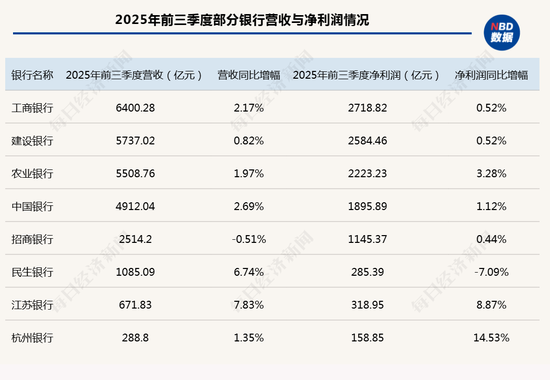
Core Insights - The overall performance of A-share listed banks in the first three quarters of 2025 reflects a stable total, improved structure, and significant differentiation amid a gradually recovering macroeconomic environment [1][10] - Revenue growth remains robust, with over 60% of listed banks reporting year-on-year increases, driven by optimized asset structures and a focus on non-interest income [2][10] - The net interest margin (NIM), a key profitability driver, is under pressure, posing challenges to the banking industry's profit model [1][7] Revenue Growth Resilience - More than 60% of A-share listed banks achieved positive year-on-year revenue growth in the first three quarters of 2025, indicating effective support for the real economy [2][4] - There is a clear structural differentiation in growth dynamics among banks of different sizes, with larger banks showing stable revenue while some smaller banks exhibit stronger growth [4][10] Bank Performance Data - Key performance metrics for selected banks in the first three quarters of 2025 include: - Industrial and Commercial Bank of China: Revenue of 6400.28 billion, 2.17% growth; Net profit of 2718.82 billion, 0.52% growth - Agricultural Bank of China: Revenue of 5508.76 billion, 1.97% growth; Net profit of 2223.23 billion, 3.28% growth - Minsheng Bank: Revenue of 1085.09 billion, 6.74% decline; Net profit of 285.39 billion, 7.09% decline - Jiangsu Bank: Revenue of 671.83 billion, 7.83% growth; Net profit of 318.95 billion, 8.87% growth [3][4] Performance of State-Owned Banks - State-owned banks maintain a leading position in revenue due to their large asset scale and extensive customer base, with revenue growth rates above 1.5% for major banks [4][6] - Despite a stable net profit growth, the overall growth rates are moderate, reflecting the challenges of achieving high growth from a large base [4][6] Performance of Smaller Banks - Some smaller banks and regional banks demonstrate significant growth potential, with Minsheng Bank and Jiangsu Bank showing revenue growth rates of 6.74% and 7.83%, respectively [4][6] - The ability of these banks to achieve rapid profit growth is attributed to precise customer targeting, effective cost management, and supplementary income from non-interest sources [6][10] Net Interest Margin Challenges - The net interest margin for listed banks is generally declining, primarily due to factors such as the decrease in loan market quotation rates and adjustments in existing mortgage rates [7][8] - State-owned banks and some joint-stock banks experience a decline in NIM by approximately 15 basis points, while Postal Savings Bank sees a more significant drop of 21 basis points [8][9] Resilience in NIM - Some banks, like Minsheng Bank, show resilience with a slight increase in NIM, indicating effective business structure management in response to interest rate fluctuations [9][10] - Regional banks like Ningbo Bank exhibit smaller declines in NIM compared to the industry average, showcasing the effectiveness of their localized service models [9][10] Future Outlook - The banking sector's operating environment is expected to gradually improve with the continued effectiveness of macroeconomic policies, although differentiation among institutions is likely to persist [10] - Large banks need to leverage technology to enhance their comprehensive service advantages, while smaller banks must focus on deepening their niche markets to establish competitive strengths [10]



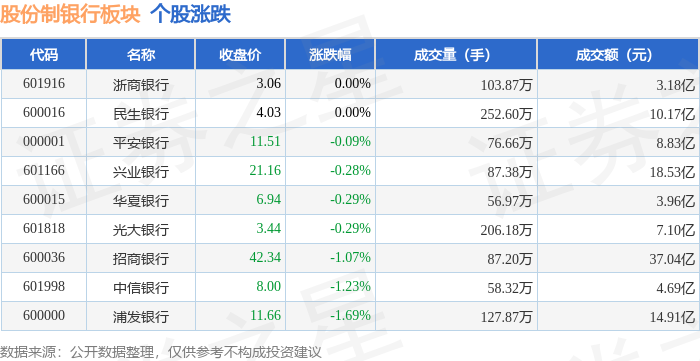
股份制银行板块11月6日跌0.81%,浦发银行领跌,主力资金净流出5.41亿元
Zheng Xing Xing Ye Ri Bao· 2025-11-06 08:51
Market Overview - On November 6, the shareholding banks sector declined by 0.81%, with Pudong Development Bank leading the drop [1] - The Shanghai Composite Index closed at 4007.76, up 0.97%, while the Shenzhen Component Index closed at 13452.42, up 1.73% [1] Individual Bank Performance - The closing prices and performance of key banks are as follows: - Zheshang Bank: 3.06, unchanged - Minsheng Bank: 4.03, unchanged - Ping An Bank: 11.51, down 0.09% - Industrial Bank: 21.16, down 0.28% - Huaxia Bank: 6.94, down 0.29% - Everbright Bank: 3.44, down 0.29% - China Merchants Bank: 42.34, down 1.07% - CITIC Bank: 8.00, down 1.23% - Pudong Development Bank: 11.66, down 1.69% [1] Capital Flow Analysis - The shareholding banks sector experienced a net outflow of 541 million yuan from main funds, while retail investors saw a net inflow of 463 million yuan [1] - The following table summarizes the capital flow for individual banks: - CITIC Bank: Main net inflow of 27.51 million yuan, retail net inflow of 11.20 million yuan - Huaxia Bank: Main net inflow of 23.08 million yuan, retail net outflow of 27.16 million yuan - Zheshang Bank: Main net inflow of 7.26 million yuan, retail net inflow of 5.91 million yuan - Everbright Bank: Main net inflow of 1.13 million yuan, retail net inflow of 15.17 million yuan - Pudong Development Bank: Main net inflow of 0.08 million yuan, retail net outflow of 0.76 million yuan - Industrial Bank: Main net outflow of 1.74 million yuan, retail net inflow of 80.35 million yuan - Minsheng Bank: Main net outflow of 73.74 million yuan, retail net inflow of 80.06 million yuan - Ping An Bank: Main net outflow of 87.51 million yuan, retail net inflow of 55.48 million yuan - China Merchants Bank: Main net outflow of 437 million yuan, retail net inflow of 25 million yuan [2]

警惕平安信用卡征信修复陷阱,黑灰产利益链暗藏玄机
Jin Tou Wang· 2025-11-06 08:14
Core Viewpoint - The rise of illegal proxy complaint services in the credit card sector has led to a systematic and industrialized approach, exploiting vulnerable debtors through deceptive practices and false advertising [1][2]. Group 1: Industry Trends - The illegal proxy complaint industry is increasingly using social media and short video platforms to promote fraudulent services, claiming to have internal bank partnerships that can eliminate bad credit records at no cost [1]. - The operational model of these illegal services is highly covert, luring debtors with "free consultations" and subsequently charging high fees under the guise of "deposit + final payment" [1]. Group 2: Consumer Impact - Debtors, such as individual Zhang, have fallen victim to these scams, paying significant sums (e.g., 5,000 yuan) for services that were never delivered, leading to personal information being sold to loan platforms and resulting in harassment [6]. - The fraudulent activities have severe consequences, including being placed on risk lists by banks due to falsified documents, which further complicates the debtor's financial situation and leads to a cycle of increasing debt [6]. Group 3: Regulatory Response - In response to the rampant illegal activities, regulatory bodies and financial institutions are developing a multi-dimensional governance system to disrupt the customer acquisition chain of these black and gray market operations [7]. - Initiatives such as the "Qinglang Pujiang" special action plan for 2025 will focus on illegal financial intermediaries, while financial institutions are employing big data models to identify and block abnormal complaint behaviors [7].