中航高科

Search documents
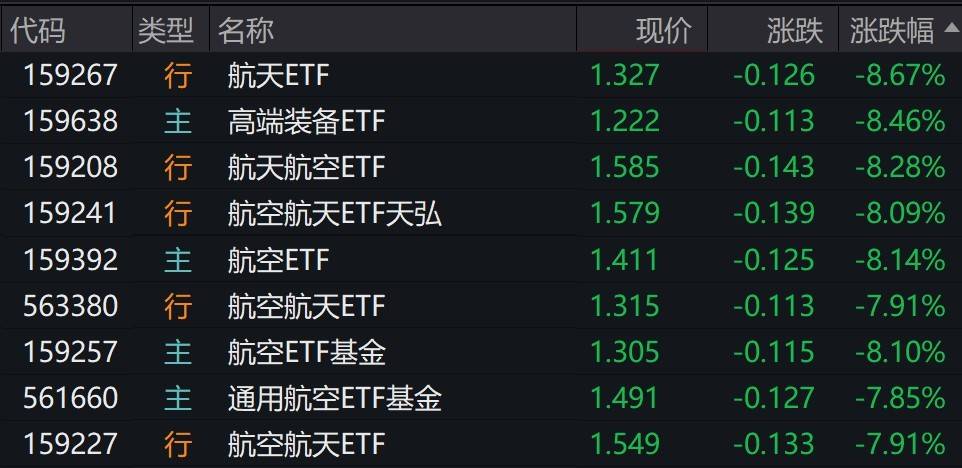
航天航空概念股早盘大幅调整,多只航天航空相关ETF跌超8%
Sou Hu Cai Jing· 2026-01-13 02:00
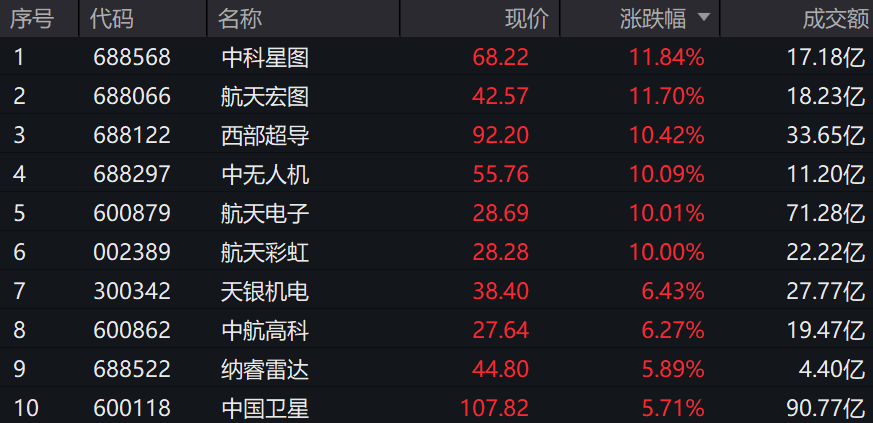
Group 1 - Aerospace and aviation concept stocks experienced significant declines in early trading, with Aerospace Electronics down over 8%, AVIC High-Tech down over 6%, and AVIC Heavy Machinery down over 5% [1] - Several aerospace-related ETFs also fell by more than 8%, reflecting the overall market trend [1] Group 2 - Specific ETFs reported the following price changes: Aerospace ETF (1.327, -8.67%), High-end Equipment ETF (1.222, -8.46%), Aerospace Aviation ETF (1.585, -8.28%), and others showing similar declines [2] - Analysts believe that recent improvements in top-level design and new policy support in the commercial aerospace sector have clarified the development blueprint for the industry, enhancing market confidence in its long-term growth [2] - With decreasing launch costs and increased in-orbit computing power, the future of space computing is expected to create a "more launches, more savings" scenario, potentially leading to a transformative industrial change with scalable commercial value [2]


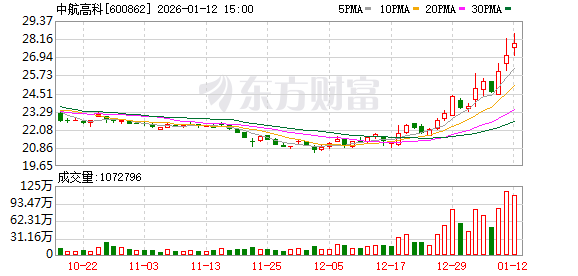
中航高科:截至2026年1月9日收盘股东户数120101户
Zheng Quan Ri Bao· 2026-01-12 14:14
Core Viewpoint - As of January 9, 2026, the number of shareholders for AVIC High-Tech reached 120,101 [2] Company Summary - AVIC High-Tech responded to investor inquiries on an interactive platform regarding its shareholder count [2] - The company is actively engaging with its investors through platforms to provide updates on shareholder statistics [2]
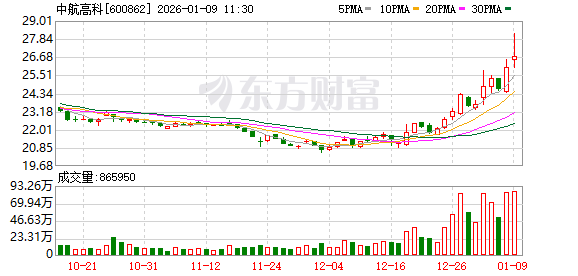
中航高科股价涨5.1%,中邮基金旗下1只基金重仓,持有5万股浮盈赚取6.9万元
Xin Lang Cai Jing· 2026-01-12 03:00
Group 1 - The core viewpoint of the news is that AVIC High-Tech has seen a stock price increase of 5.1%, reaching 28.45 CNY per share, with a trading volume of 1.501 billion CNY and a turnover rate of 3.92%, resulting in a total market capitalization of 39.632 billion CNY [1] - AVIC High-Tech, established on December 21, 1988, and listed on May 20, 1994, is primarily engaged in the research, production, and sales of aerospace new materials, CNC machine tools, and aviation-specific equipment [1] - The revenue composition of AVIC High-Tech is as follows: aerospace new materials account for 97.69%, leasing business 1.16%, aviation-related equipment 0.60%, others 0.32%, metal cutting machine tools 0.22%, and high-speed rail equipment and accessories 0.00% [1] Group 2 - From the perspective of fund holdings, one fund under China Post Fund has a significant position in AVIC High-Tech, specifically the China Post Stable and Flexible Allocation Mixed Fund (001226), which holds 50,000 shares, unchanged from the previous period, representing 3.62% of the fund's net value [2] - The China Post Stable and Flexible Allocation Mixed Fund (001226) was established on May 5, 2015, with a latest scale of 32.6974 million CNY, and has achieved a year-to-date return of 6.46%, ranking 1565 out of 9012 in its category [2] - The fund has a one-year return of 37.37%, ranking 3466 out of 8157, and a cumulative return since inception of 20.49% [2]
我国新增超20万颗卫星申请,航空航天ETF(159227)涨超3.5%
Xin Lang Cai Jing· 2026-01-12 02:31
Core Viewpoint - The aerospace industry index in China has seen a significant increase, with a notable rise in several key stocks, indicating a bullish trend in the sector driven by increased satellite launch demands and advancements in low-cost launch technologies [1]. Group 1: Market Performance - As of January 12, 2026, the CN5082 aerospace industry index surged by 3.83%, with major stocks like Guobo Electronics rising by 15.17%, Xinjingang by 13.68%, and Guoguang Electric by 11.62% [1]. - The Aerospace ETF (159227) also experienced a rise of 3.57%, marking its third consecutive increase, with the latest price reported at 1.62 yuan [1]. Group 2: Satellite Launch Developments - On January 11, the International Telecommunication Union (ITU) announced that China submitted an application for frequency and orbital resources for 203,000 new satellites, covering 14 satellite constellations, including low and medium Earth orbit satellites [1]. - This submission is noted as the largest international frequency application action by China to date [1]. Group 3: Industry Insights - Zhonghang Securities suggests that the unprecedented increase in satellite launch demand will be a pivotal change in the industry, with reusable rocket technologies enabling low-cost launches [1]. - The report recommends focusing on companies that have achieved large-scale launches or are in the research phase with first-mover advantages, as well as those involved in core rocket components or systems, and enterprises transitioning from military to civilian applications in rocket manufacturing [1]. Group 4: ETF Composition - The Aerospace ETF (159227) closely tracks the CN5082 index and encompasses key segments of the aerospace supply chain, including aerospace equipment, satellite navigation, and new materials, with commercial aerospace concepts accounting for 70% of its weight [1]. - The top ten holdings include industry leaders such as Aerospace Development, China Satellite, Aerospace Electronics, AVIC Avionics, and AVIC High-Tech [1].

中航高科成交额创上市以来新高
Zheng Quan Shi Bao Wang· 2026-01-09 03:45
Core Viewpoint - Zhonghang Gaoke's trading volume reached 2.177 billion yuan, marking a new high since its listing, with the latest stock price increasing by 4.65% and a turnover rate of 5.81% [2] Trading Performance - The stock's trading volume on the previous trading day was 2.175 billion yuan [2] - The current trading volume indicates a significant interest from investors, as reflected in the increase in stock price and turnover rate [2]
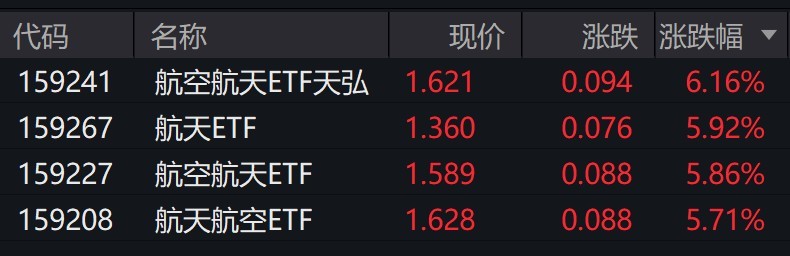
航空航天概念股走强,相关ETF涨约6%
Mei Ri Jing Ji Xin Wen· 2026-01-09 03:20
Group 1 - Aerospace concept stocks have strengthened, with companies like Guangqi Technology and Aerospace Electronics hitting the daily limit, and AVIC Chengfei rising over 6%, while China Satellite and AVIC High-Tech increased by over 5% [1] - The aerospace-related ETFs have risen approximately 6% due to market influences [1] Group 2 - The Star River Power Aerospace announced plans to implement the "Ceres-1 Sea Launch Type (Remote 7)" commercial launch vehicle mission in the near future. This mission, if successful, could make Star River Power Aerospace the first private aerospace company to complete a launch by 2026, injecting strong momentum into the development of China's private aerospace industry [2] - Analysts believe that with the increasing demand for space computing and the maturation of reusable launch vehicle technology, China's commercial aerospace sector is expected to experience a significant growth inflection point, characterized by reduced costs and enhanced launch capabilities [2]


商业航天连续爆发,航天电子两连板,通用航空ETF基金(159230)大涨3.39%
Sou Hu Cai Jing· 2026-01-09 03:18
Group 1 - The three major indices collectively strengthened, with the commercial aerospace and large aircraft sectors experiencing a resurgence, as evidenced by the Aerospace ETF rising by 5.93% and the General Aviation ETF increasing by 4.48% [1] - The low-altitude economy has seen significant deployment in provincial "14th Five-Year" plans, showcasing distinct regional characteristics and development paths, with Guangdong focusing on low-altitude flight and infrastructure, while Chongqing aims to become a strong city for low-altitude economic innovation [1] - The logistics drone market in China reached a scale of 6.13 billion yuan in 2023, with expectations for continued rapid growth, particularly in the last-mile drone market, which is projected to see a year-on-year increase of 286% in delivery volume by mid-2025, with the market size expected to exceed 96 billion yuan by the end of the year [1] Group 2 - The General Aviation ETF tracks the National General Aviation Industry Index, focusing on the low-altitude economy, covering sectors such as aviation materials, infrastructure, aircraft manufacturing, operational services, and application scenarios, with low-altitude economy content at 88.26% and commercial aerospace content at 65.32% [2]


广州低空经济规划落地,同类规模最大的通用航空ETF(159378)涨超4%,成分股航天电子、航天彩虹涨停
Sou Hu Cai Jing· 2026-01-09 03:01
Group 1 - The core viewpoint of the news highlights the significant growth in the general aviation sector, driven by policy, technology, and market forces, particularly focusing on the low-altitude economy and drone technology [3] - The Guangzhou Municipal Government has issued a plan to accelerate the development of advanced manufacturing, emphasizing the growth of the low-altitude economy and the establishment of a civil unmanned aerial vehicle testing zone [2][3] - The General Aviation ETF (159378) has seen a notable increase of 4.21%, with key stocks such as Aerospace Electronics and Aerospace Rainbow reaching their daily limit up [1][2] Group 2 - The General Aviation ETF (159378) is the largest of its kind, focusing on low-altitude economy and drone applications, benefiting from the rapid development of integrated air-space-ground systems [3] - The ETF's performance is linked to the dual boost from "new combat capabilities" and "new production capabilities," indicating a strong market potential [3] - The ETF was established on January 2, 2025, making it the first and largest ETF tracking the national general aviation industry index [3]


内外需共振-看好军工板块价值重估
2026-01-08 16:02
Summary of Key Points from Conference Call Industry Overview - The military industry is expected to benefit significantly from the increase in the U.S. defense budget, projected to reach $1.5 trillion by 2027, which will stimulate global military and arms trade market expansion. China, as a major supplier of weaponry, stands to gain from this trend [1][3][4]. - The changing international landscape, including events in Venezuela and the Russia-Ukraine conflict, has heightened the demand for military capabilities, providing opportunities for China's arms trade development [1][5]. Core Insights and Arguments - The gross profit margin for arms trade is significantly higher than domestic sales, as international pricing is market-driven and typically exceeds domestic prices. This suggests that expanding arms trade can optimize financial statements and enhance profitability [1][6]. - The domestic large aircraft manufacturing sector is crucial, with the C919 aircraft steadily improving its delivery capabilities. However, challenges remain in the localization of onboard systems and engines [1][7][9]. - The commercial aerospace sector is entering a phase of rapid growth, with expectations that domestic commercial space will transition from an introduction phase to an early growth phase by 2026, with satellite bidding orders projected to increase by over tenfold compared to 2025 [1][2][8]. Important but Overlooked Content - The U.S. defense budget increase is expected to lead other countries to follow suit, further driving global military spending, which reached $2.4 trillion in 2025, with the U.S. accounting for over one-third of this total [4]. - The domestic aviation manufacturing industry is currently dominated by Boeing and Airbus, with China importing over 200 aircraft annually, totaling over $20 billion. The need for over 9,000 new aircraft in the next 20 years underscores the importance of domestic large aircraft production [7]. - In the commercial space sector, the focus is on the integration of satellite manufacturing and applications, with significant market potential and growth expected in the coming years [11][12]. Recommendations for Investment - Companies to watch in the arms trade include those involved in aircraft, drones, radar systems, and guided equipment, such as Hongdu Aviation and AVIC [1][6]. - In the commercial aerospace sector, attention should be paid to suppliers like COMAC and engine manufacturers like Commercial Aircraft Corporation of China [7][9]. - For satellite manufacturing, recommended companies include XinKong Mobile and China Satellite, with a focus on their technological advantages and market positions [13][14][15]. Conclusion - The military and aerospace industries are poised for significant growth driven by increased defense spending and technological advancements. Investors should focus on companies that are well-positioned to capitalize on these trends, particularly in arms trade and commercial aerospace sectors.
商业航天深度:技术收敛引爆“奇点”,蓝海市场破晓已至(附62页PPT)
材料汇· 2026-01-08 16:01
Group 1 - The article emphasizes the explosive growth of the commercial space industry driven by supportive policies and technological advancements [4][19] - The transition from traditional space (government-led) to commercial space (private sector-driven) is highlighted, showcasing the shift in funding and operational models [10][12] - The U.S. and China are establishing a bipolar competitive landscape in the space industry, with the U.S. leading in commercial launches and satellite deployments [24][28] Group 2 - Key sectors in the space industry include satellites, launch vehicles, ground equipment, and terminal applications, which are experiencing increased demand [3][29] - The competitive landscape is maturing, with significant advancements in technology such as reusable rockets and cost-effective satellite manufacturing [20][23] - Investment recommendations suggest focusing on companies that are well-positioned within the rapidly evolving commercial space ecosystem [3][39] Group 3 - The article outlines the historical development of commercial space, noting critical milestones from the 1980s to the present, including the rise of companies like SpaceX and Blue Origin [11][16] - The U.S. has shifted its procurement model from cost-plus contracts to fixed-price contracts, incentivizing cost reduction and innovation in the space sector [14][15] - China's commercial space sector is rapidly developing, with government initiatives aimed at fostering innovation and investment in the industry [19][27] Group 4 - The article discusses the structure of the space industry supply chain, which includes upstream (manufacturing), midstream (launch services), and downstream (applications) segments [30][32] - The total addressable market (TAM) for the space industry is projected to grow significantly, with commercial space revenues expected to dominate [39][40] - The article highlights the high barriers to entry in the space industry, particularly in the upstream segment, which contributes to high profit margins [41]