
千禾味业

Search documents
千禾味业(603027) - 千禾味业食品股份有限公司期货套期保值业务管理制度(2025年12月)
2025-12-29 08:30
千禾味业食品股份有限公司 期货套期保值业务管理制度 第一章 总则 第一条 为规范千禾味业食品股份有限公司(以下简称"公司")期货套期 保值业务(以下简称"套保业务"),防范交易风险,确保套保业务有序进行, 根据《中华人民共和国公司法》《中华人民共和国证券法》《上海证券交易所股 票上市规则》《上海证券交易所上市公司自律监管指引第 1 号——规范运作》《上 海证券交易所上市公司自律监管指引第 5 号——交易与关联交易》及《千禾味业 食品股份有限公司章程》(以下简称"《公司章程》")等有关规定,结合公司 实际情况,特制订本制度。 第二条 本制度适用于公司及全体子公司。 第三条 公司进行套保业务的期货品种仅限于与公司生产经营相关的产品或 者所需的原材料。以保证原材料供应、公司正常生产为前提,以规避生产经营中 的商品价格风险为目的。公司不得进行以投机为目的的交易。 第四条 公司从事套保业务,应遵循以下原则: (一)公司在进行套保业务时,应严格遵守相关法律、法规和规范性文件与 期货交易的规定,不得进行违法违规的交易; (二)公司进行套保业务,只能在依法经过批准或者核准,具有衍生品交易 业务经营资格的机构进行。 第五条 从 ...

千禾味业:12月29日召开董事会会议
Mei Ri Jing Ji Xin Wen· 2025-12-29 08:30
Group 1 - The core viewpoint of the article highlights that Qianhe Flavor Industry (SH 603027) held its eighth meeting of the fifth board of directors on December 29, 2025, to discuss the feasibility analysis report on futures hedging business [1] - For the year 2024, Qianhe Flavor Industry's revenue composition is reported to be 98.7% from the food manufacturing sector and 1.3% from other businesses [1] - As of the time of reporting, Qianhe Flavor Industry has a market capitalization of 13 billion yuan [1] Group 2 - The article also mentions a significant event involving Moutai distributors, where over 2,000 attendees gathered for a conference that announced major changes regarding Moutai pricing and distribution [1] - Chairman Chen Hua emphasized that distributors can no longer rely on passive income [1]
千禾味业(603027) - 千禾味业食品股份有限公司关于开展期货套期保值业务的可行性分析报告
2025-12-29 08:30
关于开展期货套期保值业务的可行性分析报告 一、开展期货套期保值业务的必要性 千禾味业食品股份有限公司(以下简称"公司")专业从事高品质酱油、食醋、 料酒、蚝油等调味品的研发、生产和销售,公司主要原材料为大豆、小麦和白糖 等农副产品。农副产品价格受当年的种植面积、气候条件、市场供求以及国际期 货市场价格等因素的影响,长期以来波动频繁,为控制主要原材料价格波动对公 司经营可能产生的风险,保证产品成本的相对稳定和竞争优势,公司开展期货套 期保值业务具有必要性。 千禾味业食品股份有限公司 4、交易期限 自董事会审议通过之日起 12 个月内。 三、开展期货套期保值业务的可行性 2、资金额度 1、期货套期保值的交易方式 预计动用的交易保证金上限不超过 2,000 万元人民币,任一交易日持有的最 高合约价值不超过 2 亿元人民币,上述资金额度在期限内可循环使用。 交易场所:境内商品期货交易所。 3、资金来源 二、期货套期保值业务的基本情况 交易品种:商品期货交易所挂牌交易的与公司生产经营有直接关系的大豆、 小麦和白糖等商品的期货合约。 公司的自有资金,不涉及募集资金。 公司进行原材料的期货套期保值业务,可规避原材料价格大幅 ...
千禾味业(603027) - 千禾味业食品股份有限公司关于开展期货套期保值业务的公告
2025-12-29 08:30
千禾味业食品股份有限公司 关于开展期货套期保值业务的公告 本公司董事会及全体董事保证本公告内容不存在任何虚假记载、误导性陈 述或者重大遗漏,并对其内容的真实性、准确性和完整性承担法律责任。 重要内容提示: 交易主要情况 | 交易目的 | □获取投资收益 | | | --- | --- | --- | | | ☑套期保值(合约类别:☑商品;□外汇;□其他:________) | | | | □其他:________ | | | 交易品种 | 与公司生产经营有直接关系的大豆、小麦和白糖等商品的期 | | | | 货合约 | | | 交易金额 | 预计动用的交易保证金和权利金 上限(单位:万元) | 2,000 | | | 预计任一交易日持有的最高合约 价值(单位:万元) | 20,000 | | 资金来源 | ☑自有资金 □借贷资金 □其他:___ | | | 交易期限 | 自董事会审议通过之日起12个月内 | | 履行及拟履行的审议程序 本事项已经公司董事会审计委员会、第五届董事会第八次会议审议通过。 证券代码:603027 证券简称:千禾味业 公告编号:临 2025-041 特别风险提示 公司进行期货套期保值 ...
千禾味业(603027) - 千禾味业食品股份有限公司第五届董事会第八次会议决议公告
2025-12-29 08:30
会议经过董事会充分讨论和认真审议,通过了如下决议: 证券代码:603027 证券简称:千禾味业 公告编号:临 2025-040 千禾味业食品股份有限公司 第五届董事会第八次会议决议公告 本公司董事会及全体董事保证本公告内容不存在任何虚假记载、误导性陈述 或者重大遗漏,并对其内容的真实性、准确性和完整性承担个别及连带责任。 一、董事会会议召开情况 千禾味业食品股份有限公司(以下简称"公司")第五届董事会第八次会议通知 于2025年12月25日以书面、电子邮件、电话形式通知了全体董事,会议于2025年 12月29日在公司会议室以现场结合通讯方式召开。本次会议应参加表决董事9名, 实际参加表决董事9名。会议由公司董事长伍超群先生主持,公司高级管理人员列 席了本次会议。本次会议的召集和召开符合《公司法》等有关法律、行政法规、 部门规章、规范性文件和《公司章程》的相关规定,会议形成的决议合法、有效。 二、董事会会议审议情况 具体内容详见公司同日披露于上海证券交易所网站(www.sse.com.cn)的公告。 1、审议并通过《关于修订<千禾味业食品股份有限公司期货套期保值业务管 理制度>的议案》 董事会同意公司根据《中华 ...
调味发酵品板块12月26日跌0.16%,日辰股份领跌,主力资金净流出2921.81万元
Zheng Xing Xing Ye Ri Bao· 2025-12-26 09:07
证券之星消息,12月26日调味发酵品板块较上一交易日下跌0.16%,日辰股份领跌。当日上证指数报收 于3963.68,上涨0.1%。深证成指报收于13603.89,上涨0.54%。调味发酵品板块个股涨跌见下表: | 代码 | 名称 | 主力净流入(元) | 主力净占比 游资净流入(元) | | 游资净占比 散户净流入(元) | | 散户净占比 | | --- | --- | --- | --- | --- | --- | --- | --- | | 600186 莲花控股 | | 4638.34万 | 8.97% | -1174.15万 | -2.27% | -3464.19万 | -6.70% | | 603755 日辰股份 | | 2017.84万 | 19.07% | -264.82万 | -2.50% | -1753.02万 | -16.57% | | 603288 海天味业 | | 1623.23万 | 5.65% | -848.33万 | -2.95% | -774.90万 | -2.70% | | 002495 佳隆股份 | | 942.59万 | 14.39% | -263.68万 | -4. ...


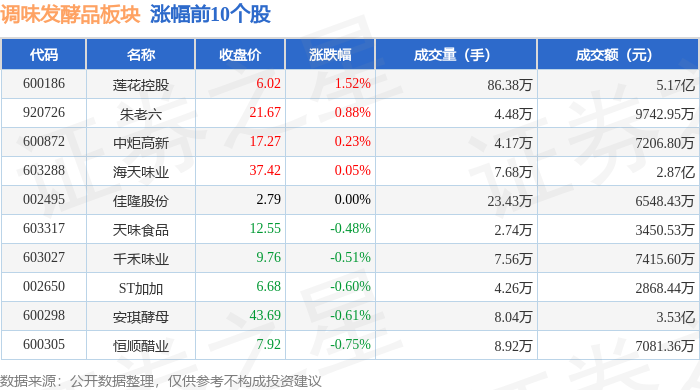
调味发酵品板块12月25日涨0.17%,日辰股份领涨,主力资金净流出1.62亿元
Zheng Xing Xing Ye Ri Bao· 2025-12-25 09:07
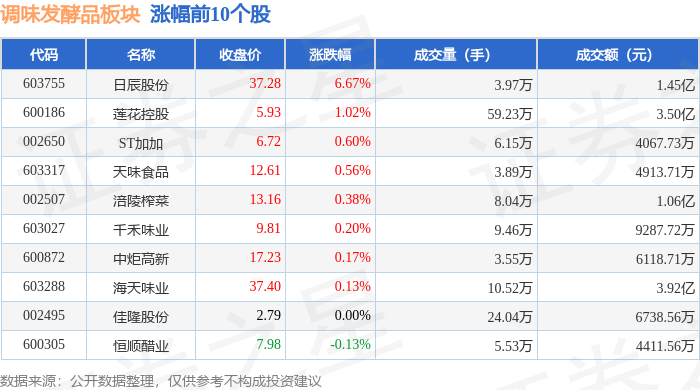
Market Overview - The seasoning and fermentation sector increased by 0.17% compared to the previous trading day, with Richen Co., Ltd. leading the gains [1] - The Shanghai Composite Index closed at 3959.62, up 0.47%, while the Shenzhen Component Index closed at 13531.41, up 0.33% [1] Stock Performance - Richen Co., Ltd. (603755) closed at 37.28, up 6.67% with a trading volume of 39,700 lots and a transaction value of 145 million [1] - Lianhua Holdings (600186) closed at 5.93, up 1.02% with a trading volume of 592,300 lots and a transaction value of 350 million [1] - ST Jiajia (002650) closed at 6.72, up 0.60% with a trading volume of 61,500 lots and a transaction value of 40.68 million [1] - Tianwei Food (603317) closed at 12.61, up 0.56% with a trading volume of 38,900 lots and a transaction value of 49.14 million [1] - Other notable stocks include Jieling Pickles (002507) at 13.16, up 0.38%, and Qianhe Flavor Industry (603027) at 9.81, up 0.20% [1] Capital Flow - The seasoning and fermentation sector experienced a net outflow of 162 million from institutional investors, while retail investors saw a net inflow of 113 million [2] - The sector's overall capital flow indicates a mixed sentiment, with institutional investors withdrawing funds while retail investors are actively buying [2] Individual Stock Capital Flow - Richen Co., Ltd. had a net inflow of 20.38 million from institutional investors, but a net outflow of 17.56 million from retail investors [3] - Qianhe Flavor Industry saw a net inflow of 373,540 from institutional investors, but a net outflow of 295,030 from retail investors [3] - Other stocks like Jiajia Co. (002495) and Tianwei Food (603317) also showed varied capital flows, indicating differing investor sentiments across the sector [3]


商标法5年来首次修订,剑指“千禾0”“多半桶”等重大乱象
凤凰网财经· 2025-12-24 12:42
Core Viewpoint - The long-awaited trademark law revision draft has entered the legislative process, aiming to address issues such as malicious trademark registration and litigation, which have garnered significant public attention [4][6]. Group 1: Background and Context - The State Intellectual Property Office released a draft for public consultation in January 2023, which has undergone nearly three years of refinement before being presented for legislative review [5]. - As of the end of 2024, China has accumulated 83.52 million trademark applications, with 49.77 million valid registered trademarks, leading the world in both categories [8]. Group 2: Issues in Trademark Registration - Malicious trademark registrations and lawsuits have become prevalent, with examples including the malicious registration of terms like "Bing Dwen Dwen" and "Gu Ailing" [6][8]. - The current trademark law, enacted in 1983, has undergone four minor revisions, with this being the first major overhaul in over five years [7]. Group 3: Legislative Changes - The revision draft emphasizes problem-oriented solutions, focusing on improving trademark registration, management, and protection systems [15]. - The draft specifies that applications for trademark registration that are not intended for use and exceed normal business needs will be rejected, enhancing the criteria for registration [16]. - It strengthens the protection of well-known trademarks by prohibiting the registration of similar trademarks across different product categories, regardless of their registration status [17]. Group 4: Enforcement and Penalties - The draft introduces penalties for misleading public use of registered trademarks, including fines of up to 50,000 yuan for non-compliance [18]. - It aims to address cases of malicious registration and litigation effectively, thereby maintaining market order and protecting consumer rights [19]. Group 5: Judicial Experience and Future Considerations - The draft incorporates judicial experiences by imposing penalties for malicious trademark litigation and holding offenders liable for damages [22]. - There are suggestions to increase official fees for trademark applications to deter malicious registrations, as the current fee structure presents minimal economic barriers [20].
血泪教训,2025供应链行业的“生死局”
3 6 Ke· 2025-12-23 01:20
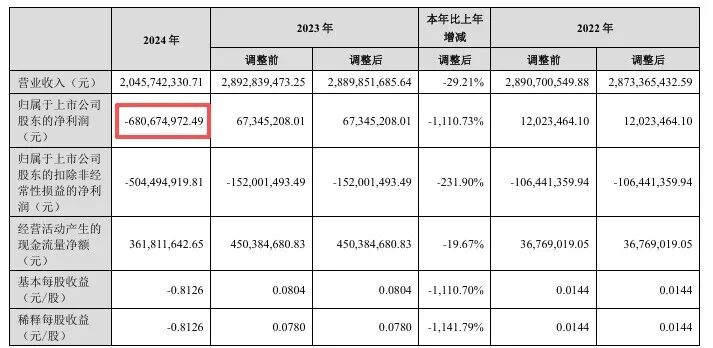
Group 1 - The supply chain industry is undergoing significant turmoil, with both successful and failed companies facing unique challenges and lessons learned from the past year [1] - Companies like Huangshi Group have faced severe penalties for financial misconduct, highlighting the risks associated with concealing financial information [2][3] - Huangshi Group's diversification into unrelated sectors has led to a dilution of its core business and financial instability, resulting in substantial losses [4][6] Group 2 - ST Jiajia has lost its controlling shareholder and is facing governance issues, which may hinder its strategic decision-making and future opportunities [7][10] - The founder of ST Jiajia has accumulated significant personal debt, leading to legal troubles and further complicating the company's situation [8][12] - The case of Green Earth highlights the risks of heavy asset reliance in the agricultural sector, where poor cash flow management can lead to severe consequences [13][16] Group 3 - Furen Food has entered a state of crisis, with multiple executives leaving and the company halting operations due to financial difficulties [17][19] - The decline of Furen Food reflects broader challenges in the frozen food industry, particularly the impact of e-commerce and changing consumer preferences [19] - Jiangsu Hongjiu's financial collapse illustrates the dangers of overexpansion and reliance on a single market segment, leading to unsustainable debt levels [20][22] Group 4 - Xiwang Food has seen a significant drop in its stock holdings by its major shareholder, raising concerns about the company's governance and financial stability [21][23] - The decline in revenue for Xiwang Food is attributed to increased competition and a lack of brand recognition in a crowded market [25][26] - Tianrun Dairy has reported its first loss in a decade, driven by market price wars and operational challenges, prompting strategic adjustments [27][30] Group 5 - Qianhe Flavor Industry has faced a crisis due to product quality issues, leading to a decline in consumer trust and financial performance [33][35] - The company's struggles underscore the importance of maintaining transparency and quality in the supply chain to build consumer confidence [36] - The experiences of these eight companies collectively highlight critical survival principles in the supply chain sector, such as focusing on core business, maintaining cash flow, and ensuring strong governance [37]


静水深流,大象无形 - 食品饮料行业2026年度投资策略
2025-12-22 15:47
Summary of the Food and Beverage Industry Conference Call Industry Overview - The food and beverage industry is expected to end its deep adjustment cycle by 2026, with consumer goods having largely completed inventory destocking [1][4] - The liquor sector, particularly baijiu, is projected to reach a new equilibrium by Q2 2026, with CPI stabilizing to alleviate price deflation pressures [1][4] - Companies with innovation or supply chain optimization capabilities are expected to stand out in the recovery phase [1][4] Key Insights and Arguments - The liquor sector is currently in a bottoming process, with mid-term investment value being significant [1][5] - Consumer goods are benefiting from an efficiency revolution and the transition between old and new growth drivers, with emerging channels and cost advantages continuing [1][5] - In 2025, the food and beverage sector showed mixed performance, with yellow wine, soft drinks, dairy products, and meat products leading in growth, while baijiu faced significant downward pressure from high-end price declines [1][6] Market Dynamics - The CPI and PPI differential has been volatile, with weak price increase expectations; however, a future stabilization of CPI could relieve downward price pressures [1][7] - The liquor price average has returned to a high level, indicating limited future downward space, necessitating companies to maintain a balance between volume and price [1][8] Sector-Specific Trends Liquor Industry - The baijiu sector is expected to reach a new balance by Q2 2026, with a characteristic of low-to-high price movement [1][5] - Companies are advised to focus on maintaining volume-price balance during the destocking phase [1][8] Consumer Goods - The industry is currently in a "channel is king" phase, necessitating the exploration of structural opportunities to meet changing consumer demands for health, personalization, convenience, and cost-effectiveness [1][9] - After completing inventory destocking, traditional sectors may rebound, with new emerging segments expected to thrive [1][9] Dairy Industry - The dairy sector is in a stabilization phase, with raw milk supply expected to contract in 2026, leading to a potential improvement cycle [1][11] - Key companies to watch include Yili, Mengniu, and Miaokelando, which are expected to show growth potential [1][11] Beer and Yellow Wine - The beer industry is stable but experiencing changes due to the rise of new channels, suggesting a focus on leading companies like Qingdao Beer and Yanjing Beer [1][12] - The yellow wine sector is seeing a concentration of market share among leading companies, with structural upgrades expected to continue [1][12] Soft Drinks and Snacks - The soft drink market is facing intensified competition, with notable segments like glucose tea and sports drinks showing promise [1][13] - The snack sector is benefiting from new channel transformations, with companies like Weilong and Chacha expected to perform well [1][13] Restaurant Supply Chain and Food Chains - The restaurant supply chain is recovering from regulatory impacts, with companies like Anji Food and Gaoli Co. being highlighted for their growth potential [1][14] - Food chain companies are accelerating their expansion through optimization and innovation, presenting investment opportunities [1][14] Health Products - The health product market shows potential for significant growth, with key products like coenzyme Q10 and probiotics gaining traction [1][15] Conclusion - Each sub-sector within the food and beverage industry presents unique opportunities and challenges, necessitating tailored investment strategies to capture alpha opportunities and achieve stable returns [1][16]