
新兴渠道

Search documents
静水深流,大象无形 - 食品饮料行业2026年度投资策略
2025-12-22 15:47
Summary of the Food and Beverage Industry Conference Call Industry Overview - The food and beverage industry is expected to end its deep adjustment cycle by 2026, with consumer goods having largely completed inventory destocking [1][4] - The liquor sector, particularly baijiu, is projected to reach a new equilibrium by Q2 2026, with CPI stabilizing to alleviate price deflation pressures [1][4] - Companies with innovation or supply chain optimization capabilities are expected to stand out in the recovery phase [1][4] Key Insights and Arguments - The liquor sector is currently in a bottoming process, with mid-term investment value being significant [1][5] - Consumer goods are benefiting from an efficiency revolution and the transition between old and new growth drivers, with emerging channels and cost advantages continuing [1][5] - In 2025, the food and beverage sector showed mixed performance, with yellow wine, soft drinks, dairy products, and meat products leading in growth, while baijiu faced significant downward pressure from high-end price declines [1][6] Market Dynamics - The CPI and PPI differential has been volatile, with weak price increase expectations; however, a future stabilization of CPI could relieve downward price pressures [1][7] - The liquor price average has returned to a high level, indicating limited future downward space, necessitating companies to maintain a balance between volume and price [1][8] Sector-Specific Trends Liquor Industry - The baijiu sector is expected to reach a new balance by Q2 2026, with a characteristic of low-to-high price movement [1][5] - Companies are advised to focus on maintaining volume-price balance during the destocking phase [1][8] Consumer Goods - The industry is currently in a "channel is king" phase, necessitating the exploration of structural opportunities to meet changing consumer demands for health, personalization, convenience, and cost-effectiveness [1][9] - After completing inventory destocking, traditional sectors may rebound, with new emerging segments expected to thrive [1][9] Dairy Industry - The dairy sector is in a stabilization phase, with raw milk supply expected to contract in 2026, leading to a potential improvement cycle [1][11] - Key companies to watch include Yili, Mengniu, and Miaokelando, which are expected to show growth potential [1][11] Beer and Yellow Wine - The beer industry is stable but experiencing changes due to the rise of new channels, suggesting a focus on leading companies like Qingdao Beer and Yanjing Beer [1][12] - The yellow wine sector is seeing a concentration of market share among leading companies, with structural upgrades expected to continue [1][12] Soft Drinks and Snacks - The soft drink market is facing intensified competition, with notable segments like glucose tea and sports drinks showing promise [1][13] - The snack sector is benefiting from new channel transformations, with companies like Weilong and Chacha expected to perform well [1][13] Restaurant Supply Chain and Food Chains - The restaurant supply chain is recovering from regulatory impacts, with companies like Anji Food and Gaoli Co. being highlighted for their growth potential [1][14] - Food chain companies are accelerating their expansion through optimization and innovation, presenting investment opportunities [1][14] Health Products - The health product market shows potential for significant growth, with key products like coenzyme Q10 and probiotics gaining traction [1][15] Conclusion - Each sub-sector within the food and beverage industry presents unique opportunities and challenges, necessitating tailored investment strategies to capture alpha opportunities and achieve stable returns [1][16]
2025年中国购物者报告,系列二:渠道破局:中国快消品市场的机会和挑战
BAIN· 2025-12-10 11:20
Investment Rating - The report does not explicitly provide an investment rating for the industry Core Insights - The Chinese fast-moving consumer goods (FMCG) market shows signs of stabilization in 2025, with a sales growth of 1.3% year-on-year in the first three quarters, driven by a 3.8% increase in volume and a 2.4% decrease in average price [9][12][10] - Lower-tier cities (third to fifth tier) contributed approximately 80% of the market growth, benefiting from urbanization, brand penetration strategies, and the expansion of new retail channels [9][20] - The report highlights a shift in consumer behavior, where price sensitivity is balanced with quality considerations, leading to a stabilization in average prices after a significant decline in previous years [10][43] Summary by Sections Market Overview - The FMCG market in China experienced a mild growth in 2025, with a notable performance in the first quarter, which saw a 2.7% increase year-on-year [12] - Sales in lower-tier cities are a key growth driver, with a volume increase of 4-6% offsetting price declines [20][39] Category Dynamics - Packaged food and household care categories led the growth with increases of 3.4% and 3.3% respectively, while the beverage category faced a decline of 1.1% [24][25] - The personal care category showed signs of recovery with a 1.1% growth after several years of decline [34] Price Dynamics - The "consumption upgrade" trend continued into 2025, with average prices decreasing by 2.4%, although the rate of decline has slowed compared to 2024 [10][43] - Promotional activities have decreased, indicating a shift in consumer purchasing behavior towards a more balanced consideration of price and quality [13][43] Emerging Channel Dynamics - New retail formats such as warehouse membership stores, snack collection stores, and discount stores are rapidly expanding, with growth rates of 40%, 51%, and 92% respectively [54][55] - E-commerce channels also showed strong growth, with an increase from 2% to 7% in the first three quarters of 2025 [54][56] Implications for Brands - Brands must adapt to the evolving retail landscape, leveraging data and technology to create demand and navigate the fragmented market [53] - The report emphasizes the importance of understanding consumer dynamics to seize opportunities in the new growth cycle [53]
中国快消品市场温和回升 新兴渠道引领消费需求新格局
Xin Hua Cai Jing· 2025-12-09 14:58
Core Insights - The Chinese fast-moving consumer goods (FMCG) market is expected to stabilize in 2025 after a flat performance in 2024, with a year-on-year sales growth of 1.3% in the first three quarters of 2025, driven by a 3.8% increase in volume and a 2.4% decrease in average prices, which is an improvement from a 3.4% decline in 2024 [1] Group 1: Market Trends - The growth in the FMCG market is primarily coming from third to fifth-tier cities, where sales volume increased by 4% to 6%, offsetting a 2% to 3% decline in average prices [1] - Consumers are becoming more rational in their purchasing decisions, focusing on quality-price ratios rather than just low prices, indicating a structural adjustment in the market [1] Group 2: Category Performance - Among the four main FMCG categories, packaged food saw the fastest growth with a 3.4% increase in sales, driven by stable demand for core staple foods and snacks [2] - The household care category grew by 3.3%, supported by stable cleaning habits and innovative products, while personal care grew by 1.1% [2] - The beverage category experienced a decline of 1.1% due to intensified competition and the impact of ready-to-drink beverages [2] Group 3: Channel Dynamics - Emerging channels are becoming the core growth driver in the FMCG market, with offline channels like warehouse membership stores, snack collection stores, and discount stores expanding rapidly, with growth rates of 40%, 51%, and 92% respectively [2] - Instant retail channels have reversed last year's decline, showing a 7.9% year-on-year growth in the third quarter, attributed to the popularity of delivery services and increased product variety [2] Group 4: Brand and Retailer Strategies - Retailers are accelerating the development of private labels, which have seen an average annual growth of 44% over the past two years, now accounting for 2% of total FMCG sales in the first three quarters of this year [3] - Brands need to redefine their relationships with retailers and platforms, integrating channel insights into product and market strategies to seize opportunities in the new growth phase of the FMCG market [3]
晨星:维持对中国旺旺(00151)公允价值6.4港元 维持盈测大体不变 认为被低估
智通财经网· 2025-11-26 06:37
Core Viewpoint - Morningstar maintains a fair value estimate of HKD 6.4 for China Wangwang (00151) and keeps its earnings expectations largely unchanged, believing the company is undervalued primarily due to a projected dividend yield of 4.3% in 2025 [1] Financial Performance - For the half-year period ending September, Wangwang reported a revenue increase of 2.1% year-on-year, while net profit decreased by 7.8%, attributed to a decline in gross margin and increased operating expenses [1] - Revenue exceeded expectations, but net profit was in line with forecasts [1] Investment and Growth Strategy - The company is increasing investments in new channels, which has temporarily raised the sales expense ratio; however, this is viewed positively as essential for long-term growth [1] - Revenue from traditional wholesale and modern retail channels decreased by approximately 15-20%, indicating a shift in customer traffic from traditional products and channels [1] Emerging Channels and Market Expansion - Despite the decline in traditional channels, overall revenue growth remains positive, supported by new products in emerging channels [1] - Wangwang is optimistic about expanding sales in niche markets like dairy products through discount stores, which accounted for 15% of total sales during the period [1] - The overseas market also showed positive growth, which is viewed favorably [1]

旺仔牛奶“失宠”!中国旺旺净利下滑 机构下调目标价
Guo Ji Jin Rong Bao· 2025-11-25 15:47
Core Insights - The financial report of China Wangwang (00151.HK) for the half-year ending September 30, 2025, shows a revenue of 11.108 billion yuan, a slight increase of 2.1% year-on-year, but a decline in net profit by 7.8% to 1.717 billion yuan, marking the lowest net profit margin of 15.46% in nearly four years, which fell short of market expectations [2][4][9] Revenue Composition - The dairy and beverage segment, primarily driven by the flagship product Wangzai Milk, constitutes a significant portion of the company's revenue, accounting for nearly half of total revenue [3] - The revenue from the dairy and beverage segment decreased by 1.1% year-on-year to 5.941 billion yuan, attributed to a sluggish ambient dairy market and the rapid growth of affordable ready-to-drink tea beverages [4][9] Emerging Sales Channels - The company is actively expanding into emerging sales channels such as e-commerce, instant retail, and snack wholesale, with the snack wholesale channel growing rapidly and now representing 15% of total revenue [4] - Despite the growth in new channels, the gross margin for the dairy and beverage segment fell from 50.3% to 47.8%, indicating significant pressure on profitability [4][9] Market Reactions - Following the financial report, several financial institutions, including JPMorgan, Bank of America, and UBS, downgraded their target prices for China Wangwang, with Bank of America lowering its target price to 4.7 HKD and assigning an "underperform" rating [8] - Analysts pointed out that the decline in milk beverage sales, reduced gross margins, and increased selling and administrative expenses are key reasons for the company's underperformance [9] Cost Pressures - The company's total operating expenses rose by 10.6% year-on-year to 3.202 billion yuan, with the distribution costs increasing significantly by 13.2% to 1.555 billion yuan, contributing to the pressure on profits [9] - UBS forecasts a 9% year-on-year decline in net profit for the fiscal year 2026, while Citi has adjusted its net profit forecasts for 2026-2028 down by 8%-13% due to rising raw material costs and increased advertising expenditures [9]

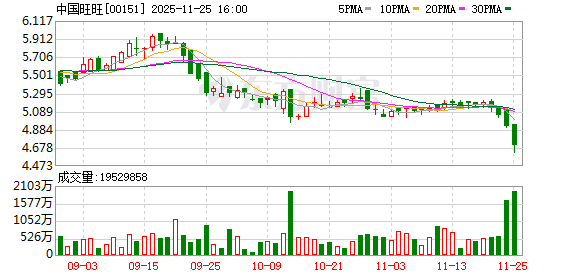
中国旺旺(00151.HK)上半财年纯利跌7.8%至17.17亿元 新兴渠道收益获得双位数的良好增长
Ge Long Hui· 2025-11-24 04:10
Core Viewpoint - China Wangwang (00151.HK) reported a revenue of RMB 11.108 billion for the first half of the 2025 fiscal year, reflecting a year-on-year growth of 2.1%, while the profit attributable to equity holders decreased by 7.8% to RMB 1.717 billion, with basic earnings per share at RMB 0.1455 [1][2] Group 1: Financial Performance - The total revenue for the first half of the 2025 fiscal year was RMB 11.1078 billion, showing a growth of 2.1% compared to the same period last year, with sales increasing nearly in double digits [1] - The profit attributable to equity holders decreased by 7.8% year-on-year to RMB 1.717 billion [1] - The basic earnings per share for the period was RMB 0.1455 [1] Group 2: Product and Market Performance - The ice cream segment within the leisure food category achieved double-digit growth [1] - Emerging channels such as e-commerce and OEM continued to perform well, with revenue from these channels growing in double digits [1] - The company launched new products targeting the snack wholesale channel, which were well-received by consumers, demonstrating effective strategic response to rapid market changes [1] Group 3: International and New Product Growth - Overseas revenue for the first half of the 2025 fiscal year saw low single-digit growth, with positive momentum in regions like Japan and India [1] - Revenue from new products launched in the past five years accounted for a mid-double-digit percentage of total revenue, serving as a significant growth engine for the company [1] Group 4: Cost and Margin Analysis - The gross profit margin for the first half of the 2025 fiscal year decreased by 1.1 percentage points to 46.2% [2] - While the costs of some raw materials like white sugar and gelatin decreased, the rising costs of imported whole milk powder and palm oil offset these benefits, leading to a decline in gross margin [2] - Overall operating expenses increased by 10.6%, primarily due to promotional expenses for new channels and products following internal organizational restructuring [2]
有友食品(603697):公司信息更新报告:Q3成长动能持续,收入利润好于预期
KAIYUAN SECURITIES· 2025-11-03 06:11
Investment Rating - The investment rating for the company is "Outperform" (maintained) [1] Core Views - The company has shown strong revenue and profit growth, exceeding expectations, with a year-on-year revenue increase of 40.4% to 1.24 billion yuan and a net profit increase of 43.3% to 170 million yuan for the first three quarters of 2025 [4][5] - The growth momentum is driven by new product channels and strong performance in existing markets, particularly in the poultry product segment [5][6] - The company maintains its profit forecast for 2025-2027, expecting net profits of 220 million, 270 million, and 320 million yuan, representing year-on-year growth rates of 41.2%, 22.8%, and 16.2% respectively [4][6] Financial Performance Summary - For Q3 2025, the company reported revenue of 470 million yuan, a 32.7% increase year-on-year, and a net profit of 70 million yuan, up 44.8% year-on-year [4][5] - The revenue from meat products reached 450 million yuan, with poultry products contributing 420 million yuan, reflecting a growth of 34.7% and 36.1% respectively [5] - The gross margin decreased by 1.95 percentage points to 26.95% due to lower margins from newly developed channels, but the net margin improved by 1.15 percentage points to 13.78% due to reduced expense ratios [7] Market Channel Analysis - Offline channel revenue grew by 33.6% to 450 million yuan, with membership supermarkets and snack wholesale showing strong trends [6] - Online channel revenue increased by 17.7% to 30 million yuan, indicating ongoing expansion efforts [6] - The Southeast region saw a significant revenue increase of 59.6%, primarily driven by the rapid growth of new channels [6] Earnings Forecast and Valuation Metrics - The company forecasts earnings per share (EPS) of 0.52, 0.64, and 0.74 yuan for 2025, 2026, and 2027 respectively, with corresponding price-to-earnings (P/E) ratios of 22.7, 18.5, and 15.9 [4][8] - The projected revenue for 2025 is 1.643 billion yuan, with a year-on-year growth of 38.9% [8]

经营策略调整见成效 劲仔食品第三季度营收创单季度新高
Zheng Quan Ri Bao Zhi Sheng· 2025-10-23 13:41
Core Viewpoint - Jinzhai Food Group Co., Ltd. reported a revenue of 1.808 billion yuan for the first three quarters of 2025, marking a year-on-year increase of 2.05%, with the third quarter achieving a record high revenue of 685 million yuan, up 6.55% year-on-year, attributed to new product launches and optimized channel strategies [1] Group 1: Financial Performance - The company achieved a revenue of 1.808 billion yuan in the first three quarters of 2025, reflecting a 2.05% increase year-on-year [1] - In the third quarter, the revenue reached 685 million yuan, representing a 6.55% year-on-year growth and setting a new quarterly record [1] Group 2: Product Development and Innovation - Jinzhai Food invested over 38 million yuan in R&D in the first three quarters of this year, an increase of approximately 11% year-on-year [2] - The company has established multiple health research and development systems, leveraging various scientific platforms to enhance its core competitiveness [2] - New products such as "Jingmen Baodu" and "Konjac Dried Fish" were launched to enrich the product line and stimulate growth in the konjac category [1][2] Group 3: Market Strategy and Channel Optimization - The company is actively optimizing its channel layout, focusing on online, distribution, and modern channels while expanding into emerging channels like bulk snacks and instant retail [2] - Revenue from the bulk snack channel grew by over 50% year-on-year in the first three quarters [2] - The company collaborates with over 100 snack specialty systems, covering more than 40,000 retail outlets [2] Group 4: Share Buyback and Dividends - Jinzhai Food completed its third share buyback on September 26, with a total amount of approximately 99.99 million yuan, representing 1.79% of the company's total share capital [3] - Cumulatively, the company has spent around 200 million yuan on share buybacks and distributed 638 million yuan in dividends, which is about four times the net amount raised during the IPO [3]
港股异动 | 日清食品(01475)午前放量飙升 股价一度涨近44% 刷新该股历史新高
智通财经网· 2025-10-23 03:58
Core Viewpoint - Nissin Foods (01475) experienced a significant stock price increase of 44%, reaching a historical high of 9.6 HKD, driven by strategic expansion plans in China [1] Company Developments - In September, Nissin Foods successfully bid 30.68 million HKD for a land parcel in Zhuhai, intended for the construction of new production facilities to enhance its operations in China [1] - The company is actively adapting to new consumer trends while solidifying its existing business foundation and exploring emerging domestic channels and overseas markets [1] Future Outlook - According to Guoyuan International, Nissin Foods is expected to return to a growth trajectory by 2025, suggesting that investors should maintain attention on the company [1]
南京糖酒会调研总结及三季报前瞻
2025-10-19 15:58
Summary of Conference Call Records Industry: Baijiu (Chinese Liquor) Key Points and Arguments 1. **Emerging Channels and Consumer Trends** The live streaming phenomenon at the Nanjing Sugar and Wine Fair highlights the penetration of new channels like instant retail in the baijiu industry. The popularity of light bottle liquor priced under 100 yuan indicates robust consumer spending and a trend towards consumption upgrades [1][3]. 2. **Performance During Mid-Autumn and National Day** The baijiu industry performed slightly better than expected during the Mid-Autumn and National Day holidays. Notably, the sales of Yanghe Jinshuiyuan exceeded company expectations, with significant year-on-year growth in sales volume and banquet sessions. However, the overall banquet sales growth was modest due to a decline in the number of bottles opened per banquet [4][5]. 3. **Consensus on Industry Bottoming** There is an increasing consensus that the baijiu industry has reached its bottom, but expectations for recovery remain cautious. Demand is currently affected by alcohol bans and economic downturns, while supply is entering a destocking phase. Moutai's prices have stabilized, and distributor inventories are low [6]. 4. **Price Trends and Distributor Conditions** Moutai's post-holiday prices exceeded expectations, with stable original box prices around 1,780 yuan. Distributors' inventory levels are healthy, with a turnover rate of about one month. In contrast, Wuliangye faces price inversion and subsidy pressures, leading to a challenging situation for both Wuliangye and Luzhou Laojiao [7][8]. 5. **Projected Performance for Q3 2025** For Q3 2025, Moutai is expected to maintain mid-to-high single-digit growth, while Wuliangye may see double-digit revenue growth but with larger profit margins. Luzhou Laojiao is also projected to achieve double-digit growth in both revenue and profit, while Fenjiu and Gujing Gongjiu are expected to decline significantly [9][10]. 6. **Future Outlook and Recommendations** The baijiu industry is currently at a fundamental bottom, with a potential adjustment period from Q2 to Q1 of the following year. The valuation appears attractive. Recommended stocks include leading brands like Moutai, Fenjiu, Gujing Gongjiu, and Jiansu Yuer, as well as dividend-paying companies like Wuliangye, Luzhou Laojiao, and Yanghe. Attention is also drawn to flexible stocks like Zhenjiu Lidu [10][11]. Industry: Beverage Key Points and Arguments 1. **Steady Growth in Beverage Sector** The beverage industry is experiencing steady growth in Q3 2025, with standout performances from tea drinks, traditional health waters, electrolyte waters, and coconut water. Companies like Nongfu Spring and Dongpeng Special Drink are seeing rapid revenue growth, with profit margins expected to improve [2][12]. 2. **Differentiated Performance of Major Brands** In Q3 2025, Master Kong benefited from price increases, while Uni-President faced challenges due to delivery subsidies. Master Kong's instant noodle business returned to low single-digit growth, while its beverage segment experienced a mid-single-digit decline [13][14]. 3. **Emerging Categories and Competitive Landscape** New categories such as tea drinks and health-oriented beverages are showing significant potential for growth. The competitive landscape is intensifying due to declining raw material prices and increased subsidies from delivery platforms [12][16]. 4. **Long-term Growth Potential** Companies like Nongfu Spring and Dongpeng Special Drink are recommended for their strong brand power and growth potential, with expectations for continued performance above industry averages in the coming years [15]. Industry: Dairy Products Key Points and Arguments 1. **Dairy Sector Challenges** The dairy sector is facing a decline in supply and weak downstream demand. The number of dairy cows has decreased, while milk prices have risen slightly. Companies like Yili are expected to see modest revenue growth, while Mengniu may experience a decline due to previous high bases [18]. 2. **Market Dynamics and Future Outlook** The overall dairy market is expected to stabilize in 2026, with potential improvements in competition dynamics as raw milk prices balance out. Companies like New Dairy, Mengniu, and Yili are seen as having certain investment value [18]. Industry: Snack and Frozen Food Key Points and Arguments 1. **Snack Industry Performance** The snack industry is developing steadily, with franchisees favoring larger stores. Despite a slight decline in average transaction prices, new product categories are expected to drive growth. Companies like Wancheng are projected to achieve significant revenue growth [19][20]. 2. **Frozen Food Sector Trends** The frozen food sector is experiencing flat performance, with slight revenue growth but ongoing profit pressures. Companies like Anjijia and Qianwei Central Kitchen are seeing modest revenue increases, while others like Baobi are benefiting from lower pork costs [22][23]. 3. **Future Growth Expectations** The snack sector is anticipated to perform better in 2026, with cost pressures easing and new channel opportunities emerging. Companies are encouraged to adapt to market changes and explore new distribution channels [21]. Industry: Beer Key Points and Arguments 1. **Beer Industry Performance** The beer industry is facing moderate demand, with on-premise channels underperforming. However, off-premise channels are showing resilience, with moderate sales growth. Companies like China Resources Beer and Qingdao Beer are expected to see slight revenue increases [24][25]. 2. **Cost and Profitability Trends** The cost of beer production is expected to stabilize, with key variables focusing on ASP (average selling price) increases and cost-saving measures. Companies with strong operational capabilities, such as China Resources Beer and Yanjing Beer, are recommended for investment [25][26].


