
澄星股份

Search documents
农化制品板块12月12日跌0.85%,澄星股份领跌,主力资金净流出8.3亿元
Zheng Xing Xing Ye Ri Bao· 2025-12-12 09:05
以上内容为证券之星据公开信息整理,由AI算法生成(网信算备310104345710301240019号),不构成投资建议。 从资金流向上来看,当日农化制品板块主力资金净流出8.3亿元,游资资金净流入1.42亿元,散户资金净 流入6.89亿元。农化制品板块个股资金流向见下表: 证券之星消息,12月12日农化制品板块较上一交易日下跌0.85%,澄星股份领跌。当日上证指数报收于 3889.35,上涨0.41%。深证成指报收于13258.33,上涨0.84%。农化制品板块个股涨跌见下表: ...


干货来啦!一文了解磷化工产业链
Xin Lang Cai Jing· 2025-12-10 13:59
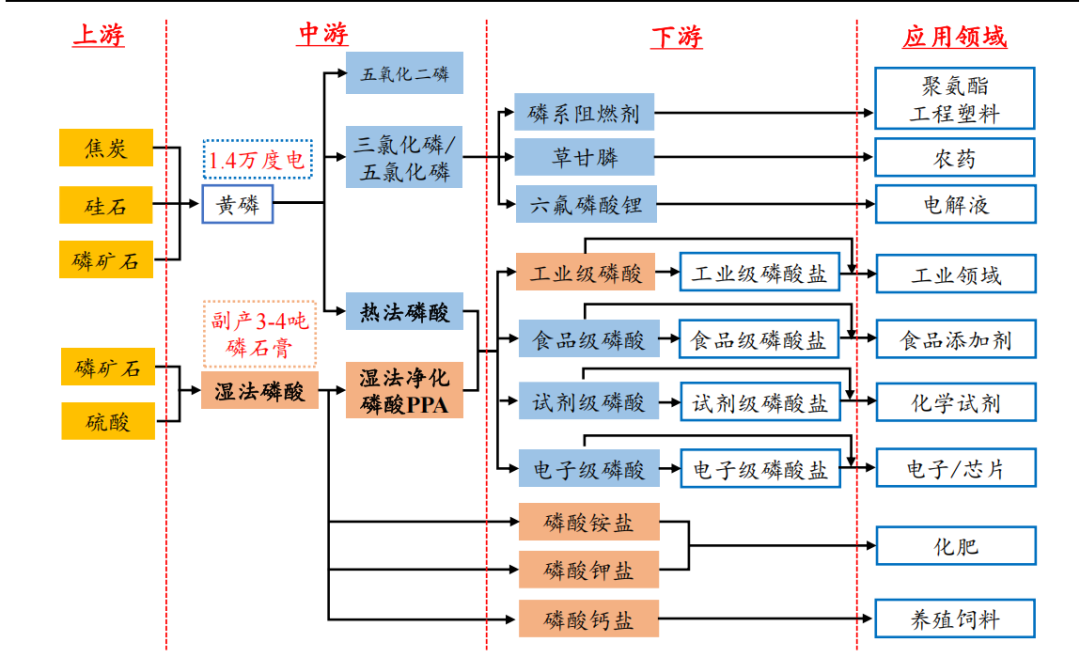
Industry Overview - Phosphate rock is a key upstream raw material, with yellow phosphorus and phosphoric acid as important intermediates, and downstream products primarily used in agriculture and industry [3][4] - The phosphate chemical industry chain includes phosphate rock and sulfur as upstream materials, with phosphoric acid produced through various processes [4] Resource End - China ranks second globally in phosphate rock reserves, with significant deposits located in Yunnan, Hubei, Sichuan, and Guizhou [6] - The total phosphate rock reserves in China are approximately 3.69 billion tons, with a low average grade of 16.85%, indicating over-exploitation and resource wastage [9][10] Production Capacity - Domestic phosphate rock production is the highest globally, but there has been a trend of decreasing output since 2018 [7] - Major phosphate rock producers include Hubei, Guizhou, Yunnan, and Sichuan, with a total production capacity of 1,450 million tons by Yuntianhua and 950 million tons by Guizhou Kaipin [11] Product Demand - Approximately 60% of phosphate rock is used for producing phosphate fertilizers, with a growing demand for high-efficiency and high-value utilization [13] - The main phosphate fertilizers include monoammonium phosphate (MAP) and diammonium phosphate (DAP), which are essential for crop growth [14][15] Phosphoric Acid Production - The phosphoric acid industry in China has a low concentration of production capacity, with a total capacity of 618 million tons, including 270 million tons of thermal phosphoric acid and 348 million tons of wet phosphoric acid [25] - The wet phosphoric acid production process is gaining traction due to its lower energy consumption and environmental impact compared to thermal methods [24][27] Environmental Considerations - The production of yellow phosphorus is characterized by high energy consumption and pollution, with limited new capacity being added [18] - The treatment and utilization of by-products such as phosphogypsum and fluorosilicic acid are becoming critical for the sustainable development of the phosphate chemical industry [32] Future Outlook - The industry is expected to focus on expanding the production capacity of wet phosphoric acid and functional phosphate salts, moving towards a more refined and specialized manufacturing approach [36] - The demand for feed-grade phosphate salts is anticipated to grow due to the increasing scale of aquaculture and livestock farming in China [37]



中国成品油周报-20251210
Yin He Qi Huo· 2025-12-10 06:42
1. Report Industry Investment Rating - No relevant content provided 2. Core Viewpoints - The supply - side of domestic refineries has limited start - stop scales, with most devices operating stably. Regional production shows differentiation, with significant diesel increments in Shandong but a slight decrease in gasoline and a slight increase in diesel for the national independent refineries. The gasoline market enters a new replenishment cycle with strong summer demand, leading to a tight - balance situation. The diesel market is pressured by weak demand and low replenishment motivation. In terms of inventory, Shandong's gasoline refinery inventory is expected to decline, while diesel inventory pressure will increase. Next week, there is still downward pressure on the wholesale prices of gasoline and diesel, but the decline in gasoline prices may narrow, and diesel will continue to explore the bottom. Retail profits of gasoline and diesel are expected to rise slightly [6]. 3. Summary by Directory 3.1 Comprehensive Analysis 3.1.1 Market Overview - On the supply side, major refineries have stable operations with no new start - stop devices. Shandong independent refineries' operation rate continues to rise. Major refineries' gasoline prices stop falling and diesel prices are stable, while independent refineries' gasoline and diesel production both decline. The diesel - to - gasoline ratio drops by 0.01 to 1.31. On the demand side, gasoline demand improves with high - volume ship orders and a sales - to - production ratio over 100%. Diesel demand is weak with low ship and vehicle order volumes. In terms of inventory, commercial inventories of gasoline and diesel both increase. Gasoline inventory is 1101 million tons, up 12 million tons (1.1%) week - on - week; diesel inventory is 1384 million tons, up 4 million tons (0.3%) week - on - week. Independent refineries' gasoline and diesel inventories slightly decrease. Social gasoline inventory increases and diesel inventory decreases [5]. 3.1.2 Market Outlook - Supply: Domestic refineries will generally maintain stable operations with limited start - stop scales. Regional production will vary, with Shandong seeing a significant increase in diesel output, while the overall independent refinery production shows a slight decrease in gasoline and a slight increase in diesel. Demand: The gasoline market will enter a new replenishment cycle, with strong summer demand and concentrated delivery of previous orders, resulting in a supply - short situation. Diesel demand will remain weak due to low rigid demand and limited replenishment motivation, leading to price pressure and an imbalance between production and sales. Inventory: Shandong's gasoline refinery inventory is expected to decline due to order delivery and strong demand, while diesel inventory pressure will increase due to rising production and low consumption. Price: Next week, there will still be downward pressure on gasoline and diesel wholesale prices, but the decline in gasoline prices may slow down due to the peak season, and diesel prices will continue to fall. Retail profits of gasoline and diesel are expected to rise slightly [6]. 3.2 Core Logic Analysis and Data Tracking 3.2.1 Price - The report provides detailed price data for gasoline and diesel in different regions of China, including national, Shandong independent refineries, and various regional markets. It shows price changes over different time intervals (year - on - year, week - on - week, month - on - month, and day - on - day) [11]. 3.2.2 Profit - Refinery profits: Major refineries' refining profit is 520 yuan/ton, independent refineries' is 179 yuan/ton, and Shandong independent refineries' is 314 yuan/ton. Gasoline profit is 603 yuan/ton, and diesel profit is 428 yuan/ton. There are also corresponding profit changes over different time periods [13]. 3.2.3 Supply - **开工率**: The overall refinery operating rate in China is 71.6%, a slight decrease of 0.5 percentage points. Major refineries' operating rate remains stable, while independent refineries' drops by 1.4 percentage points. Shandong independent refineries' operating rate is 48.2%, an increase of 0.8 percentage points [27]. - **检修计划**: As of July 11, 2025, the total refinery maintenance capacity in China is 69 million tons/year, a decrease of 2.5 million tons compared to the previous week [34]. - **产量**: Major refineries' gasoline and diesel production remains stable, while independent refineries' gasoline and diesel production both decline. Shandong independent refineries' gasoline production is 484,000 tons, a 1.1% increase, and diesel production is 931,000 tons, a 2.2% increase [35][39]. 3.2.4 Sales - Gasoline sales of independent refineries and Shandong independent refineries both increase, and the sales - to - production ratio also rises. Diesel sales of independent refineries remain stable, and Shandong independent refineries' sales increase slightly. The diesel sales - to - production ratio also shows a slight increase [43]. 3.2.5 Demand - The report uses various indicators such as consumption index, flight schedules, PMI, and congestion index to analyze gasoline and diesel demand. However, specific demand trends need to be further analyzed based on these indicators [58][60][62]. 3.2.6 Inventory - Commercial inventories of gasoline and diesel both increase. Gasoline inventory is 11.01 million tons, a 1.1% increase, and diesel inventory is 13.84 million tons, a 0.3% increase. Independent refineries' gasoline and diesel inventories slightly decrease. Social gasoline inventory increases and diesel inventory decreases. Shandong's gasoline refinery inventory is expected to decline next week, while diesel inventory is expected to increase [71][74].
研判2025!中国黄磷行业产业链、产量、需求量、企业格局及未来趋势分析:环保压力持续升级,产量呈波动态势,行业竞争激烈[图]
Chan Ye Xin Xi Wang· 2025-12-09 01:17
Core Viewpoint - The global yellow phosphorus (P4) supply is dominated by China, which accounts for 82.6% of the total production capacity in 2024, with significant contributions from Vietnam and Kazakhstan. The industry has faced challenges due to tightening environmental regulations, leading to fluctuations in production levels [1][7][9]. Group 1: Yellow Phosphorus Industry Overview - Yellow phosphorus, also known as white phosphorus, is produced primarily through electric furnace methods in China, which yield high purity and efficiency [1][2]. - The global yellow phosphorus production capacity is projected to reach 175.5 million tons in 2024, with China contributing 145 million tons [7]. - China's yellow phosphorus production has seen significant growth since the reform and opening up, with a peak production of 102.5 million tons in 2014 [9]. Group 2: Production and Consumption Trends - China's yellow phosphorus production is expected to reach 85.71 million tons in 2024, reflecting a year-on-year increase of 16.5% [9]. - The production is concentrated in Yunnan, Sichuan, Guizhou, and Hubei provinces, with Yunnan being the largest producer, contributing 44.4% of the global total [11]. - The apparent demand for yellow phosphorus in China is estimated at 74.1 million tons for 2024, indicating a self-sufficient industry with minimal import and export activities [13]. Group 3: Industry Structure and Key Players - The top five yellow phosphorus producers in China are Guizhou Wengfu, Guizhou Qieneng Tianhe, Yunnan Xuanwei Phosphate Electric, Yunnan Mile Phosphate Chemical, and Yunnan Jiangphosphate Group, collectively accounting for 29% of the national capacity [15][16]. - The industry is characterized by intense competition, with a tiered structure where the first tier includes companies with capacities over 50,000 tons, while the second and third tiers consist of smaller producers [14]. Group 4: Future Development Trends - The yellow phosphorus industry is expected to focus on environmental sustainability, with companies increasing investments in green technologies and production processes [16]. - The industry is likely to see enhanced processing capabilities and value addition, driven by policy support and ongoing research and development efforts [16]. - A trend towards consolidation is anticipated, where stronger companies will leverage technological innovation and sustainable practices to enhance their competitive edge [16].

2025年化学工业气候信息披露-基于A股上市公司报告的实证分析-绿色江南
Sou Hu Cai Jing· 2025-12-05 03:03
Core Insights - The report by the Green Jiangnan Public Environmental Concern Center focuses on the climate information disclosure status of 353 A-share listed chemical companies and 618 related enterprises, assessing their current practices to provide references for the industry's green transition and policy improvement [1][12] - The chemical industry is a high-energy consumption and high-emission sector, with a total energy consumption of 66,327 million tons of standard coal in 2022, accounting for 12.26% of the total energy consumption in the statistical industry [12] - Current international and domestic policies are strengthening disclosure requirements, transitioning the industry from voluntary exploration to standardized and normalized practices [11][12] Disclosure Status - The overall disclosure status is characterized by "overall inadequacy and structural imbalance." Only 39 companies fully disclosed core content related to greenhouse gas emissions, energy consumption, carbon reduction measures, and climate goals, while 60 companies disclosed none [2][18] - Over 70% of key emitting companies disclosed their emissions data, but only 24 companies specified Scope 1 and 2 emissions, and only 2 disclosed Scope 3 emissions [2][22] - The disclosure rate for carbon reduction measures reached 77.34%, but only 105 companies reported quantitative effects of their reduction efforts [2][28] - The energy consumption disclosure rate was 55.24%, with many lacking details on energy structure and efficiency [2][32] - Less than 15% of companies disclosed climate goals, with only 44 setting relevant targets [2][36] - Related enterprises performed worse, with less than one-third disclosing carbon emissions data, and some companies exhibited data inconsistencies [2][40] Recommendations - Establish a tiered mandatory disclosure system requiring key emitting companies to fully disclose core content by 2030, while general companies should at least disclose emissions and energy consumption [3] - Standardize disclosure requirements and develop detailed industry guidelines, enhancing third-party verification and blockchain traceability to improve data quality [3] - Create a policy and market linkage mechanism that ties disclosure quality to green finance and tax incentives, leveraging "chain master" companies to promote collaborative disclosure across supply chains [3] - Improve multi-stakeholder governance mechanisms by establishing dedicated supervision platforms and facilitating public participation to create a collaborative governance framework among government, enterprises, and society [3]

农化制品板块11月28日涨1.34%,赤天化领涨,主力资金净流入3.29亿元
Zheng Xing Xing Ye Ri Bao· 2025-11-28 09:08
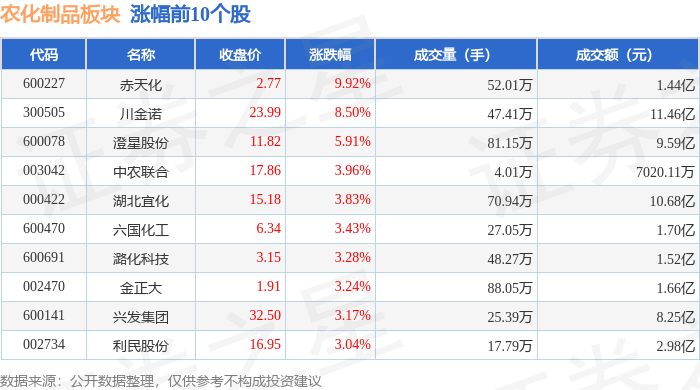
Market Performance - The agricultural chemical sector increased by 1.34% on November 28, with Chitianhua leading the gains [1] - The Shanghai Composite Index closed at 3888.6, up 0.34%, while the Shenzhen Component Index closed at 12984.08, up 0.85% [1] Stock Performance - Notable gainers in the agricultural chemical sector included: - Chitianhua (600227) with a closing price of 2.77, up 9.92% and a trading volume of 520,100 shares [1] - Chuanjinnuo (300505) at 23.99, up 8.50% with a volume of 474,100 shares [1] - Chengxing Co. (600078) at 11.82, up 5.91% with a volume of 811,500 shares [1] - Other significant performers included: - Hubei Zhihua (000422) at 15.18, up 3.83% with a volume of 709,400 shares [1] - Li Min Co. (002734) at 16.95, up 3.04% with a volume of 177,900 shares [1] Capital Flow - The agricultural chemical sector saw a net inflow of 329 million yuan from institutional investors, while retail investors experienced a net outflow of 405 million yuan [2] - The main capital inflow was observed in: - Yuntianhua (600096) with a net inflow of 1.86 billion yuan [3] - Chengxing Co. (600078) with a net inflow of 81.91 million yuan [3] - Xingfa Group (600141) with a net inflow of 80.87 million yuan [3]


PVC系列专题:进出口:PVC进出口基本面整理
Guo Lian Qi Huo· 2025-11-27 09:53
专题研究|研究报告 PVC 系列专题——进出口 2025 年 11 月 PVC 进出口基本面整理 PVC 进出口 证监许可[2011]1773 号 分析师: 张可心 从业资格证号:F03108011 随着国内 PVC 产业的发展以及产能的扩张,我国从 PVC 净进口国逐 渐摆脱进口依赖,成为全球 PVC 第一大生产国和出口国。2024 年我国 PVC 出口总量接近 300 万吨,占国内 PVC 产量比重约 12.8%。贸易对象方面 我国在进出口两方面都呈现出了一定的集中度,出口方面,我国近年对印 度、越南、孟加拉国等国家出口呈现显著增量。 2025 年,PVC 下游地产仍在下行周期,出口 PVC 需求端比重增加, 国内 PVC 价格中枢下行也增强了我国 PVC 生产企业出口竞争力。2025 年 1-10 月我国 PVC 累计出口 323,38 万吨,同比增量显著,+48.89%,占 国内 PVC1-10 月累计产量约 16%。 相关研究报告: 与此同时,2025 年我国 PVC 第一大出口国印度在 BIS 认证、反倾销 税政策上的动向对我国 PVC 出口及出口预期带来冲击,在未来出口受限 预期下,今年 PVC ...
澄星股份:在江苏资产管理有限公司留债余额为4.3亿元
Zheng Quan Ri Bao Wang· 2025-11-26 12:41
证券日报网讯澄星股份(600078)11月26日在互动平台回答投资者提问时表示,截至目前,我司在江苏 资产管理有限公司留债余额为4.3亿元人民币。 ...
澄星股份:剥离液是半导体、显示面板等精密电子制造的核心材料
Zheng Quan Ri Bao Wang· 2025-11-26 12:41
证券日报网讯澄星股份(600078)11月26日在互动平台回答投资者提问时表示,剥离液是半导体、显示 面板等精密电子制造的核心材料,核心用途是选择性去除光刻、蚀刻后多余的光刻胶。 ...
澄星股份:公司重视固态电池和光刻胶等战略性新兴产业带来的发展机遇
Zheng Quan Ri Bao Wang· 2025-11-26 12:41
Core Viewpoint - The company emphasizes the potential of high-end applications of yellow phosphorus in emerging fields such as semiconductors and renewable energy, indicating a strategic focus on solid-state batteries and photoresists [1] Company Insights - The company is actively monitoring industry trends related to strategic emerging industries [1] - The company recognizes the development opportunities presented by solid-state batteries and photoresists [1] Industry Trends - Yellow phosphorus, traditionally a basic chemical product, is now penetrating advanced applications in the semiconductor and renewable energy sectors [1]